About Me

My photo
Canberra-based naturalist, conservationist, educator since 1980. I’m passionate about the natural world (especially the southern hemisphere), and trying to understand it and to share such understandings. To that aim I’ve written several books (most recently 'Birds in Their Habitats' and 'Australian Bird Names; origins and meanings'), and run tours all over Australia, and for 17 years to South and Central America. I've done a lot of ABC radio work, chaired a government environmental advisory committee and taught many adult education classes – and of course presented this blog, since 2012. I am a recipient of the Australian Natural History Medallion, the Australian Plants Award and most recently a Medal of the Order of Australia for ‘services to conservation and the environment’. I live happily in suburban Duffy with my partner Louise surrounded by a dense native garden and lots of birds.
Showing posts with label frogs. Show all posts

Thursday, 13 August 2026

High Living #3: animals above the treeline

This is the third and final of a series on life above the treeline, mostly high up mountains but also closer to the poles, in both cases where there is no longer enough solar energy around the year to support the massive energy needs of trees. It began here and you may wish to start there for context, but if you'd prefer just to read this photo essay on its own that would work too.

Hoverfly Melangyna sp. on Billy Button Craspedia sp.
I noticed when going through photos of high country flowers that quite a few had insect pollinators in them. This is not surprising as the short growing and especially flowering season means that pollination and seed dispersal must occur in a compressed time frame, so there will be heavy competition. In the Australian alps a range of insect pollinators can be found on the flowers. I assume that most if not all of these insects have either a one year life cycle or move downslope at the end of summer. Here are a few more examples; it seems a nice segue from the plants post to this one on animals.

Wasps sharing a Billy Button flower head. I am told that wasp taxonimists are suspecting
that wasp species may prove to be even more numerous than beetles. I am
unable to say how many species are represented in this photo, but I'm 
pretty there is more than one.

Certainly this wasp, on a Purple Eyebright Euphrasia collina, is a different species again.

Fly on Alpine Sunray Leucochrysum alpinum, a very common alpine daisy.

Spotted Alpine Xenica Oreixenica orichora on Alpine Mint Bush Prostanthera cuneata.

Australian Painted Ladies Vanessa kershawi on Alpine Sunrays.
 Of course not all alpine insects by any means are pollinators. Some are preying on the pollinators.

Alpine Darner Austroaeaschna flavomaculata high in Kosciuszko NP.
And some are busy munching on the foliage, especially the abundant new growth.
Spotted Mountain Grasshopper Monistria concinna on Alpine Mint Bush which is its preferred
food plant and which is probably the source of the unpalatable protective toxins in its body.
It is entirely flightless so needs this protection. This hopper is remarkably well adapted to 
life above the tree line, and can survive winter in the snow, thanks to having sorbitol, 
an 'antifreeze' chemical, in its body which lowers the freezing point of its body fluids.
Mountain Katydid Acripeza reticulata. This the female, which is flightless. She mostly
relies on camouflage for protection but if pressed (eg by inconsiderate photographers)
she opens her wing covers (which don't now actually cover any wings) to flash
her brilliant blue and red abdomen. This warns predators that she tastes very unpleasant.
The male has the same defence mechanism but he is long and slender like a conventional 
grasshopper and has fully developed wings. They are quite common high in the south-eastern
mountains, but despite the name are also found at lower elevations and deep
inland in semi-arid woodlands, though I confess I've only seen them high up.
Given the very small area of the Australian alpine country (less than 0.1% of the land mass), it is quite unsurprising that there are no specialist alpine bird species here though some birds that are common lower down go up there in summer for the food on offer. 
Little Ravens Corvus mellori foraging in the mist among boulder stacks on Mount Kosciuszko 
for Bogong Moths which aestivate there (the summer equivalent of hibernate) in the 
cool rock crevices, in their thousands.

Australasian Pipit Anthus australis, taking advantage of the temporary insect
bonanza, again high on Mount Kosciuszko.
In major mountain ranges however, and in lower altitude treeless regions closer to the poles, there are many bird species which specialise, either solely or primarily, in these environments. 'Andean' appears repeatedly in the names that follow. 

Andean Condors Vultur gryphus at the carcase of a Guanaco killed by a Puma the previous
night in Torres del Paine NP in Chilean Patagonia. This magnificent New World vulture
was once common down the full length of the Andes, but due to human interference and
deliberate extermination it is now rare in the north of its range, and only common 
in Patagonia, especially in this park.

4000km to the north, Andean Condors roost overnight on cliff faces low down in 
Colca Canyon in southern Peru, a gorge that is twice as deep as the US's Grand Canyon.
In the morning they rise on air thermals to forage for carcasses over the mountainous 
surrounds. This is a huge bird, which can have a wing span of over three metres
and weigh up to 15kg, which is mechanically the upper weight limit of a flying bird.
While in places they be sometimes seen at sea level, they breed at up to 5000 metres
above sea level (masl from here on) on isolated rocky ledges. This is the only
healthy condor population left in Peru.

Quite a few of the true alpine birds are waterbirds, for whom trees are generally not immediately relevant.

Andean Avocets Recurvirostra andina, here at Laguna Chaxa in the Atacama Desert in northern Chile,
are restricted to the central Andes from southern Peru to northern Chile, via Bolivia and 
northern Argentina. They breed at above 3500masl. 
These high altitude alkaline and hypersaline lakes are counter-intuitively rich in small animals
Andean Flamingo Phoenicoparrus andinus, also at Laguna Chaxa. They have an Andean
range which has the same core as that of the Andean Avocet, but is considerably smaller.
This, the least abundant of the flamingos, breeds at 3000-4000masl, but afterwards
some move to lower altitudes, though many don't.
The Salinas y Aguada Blanca National Reserve is in the Andes of far southern Peru. It covers a vast area of 370,000ha of puna meadows and ponds, 3500masl at its lowest point and rising to over 6000masl. Probably unsurprisingly in all this huge landscape there is only one tree species - a Polylepis, the highest altitude tree species in the world. The next three photos were all taken there.
Andean Geese Chloephaga melanoptera. This handsome bird lives its life at over 3000masl, along the 
Andes from central Peru to central Chile. The South American 'geese' are actually most closely
related to the shelducks.
Andean Lapwing Andean Lapwing, which lives and breeds in the puna and páramo of
the Andes from southern Colombia to northern Argentina, from 2700 to 5000masl.

Giant Coot Fulica gigantea on its huge weed nest, which can be three metres long and stand 
50cm out of the metre deep water, resting on the lake bed, though to 
start with it floats. It will be defended and expanded for years. The bird is indeed a giant among 
coots, being 60cm long and weighing up to 2.5kg. (Compare this to the familiar Eurasian
Coot, found widely from Britain to Australia, which is about 37cm long and weighs up 
to 900g.) The Giant Coot is a bird of the high central Andes puna above 3600masl,
ranging up to 6500masl.
Andean Teals Anas andium in El Cajas NP, southern Ecuador, at roughly 4000masl.
This species is restricted to the northern high Andes of Ecuador, Colombia and Venezuela.
In the south it is only found between 3500masl and the snowline, while further north
it may venture down to 'only' 3200masl.
While in El Cajas - truly a most remarkable and rewarding reserve, no matter what your natural history interests are, from plants to birds to extraordinary scenery - here are a couple of small terrestrial birds which have made the high bleak meadows their home. Both these were at about 4000masl.
Stout-billed Cinclodes Cinclodes excelsior. There are 15 species of ground-dwelling cinclodes,
members of the ovenbird family, one of the two ancient South American passerine groups
which dominate the continent (and which are a challenge for birders new to
South America!). This one lives only high in the northern Andes, from 3200 to 5200masl.
Many-striped Canastero Asthenes flammulata, another (and quite striking) ovenbird
with a similar range in the northern Andes, from 3000 to 4500masl.

Cinereous Ground Tyrant Muscisaxicola cinereus in similar habitat, but 2000km south
in the splendid Lauca NP in Northern Chile and also at about 4000masl. 
The tyrant flycatchers form the other ancient South American passerine assemblage. 
Many are forest flycatchers but this one spends most of its time foraging on the 
ground in the high central-southern Andes.

And, returning to both the pollination theme with which we began this post and to El Cajas NP, here are a couple of high altitude hummingbirds pollinating flowers in the thin air of El Cajas. 

Ecuadorean Hillstar Oreotrochilus chimborazo feeding on the national flower of Ecuador, the
'Flower of the Andes' Chuquiraga jussieui, a daisy. Both bird and flower live at 3000 to 5000masl
in the Ecuadorian Andes, though the plant also extends south into Peru.
Blue-mantled Thornbill Chalcostigma stanleyi on another daisy, though I can't put a
name to this one. (I can't readily think of an Australian daisy which is bird-pollinated,
but I imagine that at these altitudes insects could not be relied on.)
I love the iridescence of this beauty!
And finally, a ground-dwelling alpine woodpecker.
Andean Flicker Colaptes rupicola near Chivay (and Colca Canyon) in southern Peru at 3600masl.
It is entirely a bird of the high treeless Puna. Weirdly, depending on the population,
the black moustache could indicate a male, in which case the female will have no
moustache, or it could mean a female, in which case the male will have a red one!

High altitude - ie above the treeline - specialists are less numerous among mammals and reptiles, though they're not rare either.

In Australia the Mountain Pygmy-Possum Burramys parvus lives and breeds in shrubby healthland among the boulder piles at the highest parts of the Australian Alps, and doesn't extend lower than the Snow Gums of the high subalps. Moreover it occurs in just three sites in the Alps, with one small range in Kosciuzsko NP in NSW and two in the Victorian Alps. The total range of the species is about 600ha and the adult population apparently only about 2200 animals. Males mostly live lower down but go up to the females when it's time to mate. In winter they go into extended true hibernation under the snow among the boulders, where the temperature rarely falls below 0 degrees centigrade. They are the only Australian mammal to truly hibernate. In summer they feast on the masses of Bogong Moths which aestivate in boulder crevices, along with other invertebrates and hard seeds including that of the sprawling conifer Podocarpus lawrencei. In Australia it is the only mammal restricted to the alpine (and adjacent high subalpine) zones. There are a few South American marsupials (the shrew-opossums Family Caenolestidae) which also live above the treeline, but no others in Australia.

Mountain Pygmy-Possum, photo courtesy Melbourne Museum.
(I try to use only my own photos, but don't have any of this rare and shy little
marsupial. However it was too important a subject for this post to ignore.) 

Other Australian mammals of course move up the mountains in summer but only this pygmy-possum is there all year round. 
Bennett's Wallaby Macropus rufogriseus dwarfed among the heaths and granites of 
Ben Lomond in north-eastern Tasmania. This wallaby is known as Red-necked 
Wallaby on the mainland of Australia.
And here it is in close-up!

For the rest, regarding mountain mammals, it's back to South America. First a couple of camelids, with a group shot and a portrait for each. 

Guanacos Lama guanicoe (above and below) in Torres del Paine NP in Chilean Patagonia. 
While these are only at about 1500masl, at this latitude (50 degrees south), the tree line
is at about 500masl, so they live and thrive in a treeless and perpetually
windy environment. This park is one of their strongholds. Further north in the 
Andes they can be found at over 4000masl, but in other places (especially
Tierra del Fuego) they live at sea level.
Guanacos at higher altitudes have greater red blood cell counts and larger
hearts than expected for a mammal of their size.
Vicuñas Lama vicugna are smaller, higher altitude relatives of the Guanaco. They are
found further north in the Andes. Here is a small herd in the grandly bleak landscapes of 
Salinas y Aguada Blanca National Reserve in southern Peru. The lowest point of the park 
at 3500masl is close to the lowest to which Vicuñas descend. 
They can also thrive at nearly 5000masl.
Vicuña near Chivay in southern Peru, at 3600masl. 
Andean Tapeti Sylvilagus andinus, a cottontail rabbit from the high altitude páramo
grasslands of the northern half of the Andes; this one was in El Cajas NP, Ecuador,
 at close to 4000masl.
Male Southern Huemul Hippocamelus bisulcus, Torres del Paine NP. This is a seriously
endangered species from the far southern Patagonian highlands.
Southern Viscacha Lagidium viscacia in Lauca NP, which at its lowest point is 3200masl
and rises to well over 6000masl, in the arid Andes of far northern Chile. This is one of 
the ancient South American rodents, whose ancestors apparently rafted here from
Africa perhaps 45 million years ago.
And finally, and perhaps surprisingly, some reptiles and a frog. In the Australian Alps there are two species of porcelain-shiny black and gold alpine frogs called corroborree frogs, both Critically Endangered. The Northern Corroboree Frog Pseudophryne pengilleyi lives in the Brindabella Ranges in the ACT and adjacent NSW and in nearby northern Kosciuszko NP. Chitrid fungus, fires in the highland sphagnum bogs which they rely on, trampling of the habitat by feral horses and pigs and warming temperatures are driving both species to extinction though major captive breeding programs are providing some hope.
 
Southern Corroboree Frog in captivity in the ACT, part of a breeding program. They are less
than 3cm long, and do not hop. They spend winter under logs and rocks in woodland around
the bogs and in spring the males make nest burrows in the moss and call to the females
with a sound like a finger on a wet balloon. She lays no more than 25 large eggs. The tadpoles
stay within the jelly for up to six months, until melting snow floods the nest, and they take three
years to mature to a frog. In that time they conserve all waste nitrogen (other frogs convert it
to ammonia but this would be fatal in a burrow) and convert it to body tissue.
I remember when it was easy to find Corroboree Frogs, but now it would be nearly impossible - 
as well as being irresponsible to try.
Montane reptiles rely on basking on rocks and logs warmed by the sun; accordingly all such reptiles are diurnal. They are also adapted to be able to operate at much lower temperatures than most other reptiles. Most give birth to live young, which benefit before birth from their mothers' basking. Many mate in autumn, store the sperm over winter and are thus able to fertilise their eggs early and give their offspring more time to develop over summer to better survive the next winter. 
 
There are a couple of above-the-treeline snakes in the south-eastern Australian high country. 
The Highland Copperhead Austrelaps ramsayi can be found at up to 2000masl, well above 
the treeline, but also below it. This is much the larger of the two snow country
Australian snake species, growing to 1.7 metres long.
White-lipped Snake Drysdalia coronoides, southern Namadgi NP, ACT. It can be
active at up to 2100masl, almost to the top of Mt Kosciuszko, Australia's highest point.
It is generally only about 30cm long and lives mostly on small skinks.
Southern Water Skinks Eulamprus tympanum, basking on a wooden barrier by a carpark
on Mount Ginini, Namadgi NP. This is an abundant skink in the high country, found 
well above the treeline, especially in bogs and along stream lines.
And while I have no doubt that if Australian mountains were higher (as of course they were before erosion ground them away) there would be reptiles up there too, I have to go back to the Neotropics to introduce a couple of seriously high altitude reptiles.
Green Spiny Lizard Sceloporus malachiticus at 3400masl in the mountains of central
Costa Rica. These beautifully coloured lizards, found only in Central America,
spend a lot of time raising their temperatures by basking in the sun.
This one was doing so on a very cold day by my standards!
Fabian's Lizard Leialomus fabianus, Laguna Chaxa. It is restricted to the vast salt flat
that includes Laguna Chaxa, an incredibly harsh environment, and can be found
at up to 3000masl.
Which is probably a good time to draw a curtain (of mountain clouds) over this topic, while hoping that you've enjoyed reading it as much as I have enjoyed researching and writing it. My thanks for your support and I'll be back next time with something completely different!

NEXT POSTING THURSDAY 3 SEPTEMBER

I love to receive your comments and I will notify you personally by email when a new posting appears, if you'd like me to. This will mean one email every three weeks at the current rate of posting. I promise never to use the list for any other purpose and will never share it. Should you wish to be added to it, just send me an email at calochilus51@internode.on.net. You can ask to be removed from the list at any time,or you could simply mark an email as Spam, so you won't see future ones.
If you do leave a comment - and I love it when you do - please remember to click the
box below your comment that says 'Email follow-up comments to...[your address]'
so you'll know when I reply - and I always do!

Thursday, 17 July 2025

Wild Ireland#2: some animals

In my last post I offered some impressions and understandings of the Irish landscape and some of the flowering plants we enjoyed. Here I am concluding this two part series by introducing some of the animals we encountered. There's nothing unexpected here and if you're familiar with Ireland (or indeed other parts of Europe) then you may well find this a bit pedestrian. But if, like us, you're not sure what to expect there then you may find it of interest. There are quite a few birds in particular so it's a relatively long post, but I'll try to keep it manageable by mostly making it a photo essay without too much other commentary.

I'll start with a few other animals. We didn't do well with mammals; I expected to see Red Deer in the moorlands, and really hoped to see a Stoat (which are apparently commoner there than in Britain) but we missed on both. Others told us about Basking Sharks close to the shore, but again no luck. Here are a couple of nice ones that we did see however.

Irish Hare Lepus timidus, Iveragh Peninsula, County Kerry.
This is the Irish subspecies of Mountain Hare, which is found right across far northern
Europe and Asia, plus the European Alps and the Scottish highlands. This rusty coat
is typical of it; we didn't see it often and this is the only photo I managed.

Distant Red Squirrel Sciurus vulgaris, The Raven NR, County Wexford.
This squirrel is found across Eurasia from Portugal to the Bering Strait but in Britain
in particular it has declined severely from competition by the introduced North American
Grey Squirrel Sciurus carolinensis. In Ireland however Red Squirrels are doing fairly well
following their almost total extinction due to the completion of deforestation
in the 17th century and reintroductions in the 19th century. So far Grey Squirrels have
not appeared in the west of Ireland - perhaps they are still unaccustomed to being 
hunted by Pine Martens, while the Reds have developed protective strategies? 
- but elsewhere they carry diseases which do affect Red Squirrel populations.

Grey Seal Halichoerus grypus, Great Saltee Island, Co Wexford.
We surprisingly didn't see many seals (and no Harbour Seals); a boat trip we 
did in Donegal Harbour to visit a colony was nowhere near as interested
in them as we were, despite their advertising. 
I recall my astonishment when our good friend Sarah, from England, told us long ago that there is only one frog native to Britain - The Frog! We were delighted to have Sarah and Richard with us for a couple of days in Wexford and she found a frog for us at Tacumshin Wetland (more on that, and other reserves mentioned here, in the previous post - see link in first line above).  

Common Frog (to give it its full name!) Rana temporaria, Tacumshin Wetland.

This extremely impressive big Black Slug (or Black Arion) Arion ater
appeared on our cabin verandah after a wet night near Doolin, Co Clare.
It's normally nocturnal but this was a dull morning. It's native to northern Europe
but has been introduced elsewhere, apparently including Australia though
I've not seen one here. They grow to 15cm long so are hard to miss!
It was early spring while we were there and the flowers were appearing, though many hadn't started by the time we left in early May. There were quite a few small quick grey butterflies, but one stood out, though we didn't get very close to it.

This Peacock Butterfly Aglais io, The Raven NR, Co Wexford, is truly lovely.
They hibernate over winter to give their larvae a head-start in spring, hence
this one being active so early.

The insects we saw most on flowers however were bumblebees, which I was intrigued by as there are none native to Australia and they really are very appealing. To my surprise when I got back and did some homework I realised that I had photos of four different species, though as ever I welcome corrections.

White-Tailed Bumblebee Bombus lucorum, Glenveagh NP, Co Donegal.
Garden Bumblebee Bombus hortorum, Glenveagh NP, Co Donegal.
Common Carder Bee Bombus pascuorum on Dandelion, Wild Nephin NP, Co Mayo.
Buff-Tailed Bumblebee Bombus terrestris, on Thrift flowers, Fanad Lighthouse, Co Donegal.
This one I'm not entirely confident about as I can't see its tail, but the orange band
(rather than yellow) encourages me.
Which brings us to the birds. Again if you're familiar with European birds there won't be much to excite you here but hopefully it's of some interest to other readers. Our first real excursion after we left Dublin was a very good one, via a ferry to Great Saltee Island off Wexford, accompanied by our very bird-wise friends, Richard and Sarah Thomas. It gave us by far the best seabird experience of our month in Ireland (which was probably a mixed blessing, having it over with right at the start!), and also coincided with a wonderful 'fall' of migrant songbirds coming north from Africa en route either to Ireland itself or points much further north for summer. Let's start with the seabirds though, where several species were already breeding - and we might as well start with the stars (as voted by us), the Atlantic Puffins Fratercula arctica which must be one of the most-recognised birds in the western world! We had the bizarre and delightful experience of sitting down on a grassy slope to eat our picnic lunch while less than 20 metres away puffins loafed and paraded by their burrows. They get two photos! 
Atlantic Puffins (there are also two species from the North Pacific)
by their breeding burrows, Great Saltee Island, Co Wexford. Males and females
are indistinguishable (to us anyway). They are auks (not to be confused with orcs),
a family of northern hemisphere seabirds.
The extraordinary bill only looks like this during breeding; afterward the bright
orange plates are shed and the bill is much plainer, though as they spend winter
entirely at sea we rarely it like that. The structure of the bill enables them to carry up to a
dozen sand eels at a time, which they've caught underwater, to the nest.
(The first ones are held in place by the tongue, while they catch more.)
OK, so puffins also get more words here than most other birds are going to; favouritism? Yeah, guilty as charged. Another two auk species were also present, probably more abundant here than the puffins. I couldn't get close enough to the Common Guillemots (or Murres) Uria aalge for a photograph, but the abundant Razorbills Alca torda were more obliging. Unlike the puffins on Great Saltee, both these species nest on the cliff faces.  
Razorbills, Great Saltee. The white line on the bill is only present during breeding.
The somewhat similar guillemots have a sharp, thin bill, rather than the Razorbill's
side-to-side flattened deep bill.
Australia is quite depauperate in gull species relative to other places, with only three regular species. The Saltee cliffs alone had more species than that. Here are three of them. 
Lesser Black-backed Gull Larus fuscus, Great Saltee. There were also 
Great Black-backed Gulls present, which are the world's largest, but I somehow
failed to get a photo of them.
Kittiwakes Rissa tridactyla, Great Saltee. This is an elegant little gull, and the only
one which nests solely on cliffs. 
Herring Gulls Larus argentatus were also at Great Saltee (indeed they seem to be 
absolutely everywhere) but these were in Dublin. In fact they were the first Irish 
birds we saw, flying overhead as we rode in a taxi from the airport to our hotel.
This is an enormous gull, at least four times the weight of our familiar Silver Gull.
Another very common gull across Ireland is the Black-headed Gull Chroicocephalus ridibundus, another small gull. This one was hunting crabs (successfully) alongside the ruined Doe Castle in Donegal.
And here are another two common seabirds which were nesting on the Great Saltee cliffs.

A nesting colony of Northern Gannets Morus bassanus, on a rock stack just 
off Great Saltee. This is the largest gannet species in the world. Although 
numbers are currently healthy there is concern about their vulnerability to bird flu.

Gannets hunt by diving from considerable heights into the ocean and chasing
fish underwater. This one off County Galway was just starting its dive.
 
Shag Gulosus aristotelis on Great Saltee where there was a small breeding group.
This is a common marine cormorant, but the cormorant which can be seen anywhere 
throughout Ireland is the same as our Great Cormorant Phalacrocorax carbo.
Common Shelduck Tadorna tadorna, on tidal flats of the Moy River, Co Mayo.
This is a very handsome big duck which I found hard to get near. It is nearly
always found on estuaries and salt marshes.

Greylag Geese Anser anser, in a bay near Carrowkeel, Co Donegal.
These are the ancestors of domestic geese, and are more usually seen on inland waters 
and fields. They're mostly winter vistors to Ireland but some stay all year round.
 

There are of course other waterbirds which can be found on both inland and coastal waters too, including the ubiquitous Grey Heron Ardea cinerea. 

Grey Heron in a freshwater pond, St Stephens Park, Dublin...

... and in a bay, Co Donegal.
And for the record, a couple of the commonest waterbirds in Ireland, found on any inland waters, including town parks. Both these photos were taken in Saint Stephens Park, Dublin.

Mallard Anas platyrhynchos, the basis of all domestic ducks except Muscovies
(which are from South America). In the same way as we had to get used to seeing
Gorse and Hawthorn as native species rather than weeds, it took a bit to get thinking
of Mallards as other than exotics. 
Mute Swans were abundant on rivers, loughs, and town parks, 
and are always superb birds.
And so to some land birds, perhaps the most obvious of which were the various species of crows which were virtually never out of sight. Here are four common ones, plus another couple which we only encountered once. 

Rook Corvus frugilegus inspecting the picnic tables at The Hook lighthouse, Co Wexford.
This is a large sociable crow which feeds in flocks and is found across Eurasia; the broad
expanses of cleared Irish countryside suit it well. It is readily distinguished by the large bare 
white patch of skin around the base of the beak.

Rooks also breed colonially; here is an active spring rookery in Co Tipperary.
This is a common sight across Ireland. 

Eurasian Magpie Pica pica, Dublin. The origin of the (unrelated) Australian Magpie's name.
Highly intelligent and found throughout Ireland - and east to Kamchatka.

Jackdaw Coloeus monedula, Cashel Castle, Co Tipperary. An engaging little gregarious crow
which is abundant in Ireland, and often nests in the rnassive stone ruins which dot the countryside.

Hooded Crow Corvus cornix, Doolin, Co Clare. A striking crow (especially to those of us
who expect all crows to be black!) which I found to be particularly wary, probably with 
good reason. An inveterate scavenger, it is found in all habitats from the sea shore to the mountains.

Red-billed Chough Pyrrhocorax pyrrhocorax, Great Saltee Island. An uncommon crow
of the Atlantic cliffs and islands of Ireland, we were very fortunate to see this bird (and its mate)
at the beginning of our trip at Great Saltee, as we didn't see it again. No relation to
(and really very little resemblance to) its Australian namesake the White-winged Chough.
 
(Eurasian) Jay Garrulus glandarius, Belleek Woods, Co Mayo. A very poor photo of 
this attractive forest crow, but surprisingly it was the only one we saw. My ignorance of the
calls of the Irish birds probably contributed to this, but they are also reported to be
'significantly shyer and more elusive' in Ireland than they are elsewhere in Europe.
Finches are always welcome, not least because we don't have any native 'real' finches in Australia; the birds we refer to as finches all belong to another family entirely, the grassfinches or waxbills. Nonetheless we continue to call ours finches and that's fine, but here are the 'other finches' if you'd prefer. 
Male Chaffinch Fringilla coelebs, Glenveagh NP, Co Donegal.
One of the commonest birds in Ireland, and always a delight.

Female Chaffinch, Co Cork. They are essentially seed-eaters like all finches
(and indeed all grassfinches).
Bullfinch Pyrrhula pyrrhula, Co Clare. A very poor photo of a most attractive
bird, but sadly it was the only one I got.
Goldfinch Carduelis carduelis, just outside our cabin window near Lough Gill, Co Sligo.
This one has been familiar to Australians since its introduction here in the 19th century,
but it's never been in sufficient numbers here to cause concern.
Siskin Spinus spinus, seen through the same window. This one is common enough,
though we didn't see it as often as the Goldfinch, or perhaps it just doesn't stand out
as much when seen from a car window.
Thrushes are prevalent, but mostly the three following common species; we saw others, but no photos.
Common Blackbird Turdus merula, Dublin. This is a familiar exotic species in 
south-eastern Australian urban areas and, as with other such species, it was
good to be able to enjoy it as a native species on its home turf. 
Song Thrush Turdus philomelos, County Kerry. One of the commonest Irish birds,
usually seen hunting worms and insects on grassy areas. Though they were released in
Australia in the 19th century by the pernicious acclimatisation societies, the introductions
were not ultimately successful and now they survive only as a small and declining 
population in Melbourne and on Lord Howe and Norfolk Islands.

Mistle Thrush Turdus viscivorus, Belleek Woods, Co Mayo. Another fairly common
thrush, often feeding in the open like the Song Thrush. This one was very curious,
inspecting us from various angles as soon as we stepped out into the carpark.

Here are a couple of Old World flycatchers (ie members of the big family Muscicapidae), one of which is probably the bird most featured on Christmas cards, albeit usually in distortion and in countries, such as Australia, very far from where it actually lives. 

European Robin Erithacus rubecula, Co Donegal. It actually could have been
taken anywhere, as they are ubiquitous, in town and forest, and are curious and engaging,
often accompanying gardeners to see what's turned up that might be wriggling and edible.

Male Northern Wheatear Oenanthe oenanthe, Great Saltee Island, Co Wexford.
This bird had just flown in, with many others of various species, from somewhere 
in Africa where it had spent winter, to breed in Irish heathlands in mountains 
or along rocky coasts.
Wagtails and pipits (same family) are abundant, though this is only true of one or two species of each.

Pied Wagtails Motacilla alba are seemingly everywhere in open spaces, on grass or
even carparks and other sealed urban space, or along the coast. They hunt insects on the ground.
Both these birds were in County Cork, the male above in the grounds of one of the 
numerous castles, ruined and otherwise; most castles have a resident pair. 
He is in his dapper summer plumage.
 
This one, on the busy foreshore in Cobh is, I'm pretty sure, a female, though
I have some trouble with recognising males coming out of their paler winter coat.

Distant Grey Wagtail Motacilla cinerea on the mud flats of the River Ilen in Skibereen,
also in Co Cork. It is apparently 'common and widespread' but I mostly missed them! 
We probably didn't spend enough times along rushing streams. 
The two resident species of pipits are both common, though one is found only along the coast.
Meadow Pipit Anthus pratensis, Co Clare. It is found throughout the island in open country,
(of which there is a lot), but I found them hard to approach closely.
Rock Pipits A. petrosus, here on shoreline rocks in Co Kerry, are birds of the shorelines
and offshore islands. It seemed to me to be a lot more tolerant of humans than Meadow Pipits.

The 'Old World Warblers' used to form a huge family of small songbirds, but better understanding has now recognised that this was always just a grouping of convenience and several families are actually involved. Many of these warblers pass through Ireland from their wintering grounds in Africa, but here are a couple that breed in Ireland and are quite common.

Blackcap Sylvia atricapilla, Family Sylviidae, Co Wexford. A very distinctive bird.

Less distinctive for newcomers like me to the European birds, is the 
Willow Warbler Phylloscopus trochilus, here singing in Killarney NP, Co Kerry.
It is very similar to the closely related Chiffchaff P. collybita, but the songs are different
and the yellow legs on this bird are very different from the black ones of Chiffchaffs. 
There are three very common species of tit, Family Paridae, which are also widely familiar as they readily come to garden feeders. Here are two of them.
Blue Tit Parus caeruleus Co Cork; this is likely to be one of the first Irish birds you see,
and they are colourful, abundant and not especially shy. I find them most endearing. 

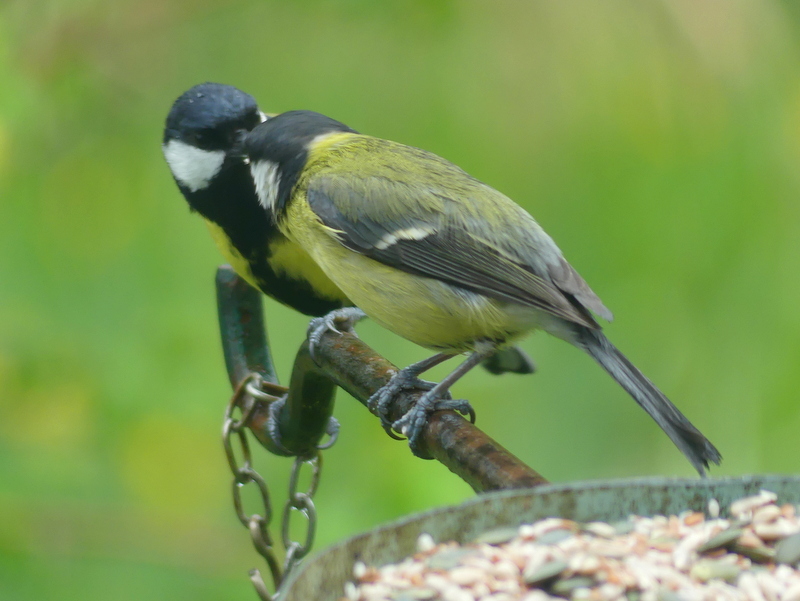
Great Tits Parus major Co Sligo. This very much seems to be ritual courtship
feeding, as the adult recipient certainly doesn't need to be fed in this situation!
And finally four birds from four families, all fairly common, one abundant.

Wood Pigeon Columba palumbus, Dublin. Another of the very commonest Irish
birds, in towns and countryside. There is open hunting season on them over the three winter
months (November to January) when they are not breeding, but there are also huge loopholes
which allow shooting pretty much all year round, and it seems to be quite an industry, eg here. 
Needless to say, Wood Pigeons in rural areas are pretty toey!
Reed Bunting Emberiza schoeniclus, Co Wexford. This attractive bunting is certainly a bird of 
the reed beds, but is also found beyond them. It has a huge range over most of Europe
and much of Asia.

Dunnock Prunella modularis, Glendalough, Co Wickford. An easily overlooked 
little bird of the forest understorey, hedgerows and even in town parks, though I 
certainly overlooked them there! They are accentors, in the Family Prunellidae,
of which there are only a dozen closely related species, nearly all the others
being birds found very high in the mountains, above the tree level.

And lastly one of my favourites (yes I know but I can't help it), the tiny
Goldcrest Regulus regulus, here preening in early dawn light outside our
cabin in rural Co Kerry. You can just see the yellow and orange crest here,
but better below in an even more light-deprived photo, which makes this a male.
(She has just yellow.) Its family, the kinglets, has just six members
across Eurasia and North America.

Well I hate to leave you with such a poor photo, which hopefully you can forgive me for the sake of the subject. 

It's been a long post, as I warned, and if you've got this far I thank you for your diligence!

THERE WILL BE QUITE A HIATUS NOW BEFORE MY NEXT POST,
AS WE'LL BE TRAVELING TO AND IN TROPICAL QUEENSLAND. 
HOWEVER I SHOULD COME BACK WITH MORE MATERIAL FOR YOU!
 
NEXT POSTING THURSDAY 25 SEPTEMBER

I love to receive your comments and in future will be notifying you personally by email when a new posting appears, if you'd like me to. All current subscribers have been added to this mailing list and have already been contacted. This will mean one email every three weeks at the current rate of posting. I promise never to use the list for any other purpose and will never share it.
Should you wish to be added to it, just send me an email at calochilus51@internode.on.net. You can ask to be removed from the list at any time,or could simply mark an email as Spam, so you won't see future ones.
If you do leave a comment - and I love it when you do - please remember to click the
box below your comment that says 'Email follow-up comments to...[your address]'
so you'll know when I reply - and I always do!