About Me

My photo
Canberra-based naturalist, conservationist, educator since 1980. I’m passionate about the natural world (especially the southern hemisphere), and trying to understand it and to share such understandings. To that aim I’ve written several books (most recently 'Birds in Their Habitats' and 'Australian Bird Names; origins and meanings'), and run tours all over Australia, and for 17 years to South and Central America. I've done a lot of ABC radio work, chaired a government environmental advisory committee and taught many adult education classes – and of course presented this blog, since 2012. I am a recipient of the Australian Natural History Medallion, the Australian Plants Award and most recently a Medal of the Order of Australia for ‘services to conservation and the environment’. I live happily in suburban Duffy with my partner Louise surrounded by a dense native garden and lots of birds.
Showing posts with label millipedes. Show all posts

Thursday, 19 November 2026

Only in Sri Lanka; some animals found nowhere else

Since my last post I've had the wonderful experience of a fairly brief but totally rewarding visit to Sri Lanka, a teardrop-shaped tropical island republic about the size of Tasmania or a bit smaller than Ireland, off the south-east coast of India. (Both Sri Lanka and Tasmania are roughly 65,000 square kilometres, Ireland is 84,000.) 

Our tour focused on endemic birds (and supposedly on mammals, though that wasn't given the emphasis that I'd hoped for) in the south of the island.  

A low-resolution indicative map of Sri Lanka, borrowed with thanks from Alamy.
It shows the southern mountains, a hot spot for endemic species, 
and the relationship to India in the top right window.
You'll need to click on it to see it at all clearly.
But whereas Tasmania's human population is less than 600,000 and Ireland's about five million, Sri Lanka has some 23 million people, so there is considerable pressure on the natural environment. Nonetheless, Sri Lanka has a remarkably high proportion of endemic animals and plants - that is, species found nowhere else in the world. 12% of the bird species (34 species), 17% of the mammals, 65% of reptiles and 92% of the amphibians are endemic, as are some 25% of the plants. It seems a bit counter-intuitive, given its small size and proximity to India. 

However other factors need to be taken into account. Overall it is part of a biological hotspot of world significance, the Indian Western Ghats–Sri Lanka Biodiversity Hotspot, so it is rich. When Gondwana began to break up, Sri Lanka sailed north to Asia with India on the Indian Tectonic Plate; it was never directly part of Asia. For at least 20 million years Sri Lanka has been unconnected to India, though there has been periodic contact via a low chain of sandy islets and sandbars called Adam's Bridge joining north-western Sri Lanka to islands off Tamil Nadu. However the majority of Sri Lanka's endemic species are found in the southern rainforests (which are found low in the mountains in the above map and in adjacent lowland rainforests to the west and south) and in cloud forests higher up. The north and east of the island is quite dry, so the rainforests are well insulated from any recent Indian influences. 

Lowland rainforest around Kitulgala ['kit-UHL-ga-la'] in the south-west.

Cloud forest in Hortons Plains National Park, higher in the mountains.

I have probably been guilty of too much background (I have form for it), but I hope that it has been of interest to some of you at least. In any case it's time I started introducing some the species are specific to Sri Lanka. 

And a warning! With some trepidation I have opted to include some photos that I would not normally inflict on anyone, of the birds in particular. Many were in the rainforest canopy or deep in the understorey; others were high on perches against a grey sky. It rained a lot and our expeditions usually began in dim very early light. My camera, and more importantly its operator, often doesn't cope well in such conditions. However I hope you can bear to look at some of them (squinting or looking sideways might help) for the sake of the wonderful animals. From now on it's mostly one of my photo essays, starting with my favourite Sri Lankan bird (and currently one of my favourite birds anywhere!). 

Sri Lanka Blue Magpie Urocissa ornata, Sinharaja forest. It has a small range in
the mature rainforests of the south-west, foraging mostly in the canopy. It's a magpie
to the extent that it's a long-tailed crow, like the Eurasian Magpie, but they are not
closely related. It's one of five in the genus, all in south and south-east Asia.
I was thrilled to see this one.

Sri Lankan Junglefowl Gallus lafayettii, Kitulgala. Another high on my wish-list before
the trip, though this one is easier than the magpie. It is closely related to the south and
south-east Asian Red Junglefowl, the main ancestor of the domestic chook. However 
its genes too appear in chooks. This is the national bird of Sri Lanka.

Male Sri Lanka Spurfowl Galloperdix bicalcarata, Sinharaja. 
This is normally a tricky one to see, though local people put seed out for these
and call them in, in return for a small income from groups like ours.
 
Red-faced Malkoha Phaenicophaeus pyrrhocephalus, Sinharaja. The malkohas
comprise a genus of seven large, non-parasitic cuckoos from south and 
south-east Asia. This one is rare and limited to southern Sri Lanka, but is found in 
both wet and dry forests. 

Red-backed Flameback Dinopium psarodes, in busy urban Viharamahadevi Park in Colombo.
This is a common woodpecker and one of the commonest of the endemics.
Scarlet-backed Flameback Chrysocolaptes stricklandi, Sinharaja forests.
Despite being very similar to the previous species, and carrying the same
group name, they are in different genera. This one is a lot less common.
(And this is the first, but not the worst, of the 'bad' photos.)

(And another bad one; I won't mention this again.)
Layard's Parakeet Psittacula calthrapae, Sinharaja. This is a male, with a red
(not black) beak. It is uncommon but loud and frequents the wet forests,
especially on the edges and in clearings. Edgar Layard was a British
diplomat and serious ornithologist who spent a lot of time in Sri Lanka.
 
Sri Lanka Hanging Parrot male Loriculus beryllinus, Kitulgala. This tiny parrot reminds 
me of the fig-parrots of the Australian tropics. It forages in trees on nectar, seeds
(especially of casuarinas) and fruit across the south.

Sri Lanka Grey Hornbill Ocyceros gingalensis is a common and widespread Sri Lankan
bird, found across the country. As here at Sinharaja they will readily come to feeders
and balconies for handouts.
Serendip Scops Owl Otus thilohoffmanni, Kitulgala. This was the most recent Sri Lankan
bird to be discovered (in 2001) and the first since 1868. It is only known from
a small area in the south-west, but it could well be living discreetly in other forested
areas. Serendib was an old Arabic or Persian name for Sri Lanka, and is 
the basis of 'serendipity'.
Yellow-fronted Barbet Psilopogon flavifrons, Kitulgala. (I know, but it's the best I've
got. I was mortified on the last morning of the tour when one turned up at the bird feeder
by the balcony in the short time I was absent!) It is a small Asian barbet
from the wet southern forests. 

The rest are passerines, and since they're often smaller than the others, there are probably even more bad photos coming... 

There are six bulbul species in Sri Lanka; two are endemic to the island, while another is restricted to the wider but still localised Western Ghats-Sri Lanka biodiversity hotspot (which doesn't qualify it for this post).  

Black-capped Bulbul Rubigula melanictera, Sinharaja forests.A very smart little forest bird.

Yellow-eared Bulbul Pycnonotus penicillatus, Horton Plains NP. A much more range-restricted
endemic, found only in the higher mountain forests, though it is fairly common there.

Dull-blue Flycatcher Eumyias sordidus, Horton Plains NP. Another bird of the mountain forests.
And what a calumny of a name! The blue head was gleaming in the early morning sun.

Legge's Flowerpecker Pachyglossa vincens, Sinharaja. The flowerpeckers are a family of
nearly 60 species of stocky little birds with short curved bills for picking mistletoe berries, 
though they also eat nectar and insects. They are found from southern Asia to the
western Pacific, though of course this one is only found in Sri Lanka, in the wet
south-western forests. William Legge was a 19th century Tasmanian, a professional
soldier who spent his leave studying birds in Sri Lanka. He later became the inaugural
president of the Royal Australasian Ornithologists Union.

Spot-winged Thrush Geokichla spiloptera on the rainforest floor at Sinharaja, 
its typical habitat in the mountain rainforests. It took some time to find this one.
A very striking Sri Lanka Shama Copsychus leggei in drier Yala NP. This stunning flycatcher
is found sparsely throughout the Sri Lankan lowlands. It is another Sri Lankan species named 
for William Legge (see the caption for Legge's Flowerpecker above), this time via the
scientific name.
Sri Lanka White-eye Zosterops ceylonensis, foraging in a tea plantation near Horton in 
southern highlands. In its limited range in these highlands it is found as often in gardens
and plantations as in the forests. A 2017 study suggests that the Sri Lanka White-eye is 
the origin species of more than 100 species of White-eye now found across much
of Africa, Asia and Australasia.

Sri Lanka Hill Myna Gracula ptilogenys, Sinharaja. The Asian myna group of starlings
includes some notorious feral species now found across much of the world (including
Australia) but this one is uncommon and only found in the wet south-west of Sri Lanka.

And a strong contender for worst photo is... Sri Lanka Drongo Dicrurus lophorinus, 
Sinharaja. Another Sri Lankan endemic found only in the rainforests of the south-west.
There are of course Sri Lankan endemic mammals, but while the tour title suggested that there would be an emphasis on them (which influenced our decision to join it), that didn't really eventuate. However, here is one at least (I thought I also had photos of Layard's Striped Squirrel, but now I'm not confident enough to post it). 
Toque Macaque Macaca sinica, Peradeniya Botanic Gardens, Kandy. No problem seeing these
rascals, they're everywhere. Like other macaques they can be a serious pest (or worse) when
irresponsible visitors feed them, but the large populations in these gardens totally ignored people.
We did see a staff member disturbing them with a laser, presumably to put them off humans;
it seems to work. (A toque is either a small brimless hat or a tall chef's hat; either way
the usage here is obscure to me.)

As mentioned, there is a very high proportion of endemism among the reptiles; here are a few.

Day gecko Cnemaspis sp., Sinharaja. While I can't pin this one down to species level,
it seems that all Sri Lankan geckoes of this genus are endemic. If you can help out 
with this I would of course be very grateful.

Hump-nosed Lizard Lyriocephalus scutatus, Sinharaja. A big dragon lizard - the largest
Sri Lankan endemic member of the family Agamidae - this one is common and usually
perched vertically on tree trunks, as here. The orb on the nose is diagnostic.

Lowland (or Black-spotted) Kangaroo Lizard Otocryptis nigristigma Kitulgala.
There are two species of the long-legged and long-tailed kangaroo lizards in the genus
Otocryptis and both of them are endemic to Sri Lanka. 
While this one is mostly found in the drier zones it is also found in wetter areas, like this.
Sri Lanka (or Wiegman's) Kangaroo Lizard Otocryptis weigmani, Sinharaja.
This one is confined to the wet south-western forests.
Both species will run on their hind legs if threatened.

Sri Lanka Green Pit Viper Craspedocephalus trigonocephalus, Kitulgala. This venomous
 snake is widespread across the country, though commonest in the wet zone,
where it is likely to be found in streamline shrubbery, as this one was. They are 
active at night, especially in tree canopies. While the venom causes severe pain
and localised tissue damage, human fatalities have not apparently been recorded.
(I will note too that I don't recall typing a longer scientific name in any previous post!)

Sri Lankan Green Vine Snake Ahaetulla nasuta, Sinharaja. A slender snake in the 
family Colubridae, the back-fanged venomous snakes, which are not typically
considered dangerous to humans. It may grow to nearly two metres long and relies
on camouflage to hunt lizards and frogs in shrubbery.

And doubtless there are many endemic invertebrates, but I wasn't able to identify many; here are a couple of notable ones however.

Tree Nymph Idea iasonia, Sinharaja, one of the most impressive butterflies I've seen, up to
15cm across with a very distinctive slow gliding flight. It is found in both the wet 
and dry zones.
Sri Lanka Giant Millipede Ktenostreptus centrurus, Sinharaja. Even a casual
visitor to the Sri Lankan wet forests is unlikely to miss this extraordinary
Sri Lankan special, which is up to 25cm long, with distinctive white legs
and often found conspicuously on tree trunks like this.

Well, that's my offering for the day, of animals you won't see in the wild unless you go to Sri Lanka. I think you should at least consider going there, for this and many other reasons. There'll be more posts on other aspects of wild Sri Lanka from me in coming months.

Thanks for being with me, hope to see you here again next time! 

 NEXT POSTING THURSDAY 17 DECEMBER

I love to receive your comments and I will notify you personally by email when a new posting appears, if you'd like me to. This will mean one email every three weeks at the current rate of posting. I promise never to use the list for any other purpose and will never share it. Should you wish to be added to it, just send me an email at calochilus51@internode.on.net. You can ask to be removed from the list at any time,or you could simply mark an email as Spam, so you won't see future ones.
If you do leave a comment - and I love it when you do - please remember to click the
box below your comment that says 'Email follow-up comments to...[your address]'
so you'll know when I reply - and I always do!

Thursday, 11 January 2018

Brazil's Amazing Pantanal; an introduction. Part 1.

The Pantanal is one of those places I'd always wanted to see (courtesy primarily, as with so many other things, of David Attenborough), but never expected to do so. That changed when, late last year, we were sent to do a reconnaissance with my Peruvian friend Juan, preparatory to accompanying a tour there later this year. And it is every bit as extraordinary as I'd been led to believe, truly one of the world's great wildlife spectacles! I can't wait to get back there for further exploration.
Yacaré Caiman Caiman yacare and Capybara Hydrochoerus hydrochaeris, Pousada Piuval, Pantanal.
The Pantanal is said to have the largest concentration of crocodilians in the world, and Capybaras,
the planet's largest rodent, are also abundant and ubiquitous.
Today I want to give you a flavour of the place, or at least to start to - even that is too big a task for one day - but first some background. Firstly, it's huge - it has no clearly defined boundaries, but estimates vary from 140,000 to 210,000 square kilometres - but just where is it?
The end of the arrow indicates approximately the heart of the Pantanal, which is located just inside the
tropical zone, pretty much in the centre of South America, mostly in south-western Brazil.
 The Pantanal lies mostly in the Brazilian states of Mattto Grosso and Matto Grosso do Sul,
though it spills over to minor a degree into both Bolivia and Paraguay. The Rio Piquirí forms the boundaries between the two Brazilian states. As is obvious, road access is very limited - more on that anon. Today's post will deal only with the northern section, in Mato Grosso. (Map courtesy hot-map.com).
The Panatanal is essentially a vast ephemeral wetland - some 80% of the flood plains disappear under about a metre and a half of water each year, though it can be up to five metres deep in places. Its area is 15 times that of the (justly) famed wildlife haven of the Okavango Delta in Botswana. However an area that large is not homogenous, and various habitats are recognised, including several major rivers with associated gallery forests, permanent lakes, swamps which expand and contract with the rains, open grasslands and the woodlands of the cerrado, which both flood annually, and drier deciduous and semi-deciduous forests on higher ground.
Grassland and forest patches on higher ground, from observation tower, Pousada Piuval.
(Pousada simply means a guesthouse, or lodge; like the others, this one is a working cattle station,
but supports remarkable wildlife.)
One astonishing aspect of the area (to me at least) is that almost none of it is formally protected; there is one small park in Brazil, covering less than 3% of the Brazilian Pantanal (see on the map just south-west of Porto Joffre) and some protected areas in Paraguay and Bolivia. Beyond that it is all private grazing land, where fortunately landowners are increasingly seeing the value of ecotourism and providing some excellent lodges and wildlife viewing opportunities, which of course means they are managing for wildlife too. Some of these are also apparently committed to protecting the habitat for its own sake.

In 1976 an ambitious plan was launched to build a highway right through the Pantanal, from Cuiabá in the north to Corumbá in the south-west. Unfortunately the planners seem to have overlooked the existence of the impressive Cuiabá River, or perhaps they simply ran out of money at that stage; either way the Transpantaneira Highway ends, after 148km and 120 bridges, at tiny Porto Joffre (also known as Porto Jofre). The southern section - 60% of the Brazilian Pantanal - has no access road to join lodges, so travel is much more difficult; as mentioned, I'll be able to report further on that later in the year!

It's probably more than time now to deliver the promised brief overview of the habitats and some of their particularly striking inhabitants. There is, as I've mentioned, too much for one posting, so I'll start with the drier habitats. That may well be leaving the best to last, but there was plenty to enthrall us in the grasslands, woodlands and drier forests!
Cerrado, Pousada Alegre. As elsewhere the grasslands and open woodlands tend to merge into one another.
They have some very exciting inhabitants.
Greater Rhea Rhea americana, Pousada Piuval.
Common and tolerant of people, this is a much bigger bird than the little Darwin's Rhea R. pennataof the far south that I'm more familiar with.
Red-legged Seriema Cariama cristata, Pousada Piuval.
One of the first birds we saw, and was I excited?! (Yes.)
Big mostly ground-living hunters of small animals, this one and the closely-related
Black-legged Seriema are the only members not only of their Family, but an entire Order.
Campo Flicker Colaptes campestris.The flickers are group of seven species of mostly ground-dwelling American woodpeckers in this genus, and I think this one is especially handsome!
While we're on woodpeckers - a group I'm especially fond of and which don't live in Australia - here are a few more.
Pale-crested Woodpecker Celeus lugubris.This beauty is not found much outside the Pantanal.
Cream-coloured Woodpecker Celeus flavus, Pixaim River.
She (he has a red moustache, or malar stripe if you'd prefer) was in gallery forest along the river bank.
White Woodpecker Melanerpes candidus, Pousada Piuval.
This one, a specialty of grassy woodlands, instantly became one of my favourite woodpeckers!
Green-barred Woodpecker Colaptes melanochloros, Pousada Arara, a flicker relative from the dry forests.
And maybe that's enough woodpeckers? Oh all right, just one more then...
White-wedged Piculet Picumnus albosquamatus, along the Transpantaneira Highway.
Tiny, like all piculets, this one is only 10cm long and weighs around 10 grams.
Parrots are also a glorious feature of the Pantanal, with one above all others starring; the huge Hyacinth Macaw Anodorhynchus hyacinthinus at a metre long is the longest living parrot, and only the flightless New Zealand Kakapo is heavier. Habitat loss and the insidious pet trade have shattered its numbers, but the Pantanal is its stronghold and it is in many ways the poster bird of the region.
Hyacinth Macaws, Pousada Arara; arara is Portuguese for macaw, and most lodges
have at least one pair breeding in the vicinity.
Golden-collared Macaw Primolius auricollis. This much smaller macaw's range extends from the Pantanal west into Bolivia.
White-eyed Parakeet Psittacara leucophthalmus, Pousada Piuval.
Unlike the previous two parrots, this one is found across much of the northern part of the continent,
and flocks of them hang around the lodges.
Monk Parakeets Myiopsitta monachus, at the entrance (or one of them) to their big colonial stick nest
along the Transpantaneira. They are unique among parrots in this.
Escapes from cages in Europe and North America have formed big urban populations.
Cracids are a Family of large South and Central American birds - guans, curassows and chachalacas - which are in the same Order as fowls. Many have suffered heavily from hunting, but they are present and conspicuous in the Pantanal.
Bare-faced Curassows Crax fasciolata, Pousada Arara;
female above, and male below.
These birds have become habituated to people.


Chestnut-bellied Guan Penelope ochrogaster.A Brazilian endemic, it is a listed Threatened Species, and even in the Pantanal it is scarce.
Red-throated Piping Guan Pipile cujubi, a big handsome guan.
Some sources suggest that only the Blue-throated Piping Guan P. cumanensis is present; others that
White-throated Piping Guan P. grayi is also present, plus hybrids!
I understand why some taxonomists just hide their heads in their hands and lump them all as one species, Common Piping Guan P. pipile! However both Avibase and Handbook of the Birds of the World
make it clear that this is within the range of Red-throated, so I have no reason to call this anything else;
despite a blue trim to the throat in this bird, neither of the other species has red there,
so I'm going with the evidence.
(My thanks to my friend Martin for helping me through this taxonmic tangle.)


Chaco Chachalaca Ortalis canicollis. There are gangs of these everywhere, and like all chachalacas they comment loudly,
rudely and incessantly on everything.
Pousada Arara runs a little roadside cafe-bar - the only one on the highway - and a bird bath there attracts a most impressive array of birds, especially in the dry season. Here are some.
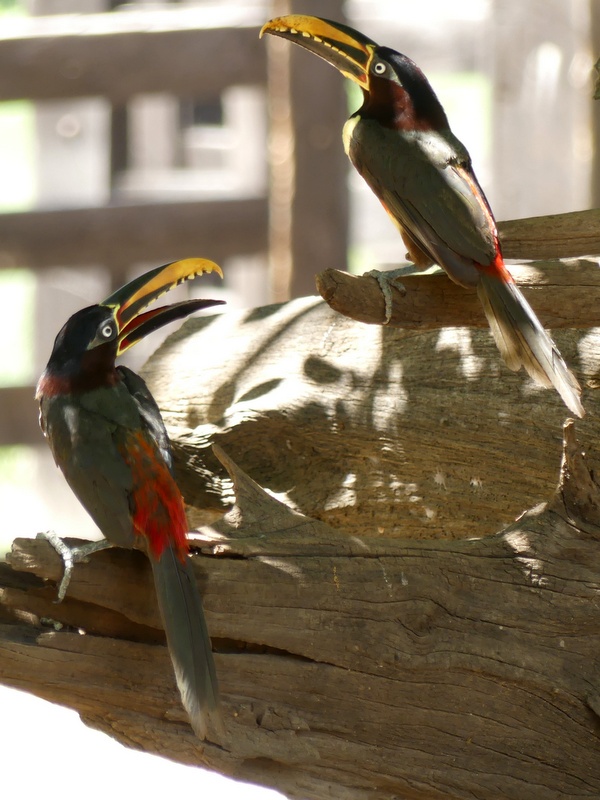
Chestnut-eared Aracaris Pteroglossus castanotis; aracaris, all in this genus, form
a group of smaller colourful toucans. Toucans will get their own post here one day.
Crested Oropendola Psarocolius decumanus. Oropendolas are a group of large, colonial-nesting
icterids (or North American blackbirds, whose ancestors arrived in South America a few million years
ago when the Isthmus of Panama arose).
This is an impressive bird, but the crest? Well not quite so much....
Purplish Jay Cyanocorax cyanomelas; not at all shy!
Yellow-billed Cardinal Paroaria capitata. One of the most prominent birds in the Pantanal, and a delightful one.
The Streaked Flycatcher Myiodynastes maculatus, is widespread in the Pantanal and beyond.

Grey-necked Wood Rail Aramides cajaneus.While this big rail is far from the hardest rail to see, it's not usually this easy!
And with that we'd better look at some other animals while someone is (I hope) still reading...
Crab-eating Fox Cerdocyon thous, hunting frogs in the grounds of the lodge at Pousada Piuval.
These South American foxes are not very closely related to northern hemisphere foxes.
 South American Coatis Nasua nasua. Highly sociable members of the raccoon family,
they hunt a range of prey. I couldn't get very near to this group.
Black-striped Tufted Capuchin Sapajus libidinosus (formerly lumped with the more widespread
Brown Capuchin). This chap was eating green mangoes, which might explain his grumpy demeanour.
Black-tailed Marmoset Mico melanurus, a diurnal tree sap specialist whose range is centred
on the Pantanal.
Brown (or Grey) Brocket Deer Mazama gouazoubira Pousada Alegre; a small deer
and one of four species found in the Pantanal.
Black (or Black and White) Tegu Salvator merianae, Family Teiidae, along the Transpantaneira Highway.
These are big lizards, up to a metre long and massive, filling the niche of goannas (or monitors) in
some other parts of the world. They are often seen around the lodges.
Another member of the same Family, which I've not yet been able to identify.
Red-footed Tortoise Chelonoidis carbonarius, sprinting across the Highway.
This lovely tortoise - and we only saw one - is another Threatened Species, and again the illegal pet trade
is complicit in its decliine.
Wasp nests: Pousada Piuval above,
armadillo wasps, along the Transpantaneira, below.
I was advised that both are well worth not disturbing!

Butterflies enjoying the benefits of cow pats, above and below.
 

OK, I'm sorry that wasn't perhaps the most tasteful way to conclude, so perhaps something a little more romantic to end on.
Amorous millipedes, Posada Piuval.
I hope you're still there - or if you've left, you've done so to rush off to the fabulous Pantanal. And before you say something like "hey, what about the ....?!", remember I'll be back next week with some delights associated with the Pantanal's wonderful swamps and rivers. Hope you can be here for that.

NEXT POSTING THURSDAY.
(And remember that you can get a reminder when the next post appears by putting your email address in the Follow by Email box in the top right of this screen.
And I'd love to receive your comments - it's easy and you don't need to sign in!)