About Me

My photo
Canberra-based naturalist, conservationist, educator since 1980. I’m passionate about the natural world (especially the southern hemisphere), and trying to understand it and to share such understandings. To that aim I’ve written several books (most recently 'Birds in Their Habitats' and 'Australian Bird Names; origins and meanings'), and run tours all over Australia, and for 17 years to South and Central America. I've done a lot of ABC radio work, chaired a government environmental advisory committee and taught many adult education classes – and of course presented this blog, since 2012. I am a recipient of the Australian Natural History Medallion, the Australian Plants Award and most recently a Medal of the Order of Australia for ‘services to conservation and the environment’. I live happily in suburban Duffy with my partner Louise surrounded by a dense native garden and lots of birds.
Showing posts with label insects - Australia. Show all posts

Thursday, 8 October 2026

Goobang National Park; an important remnant of the SW Sopes of NSW

The Central Western Slopes of NSW are part of the great grassy woodlands that once stretched from northern NSW  to southern Victoria and into South Australia. They grew on fertile deep soils which soon attracted farmers and graziers and now very little of the original woodland is left. On the rocky hills and ridges that dotted them grew a different vegetation, the open forests dominated by different trees. These were more likely to escape widescale clearing but were still heavily logged for building, fence-posts and firewood; not much of them were actively protected in formal reserves. 

In the extensive plains of the Central Western Slopes - the transition from the near-coastal ranges to the great western plains which extend to the Indian Ocean - there are just four national parks, Weddin Mountains (8300ha), Nangar (9200ha), Conimbla (8500ha) and Goobang, which is by far the largest of them with 42,000ha. Each of them comprises a mountain range, with some fringing woodland (especially Weddin Mountains and Goobang) surrounded by mostly cleared plains.

Looking west from Caloma Lookout in the northern section of the park. 
The woodland fringing the range ends right on the park boundary.

Goobang NP in the Hervey and Curumbenya Ranges, east of the busy Newell Highway
 between Parkes (bottom left of the map) and Dubbo (further north along the Newell). 
Ideally a reserve will have the minimum ratio of boundary to area (ie a circle or square)
 but we must be grateful for what was available in 1995 when the park was gazetted. 
Map courtesy of NSW NPWS.

And here's a view from the west looking across to the range. Again the island nature of the park is evident. The remnant paddock trees are all that is left of the original woodlands, that were teemingly diverse. That is the sad story of most of those woodlands.

We stayed at Greenbah campground which has only four campsites; as with all NSW (and I think now all Australian) park campgrounds, booking is essential but as with many inland parks there is only a modest booking fee to pay. You can't book a specific site, so are relying on other people not turning up without booking. However it's not a busy campground, especially during the week. The Wanda Wandong campground in the north is larger and apparently caters more to family groups, especially from Dubbo; we've not stayed there. Greenbah though was a delight, quiet except for the birds, which were abundant. At one stage I sat in my chair in our camp and counted at least 15 species in about 30 minutes.

The activity was mostly in the grassy open forest beyond our trailer; behind the camera is a large
open grassy area with tables and fireplaces (below). 

Looking across the open area towards our camp (back right).

And from now on this will mostly be a photo essay.   

In the range (where most of the road access is) the open forests typically comprise
Scribbly Gums E. rossii, White Box E. albens, Red Stringybark E. macrorhynca and some
other eucalypts, including ironbarks, plus areas of callitris pine.

Old Scribbly Gums along the Burrabadine walking track. There are relatively few 
such older trees after more than a century of local felling.
Ironbarks (both Mugga Ironbark E. sideroxylon and Red Ironbark E. fibrosa are present).

A small sheoak Allocasuarina diminuta, growing on a gravelly ridge near 
to Caloma Lookout and forming a distinct heathy vegetation type.
A small inland cycad Macrozamia secunda, which I think is the only cycad to grow
in the Central West. I used to think of cycads as being near-coastal plants
and was surprised to find it out here, but I now know that it's fairly common
in these drier forests. 
Peak flowering seems to be in September, but doubtless extends at least into early October too. Here is a Goobang bouquet for you, starting with some of the many superb wattles. 
Mudgee Wattle Acacia spectabilis, one of my favourites.
Hakea Wattle Acacia hakeoides; the name is perplexing as hakea foliage, like that of the
wattles, comes in a very wide array of forms.
A spectacular mass flowering of Western Silver Wattle A. decora.
Deane's Wattle A. deanei, which is found on the western slopes from central Queensland to Victoria.

Sandstone Boronia B. glabra, always a welcome genus to see! Family Rutaceae.

Pink Phebalium P. nottii, a truly striking plant and one which perplexed me mightily at the
time. It was only when I got home that I was able to identify it; in my ignorance I'd
always thought that all phebaliums are cream or yellow. Same family as boronia.

I think that this prostanthera is P. howelliae, but would be happy to be corrected. 
In the mint family, Lamiaceae.

Slender Westringia W. eremicola at Caloma Lookout. Also Lamiaceae.

Common Fringe-Myrtle Calytrix tetragona; a common and widespread species but always welcome.
 
Hill Teatree, formerly Leptospermum trivalve but apparently now known as
Gaudium divaricatum. A common shrub in Goobang and coming into flower
a week or so ago. Plus a bonus wasp coming in for a nectar hit.

One of the bush-peas Pultenaea cinerascens, limited to the western slopes and
here at close to its southern limit.

A hop bush Dodonaea heteromorpha; we're looking, not at the flowers which are 
wind-pollinated and inconspicuous, but at the colourful papery winged fruit.
This species is restricted to the Central and Northern Western Slopes.
 
Seven Dwarfs Grevillea Grevillea floribunda, one of my favourite grevilleas and not
just for its whimsical name. It is found in remnant forest throughout the western slopes

Hop Goodenia G. ovata, common and widespread and the only shrubby goodenia in the region.

Silky Purple-flag Patersonia sericea, with a pollinating hoverfly casting a
shadow on the petal.

Pale Sundew Drosera auriculata, which grows in nutrient-leached wet areas and
supplements its nutrient requirements by attracting insects (including many ants)
with a sugary solution in the leaves. The long sticky fibres close over, trapping the victim,
and the sweet lure now begins its other job of dissolving the body.
The flower is held high above the leaves - it doesn't want to eat its own pollinator
(at least not until it's done its job).
The sticky fibres at different stages of closing over. The black blobs in the lowest
and furthest right leaf are trapped insects.

Western Donkey Orchid Diuris goonooenis, a very handsome inland donkey orchid
of the slopes and ranges.
Pink Fingers Orchid Caladenia carnea, probably the commonest and most familiar of
south-eastern Australian orchids. But that doesn't mean we should ignore it!

Grasstree Xanthorrhoea glauca with a full magnificent flowering spike. 
This species is widespread, mostly west of the ranges. For close-ups of
the flowers, see the next two photos of pollinators.
It seems a logical segue to go from that photo to some pollinating insects.

Hoverflies, Family Syrphidae, on the grassree spike, which comprises thousands of 
tiny flowers; grasstrees are in the broad and informal lily group of families.

Australian Painted Lady Vanessa kershawi on the grasstree spike. 
(Also, inevitably, another hoverfly - they really are ubiquitous around flowers.)

Red-necked Wallaby Notamacropus rufogriseus in the campground. A common 
and widespread wallaby but I always enjoy them.

Shingleback Lizard (though I still think of them as Sleepy Lizards from my 
South Australian childhood) Tiliqua rugosa. One of our largest skinks and full
of surprises eg they mate for life! A bit more about them in an old post here. 
Male Spotted Pardalote Pardalotus punctatus, a common species that is often more
readily heard than seen. But sometimes you get lucky.
Pair of Galahs Eolophus roseicapilla. If I were inclined to anthropomorphism I might
suggest this looks like a domestic disagreement that has reached a stalemate.
Sulphur-crested Cockatoo Cacatua galerita dazzlingly catching the early morning sun.

Willie Wagtail Rhipidura leucophrys on its exquisite spiderweb-bound nest very close to our camp.

OK, that's four very common and familiar birds; now for one that definitely isn't.

This little glory was the highlight of our camp. On consecutive days he flew in and 
foraged quietly on the ground for grass seeds, fluttering up briefly when I pushed
my luck in trying to get a bit closer to him. He's a Turquoise Parrot Neophema pulchella,
surely (and of course subjectively) one of Australia's most delightful birds and tiny,
not much bigger than a Budgerigar. When the English colonists began exploring the new
Sydney colony this was one of the commonest parrots they found, in the open woodlands.
Such woodlands are scarce now, but the 'Turqs' are scattered from south-east Queensland
to Victoria, though mostly in NSW
Well I hope I've managed to convince you to put Goobang on your 'to do' list, especially if you're in my part of the world. You won't be sorry. Thanks for reading.

***I'M GOING TO BE AWAY FOR A WHILE, ON AND OFF, BUT MY 
TIME BACK IN CANBERRA IN BETWEEN TRIPS WON'T BE ENOUGH TO ALLOW ME
TO PREPARE ANOTHER POST.

I'LL BE BACK THOUGH, HOPEFULLY WITH SOME NEW MATERIAL!
 
***

 NEXT POSTING THURSDAY 19 NOVEMBER

I love to receive your comments and I will notify you personally by email when a new posting appears, if you'd like me to. This will mean one email every three weeks at the current rate of posting. I promise never to use the list for any other purpose and will never share it. Should you wish to be added to it, just send me an email at calochilus51@internode.on.net. You can ask to be removed from the list at any time,or you could simply mark an email as Spam, so you won't see future ones.
If you do leave a comment - and I love it when you do - please remember to click the
box below your comment that says 'Email follow-up comments to...[your address]'
so you'll know when I reply - and I always do!

Thursday, 13 February 2025

Queensland's Channel Country#2: some animals

Last time I offered an introduction to south-west Queensland's Channel Country, one of our (many) favourite destinations, a vast arid and semi-arid area of wide plains and braided stream channels that ultimately empty into Kati Thanda - Lake Eyre. Today, as promised, I'm going to complete this little series by introducing some of the animals we've come across in our various visits. It's not entirely representative as we tend to go there in the cooler months (except for one April stay in Bladensburg NP, south of Winton and close to the northern edge of the Channel Country), so reptiles for instance feature here far less than they should. The mammals are largely nocturnal so we tend to miss those too but I offer a few here. So it's mostly birds and invertebrates this time, hope you keep reading anyway! It's turned out to be longer than I'd anticipated, my regular readers will not be at all surprised to learn.

We'll start with three different plovers, all of them inland specialists though one extends to the coast as well.

Black-fronted Dotterel Charadrius melanops on one of the Diamantina Channels.
This little wader can be found on any inland water body but also sometimes comes to
the coast. For a long time it was placed in its own genus, but very recently it was
reinstated in the 'general' dotterel genus Charadrius. It seems that this species
and the next evolved on the inland waterways as Australia dried out.

Red-kneed Dotterel Erythrogonys cinctus, on the same channel as the previous one.
This very pretty dotterel is definitely a bird of the inland, and retains its
single-species-genus status.
 
Banded Lapwing Vanellus tricolor west of Windorah. This lapwing is essentially
a dry-country bird, though it sometimes irrupts into the south-east. It is closely
related to the other Australian lapwing, the familiar Masked Lapwing V. miles.
I reckon this one's more attractive though!
There are some impressive pigeons and doves too.
Diamond Dove Geopelia cuneata, Morney Creek, 150k west of Windorah.
A common little dove across most of the inland, and near the coast in the tropics.

Spinifex Pigeon Geophaps plumifera, also at our Morney Creek camp.
These delightful little desert pigeons are among our favourites. Their main
needs appear to be spinifex (of course), rocks and not to be too far from
water (like other pigeons and seed-eating birds).
 
Flock Bronzewing Phaps histrionica just west of Windorah. This was an
unexpected treat. Their core range is the vast Mitchell Grass plains of northern
Australia, though they used to extend far beyond that. However they are
highly nomadic and they can still turn up unexpectedly elsewhere in good seasons.
Indeed I've only seen them five times and three of those have been
in the Channel Country. They were superabundant before the sheep arrived
but even as recently as 1968 the great Australian ornithologist Harry Frith reported
from near Katherine in the Northern Territory a flock "a kilometre long and
10-20 metres thick, flying on a front of 100m". What a sight!
Of course the channels support water birds, sometimes in huge numbers. Last post contained an image of part of a big flock of Little Black Cormorants by the road bridge over Cooper Creek near Windorah; often this species accompanies Pelican feeding flocks. Here are a couple more, and arguably another..
White-necked Heron Ardea pacifica at Bladensburg NP.
We can see this handsome heron anywhere in Australia, but it is always a pleasure.
Glossy Ibis Plegadis falcinellus in an ephemeral wetland west of Windorah. This
attractive little ibis (they were rather distant here) is found across Australia,
though it is much commoner in the tropics, and Africa. It also has populations
scattered across Asia and around the Caribbean.
Brolgas however are a bit harder to categorise; cranes are often thought of as waterbirds, and Brolgas nest and sometimes feed in wetlands, but they are equally at home foraging and display 'dancing' on the plains. It's not important how we classify them, they are truly magnificent birds either way. They are present throughout the Channel Country and you'd be unlucky to pass a day there without seeing or hearing them.
Brolga Antigone rubicunda by the road to the Noccundra Pub and Waterhole.
The latter, an excellent camp site, is on the Wilson River and the two are
within perfect walking distance of each other.
Brolgas displaying in grasslands near the Diamantina Channels.
And while we're on it, there's also another Big B Bird that you'll almost certainly encounter in a trip to the region.
Male Australian Bustard Ardeotis australis, Farrans Creek west of Windorah.
He stands about 120cm tall and weighs up to 8kg, which I think
makes him Australia's most massive flying terrestrial bird.
It's always a thrill to see them.
There are of course parrots and cockatoos; here are just a couple of them that you're unlikely to see in less arid areas.
Flock of Cockatiels Nymphicus hollandicus, Bladensburg NP.
Australia's smallest cockatoo, chattery flocks of them can turn up
anywhere in the Channel Country.
Bourke's Parrot Neopsephotus bourkii west of Windorah.
I'd not normally inflict quite such an ordinary photo on you, but I've
always found these very hard to approach and photograph, so it's a case
of something hopefully being better than nothing.
They're found across central Australia west from the Channel Country,
not really rare but shy and quite cryptic, though when seen well their
softly pink undersides and blue rump are truly lovely.
There are lots of birds of prey, especially the ubiquitous Black Kites and Whistling Kites along the waterways, but here's one that not nearly as common, though it can turn up across most of the country.
Black Falcon Falco subniger, Bladensburg NP. Other than the semi-mythical (😀)
Grey Falcon this is the least-known of Australian falcons.
And any small lizard or grasshopper would agree that a Red-backed Kingfisher is a predator!
A Red-backed Kingfisher Todiramphus pyrrhopygius at Welford NP, just showing off
its red rump. It is found across much of Australia but is an arid land specialist.
It belongs to a large genus of non-fishing 'tree kingfishers' found from the Philippines
to Australia and across much of the Pacific.
And finally for the birds, a small selection of passerines. The woodswallows are among my favourite bird groups. (Though aerial insect eaters, they are not at all related to swallows and in fact are closest to the magpies and butcherbirds.) In Australia most of the six species are nomads across the dry country, and beyond it during droughts. They often appear in large flocks near water in the evenings, and will arrive in big numbers when the eucalypts are flowering, when they feed on the nectar..
A very small part of a mixed flock of White-browed and Masked Woodswallows
in front of storm clouds west of Windorah.

White-browed Woodswallows Artamus superciliosus;
female above south of Jundah and
male below at our Morney Creek camp.
He in particular is a most striking bird.


Black-faced Woodswallow Artamus cinereus, Bladensburg NP.
This one is the most sedentary of Australian woodswallows, so rarely
forms large flocks but is commonly seen along the wires by inland roads.
Of the true swallows the most commonly seen is the pretty little Fairy Martin Petrochelidon ariel. Almost any road culvert, especially when water is present, is likely to host a nesting colony of them, such as this one west of Windorah. 

The mud nests are bottle-shaped when separate, but when the colony is crowded
the nests may merge into each other.
Here's another colony, at Farrans Creek, in a situation that I'd never seen before.

The flood monitoring equipment sits on a platform a few metres above the ground
(and the flood waters) by the creek. The Fairy Martins found the underside of
the platform to be an eminently suitable nesting site.

The Spotted Bowerbird Chlamydera maculata is one of three closely related
arid land bowerbirds, but the only one restricted to eastern Australia.
This one was inspecting our creek-side camp at Bladensburg NP.
One of the delights of arid Australia, including the Channel Country, are the tootling
little flocks of Zebra Finches Taeniopygia castanotis which come to drink at any water
at any time of day. I keep meaning to dedicate a whole blog post to them one day; I just
need one more photo... :-) The most suprising thing about this photo is that there
is just one Zebra Finch in it!
Finally, a fascinating little visitor that came hopping around our feet at the
Morney Creek camp. She is a normally shy female Black Honeyeater Sugomel nigrum,
though only he is actually black (and white). They are tiny, not much more than 10cm long.
Finally she revealed her purpose, by taking ash from our (now cold) fire. This has been
reported before but it's only the second time I've seen it. It is suggested that they are
seeking calcium to assist in egg shell formation (only females have been reported
doing so) but it's so far just speculation. A fascinating behaviour to watch anyway!
Reptiles are diverse and abundant in the Channel Country, but as I mentioned earlier we're usually there in the colder months. Accordingly most of the following reptiles were encountered on our April visit to Bladensburg NP near Winton.
Gilbert's Dragon or Ta Ta Lizard Amphibolurus gilberti, Bladensburg NP.
They 'wave' to other males to indicate territoriality. This young lizard, even if
it were a male, would not dare bring trouble on itself by such effrontery.

Yellow-spotted Monitor Varanus panoptes, Bladensburg NP, visiting camp,
doubtless based on previous positive outcomes. This large goanna is found widely
across northern and western Australia, but has suffered badly from the arrival
of Cane Toads.
Eyrean Earless Dragon Tympanocryptis tetraporophora, Bladensburg NP.
This blunt-faced little dragon is found widely across the Lake Eyre Basin.
(I, with no expertise in this genus, had previously identified it as Gibber Earless
Dragon T. intima, but on further investigation I've changed my mind. Any
assistance gratefully received!)
Central Bearded Dragon Pogona vitticeps, west of Windorah, with head comfortably pillowed on
a dry cow pat! It had braved a day that was far too cold for it, and was unable to flee from us.
Here are some obvious large mammals, for the record.
Dingo Canis lupus or C. familiaris (it really still isn't clear which, ie wolf or ancient
domestic dog) west of Windorah. Despite constant persecution, they can still be
seen or heard across most of the arid inland.
Red Kangaroos Osphranter rufus, mother and semi-independent young,
Welford NP. The largest living marsupial and Australian land mammal,
superbly adapted to life on the open plains.
Euro Osphranter robustus (and bonus Spinifex Pigeons) Bladensburg NP.
This stocky kangaroo is found across most of the continent but is especially
associated with rocky hills.
And finally some invertebrates, a pretty random selection! I'll start with an event that I've only seen once, on a trip to the Channel Country 15 years ago when it had been wet but we were able to drive west from Winton into the Diamantina Channels on a bitumen road. The event was a remarkable mass movement of slaters (or 'flood bugs' as they're also known) along the edge of the road in cracking black soil Mitchell Grass country. The thing is it only seems to happen following rain, and you don't drive in that country then, unless you have the luxury of bitumen.
Slaters Australiodillo bifrons, on the move! They are not insects but crustaceans, and
specifically isopods (like many marine and shoreline animals), and are very ancient. You'll find
some by looking in your compost heap or under rocks or wood in your garden.
More of the massed slaters on the road verge. I did a post on them many years
ago, which has a lot more information if you're interested.
And of course there are spiders, especially orb weavers near water where there are lots of flying insects.
Orbweb spider Family Araneidae, Morney Creek 115k west of Windorah.
She has a row of neatly packaged lunches above her.
The rest are insects.
Grasshopper (sorry I can't do better) and tracks on a dune west of Windorah.
Under certain conditions (which I wrote about here quite briefly long ago, at the very start of my blogging career) four Australian grasshopper species suddenly increase dramatically in number and start to move, causing great alarm in agricultural communities but a providing a massive food source to many other animals too.
Spur-throated Locusts Austracris guttulosa south-west of Quilpie,
above and below.
Moths and butterflies are of course everywhere; here are just a couple of Channel Country species. The same rain event that spurred the flood bugs into action also produced a major breeding flurry west of Windorah among very beautiful White-lined Hawk Moths Hyles livornicoides.
White-lined Hawk Moths mating, and caterpillar (below) travelling
presumably to find a suitable patch of sand for pupating. This was
an impressive event to witness.

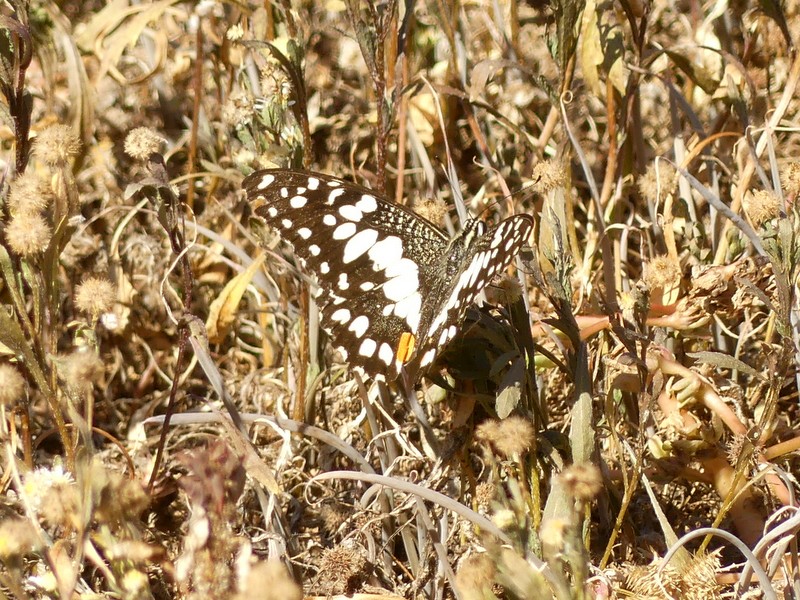
Chequered Swallowtail Papilio demoleus, Morney Creek. I have seen this
butterfly referred to as 'perhaps the most widely distributed swallowtail in the world',
so not at all limited to the Channel Country, but I'm happy to see them anywhere.
And to end, another encounter that was due to the rains, a great gathering of water striders in an ephemeral pond between the dunes west of Windorah.
Water striders are bugs (ie members of the insect order Hemiptera, not just
'creepy crawlies'!), with very long middle and hind legs to distribute their
weight enough to walk on the water surface, where they hunt smaller animals.
We can see the long legs in this somewhat muddy closeup.
And that's probably a bit more than enough from me this time! I hope you can experience the wonders of the Channel Country and enjoy them as we have. And you only have to walk on the dunes in the morning to realise how much else goes on at night! Thanks for reading.

NEXT POSTING THURSDAY 6 MARCH
I love to receive your comments and in future will be notifying you personally by email when a new posting appears, if you'd like me to. All current subscribers have been added to this mailing list and have already been contacted. This will mean one email every three weeks at the current rate of posting. I promise never to use the list for any other purpose and will never share it.
Should you wish to be added to it, just send me an email at calochilus51@internode.on.net. You can ask to be removed from the list at any time,or could simply mark an email as Spam, so you won't see future ones.
If you do leave a comment - and I love it when you do - please remember to click the
box below your comment that says 'Email follow-up comments to...[your address]'
so you'll know when I reply - and I always do!