About Me

My photo
Canberra-based naturalist, conservationist, educator since 1980. I’m passionate about the natural world (especially the southern hemisphere), and trying to understand it and to share such understandings. To that aim I’ve written several books (most recently 'Birds in Their Habitats' and 'Australian Bird Names; origins and meanings'), and run tours all over Australia, and for 17 years to South and Central America. I've done a lot of ABC radio work, chaired a government environmental advisory committee and taught many adult education classes – and of course presented this blog, since 2012. I am a recipient of the Australian Natural History Medallion, the Australian Plants Award and most recently a Medal of the Order of Australia for ‘services to conservation and the environment’. I live happily in suburban Duffy with my partner Louise surrounded by a dense native garden and lots of birds.

Monday, 17 December 2012

Daisy Days 1

One of the many pleasures of summer for me is that it seems to be peak time around here at least for daisies to flower. 25,000 species of daisies form the family Asteraceae, the most numerous plant family except for the wonderful orchids; nearly 10% of this number is found in Australia. Here, they are found from seashores to the top of Mt Kosciuszko, from wet forest to the driest deserts. They may be tiny annuals, perennial herbs, shrubs or trees. Apart from many popular garden plants, both ornamental and edible (artichokes and lettuce for instance) many daisies are weeds, including thistles, dandelions and boneseeds.
Cephalipterum drummonditum in red sand plains near Mt Magnet, Western Australia.
Silver Snow Daisies, Celmisia sp, in mist at 1700 metres, Namadgi National Park.
But it's the structure of the 'flower' which is one of the bases of their success. I put 'flower' in parentheses because what we see isn't really a flower at all, but a congregation of numerous flowers to increase the visibility of each to a pollinator. Here are a couple of 'basic' daisies to illustrate the point.
Billy Button, Crapedia sp. Namadgi National Park.
Yellow Buttons, Chrysocephalum apiculatum.
In each case we can see that the individual head comprises numerous tiny florets clustered together on a base which is formed by the expanded tip of the flower stalk. Each is fertile and the presence of each makes them all more visible to passing flies or wasps or bees.

Many daisies however have added refinements. A result of one such set of refinements is one of the great hoaxes of nature - a collection of little flowers to resemble a large conventional flower. Again, here are some examples. 
Podolepis jaceoides, Namadgi National Park.

Brachyscombe aculeata, Namadgi National Park.
Olearia tenuifolia, Namadgi National Park.
In each case, we can again see the fertile disc florets in the middle; now however our attention has been drawn more strongly to them by the presence of surrounding 'petals', as in a real flower. Here however the 'petals' are themselves flowers, sterile ray florets whose sole purpose is to draw attention to the disc florets. In the second two examples, the ray florets are of contrasting colours to make the whole structure even more conspicuous.

Other daisies achieve the same effect in an entirely different way.
Waitzia nitida, Kalbarri NP, Western Australia.

Xerochrysum subundulatum, Kosciuszko NP, New South Wales.

Leucochrysum albicans, Namadgi National Park.
In these three cases the now-familiar central disc florets are still visible, but the attention-grabbing surrounds are formed by shiny stiff papery bracts - effectively modified leaves - either of the same or contrasting colours.


 That will probably do for today, but in the not-too-distant future I'll return to the wonderful daisies, even if only to celebrate them.

Saturday, 15 December 2012

Oddbills 1

This is the first in an occasional series celebrating truly wonderful bills. (Not the sort that charges you $4,358 for a month's electricity that normally costs about $60, or that includes the cost of a bottle of Moet that you didn't have with your Special Fried Rice!)

It was inspired by finally seeing the fabulous Sword-billed Hummingbird (Ensifera ensifera) very recently in Ecuador, at the delightful Yanacocha Reserve, 6,700 hectares of cloud forest on the northern slopes of Pichincha Volcano, across the ridge from Quito. Like other precious cloud forest reserves, it is run by the admirable Jocotoco Foundation. I'd searched for this bird for some time in Peru and more briefly in Ecuador, but this is a hot-spot for it and we were definitely not disappointed.

It is widely reported that this is the only bird whose bill is longer than its combined head-body; neither this photo nor more sober measurements cited in the literature quite support that claim, but there's not much in it and there's no doubt that it has the relatively longest bill of any hummingbird and probably of any bird at all. I'm not too worried about records, it is just an extraordinary bird.
Female Sword-billed Hummingbird, Yanacocha Reserve.
Another apparent myth is that it always rests with the bill elevated, to help balance it, but this one seemed to have no trouble supporting the gram or two it must weigh. Like other long-billed hummingbirds, the Sword-bill has sacrificed the ability to preen with the bill, so does a lot of scratching.

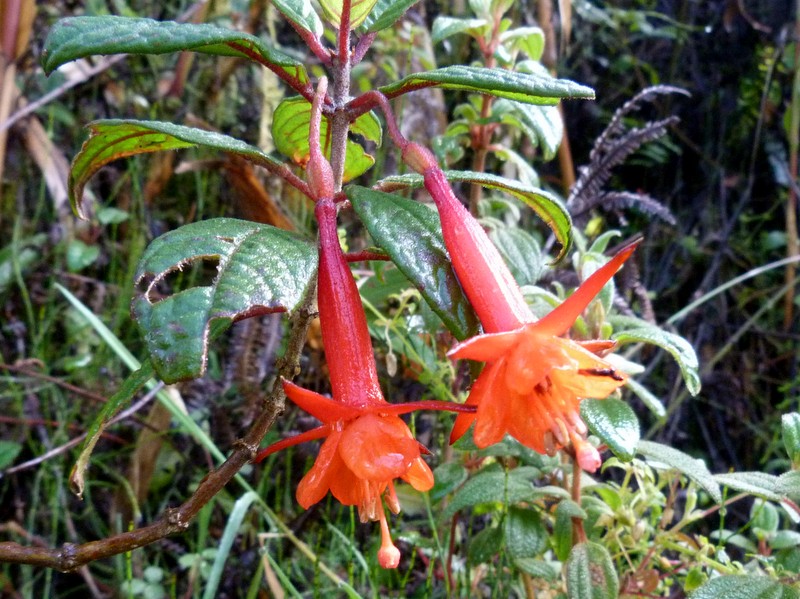
The bill's purpose is to probe straight tube flowers, including Datura (Angel's Trumpet), Passiflora (Passionflowers) and Fuchsias, though most of these would not seem to require such an extreme probe and I find it somewhat perplexing.
Fuchsia ampliata, Yanacocha Reserve.
Being perplexed however is one of the joys of immersing oneself in nature, and I am privileged to have seen this wonderful animal.

Back on Monday.

Friday, 14 December 2012

The Delightful Lady Elliot

There is really no bad time to visit the Great Barrier Reef (though cyclone season can be a bit tricky) but right now is the perfect time to visit one of the southern-most islands of the national park, Lady Elliot. This is because of tens of thousands of other visitors are also there. Now, I would not usually suggest this as a desirable thing, but when the other residents are seabirds and turtles coming to breed, then that changes things a bit. 

It is a classic coral cay (a sand island sitting on a coral reef).
Lady Elliot island from the air; the surrounding reef is clearly visible.
 Lady Elliot - named for a ship which visited in the early 19th century - is just outside the tropics; the nearest city on the mainland is Bundaberg. It is less than 50 hectares in area, some of which is occupied by a small resort, though even here humans must fit in with the original inhabitants. 
Bridled Terns feeding chick on the walkway connecting the basic cabins with the dining area.
Because of its status as national park, once you are there, there is little to do other than walk around enjoying the birds, and snorkel to wonder at the remarkably rich life under the water. Perfect really; let's do it.
Black Noddy colony; some of these colonies, in Coastal Casuarinas, Casuarina equisetifolia,
are immediately adjacent to the cabins.

Black Noddies with chick.
Common, or Brown, Noddy; unlike Black Noddies these mostly nest on the ground.
Black-naped Tern.
Roseate Terns with chick.
Red-tailed Tropicbird and chick; this nest was just metres from cabins.

Brown Booby; these tropical gannets are very imposing birds.
Buff-banded Rail; shy and elusive in most mainland sites, they forage under - and on - tables on Lady Elliot.
Capricorn White-eyes are equally relaxed about humans; they have been
described as a separate species from the mainland Silvereye, though that is not now generally accepted.

And when it all gets a bit much, you can just contemplate the sunsets.
You really should consider it some time...

Thursday, 13 December 2012

On This Day, 13 December; Phillip Parker King's birthday

Phillip Parker King is not a household name, even in Australia, though his father, Philip Gidley King, is remembered as the third British Governor of New South Wales, which was effectively 'Australia' at the time, though the name Australia wasn't in use then, and wasn't formalised until 1824. 

(Incidentally, neither his parents nor I are guilty of misspelling his first name, which was not taken from his father's but from the first Governor, Arthur Phillip, a sponsor of Philip Gidley's career.) Born on Norfolk Island in 1791, Phillip Parker is best remembered for his series of impressive surveying expeditions in the little vessel the Mermaid, and later the Bathurst, mostly across the little-known tropical north coast. Accompanied for much of the time by the great botanist-explorer Allan Cunningham - of whom surely more anon in these pages - he spent most of four years, from 1818 to 1822, in these arduous efforts. He returned to Britain a celebrated hydrographer, and later explored Patagonia in the Beagle, before Charles Darwin sailed in her. In later life he returned to his Australian estates and became active in NSW politics and commerce.

His name lives on in a spectacular Western Australian genus, containing just one species, Kingia australis. The plant superficially resembles the Xanthorrhoeas, or grass-trees, but is not closely related. 
Kingia australis, Badgingarra National Park, Western Australia.
The preferred common name is now Kingia, but it was long and widely known as 'Black Gin'; this was based on the name 'Blackboy' for Xanthorrhoea (which in silhouette with a flower spike supposedly resembled an indigenous man with a spear). There was a Western Australian belief - not among botanists! - that the Kingia represented a female form, and 'gin' was a term often used for an indigenous woman. The terms now have undesirable racist overtones and their use is disappearing. 

Kingias are in the small monocot family Dasypogonaceae; comparing Kingias with the tinsel lilies, also in the family, the connection is non-intuitive!
Blue Tinsel Lily, Calectasia grandiflora, Moore River National Park, Western Australia.
When the great Scottish botanist Robert Brown named Kingia, he may also have wished to honour Philip Gidley King. In eastern Australia, a familiar and spectacular bird was also named for him, though in this case it was the common name; the connection has been largely forgotten however.

When specimens of King-Parrot were sent to Britain in the early 1800s by George Caley, Joseph Banks' botanical collector, he suggested that they be called King's Parrot for the Governor. This was done, but within a couple of decades the apostrophe was disappearing, and it became widely known as King Parrot. 
Tht
Australian King-Parrot Alisterus scapularis, Canberra; male above, female below.
The link was entirely broken in 1978 when the then Royal Australasian Ornithologists' Union bizarrely introduced the hyphen, for no comprehensible reason. While I'm not a great fan of naming organisms for people, if we're going to do so we might as well honour them properly!

Still, I don't suppose either Phillip or Philip care now. Happy birthday anyway Phil...

Wednesday, 12 December 2012

Talking Points (2)

As I said yesterday, true horns are nearly exclusively the province of the cattle/antelope/goat family, but many other animals - especially in the same big hoofed Order of Artiodactyls - have developed sharp things on their heads for poking other animals, or least to threaten to do so.

Probably the best-known of these are the deer (Family Cervidae); these are very familiar to many of the northern hemisphere readers of this blog, though in most parts of Australia deer are non-numerous invasive animals. (In some areas here however they are definitely a looming environmental problem.) In all deer species but Reindeer, only the males have antlers. Like true horns the mature antlers are formed of bone, but there are some important differences. The antlers grow every year and are shed at the end of the mating season; each year the antlers are larger and more complex that the previous year's growths. Moreover each year the antlers are relatively larger compared with the stag's body size, so that a bull Moose (Alces alces) may have antlers weighing 30kg and with a span of two metres. This is a hugely demanding process, both to grow and to carry them. While growing, antlers are covered in skin called 'velvet'; unlike the keratin covering of horns, this velvet is covered with hair and is full of blood vessels and nerve fibres, and is very sensitive to the touch. After some five months the bone hardens and 'dies' and the velvet dries and is shed. 
Young Huemul stag (Hippocamelus bisulcus), with developing velvet-covered antlers,
Torres de Paine National Park, Chile.
This species is limited to the Patagonian Andes of southern Chile and Argentina.
Hormones spark the growth of the antlers each year; as the hormones recede at the end of the season, a layer of cells grows through the base of the antler, weakening the bone so that it eventually drops.

Giraffe (Giraffa camelopardalis) horns are not sharp, but they are certainly functional. Unlike antlers they are simple and permanent and borne by both sexes, though like antlers they are covered in skin and hair. They comprise bony cartilage and are technically known as ossicones. Males use them as formidable weapons, using the full length of the neck to swing the horned head as a potentially lethal club, especially in combat with rival males. 
Giraffe ossicones, Etosha National Park, Namibia.
Another well-known bearer of horns is the rhino - or rather the five living species of rhinoceros, which belong, along with tapirs and horses, to the much smaller Order Perissodactyla, the odd-toed ungulates. Their horn differs from other structures we've discussed in having no bony core; rather it consists of fused keratin fibres, attached to a roughened area of bone on the skull. The two African species and the Sumatran Rhino have two such horns; the other two Asian species have only one.
White Rhinoceros (Ceratotherium simum) female and calf, Mkuze Game Reserve, South Africa.
Tusks are another version of pointy tools or weapons on heads, but they are greatly extended teeth. Probably our first thought with regard to tusks is of elephants, whose tusks comprise elongated incisors; in the African species both sexes have them, while in Asian Elephants they are mostly limited to males. 
African Savanna Elephant (Loxodonta africa), Queen Elizabeth National Park, Uganda.
Pigs also often bear tusks, though theirs are enlarged canine teeth. They are used for digging up tubers and other food, as well as formidable weapons of defence.
Warthog (Phacochoerus africanus), Queen Elizabeth National Park, Uganda.
In entirely different Orders of mammals, other tusk-bearers are Walrus (Odobenus rosmarus), the sole member of a family related to seals and sea-lions, whose tusks are also canines, and the toothed whale called the Narwhal (Monodon monoceros) whose tusk comprises just one elongated straight canine.

And it may be drawing a longish bow, but even some reptiles have spiked heads, though in their case the 'horns', or spines, consist of modified scales - keratin, like the rhino's. 
Marine Iguana (Amblyrhynchus cristatus), Galapagos.
Central Bearded Dragon, (Pogona vitticeps), Family Agamidae; south-west Queensland.
And I think with that we're pretty much horned out, and it's time to think of something a bit smoother tomorrow.


Tuesday, 11 December 2012

Talking Points (1)

A perhaps surprising number of vertebrate animals from different groups have developed 'sharp things' on their heads. While it might seem that these evolved primarily for defence, the fact that in many species only the males have horns suggests that this is unlikely to be the main, or even primary, purpose. In many cases males use the horns - and I'm using the term loosely for now - in competition for mating rights. Secondary uses for food foraging have also developed.

True horns occur in two families of the huge Order of Artiodactyla, which comprises the even-toed ungulates, or hoofed mammals; one family comprises just the North American Pronghorn, the other includes cattle, various antelope groups, goats and sheep. A horn consists of a core of living bone, covered in a tough keratin sheath (keratin being a tough fibrous protein which also forms outer skin, claws, scales, feathers and hair). Interestingly most horns are curved and ridged, though they range from simple and slender to massive and complex.
Oribi male, Ourebia ourebi, Murchison Falls National Park, Uganda. Only male Oribi have horns.
Waterbuck male, Kobus ellipsiprymnus, Lake Mburo National Park, Uganda. Again, only the males are horned.


Korrigum pair, Damaliscus korrigum, (formerly lumped with other Topi or Tsessebe species),
Waza National Park, northern Cameroon.
Loder's Kob male, Kobus loderi, Benoue National Park, central Cameroon.
Impala male, Aepyceros melampus, Lake Mburo National Park, Uganda.
Only males have the lovely spiralling horns.
Merino ram Ovis aries, Lake Cargelligo Show, New South Wales.
Sheep and goats are actually taxonomically very close, and are generally described as goat-antelopes!
African, or Cape Buffaloes, Syncerus caffer, Queen Elizabeth National Park, Uganda.
Both males and females are horned, but the males' armoury is much more massive.
(The flying egret and Skimmer are bonuses!)

The budding horns can just be discerned in this African Buffalo calf.
On the other hand several other mammals - and even some other animals - have evolved pointy things on their heads for similar purposes, albeit not formed in the same way. I'll visit some of them tomorrow.

Monday, 10 December 2012

When Orchids Duck

Hello again! Just back from our Ecuador adventures. More of that in weeks to come, especially as I get my photos organised. For now though, I'll limit my comments on that topic to the irony of my last posting - the only thing we wanted to do and weren't able to was enjoy the Sacha Rainforest tower, which was closed due to storm damage!

I was probably a bit ambitious in promising to get back on line today, given that we only got home last night, my brain is still somewhere over the Pacific, and there is a lot to catch up on here... So, just a brief one today, with a bit more substance tomorrow.

One late flowerer in Canberra (and elsewhere) at the moment is the delightful and improbable Small Duck Orchid Caleana minor; until recently it was given its own genus, Paracaleana. Caleana is for George Caley, an intriguing English plant collector in early 19th century Sydney, working for the great Joseph Banks; more on him in due course.
Small Duck Orchid, Black Mountain, Canberra
Perhaps you need a bit of imagination, but I reckon it's a bit ducky, though the 'original' Flying Duck Orchid, Caleana major, which doesn't occur in Canberra, is a bit more convincing.
Flying Duck Orchid, Bundanoon, New South Wales.
OK, maybe you need to think more along the lines of Daffy Duck... This is an 'upside down' orchid, in that the labellum, the petal which acts as a landing platform for pollinating insects, is at the top of the flower rather than at the bottom as is more usual - here it forms the duck's head. (That whole concept needs exploring too, but again that's one for another day.) The flower is pollinated by a male sawfly (a wasp relative); the strap holding the labellum is flexible, so the 'head' nods, mimicking a female sawfly, swinging the unrequited male onto the pollen below; the 'upside down' column in this picture is hidden between broad column wings.
Triggered Flying Duck Orchid.
After a few minutes the labellum resets and the duck pulls its head out!

It's a great story, but no more so than you'd expect from the fabulous orchids...

Thursday, 8 November 2012

Off to the Sacha Rainforest Tower; back in 4 weeks!

Well, actually I'm visiting a lot of the rest of Ecuador too, but it's one place I'm especially looking forward to, not least because I dread high places, and this walkway (linking three fifty metre high towers) was so amazing - and stable - that I forgot to be scared. 

Epiphytes high above the canopy.
The tower is owned by Sacha lodge, a beautiful and sensitively run ecotourism lodge on the edge of the superb Yasuní National Park.

The experience of being above - and alongside - the primary rainforest canopy was totally absorbing in itself; we spent hours there, including watching a tropical storm coming and passing over.
In the midst of the storm (above) and the rising mist in its wake (below).


However the real thrill is the parade of life that comes past, apparently oblivious to us watching. Here are just a few examples.
Masked Tanager; there is a seemingly endless parade of glorious tanagers everywhere in Ecuador.

Bare-necked Fruit-crow.
Blue-throated Piping-Guan.
Double-toothed Kite; this bird approved of the provision of the cables as a convenient
perch to bring a succession of canopy lizards to munch on.

Gilded Barbets.
Ivory-billed Aracaris; the aracaris form a group of small toucans.
Black-mantled Tamarin; small monkey, not very close...
I'll have lots more to talk about in the coming months from this trip, as well as on lots of other things; please don't forget me in my absence!

BACK ON 10 DECEMBER.