About Me

My photo
Canberra-based naturalist, conservationist, educator since 1980. I’m passionate about the natural world (especially the southern hemisphere), and trying to understand it and to share such understandings. To that aim I’ve written several books (most recently 'Birds in Their Habitats' and 'Australian Bird Names; origins and meanings'), and run tours all over Australia, and for 17 years to South and Central America. I've done a lot of ABC radio work, chaired a government environmental advisory committee and taught many adult education classes – and of course presented this blog, since 2012. I am a recipient of the Australian Natural History Medallion, the Australian Plants Award and most recently a Medal of the Order of Australia for ‘services to conservation and the environment’. I live happily in suburban Duffy with my partner Louise surrounded by a dense native garden and lots of birds.

Monday, 8 April 2013

The Blues; nature's trompe d'oeil #1

I think it's time to introduce another chapter in our intermittent discussion of Colours in Nature - you can find the others from that most recent one. As soon as I started preparing for some musings on blue in nature, I realised that yet again one posting wasn't going to nearly cover it. At this stage I anticipate two on animals and one on plants, but I've been wrong before...

It is a bit of a shock to realise that it's becoming increasingly likely that there are no blue pigments in any terrestrial vertebrates! As I suggest in the title it's all a trick, by an array of complex structural mechanisms wherein small 'bubbles' in skin or feathers or shell allow longer wavelengths (reds, oranges, yellows) to pass through but are of a size to 'trap' shorter wavelengths - specifically blues - and reflect them back to us. The principal is known as Tyndall scattering after 19th century Irish-born British physicist John Tyndall who described it; the effect is often seen with very fine particles suspended in liquid, such as very fine silt in rushing streams or the iris of a blue eye. There are variations too, but this isn't a physics blog...
Male White-winged Fairy-wren Malurus leucopterus, north-western New South Wales.
The male White-winged Fairy-wren, sitting up on a saltbush in its vast plains habitat, shines like a light. However if you were to find a shed feather, and crush it, you'd find it turned from shining blue to a indeterminate dirty-whitish, as the crucial little bubbles were broken. Let's just admire a few of the results of this extraordinarily subtle and precise application of wave physics in the feathers of some of the most glorious birds I've seen. Some, like the wren above, are mostly blue; others feature blue highlights that stand out from the surrounding contrasting colours.

Crimson Rosella Platycercus elegans on Banksia integrifolia. This is one of the commonest and most familiar bird species around here, but I reckon that the day I get bored with them is the time to hang up my binoculars.
Swift Parrot Lathamus discolor, by contrast one of the rarest of parrots and a listed threatened species; there may be only 1000 wild pairs left. They breed in Tasmania and every autumn cross the Bass Strait to over-winter in the woodlands of inland south-eastern Australia, including around Canberra. This one was part of an influx to Mount Majura on the edge of Canberra  couple of years ago. The lovely sky-blue wing patch and forehead are really only visible when the bird is perched close by - something they don't do very often!
Azure Kingfisher Alcedo azurea, Barmah Forests, Murray River, Victoria.
Every unfrozen continent has blue kingfishers, but I reckon this one is as brilliant as they come.
And not a drop of blue dye involved...
Red-and-Green Macaws Ara chloropterus, Blanquillo clay lick, Peru.
I've never understood why the green was selected above the blue for the name, but I guess either would have been inadequate alone.
Abyssinian Roller Coracias abyssinicus, Waza National Park, northern Cameroon.
A resident of the vast arid Sahel woodland strip, south of the Sahara,
its blue is displayed in contrast to the earth-brown back.
Turquoise Jay Cyanolyca turcosa, Bellavista Lodge, Ecuador.
Northerners are used to brilliantly coloured crows - of which the jays are surely pre-eminent - but in Australia we only have the black Corvus crows, so we're a bit jealous. (I say 'northerners'; although there are several jay species in South American rainforests, they only arrived there relatively recently from the north when the Isthmus of Panama joined the two American continents.)
Masked Tanager Tangara nigrocincta, rainforest canopy, Sacha Lodge, Ecuador.
The tanagers have among the widest colour ranges of any bird group; blue of course features.
Masked Flowerpiercer Diglossopis cyanea, Yanacocha Reserver, Ecuador.
A group of tanagers, the flowerpiercers make a living by 'cheating' flowers, cutting the base to obtain nectar without offering any pollination services. Blue is a favoured colour among them.
So far, all of these blue birds look uniformly blue no matter how you look at them, as you might expect. However that is not true of all blue birds by any means.
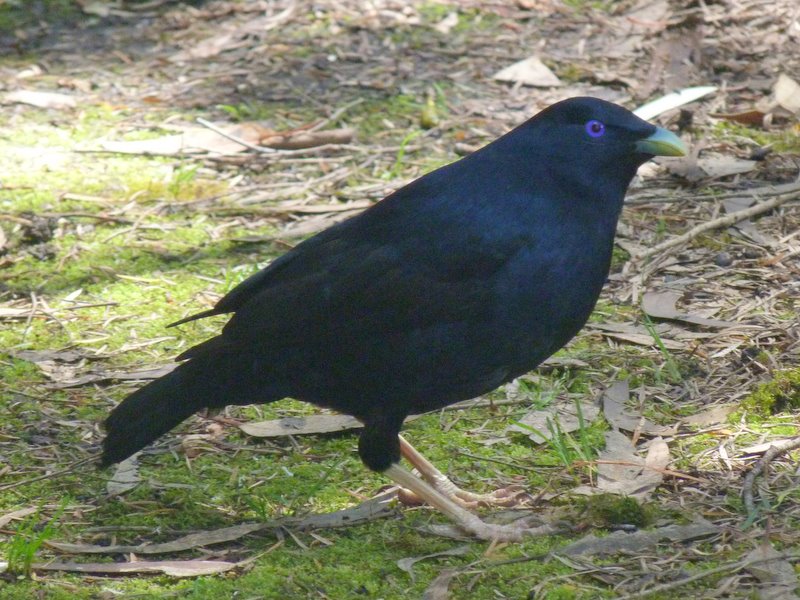
Male Satin Bowerbird Ptilonorhynchus violaceus, Canberra.
From some angles he can look dull black, then suddenly he turns and flashes deep glossy blue.
This is iridescent colouring, and the principle is different from non-iridescent colours. Here the thin surface of the feather is transparent, but beneath it is a layer of melanin. Some light reflects from the surface, more of it bounces back from the melanin layer; if the waves coincide, peak to peak, the colour is dramatically emphasised, but if peak and trough are adjacent the waves cancel each other, and the feather appears black. From one vantage point the effect is consistent, but as the observer and the feathers move, the angle changes and so does the colour. In the bowerbird above, his front half looks blue but the rest seems black; a second later and the the effect could be reversed. The actual colour is determined by the depth of the melanin layer, which decides the wavelength of the reflected light. 

Here are some examples.
Leaden Flycatcher Myiagra rubecula male, National Botanic Gardens Canberra.
This one took me by surprise; normally he is a dull leaden grey, but he suddenly caught the sun and lit up.
Ethiopian Swallow Hirundo aethiopica, Waza National Park, northern Cameroon.
Many swallows demonstrate a blue iridescence on the back. It's been suggested that the 'flash and vanish' effect in flight confuses predators.
Cape Glossy Starling Lamprotornis nitens, Etosha National Park, Namibia.
Some starlings are among the most dramatic of iridescent birds. Even they however, cannot outdo the hummingbirds...
Great Sapphirewing Pterophanes cyanopterus, Yanacocha Reserve, Ecuador.
It was hard to pick just one iridescent blue hummingbird, but this is a pretty good representative.
There are of course iridescent feathers in many other colours, but that's another story (and one which will be told, in its time). 

That's also enough for today, but next time I want to explore other blue body parts - skin, scales, beaks, legs, insect wings etc. That one threatens to be even longer than this one...

BACK ON WEDNESDAY


Friday, 5 April 2013

Musing on Emus

As Gondwana was breaking up 100 million years ago, after half a billion years of comprising one mighty southern land, many of the most familiar elements of our living world were developing, including mammals, flowering plants and birds. Only those groups whose ancestors already existed then would be expected to occur right across the Gondwanan lands today. Family Proteaceae - Proteas, Banksia, Notros - is one such. Another comprises the most ancient of living birds, the ratites, the giant southern flightless birds.
In addition to African Ostriches (above, Western Cape) and South American rheas (Darwin's Rhea below, Seno Otway, far southern Chile), living ratites include the Australian-New Guinea cassowaries and emus and the New Zealand kiwis. Ones that didn't survive human depredations include the New Zealand moas and the Madagascan elephant birds.


Presumably the ancestral ratite (which certainly could fly) continued to get larger to outgrow its enemies, and perhaps to see better in a grassland habitat. Once the apparently magical 15kg weight limit for flying birds had been passed it had to forego the powers of flight, but there was then no limit to its size; an Emu can weight 55kg, an Ostrich 150kg and the elephant birds half a tonne! The word ratite comes from the Latin for a raft; with the loss of flight came the gradual loss of the unnecessary great flight muscles, and their attachment point - the protruding keel. The resulting flat breastbone was seen by earlier ornithologists as raft-like. 

Already spread across Gondwana, they developed in different directions once they became isolated after the break-up. (However I should mention that a 2010 paper, using mitochondrial gene sequencing, claimed that the group was too young to have arisen thus, but that each group flew to its current location and subsequently each one independently lost its flight powers. I certainly can't comment on the chemistry, but this does seem such an improbable scenario that I'm waiting for some corroborative evidence before I accept it.)

All that aside, Emus are intrinsically wonderful birds, and not hard to find in inland Australia as well as in some places much nearer the coast. The name itself is not, as commonly supposed, of indigenous origin, but from the Portuguese ema, referring apparently to a crane, but more generally to any large bird (it is still used for the rhea). The sailors who reported it were Dutch, but Portuguese was then the lingua franca among European sailors in the East Indies, perhaps because the early maps were in Portuguese.
Emu Dromaius novaehollandiae, Shark Bay, Western Australia.
Emus are great nomads, walking hundreds of kilometres following rains and food sources, which at different times of year may comprise grasshoppers, seeds, caterpillars or fruit. This led them into conflict with European settlers whose farms they seemed to threaten. In Western Australia the Great Emu War of 1932 was fought between migrating mobs of over 20,000 emus, and the Australian army with machine guns and grenades, called in by the state government. Jock Marshall in his pioneering conservation work The Great Extermination reports "History does not record the name of the CO emus, but he must have been a good chap". It seems that perhaps only a dozen emus were killed, and the government had to withdraw the military to save them from further embarrassment.

Unusually among birds Emus are polyandrous - ie one female, several blokes. In June (early winter) she lays up to 20 dark green eggs in a scrape on the ground; each can weigh three quarters of a kilo, so the cost is immense. Understandably, she plays no further part in the chick rearing, but if she feels so inclined she can go off and do it all again with someone else.
Emu nest, south-west Queensland.
He sits on the eggs for eight weeks, in a semi-torpor to save energy, living off his fat reserves without eating, drinking or defecating, but turning the eggs over at regular intervals. In the south-eastern high country this also meant being covered in snow at times. 

The stripey chicks can walk within hours of hatching, and run and swim in a week. 
Emu chicks near Cue, Western Australia.
As they get older they lose their stripes but can still be distinguished from their father by their dark heads and necks.
Immature Emus, Currawinya National Park, Queensland.
He looks after them for 18 months, so he only breeds every other year; the female of course doesn't have that restriction.

A familiar night sound to campers in 'the outback' is the resonant booming of Emus, enabled by a unique cleft and an inflatable pouch in the trachea. It can be heard up to two kilometres away.

Another characteristic is the feathers; haystack-like, they seem to have no cohesion, and indeed they don't. Unlike more modern birds they don't have barbules to lock the feathers together; further, the aftershaft, which forms a woolly base to feathers in most birds, is the same length as the main shaft in an Emu, so the feathers appear to be double.
Emu plumage, which characteristically flops about while it is running.
Emus are in some ways the archetypal Gondwanans (ignoring the prevailing view of their intellectual powers!); they are ancient and very special.

BACK ON MONDAY

Tuesday, 2 April 2013

Flood Bugs on the Move

On one occasion only in western Queensland, I've come across vast numbers of what we in Australia call 'slaters' moving along roadsides in the cracking black-soil country, following rains. (I'd not expect to see this very often - in that country you don't venture off the bitumen after a few mm of rain, and there's not much bitumen about.)
Swarming Flood Bugs Australiodillo bifrons, Diamantina River west of Winton, Queensland.
These are the so-called Flood Bugs, which live in moist soil crevices in flood plains of inland eastern Australia. Their remarkable mass movements are well-documented, but as far as I can determine their purpose is not understood; it is certainly most unusual in their group.

Slaters (apparently a Scottish term originally) are known elsewhere as pill-bugs or woodlice (among many more localised terms). They are not insects, but crustacea; like insects they belong to the phylum Arthropoda, but within a different sub-phylum that comprises mostly marine animals, including crabs and prawns. The slaters form a wholly terrestrial sub-order of some 5000 species in the Order Isopoda; there is also a similar number of aquatic Isopod species, mostly marine.

They are a very ancient group, going back at least 300 million years, when they appeared in a similar form in the fossil record. They tend to be flattened dorso-ventrally (ie top to bottom) and have seven pairs of legs, each on a body segment, which number immediately seems counter-intuitive to our prejudiced ideas of how things ought to be. What seems even odder is that immatures begin life with six segments and leg pairs, and add another one later as they moult towards adulthood. Another unique aspect of slater moulting is that they do it in two stages; while virtually all other arthropods moult all their exoskeleton at once, the slater does the back half first, and the front segments a couple of days later; the new shell is paler and pinker than the old one.

The big hind legs (or pleopods) contain gill-like breathing organs; this is one reason why they are restricted to moist areas. Up to 100 young are carried in the mother's pouch (known as a marsupium, just as a kangaroo's is).

Some species are very familiar in gardens - indeed several common Australian garden species are introduced, including the familiar Porcellio scaber from Europe. On the other hand many species live far from gardens in the dry inland (albeit in sheltered situations).
Porcellio scaber, Canberra. The big pleopods are clearly visible; other slater characteristics include
the obvious antennae (plus a very inconspicuous pair) and the eyes, which are never stalked.
The first body segment is fused to the head.
As any inspection of a compost heap will confirm, slaters play an important role in recycling dead vegetable material. A curious aspect however has emerged in western New South Wales and Victoria from as recently as 2006, where there are reports, for the first time, of slaters - including it seems our friends the Flood Bugs - eating crop seedlings, including wheat and canola. Explanations for this behavioural change tentatively include changed farming practices and climate change, but we certainly don't know for sure. We can only hope that indiscriminate poisoning doesn't follow before we properly understand what's going on.

Meantime, just a couple more images of the magnificent march of the Flood Bugs.
Above, the massed animals crossing a concrete bridge, spilling from the gutter
into the roadway. References speak of more than 100,00 individuals moving, but
I think we saw many more than that, over hundreds of metres.
Below, swarming up a road reflector sign.


BACK ON FRIDAY


Thursday, 28 March 2013

Meet the Great Greenhoods!

In my last posting I featured a few greenhood orchids, but I realised later that they probably won't be familiar to readers outside of Australia, and even to many people living here. I thought I might rectify that today. As a group they are almost restricted to Australia, and they are fairly modest and inconspicuous. They are over 200 strong however, and I find them fascinating. As I mentioned in the last posting, there is some turmoil here over the taxonomy; they have always been lumped into just one genus, Pterostylis, but recently, and controversially, the genus has been divided into 16 genera by Jones and Clements. I shall use their genus names here, because that's how they appear in Jones' mighty Complete Guide to Native Orchids of Australia, the only comprehensive work.

They seem to be an old group with no close relations; indeed they are so specialised that they are not always immediately recognised as orchids. To explain just how they're composed, allow me to give you a brief revision of the basics of an orchid flower, using a more 'standard' flower type.
Diuris punctata, Tallong, New South Wales.
(Please forgive the washed-out image - I must find a better way of labelling pics and getting them to this format.)
Unlike most flowers, orchids (and lilies) have sepals - the outer ring of flower parts - which are as large and colourful as the petals. There is one dorsal sepal at the top of the flower, and two lateral sepals lower down. There are two dorsal petals (which don't look as though they arise inside the sepals, but look at the top flower), with the third petal forming an insect landing platform called the labellum (lip). And that'll do for now!
In greenhoods, the two dorsal petals and the dorsal sepal strongly overlap to form the hood, or galea.
Summer Greenhood, Diplodium decurvum, Tidbinbilla Nature Reserve near Canberra.
The hood, or galea, covers the top of the flower; it is hard to make out the three different parts of it.
This picture also shows two other features of greenhoods. One is that the lateral sepals are fused, unlike those of other orchids like the Diuris above. The other is the essential labellum, which is tucked away inside the flower, sometimes protruding but in some cases always hidden. No greenhood provides a nectar reward to hard-working pollinating insects; all of them attract small male flies, either fungus gnats or mosquitoes, with a pseudo-pheromone, a chemical that mimics the 'come hither' scent of an interested female gnat or mosquito. When the amorously hopeful insect contacts the hinged labellum it snaps back, pinning the insect against the column, which contains both pollen and style. In its struggle the unfortunate gnat collects the sticky pollen, or delivers a bundle it's already carrying.

Two basic groups of greenhoods are recognised. The larger group is characterised by having upswept lateral sepals like the summer greenhood above, and the species featured in my last posting. Here are some more of this grouping.
Snail Orchid Linguella sp., Alligator Gorge, South Australia.
There are over 30 species of the little snail orchids, mostly in Western Australia;
unfortunately, at last count only five of them had been described!
Large Mountain Greenhood Pterostylis monticola, Namadgi National Park near Canberra.
Some 25 Australian species remain in Pterostylis under Jones' taxonomy. Here the labellum protrudes.
Nodding Greenhood Pterostylis nutans, Micalong Falls, New South Wales.
Not dozing, they always look like this!

Trim Greenhood Taurantha concinna, Callala, south coast New South Wales.
Again the labellum is obvious, protruding through the join of the two lateral sepals;
this angle is the sinus, and is used for identification.
In the other sub-group, the lateral sepals point downwards - ie they are deflexed. The leafy greenhoods are good examples of this group.
Common Leafy Greenhood Bunochilus longifolius, Callala, south coast New South Wales.
The highly mobile labellum is fully exposed and snaps shut to form a closed door when an insect enters.
It then has to struggle to get out, increasing the chances of it contacting the orchid's column.
Black-tip Greenhood Hymenochilus bicolor, Munghorn Gap NR, central western New South Wales.
These flowers are tiny. In the middle flower the fly-like labellum is exposed; in the other two it has
snapped shut, locking the insect inside.
Sikh's Whiskers (!) Oligochaetochilus boormanii Weddin Mtns NP, south-western slopes New South Wales.
Not all greenhoods are just green!
To end, a couple of more spectacular ones, albeit still in an understated way.
Jug Orchid Stamnorchis recurva, Twin Creek NR, Western Australia.
The only one of its genus, restricted to the west, and quite unmistakeable.
Unnamed Plumed Greenhood Plumatichilus sp. Alligator Gorge, South Australia.
Only four of the 14 known species of plumed greenhoods have been described;
they have in common these wonderful long yellow hairs along the labellum.
So, the greenhoods, subtle beauties. I have you've enjoyed them as much as I do.

BACK ON TUESDAY

Monday, 25 March 2013

March of the Orchids

I don't generally think of March as being a good time for orchids around here, but when I started to go through my records, I decided that I might be wrong. In this part of the world at least, it's not so much a time for colourful ones, but there are quite a few fascinating and beautiful orchids (sorry, tautology!) to be found in this first month of autumn. As I've mentioned before, Australia uses the Meteorological definition of the seasons, according to which autumn officially began on 1 March.

Several species of greenhoods can be seen now. A brief word on the somewhat fraught state of Australian orchid taxonomy to explain oddities relating to genus names. Traditionally all greenhoods - some 200 or so of them - were placed in the genus Pterostylis, and for probably the majority of people they still are. However, as part of their gargantuan task of re-examining nearly all the Australian orchid genera, David Jones and Mark Clements of the Australian Herbarium split Pterostylis into 16 genera, mostly based on already recognised sub-genera. Their work was thorough and largely based on biochemical criteria. Jones, recently retired, is widely regarded as the doyen of Australian orchid taxonomists and conservationists; Clements is also well-respected. Unfortunately they chose to publish in The Orchadian, the journal of the Australasian Native Orchid Society - which does not peer-review its articles. In large part due to this, much of their conclusions have not been accepted by other taxonomists.

However, the only comprehensive identification guide to Australian orchids is written by Jones - so you see our problem... Around here it's even trickier as he also authored an excellent Field Guide to the Orchids of the Australian Capital Territory, which we all rely on. All of which is a long-winded way of explaining why several of the species which follow have two genus names; given that my audience is international, I'll use the most widely-accepted names, with Jones' names in brackets. (The same issues arise with some other genera, but they are not relevant to this posting other than the last species featured.)

All these photos were taken in March, but not necessarily this year. Except where specified, the locations are all in the Australian Capital Territory.

Summer Greenhood Pterostylis (Diplodium) decurvum, Tidbinbilla Nature Reserve.
Dainty Greenhood Pterostylis (Diplodium) reflexum, Black Mountain, Canberra.
Below, part of a large colony.


Little Dumpies Pterostylis (Diplodium) truncatum, Black Mountain, Canberra.
I do like such quaint folk names, whose origins are now lost to us.
Blushing Tiny Greenhood Pterostylis (Speculantha) rubescens, Black Mountain, Canberra.
The rest of the featured orchids are not greenhoods, though there are certainly other greenhoods to be found. Dennis Wilson of The Nature of Robertson features a rare one here.

Large Midge Orchid Acianthus exsertus, Black Mountain, Canberra; above and below.
These were probably atypically early, but were well within March.
('Large' is relative, it's worth pointing out!)

Parson's Bands Eriochilus cucullatus,
above (Smith's Road near Angle Crossing) and below (Mongarlowe, New South Wales).
These delightful little orchids flower from late summer well into autumn; they range from rich pink to white.


Mountain Spiral Orchid Spiranthes alticola, Tidbinbilla Nature Reserve.
This a truly exquisite little orchid, with each flower being no more than 5mm long;
there can be dozens of them twisting up the stem.
This used to be regarded as one species, S. sinensis, found all the way to China, but Australian plants are now known as S. australis; the species illustrated is recently described by David Jones and is widely accepted.
Tiny Strand Orchid Bulbophyllyum (Adelopetalum) exiguum, Nowra, New South Wales.
Another delightful miniature, flowers only 5mm long, growing on logs and rocks in rainforest.The splitting of Bulbophyllum by Jones is also contentious
For a couple of other March orchids, see my recent post on my visit to Monga National Park.

BACK ON THURSDAY

Friday, 22 March 2013

Eurobodalla Regional Botanic Gardens; treasure at the coast

I suspect that the majority of Canberrans make the 150km journey across the edge of the Monaro Plains, through historic Braidwood and down the steep curves of forested Clyde Mountain to Batemans Bay at least once a year. Many own or have access to holiday homes of varying grandeur or simplicity up and down the coast; we don't, though we do spend three or four weekends a year there in general. 'The Bay' is a sprawling conurbation now, but there are still quiet little off-road settlements nearby. We have a flexible set of rituals while we're there, but one unbreakable rule is a visit to the delightful Eurobodalla Regional Botanic Gardens, 42 tranquil hectares of forest and open space dedicated to local native plants. 

As you will have by now divined, this is to be another in my occasional series on favourite botanic gardens, the most recent of which you can find here.
Prostanthera porcata, a threatened species from rugged slopes in the nearby Budawang NP, only described in 1984.
All plants in the gardens are local, which is defined here as the catchments of the Clyde, Deua and Tuross Rivers.
The story of the ERBG (if I may be so familiar) is above all one of community spirit and an unusually successful co-operative venture between community, local government and a state government department. In 1986, in a reversal of the usual way of doing things, a Friends group was formed to press for a local native botanic gardens. In 1988 the Eurobodalla Shire came on board, and NSW State Forests was convinced to lease the selected area - which had not been logged for 100 years - to the shire for use as a botanic gardens. A management committee was established to oversee the development. Most of the financial support comes from the shire, with the help of government grants and vigorous fund-raising by the Friends. 
As a result of being unlogged since the early 20th century, there are some big original eucalypts
in the forests of the Gardens.
The path has not been easy. A massive bushfire in January 1994 set development back a long way. In September 2010 a destructive storm brought down numerous trees, one of which crushed the new orchid house just prior to its scheduled opening. Some of the 7km of walking tracks are still closed following that event, awaiting the funds to clear them.

Nonetheless they are now a delight to visit. The first thing a visitor encounters is the cafe and visitors' centre, which come into view as we cross a little bridge over Pat's Creek, usually busy with birds.
The Chef's Cap Cafe is on the left, with the Wallace Herbarium on the right.
The tower provides cooling in summer by drawing up hot air from the buildings.
We always indulge in at least a coffee, if not lunch, at the cafe, attended invariably
by busily speculative Superb Fairy-wrens.
Superb Fairy-wren Malurus cyaneus male, moulting into his plain winter garb,
sharing a table at the Chef's Cap Cafe.
The garden beds emphasise plants suitable for home cultivation, as well as special theme plantings including dryland, wetland and sensory gardens. Plants propagated by the horticultural team but surplus to Gardens requirements are available for sale; some unusual species can be found on occasions. This Easter there's a big sale of these plants on - see here for more details.
Looking south from the Visitors' Centre.
Chef's Cap Correa Correa baeuerlenii, from which the cafe takes its name.
It is limited to about 150km of forests south from here.
Three quarters of the area is retained as original forest, with walking tracks winding through.
Wet sclerophyll forest along the gully of Deep Creek.
The tracks feature information signs, including on indigenous usage of local plants.
Discussion of indigenous use of Burrawang, the cycad Macrozamia communis, alongside the plant.
The ten hectares of cleared land were already cleared when the site was chosen; they are designed to encourage use, for picnics and family gatherings. Children are well-catered for.
Excellent playground, including large robust musical instruments, such as the 'harp' below, played by hitting with the metal pipes supplied and tied on!

All-weather picnic shelter.
Covered stage at amphitheatre, used for concerts.
Orchid house, built to replace the one destroyed in the 2010 storm.
Water features strongly throughout the gardens; water for the ponds is mostly drawn from Deep Creek.
Two of the rich, near natural-seeming artificial ponds.


From the bird hide looking out over extensive wetland at the north-western end of the Gardens.
And speaking of birds, they are of course another feature; here are just a couple that I've photographed here at different times.
Jacky Winter Microeca fascinans, an Australian robin, which hunts insects by 'perching and pouncing'.

Eastern Whipbirds Psophodes olivaceus are generally cryptic, but sometimes come out to feed on the lawns here.

Australian Wood Ducks Chenonetta jubata, appreciate both the ponds and the lawns where they graze.
Fan-tailed Cuckoos Cacomantis flabelliformis are spring and summer visitors, when their perpetual downward trills compete with the cicada chorus.
The gardens are well-marked on the left about five kilometres south of Batemans Bay on the Princes Highway. Bearing in mind that they're closed on Monday and Tuesday, make sure you put some time aside to visit next time you're down that way. Have a look here for some more information. Beware before you visit though - you'll be hooked too.

BACK MONDAY