About Me

My photo
Canberra-based naturalist, conservationist, educator since 1980. I’m passionate about the natural world (especially the southern hemisphere), and trying to understand it and to share such understandings. To that aim I’ve written several books (most recently 'Birds in Their Habitats' and 'Australian Bird Names; origins and meanings'), and run tours all over Australia, and for 17 years to South and Central America. I've done a lot of ABC radio work, chaired a government environmental advisory committee and taught many adult education classes – and of course presented this blog, since 2012. I am a recipient of the Australian Natural History Medallion, the Australian Plants Award and most recently a Medal of the Order of Australia for ‘services to conservation and the environment’. I live happily in suburban Duffy with my partner Louise surrounded by a dense native garden and lots of birds.

Monday, 5 August 2013

Hover Craft

Many years ago I was searching for the elusive Grey Honeyeater Conopophila whitei in mulga woodland near Alice Springs (not the first or last time I've tried - and failed - to find this notoriously elusive and inconspicuous little bird). However the heart definitely beat faster on finding a relatively nondescript bird repeatedly hovering at the foliage; it took a little while to give myself a good mental shake and accept that it was in fact a not-really-very-similar and very much commoner young Western Gerygone Gerygone fusca. What it was doing however was very worthy of our attention and admiration.
Immature Western Gerygone hovering at Mulga Acacia aneura foliage.
The blunt bill alone should have told me immediately that my preliminary id was based on hope rather than science!
(This is an old photo from the pre-digital past.)
Hovering is a remarkable trick, which seems to defy commonsense. In its purest form it involves - to put it simplistically - pushing forward at the same speed as the bird is pushing backwards, while of course also cancelling out gravity, in order to hang in the air. It is often claimed that only the American hummingbirds can truly hover, but I suspect a small amount of Northern Hemisphere bias there; this character was making a pretty fair attempt at it. Elsewhere the two species of Australian spinebill Acanthorhynchus spp. (also honeyeaters) and the African sunbirds are likewise pretty adept, at least to my eyes.

However, there is no doubt that the hummingbirds are the masters; to see them park motionless in front of a flower or a feeder, then suddenly apparently vanish, to rematerialise some metres away, can be quite disconcerting. Not to mention absolutely spell-binding.
Green Thorntail Discosura conversii, Umbrellabird Lodge, Ecuador. (This is a female, hence the lack of thorny tail!)
Despite being taken at 1/100 of a second, the wings are a mere blur. Not surprising, given that they may be beating at up to 80 times a second.
It is that last observation that is the key to it all. The wings are moving in a shallow figure-8, at speeds that make my shoulders ache just thinking about it, basically flying forwards and backwards almost simultaneously. The energy costs are horrendous; their flight muscles comprise 30% of its body weight, far more than for any other bird group, and their heart weighs relatively five times what ours does. At rest a hummer breathes 300 times a minute, again five times what we require. To power such a profligate lifestyle they must fill the tank constantly, drinking up to 150% of their body weight of nectar daily - for me that would mean drinking 120 litres a day!
Bearded Mountaineer Oreonympha nobilis (above) and
Green Violetear
Colibri thalassinus (below), Peruvian Andes near Cusco,
both feeding on wild tobacco, Nicotiana sp.
The mountaineer is limited to this area, while the violetear is much more widespread.
These are bigger birds than the thorntail above, and the shots were both taken at 1/500th of a second,
but even so the wings are still blurred.


Other birds - terns and some small birds of prey for instance - also hover, but using a somewhat different principle, using the wind to provide the backward thrust to balance against. It is still a very sophisticated trick, constantly adjusting for the vagaries of the wind by fanning and part-closing wings and tail, while altering power and speed of the wing strokes. 
Nankeen Kestrel Falco cenchroides, near Canberra.
This bird was operating in a relatively light breeze, as the fully fanned tail and erect posture suggest,
both maximising the body's resistance to it.
Hovering in these situations provides a sort of platform for the bird to scan the ground for prey. Remarkably, but necessarily, the head remains almost motionless while the body is making its continual adjustments - indeed it has been calculated that a kestrel's head 'wobbles' by no more than 5mm while hovering.

In a stronger breeze the bird can afford to hover in more of a horizontal position, using 'scooping' wing beats to oppose the wind.
Black-shouldered Kite Elanus notatus (above, near Forbes, New South Wales)
and Nankeen Kestrel (below, Sturt National Park, New South Wales),


I am awed by the precision and power required for such a misleadingly effortless-seeming behaviour; wouldn't you love to hover go?

BACK ON THURSDAY

Thursday, 1 August 2013

On This Day, 1 August: Switzerland's National Day

Today, 1 August, marks the anniversary - according to tradition - of the founding of the Swiss Confederation in 1291 AD. It's a very long time since I paid a brief visit to that spectacular little country, so instead I'll pay tribute to some Swiss people (well, all men actually, as tends to the way with these things) whose names are commemorated in Australian plant names. (There may be some in Australian animal names too, but if so I can't find them.)
Thomasia macrocalyx Family Sterculiaceae; Stirling Ranges National Park, Western Australia.
This genus of some 35 species is almost entirely limited to the south-west; just one species is found in the east.
When Swiss botanist Jacques Etienne Gay named the genus in 1821 he made it clear that he was naming it in honour of no less than five people - surely something of a record! These were twin brothers Abraham and Pierre Thomas, and Abraham's sons Phillippe, Ludwig (or Ludovice) and Emanuel. All collected plants and acted as guides for other collectors in the mountains of south-western Switzerland, around their home village of Les Plans-sur-Bex. Their big break came when eminent polymath Albrecht von Haller engaged Abraham, and they became highly sought-after by other visiting botanists. (Gay worked much of his life in France, and with a bit of detective work, and applying some very rusty Latin, I can report that I believe he based his name on a specimen of Thomasia foliosa, collected in Western Australia in 1801 by Jean Baptiste Leschenault de la Tour, botanist to the mighty Baudin expedition, at Geographe Bay on the south-west peninsula where Busselton now stands.)
.........................

Our second Swiss-named Australian plant is also a genus, but in this case it isn't limited to Australia. There are some 60 Australian species of Calandrinia - broadly called Parakeelya here - with another 80-odd found through North and South America. 
Parakeelya, Calandrinia polymorpha, Family Portulacaceae, Kalbarri National Park, Western Australia.
Parakeelyas are found across inland Australia, giving spectacular displays in good seasons.
Jean-Louis Calandrini, for whom German botanist Carl Kunth named the genus in 1823, was much better known as an eminent physicist and mathematician, based in Geneva to where his parents fled from religious persecution in Italy (one source describes Calandrini as a "staunch Calvinist"). Most sources talk solely of his work on auroras, comets, lightning and trigonometry, and his significant commentary on Isaac Newton's Principia, but I've also read that he wrote on "spontaneous movement of leaves" (?!) and fertilisation of wheat. Clearly a most impressive man, he later gave up his professorships to become Treasurer of the Swiss Republic. What he'd have made of the desert homes of 'his' Australian plants must remain an interesting conjecture.
.........................
The third Swiss name today is applied to a species only, but a pretty familiar one to anyone who spends time on the coast pretty well anywhere in southern Australia. The saltbushes - family Chenopodiaceae - are arid-adapted species found throughout the world, including at least 300 in Australia.Though most are found inland, a few are coastal, and this may indeed have been where they originated.
Sea Berry Saltbush Rhagodia candolleana, Guerilla Bay, New South Wales.
The species was named by French botanist Alfred Moquin-Tandon to honour another Swiss scientist who, unlike Calandrini, was foremost a botanist. Augustin Pyramus de Candolle worked through the first half of the nineteenth century, beginning his career in Paris, continuing it in Montpelier, and spending the last 25 years back in Geneva, where he held the first chair of natural history. He described numerous plant species, but more significantly worked on a major reclassification of plants, trying to produce a 'natural system'. In the process he came to discuss the concept of competition between plant species; Charles Darwin invited him to dinner in London to discuss this idea further, while he was developing his theories of natural selection in 1838. De Candolle also pioneered work on chronobiology, the influence of daily cycles on plant activities; it was a century before our understanding of circadian rhythms reached a point where his work was properly recognised. (Much of this work was done on the 'Sensitive Plant', Mimosa pudica, whose leaves close at night and open in the day; I wonder in passing if the source I alluded to earlier which mentioned Calandrini's work on "spontaneous movement of leaves" was confusing the two men. On the other hand they could well have been collaborating.)
.........................
Our last 'Swiss Australian' has always been something of a mystery to me, but in researching for this posting I found a little more than I had previously managed, in particular the link to the great Scottish botanist Robert Brown who named the genus Burchardia, a small group of five Australian lilies, now generally placed in the family Colchicaceae. 
Milkmaids, Burchardia umbellata, Bigga, New South Wales.
This lovely species is widespread in eastern and south-eastern Australia,
but has declined with the loss on native grasslands.
Brown sailed with Matthew Flinders on the important Investigator expedition to Australia from 1801 to 1805, sponsored by Sir Joseph Banks. However Banks also sponsored exploring expeditions to other parts of the world, among them Africa. One whose approach he accepted was that of a young Swiss called Johann Burckhardt, who in 1809 offered to search for the source of the River Niger. He believed that he would be more successful if he could pass himself as a Muslim, a pretty radical idea in early 19th century Europe! Accordingly he studied Arabic at Cambridge, then went to Syria to perfect it, and become an advanced scholar of the Koran, accepted as such by local scholars. (Whether he actually converted remains contentious.) While living there he rediscovered fabulous Petra, Burgon's "rose-red city half as old as time". His ventures into the north African deserts in search of the Niger devastated him, and he died of dysentery in Cairo in 1817, aged just 33. I surmise that Brown met him in London when both were visiting Banks; he named the genus in 1810, just after Burckhardt was there. According to my source - the usually impeccable James Baines' Australian Plant Genera - it was in fact a double-honorific, in that Brown was also acknowledging a much earlier German botanist named Heinrich Burckhardt. Now that I've just looked up Brown's Latin description in his Prodromus Florae Novae Hollandiae however (isn't the internet wonderful?), I find no mention of Johann... For now I'll assume that Baines knew something I don't; I hope so! It's too good a story to ignore.

 Meantime, thanks Switzerland, a have a happy celebration!

BACK ON MONDAY


Tuesday, 30 July 2013

Bénoué National Park

I'm a big fan of woodlands; OK, I like any natural habitat, but the openness of woodlands, along with their generally rich wildlife, makes for a great natural history experience. Generally you go to central-west Africa primarily for rainforest, but there are some great woodland reserves too, and Bénoué National Park in central Cameroon is a treasure. It's huge - some 180,000 hectares - and has been reserved for over 80 years; it was officially declared a national park in 1968.

Woodland, Benoue National Park

Cameroon is in the 'armpit' of Africa (don't go reading any double entendre into that!). Colonised by Germany in the 1880s, it was divided between France and Britain after World War I, finally achieving unity and independence in 1961. French and English are the official languages, though English is limited to a relatively small area in the south-west.

Benoue National Park is indicated by the red arrow, bounded to the east by the Benoue River and to the west by the main south-north highway.
Cameroon is not always an easy country for westerners; infrastructure is widely dilapidated, roads are often appalling, and the regular military and police road blocks (whose main purpose is to extract petty bribes from drivers) can be intimidating. Nonetheless, there is not evident grinding poverty and people in general are cheerful and welcoming. Given the levels of corruption reported, I was not optimistic about the state of the parks - indeed we were warned that poaching had seriously damaged Bénoué - but in the event this park at least had good levels of fairly relaxed wildlife. It is surrounded by hunting 'reserves'.
Loder's Kob male, Kobus loderi, Benoue National Park.
This relatively recently recognised species is found across central Africa from Nigeria to western Sudan.
Accommodation in the park is basic but quite adequate, a mix of traditional rondavels (yes, I realise that's a South African term, but it's what they look like!) and less elegant rooms, set above the mostly sandy river.
Benoue accommodation. ('My' room below.)
Dining room - however it's a case of 'bring your own cook'!
An aspect perhaps unexpected to an Australian at least was the presence of people living in the park. I know nothing of their history; it could be that their families were there when the park was declared. One assumes there must be some impact on wildlife, but again I'm unable to comment.
Children of Benoue; I couldn't make out what the game was.
Nonetheless, there were certainly mammals to be seen immediately below the accommodation, in the river bed. 
Olive Baboon Papio anubis; not tame, but not intimidated by us. A powerful species, found right across central Africa.
Red-flanked Duiker Cephalophus rufilatus; tiny and shy!
We spent a lot of time by the river, but en route we did see some impressive birds.
Abyssinian Ground Hornbills Bucorvus abyssinicus; very early morning, not much light - sorry.
In the case of their facial adornments, it's blue for girls, red for boys.
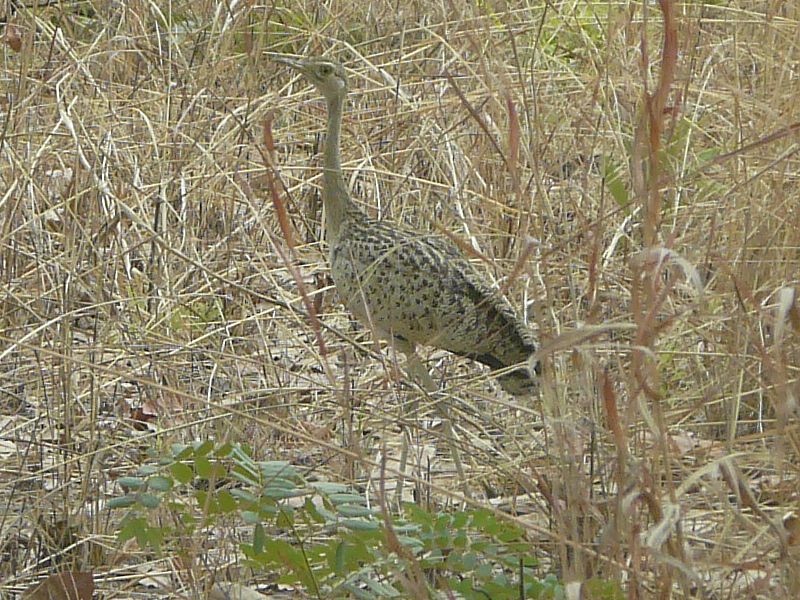
Black-bellied Bustard Lissotis melanogaster female.
Unlike some of the species already mentioned, this superb beast is found throughout much of sub-Saharan Africa.
This however was our destination and we spent a very pleasant and rewarding morning here - though the residents (below) were highly suspicious of us.

The main goal was the rare and localised Adamawa Turtle-Dove Streptopelia hypopyrrha, a west African special - we didn't see it there, but to be honest I was more than happy with what I did see, though the light was awful, overcast and glarey, as you'll see in the following pictures.
Guereza Colobus Colobus guereza (it goes by a variety of common names);
surely one of the most beautiful of all monkeys, and one I'd long wanted to see.
I spent quite some time with this family of eight or so.
I also saw a bird I never thought to - the strange Egyptian Plover Pluvianus aegyptius, not a plover, long thought to be a pratincole, now given its own family Pluvianidae all to itself.
Egyptian Plover, also called the Crocodile Bird for its supposed habit of providing dental hygiene service to crocs;
sadly this doesn't actually seem to be based on fact.
Two kingfishers - none the less delightful for being common species and widespread through Africa - featured at the waterhole too. Unlike most kingfishers, these two actually do make a living plunging for fish and other water animals.
Giant Kingfisher Megaceryle maxima; this beauty lays claim to being the world's largest kingfisher, though the title is hotly disputed by our own Laughing Kookaburra.
Malachite Kingfisher Alcedo cristata, is one of the smallest, barely a quarter the Giant's size.
The bee-eaters, one of my favourite bird groups, are kingfisher relatives (same Order anyway), and this was the first time I'd seen the glorious Red-throated Bee-eater Merops bullocki.
Red-throated Bee-eater, being especially confiding.
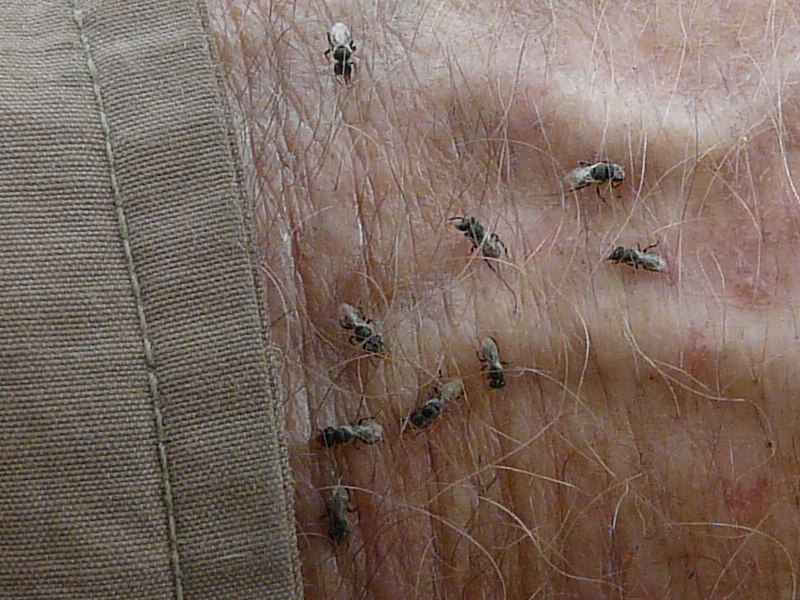
It was hot, the beer at the accommodation was room temperature (ie about 35 degrees), the water pump wasn't working (so no showers or flushing toilets) and the little sweat bees were relentless.
Sweat Bees; the term is used for a wide variety of bees that are attracted to excreted salt, but fortunately in Africa they are mostly stingless little characters in the same family as honeybees, Apidae.
Nonetheless I remember Bénoué fondly. Oh, and in the end we did see the Adamawa Turtledove, albeit somewhat distantly!


I don't suggest you alter your travel plans to take in Bénoué - or even Cameroon, though there's plenty to see there - but if you happen to be in the area...

BACK ON THURSDAY


Friday, 26 July 2013

Fifty Shades of Black

This is not really another in the intermittent series on colours in nature; it's rather about some of the amazingly diverse (and creative) ways in which taxonomists have sought to say simply that an organism - or part of it - is black. One simple way is to use the Latin ater, implying 'dull' or 'gloomy' black.
Black Tiger Snake Notechis ater, Twin Creek Reserve, Western Australia.
(This species is often now regarded as a subspecies of Tiger Snake N. scutatus.)
Another is niger, also Latin, suggesting glossy black (one English manifestation of it is in the word 'negro').


Black Caiman Melanosuchus niger, Blanquillo Lodge, Peruvian Amazon.
(The genus name means 'Black Crocodile', in case you missed the point; we'll get to melano- soon.)
No-one said names have to make sense of course; Black Caimans aren't particularly glossy, and White-cheeked Honeyeaters are even less so; in fact much of them isn't black at all!
White-cheeked Honeyeater Philydonyris niger, Lesueur National Park, Western Australia.
Variants of both these words can be used to describe 'degrees of blackness', or to specify black bits of the organism. 
Undertaker Orchid Pyrorchis nigricans; here the implication is 'blackish'.
Both this and the common name seem weird until you know that the pressed specimens went black in transit!
(It only flowers after a fire.)
Black Falcon Falco subniger, Bladensburg National Park, Queensland.
In other words, 'a bit less than black'!

Pied Butcherbird Cracticus nigrogularis, Lake Logue Nature Reserve, Western Australia.
The 'black throat' of the name is obvious here.

Black-headed Skimmer Crocothemis nigrifrons, National Botanic Gardens Canberra.
The species name just means 'black-fronted'.
 A derivative of ater is atratus, meaning 'clothed in black', or 'in mourning'.
Black Swans Cygnus atratus, Canberra.
Another option would be the Greek melas, but for some reason that is rarely used alone; the Long-finned Pilot Whale Globicephala melas is one of the very few examples I know of (and I'm afraid I can't illustrate it!). However melano- is often used in combination to describe a black aspect of the plant or animal. Blackwood Wattle is Acacia melanoxylon, though the wood isn't what we see when look at the plant! It is however a popular cabinet timber.There are many examples among birds in particular.
Noisy Miner Manorina melanocephala, Canberra; an abundant and pugnacious honeyeater.
Its black head distinguishes it from other miner species.
Black-breasted Buzzard Hamirostra melanosternon, Uluru National Park, Northern Territory.
Both common and species names refer to the same obvious feature.
Other black-implying names are more allegorical or even poetic. Fuliginosus for instance means literally sooty.
Black Currawong Strepera fuliginosa, Cradle Mountain, Tasmania

Black Kangaroo Paw Macropidia fuliginosa, Lesueur National Park, Western Australia.
This fabulous plant really does look sooty too!


Western Grey Kangaroo Macropus fuliginosus, Broken Hill, New South Wales.
A bit more imagination required here, though it's darker than the other grey kangaroo species.
Carbo, Latin for charcoal, is in similar vein.
Great Cormorant Phalacrocorax carbo, Narooma New South Wales.
Linnaeus named this bird Pelecanus carbo; it would certainly be a very black pelican!
Dusky Moorhen Gallinula tenebrosa, Adelaide.
According to John Gould who named it, this is a bird of shadows or dark places!

And black has long been associated with funerals, especially in western traditions, so perhaps it's not surprising that 'funereal' has been used as a descriptor of some black animals.
Yellow-tailed Black-Cockatoo Calyptorhychus funereus, Murramurang National Park, New South Wales.
Well, it's been fun, but maybe a slightly brighter topic next time!

BACK ON TUESDAY


Tuesday, 23 July 2013

These Wallabies Rock!

If you came here hoping for some material on the Australian Rugby team, my apologies; whether they rock remains to be seen in weeks to come... No, this is a tribute to one of my favourite marsupial groups - indeed, one of my favourite mammal groups - the elegantly beautiful rock-wallabies. 

It seems that their ancestors were small rainforest dwellers; as the land began to dry out in the last 20 million years, the general belief is one branch of the group remained in the shrinking rainforest and still survive as the pademelons, while the rockies adapted to the increasing aridity.

Red-necked Pademelons Thylogale thetis, Mount Clunie, northern NSW.
More recent, and surprising, chromosomal studies suggest that their most recent connections were in fact with the tropical tree-kangaroos.

Lumholtz's Tree Kangaroos Dendrolagus lumholtzi, Malanda, Atherton Tableland, Queensland.
Whichever was the last link with other kangaroos, the rock-wallabies now form a very distinct and coherent group of some 16 species, all in the genus Petrogale (ie 'rock weasel'!), superbly adapted to life on rock stacks and cliffs. Presumably it was in the inland ranges that conditions remained sufficiently amenable for their continued survival. They are scattered right across the country, so are - or were before the advent of foxes and probably dingoes - quite capable of crossing large tracts of open land.

One of the key adaptations is in the feet. Other kangaroos push off with a powerful elongated fourth toe and claw.
Agile Wallaby Macropus agilis, Cape Hillsborough National Park, Queensland.
The powerful long fourth toe and claw are quite visible.
This wouldn't work at all on rock faces, so rock-wallabies have short broad feet, with reduced claws. The gripping and pushing happens underneath; the soles of their feet are thick and spongy and the surfaces are rippled and ridged like sandshoes.
Black-footed (or Black-flanked) Rock-wallaby Petrogale lateralis, Alice Springs.
The shorter toes without protruding claws are evident.
The tail too isn't tapered, stiff and smooth like other kangaroos' (see again the Agile Wallaby above), but heavy, cylindrical, flexible and furry. When they run the tail is held high and swivels like a rudder, even helping them change direction in mid-leap.

Another 'unkangaroo-like' trait is in the nature of their care of youngsters newly emerged from the pouch. In other species the 'at foot' young simply follows mum about, suckling from the pouch as required and hopping back in as the mood strikes. Again this would be impractical on a cliff face - dangerous territory for inexperienced youngsters learning , and also for a pouch-carried baby likely to be banged on rocks when mum is hurrying - so the baby is parked in a convenient cave or crevice, to which the mother returns to feed it. When it is strong and confident enough, it embarks on a life on the rock faces. 
Black-footed Rock-wallaby, Alice Springs.
This baby will be left in a safe place while mother feeds, when it gets too big for her to continue to carry safely around.
All rock-wallabies had a common ancestor only 4 million years ago. The Short-eared Rock-wallaby P. brachyotis (and a couple of recently-recognised closely related species) from the north-west, the Proserpine Rock-wallaby P. persephone (a rare and threatened species from the tropical Queensland coast) and the southern inland Yellow-footed Rock-wallaby P. xanthopus, are the oldest and most distinct species.
Yellow-footed Rock-wallaby, Brachina Gorge, Flinders Ranges, South Australia, an 'old rocker'.
This lovely animal also demonstrates how colourful some rock-wallaby species are, relative to other kangaroos.
The most recently arisen are a group of species from the Queensland coast and ranges, whose ancestors came east from the drylands only in the last million years. Indeed some of them have only been recognised in the past 20 years or so, and several are virtually only distinguishable by chromosomes (not a generally useful field characteristic!) and range. 

A life on isolated outcrops has led to serious problems for several species, in combination with disruption and competition from feral goats, and ferocious predation from feral Red Foxes, especially when they are dislodged by the goats and try to cross open country. The once-abundant Brush-tailed Rock-wallaby P. penicillata has virtually gone from its south-eastern range, though captive breeding and re-colonisation programs are proceeding; animals bred at Tidbinbilla Nature Reserve have been released in Gariwerd (Grampians) National Park in Victoria.
Brush-tailed Rock-wallaby, Wollomombi Falls, northern New South Wales.
Only in small parts of north-eastern New South Wales and south-east Queensland
is this species still moderately common.
And while I try to hold my anthropomorphism in check, I have to confess that the sheer grace and beauty of the rock-wallabies biases me heavily in their favour. While the bigger Euro Macropus robustus, which often coexists with them, seems to power up the cliffs by sheer force, the rock-wallabies glide, like water improbably flowing uphill.
Euros, Broken Hill; powerful hill-climbing kangaroos.
Yellow-footed Rock-wallaby, Idalia National Park, south-west Queensland; all grace and poise, capable of flying up slopes where not even a toe-hold is obvious to us.
The range of the Yellow-foot is typical of the fractured remnant population of rockies; it is found in the Gawler and Flinders Ranges in South Australia, with a very few in the Barrier Ranges of western New South Wales, and a population in Idalia - all many hundreds of kilometres apart.
I've seen a couple of other species, but not with a digital camera; I intend to try to see more in the years to come. And every time I do, it's a good day.

BACK ON FRIDAY