About Me

My photo
Canberra-based naturalist, conservationist, educator since 1980. I’m passionate about the natural world (especially the southern hemisphere), and trying to understand it and to share such understandings. To that aim I’ve written several books (most recently 'Birds in Their Habitats' and 'Australian Bird Names; origins and meanings'), and run tours all over Australia, and for 17 years to South and Central America. I've done a lot of ABC radio work, chaired a government environmental advisory committee and taught many adult education classes – and of course presented this blog, since 2012. I am a recipient of the Australian Natural History Medallion, the Australian Plants Award and most recently a Medal of the Order of Australia for ‘services to conservation and the environment’. I live happily in suburban Duffy with my partner Louise surrounded by a dense native garden and lots of birds.

Tuesday, 10 December 2013

Genovesa: Tower of the Galápagos. Part 1.

If I was pushed, I would probably nominate Genovesa (Tower is its English name) as my favourite island in the Galápagos. It is the most remote of the islands that visitors can land on (ie the furthest from any other publicly accessible island) and the only one north of the equator available to tourists. 'Remote' is always attractive to me.
Genovesa is at the pointy end of the red arrow; the other end of the arrow is resting on the line of the equator.
Genovesa shoreline, north shore of Darwin Bay. (Darwin didn't actually visit here.)
Like many first impressions of the Galápagos islands, Genovesa can seem initially misleadingly bleak.
The remoteness is a key to Genovesa's attractions in a more direct way too. Several of the groups that characterise other islands in the archipelago didn't make it to here, including Giant Tortoises, Land Iguanas, snakes and Lava Lizards. This has had various ramifications. For instance, without the browsing pressures of the tortoises and iguanas, there has been no reason for the Opuntia cactuses (Prickly Pears) to retain their sharp spines, and they have become soft, presumably with an energy-saving benefit.
Soft Opuntia spines - their laxness can be seen here.
More obviously, the lack of Lava Lizards means no Galapagos Hawks - and only where the hawks are absent can the branch-nesting Red-Footed Boobies Sula sula, the smallest of the boobies, successfully raise chicks.
Red-footed Boobies, Genovesa.
Both the brown morph (above), dominant in the Galapagos, and the much rarer white morph (below), breed here.


Red-footed Booby colony, Genovesa.
Below, white morph with egg in nest in mangroves.
 

Young Red-footed Booby chicks (above).
Fledgling (below) practising on the beach for its imminent first flight.
 

Both other Galapagos booby species are also present.
Blue-footed Boobies Sula nebouxii, constantly overhead.
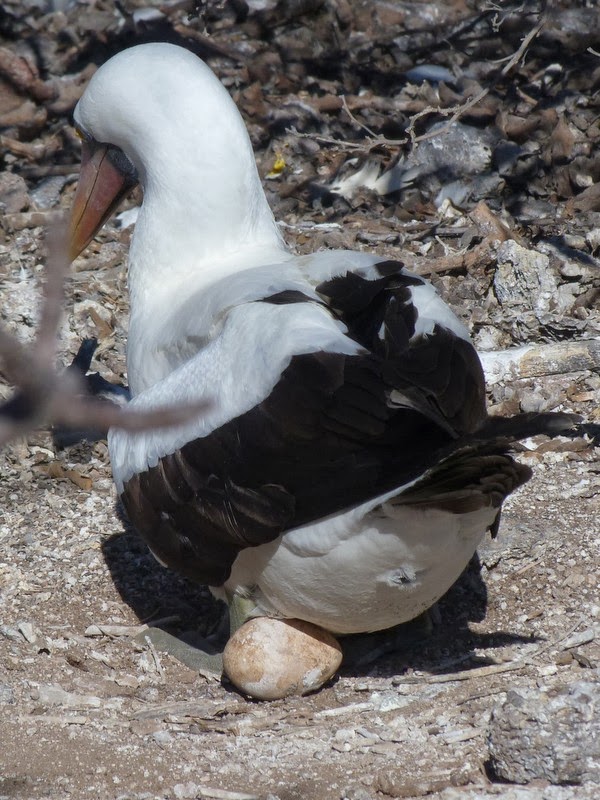
Nazca Booby Sula grantii, with egg (above)
and with week-old chick (below).


Other seabirds also nest here, and are as oblivious to human visitors as are the boobies.
Great Frigatebirds Fregatta minor are very similar to the co-occurring Magnificent Frigatebirds F. magnificens.The green sheen on the shoulders of the male (above) and the rusty head of immatures (below) are distinguishing characters. They constantly harass incoming seabirds trying to feed their own chicks.
 

Particularly constant victims of the Frigates are the beautiful Red-billed Tropicbirds Phaethon aethereus, which on Genovesa often shelter in rock crevices and overhangs.
Red-billed Tropicbirds roosting under shelter, Genovesa.


And one of the loveliest of all gulls, the mostly nocturnal-feeding Galapagos near-endemic, the Swallow-tailed Gull Creagrus furcatus, also breeds among the busyness of Genovesa. It's a special part of the Galapagos experience to look out of the cabin window at night and see, in the glow of the boat's lights, one of these beautiful birds flying alongside.
Swallow-tailed Gull with chick.
But wait, there's more (than just seabirds)... You've probably had enough for now, so I'll conclude this little snapshot of an astonishing island next time with other wildlife highlights.

BACK ON THURSDAY

Thursday, 5 December 2013

Painting the Town... brown??


During the week, following advice received, I managed for the first time to take some photos - albeit mediocre - of one of Australia's rarest honeyeaters. Painted Honeyeaters Grantiella picta are woodland mistletoe specialists, gazetted as threatened by habitat loss. Prior to last week I had only seen two, though their piercing 'taw-dee' call makes their presence pretty obvious when they're around. Fifty years ago they used to appear regularly in summer in the mistletoes in the River Oaks Casuarina cunninghamiana near the Uriarra Crossing of the Murrumbidgee River near Canberra; since then there have been few records. It would be exciting indeed if this were the beginning of regular annual returns, but maybe we simply haven't been looking in this slightly out-the-way location recently?
Painted Honeyeater in River Oak (above);
sitting on nest in mistletoe clump (below). The nest is a fragile hanging bowl of grass and casuarina 'needles', bound together and to the surrounding foliage with spider web.
 
When I got home and showed the photos to Lou, she was somewhat underwhelmed. "Painted? I thought they'd be rainbow-coloured!" That set me thinking. Why indeed should this handsome but not especially colourful bird be 'painted'? The vernacular name comes from John Gould's species name, but that of course simply begs the question. The generally sober and restrained Gould waxed quite lyrical about the 'beauty of their appearance'; fair enough too, but really there are honeyeaters more apparently worthy of being 'painted' than the yellow, black and white (plus lovely pink bill, granted) of this one.

So, I started to look at other 'painted' organisms, either by common name or having the specific name pictus/picta, and was a bit surprised.

Certainly I found a few that are colourful enough that the inspiration behind the name is pretty obvious.
Painted Locust Schistocerca melanocera, Sierra Negra, Isla Isabela, Galapagos. A glorious beastie.
African Pygmy Kingfisher Ispidina picta, Queen Elizabeth National Park, Uganda.
I particularly like the mauve patch on the side of the neck.
Spot-legged Poison Dart Frog Ameerega picta, Machuguenga Lodge, Peruvian Amazon.
The vivid lime-green stripes are brighter than they appear here.
And unless you grew up with these highly toxic little gems, don't ever try to touch one!
Painted Dragon Ctenophorus pictus, Streaky Bay South Australia.
Maybe not so obviously painted, but in fact the paint is applied only by males during breeding season.
The blue flush on the legs seen here gets much brighter and extends to the chin, contrasting with bright orange-yellow up across chest and shoulders.
However when we look further into the world of painted creatures, we get the impression that many of the authors of their names associated 'painted' primarily with shades of brown. Please don't misunderstand me - I think the subjects of the following pictures are beautiful, and of course brown (plus black and white) is a perfectly valid colour for paint, but why see these creatures and immediately think of paint?? I have no good answer, but I see no reason why I should ponder it alone! 
Upland Geese Chloephaga picta, Punta Arenas, far southern Chile. An integral part of the Patagonian landscape,
not really geese, more closely related to shelducks. Males have white heads, the females brown.
Painted Button-quail Turnix varius, Dubbo, New South Wales.
Button-quails are not at all related to either Old World or New World quails;
all are coloured in themes of black, cream and brown.
Australian Painted Snipe Rostratula australis, Jerrabomberra Wetlands, Canberra.
A very rare species (no relation at all to snipes) and rarely seen.
In this species the female is the more brightly coloured.
Painted Grasshawk Neurothemis stigmatizans, Litchfield National Park, Northern Territory.
This dragonfly is found across near-coastal tropical Australia - along with many bright red and blue ones.


Australian Painted Lady Vanessa kershawi on Pimelea ligustrina, Namadgi National Park near Canberra.
I hardly need point out the existence of butterflies in nearly any colour in the paintbox.
Cape Hunting Dog, or Painted Dog, Lycaon pictus, Perth Zoo.
It seems that mammal taxonomists are prone to it too!

Painted Fingers Caladenia picta (Petalochilus pictus), near Nowra, New South Wales.
Not brown, and a lovely pink flush to the edges, but other orchids might be reasonably seen as more painted.
My only plant example, though I'm sure there must be more.

Any thoughts welcomed, as always!

BACK ON TUESDAY


Monday, 2 December 2013

On This Day, 2 December; James Smith's birthday


Sir James Edward Smith was a very influential and enthusiastic botanist indeed, who used his family wealth - his father was a successful Norwich wool merchant - for the considerable betterment of the science. 

Born in 1759 he was the star botany student in the Edinburgh Uni medical course, but there are suggestions that his primary interest in the subject was its botany component. Either way his passions increasingly tended towards botany and away from medicine. At a young age he founded the Natural History Society of Edinburgh. 

It's often on seemingly unlikely combinations of events that history makes its turns, changing lives and the course of science itself in a given place. So it was with young Smith. When Carl Linnaeus the younger died in 1783, his widow wrote to Sir Joseph Banks, doyen of British botany at the time, asking him to buy his library and specimens – 9000 plants and some 3500 animals - for the enormous sum of a thousand guineas. Smith just happened to be breakfasting with Banks when the letter arrived (this was not an unusual occurrence, as Banks was a great encourager of young up-and-comers). Banks was unwilling or unable to raise the funds, but certainly recognised the immense value of the collection. He persuaded the young Smith, just 24 at the time, to find the money, presumably having a pretty fair idea of the Smith family fortunes. Smith in turn persuaded his father to advance him a loan. It took time, but he came round (just in time to pip the Empress of Russia who also fancied the trove) and the 26 cases arrived in England the following year – to the frustration of Swedish science. One story, which appears in a book written after Smith's death by his wife Pleasance, claims that the King of Sweden, who was in France at the time and heard about it too late, tried to fetch them back via the navy, but they failed to catch up to the ship.

On receipt of the vast, and vastly significant, array of scientific riches, Smith abandoned his medical studies, hired rooms overlooking the Chelsea physic garden to house the collection, and sorted them with the help of Banks and Jonas Dryander, Banks' librarian. 
Acmena smithii, family Myrtaceae, Lilly Pilly.
This rainforest small tree from coastal New South Wales was named by French botanist, Jean Louis Marie Poiret, Smith's contemporary, in his honour.
The berries make excellent jam - and I hasten to say I collect mine from my in-laws' garden, not the wild!
He did the Grand Tour of Europe and in the process began to amass the 18,000 specimens he was to personally add to the Linnaeus collection. 

He moved to bigger premises and founded the very influential Linnaean Society in 1788 around the collection, dedicating it to public good. Indeed, his enthusiasm and easy communication skills are said to have done much to popularise botany in Britain at the time. He was the Society's President for the next 40 years, the rest of his life in fact; it is now the world’s oldest natural history society.  
Eucalyptus smithii, Gully Gum, Bowral, New South Wales.
These trees were in fact presiding over a most memorable outdoor Leonard Cohen concert; not sure what Sir James would have made of it...
And I must acknowledge that while I had believed until now that the tree was named for Sir James, extra research I've done for this posting suggests that in fact Australian botanist and eucalypt chemist Richard Baker named it for his colleague Henry Smith. I'm not totally sure though, so I'll let the picture stand, with that proviso.
He wrote the huge 36 volume British Botany over 24 years from 1790 (it was this that earned him his knighthood) and the English Flora in the 1820s. When he died the Society bought the Linnaeus collection for £3000 - a debt that it took them over 30 years to pay off.

Very few Australian plants seem to have been named for Smith, though he himself named very many of them for his fellow British and European botanists. Keep an eye out for the cryptic little 'Sm.' that follows the name of many Australian plants - it indicates that Smith was their author.
 
Sowerbaea juncea Sm., Rush Lily, family Anthericaceae, Ulladulla, coastal New South Wales.
Named by Smith for botanical artist James Sowerby, with whom he often collaborated.
I wonder how the course of British botany and the scientific institutions of the early nineteenth century might have been different if James Smith had breakfasted elsewhere on that fateful morning in 1783?

BACK ON THURSDAY

Thursday, 28 November 2013

Cicadas; the song of summer

For reasons uncertain (I was a somewhat boring youth who didn't hang around at loud concerts for instance) I have fairly strong tinnitus, which can be a nuisance. Different people report different manifestations, but mine sounds like a chorus of insects - tree crickets or higher-pitched cicadas in particular. This means that I can't always tell if the chorus I'm hearing emanates from inside or outside my head but a week or so ago, during a family visit to Nowra in near-coastal southern New South Wales, I was in no doubt whatsoever. 

Like many cicada species, the very handsome Redeye Psaltoda moerens doesn't appear every year in any given locale, but this year appears to be theirs in that part of the world. From quite early in the day, as the temperature rose towards 20 degrees, the roar of the massed Redeyes filled the world. After a while the steady roar breaks into what's known in the cicada students' world, somewhat quaintly, as 'yodelling'; it sounds like a sawing but melodious "cheee-aw-chee-aw-chee-aw (etc!)"
Redeye Cicada on Spotted Gum Eucalyptus maculata. This species is found throughout near-coastal south-eastern Australia, and has a strong preference for smooth-barked trees, which are probably easiest to penetrate with the strong proboscis to access the sap.
The aggregations typical of this species - and others - can be enormous; I watched a constant stream of Redeyes flying from tree to tree in the yard. They gather to mate, with the males striving to capture the females' attention by the force and persistence of their song.
A few of the Redeye gathering on just one tree - and many had flown away as I approached.
A successful suitor.
This gathering had its genesis in a past one, though for most Australian cicadas we don't know the length of the cycle, though it seems to be some years at least for many species. Like her mother before her, this female will lay her eggs in dead eucalypt branches; they will hatch in 10 to 12 weeks, when the tiny nymphs will hurry down to the ground and enter soil cracks, where they will insert their proboscis into a tree root. The liquid waste they exude helps form a wall to their cell. This is how a cicada spends most of its life - the adult phase that either thrills or exasperates us, depending on our approach to nature, lasts probably no more than four weeks at the most. When the time is right, some years later, the nymph comes up to the light, climbs onto a convenient surface and emerges from the shell at night.
Redeye nymph cases; on the left-hand one the split can be seen along the back where the adult emerged.
Much of the male Redeye's body is designed to sing - his abdomen forms a fearsome resonating chamber, as we can attest, amplifying the sound made by vibrating timbals, corrugated membranes like a wobbleboard on his sides just in front of the abdomen. His song is unique to his species. The energy required to drive it at up to 100 vibrations a second is significant, which is why he can only sing when the temperature reaches a certain level. 

He is a bug - no, really, a member of the Order Hemiptera, characterised by a long sucking proboscis.
Sap-sucking Hemipteran, Kata Tjuta, central Australia.
Cicadas all have such a proboscis (more properly a rostrum), both as nymphs and adults, though it is generally kept tucked away under the body.
The adults insert the rostrum gradually into the bark, inserting saliva and extracting partly digested sap. This is dilute food, and a considerable quantity of water is constantly sprayed from the trees where large numbers of cicadas are feeding. Feeding need not be interrupted by either singing or mating incidentally!

More than one cicada species can cohabit, though only one was present this time, as far as I could see. In a recent Nowra summer however the gorgeous Yellow Mondays were abundant.
Yellow Monday Cyclochila australasiae.
This lovely cicada is very common and comes in a somewhat bewildering array of forms, including the Masked Devil, form spreta, pictured below from the Blue Moutains.
Masked Devil, still the same species as the Yellow Monday.
Other colour forms of this species are known as Chocolate Soldier, Greengrocer and Blue Moon.

Closer to home, around Canberra, cicadas are not as prominent as nearer the coast, though some years we too have massive Redeye eruptions, when a variety of bird species live well for a few weeks. Even up in the Snow Gums in the mountains however cicadas can be found, though the great choruses are rarely heard.
Southern Mountain Squeaker Atrapsalta furcilla on Snow Gum at approximately 1300 metres, Namadgi National Park.
I love the internet! Three years after I tentatively (mis)identified this little cicada, cicada authority
Lindsay Popple read this blog and kindly identified it for me - it was only described in 2016.
See his comment below, with a link to more about it.
As for overseas cicadas, I'm afraid I can't even offer a guess at the identity of this Andean specimen; again, help welcomed!
Cicada, Cuenca, 2500 metres above sea level, Ecuador.
Cicadas are one reason I look forward to summer (or maybe I like cicadas so much because they are emblematic of summer for me). But, you know one good thing about tinnitus? I can hear cicadas all year round!

BACK ON MONDAY