About Me

My photo
Canberra-based naturalist, conservationist, educator since 1980. I’m passionate about the natural world (especially the southern hemisphere), and trying to understand it and to share such understandings. To that aim I’ve written several books (most recently 'Birds in Their Habitats' and 'Australian Bird Names; origins and meanings'), and run tours all over Australia, and for 17 years to South and Central America. I've done a lot of ABC radio work, chaired a government environmental advisory committee and taught many adult education classes – and of course presented this blog, since 2012. I am a recipient of the Australian Natural History Medallion, the Australian Plants Award and most recently a Medal of the Order of Australia for ‘services to conservation and the environment’. I live happily in suburban Duffy with my partner Louise surrounded by a dense native garden and lots of birds.

Tuesday, 14 January 2014

Having a Drink

As I write, it's 36 degrees Celsius here in Canberra (and close to that here in my study!); the coming days are predicted to be 39, 39, 38 and 37. In Adelaide, my birth town on the south coast of Australia, it's currently 43, with predicted maxima of over 40 for the next three days. This is normally the hot time of year for southern Australia in particular, but we are grimly aware (as are our North American friends at present) that climatic extremes are the norm of the future, given our unwillingness to do anything about them.

The radio has been reminding me to keep up my water intake, and the bird bath outside is hosting a stream of heavy drinkers. Their styles vary however. Pigeons can suck up water, enabling them to drink quickly and leave again - waterholes are magnets to predators and thus very dangerous places to hang about. (And no, none of the following pics were taken at our bird bath!)

Bar-shouldered Doves Geopelia humeralis, Idalia National Park, central Queensland.

Diamond Doves Geopelia cuneata, West MacDonnell Ranges, Northern Territory.
Most however have to scoop up a beakful of water and tip it back.
White-winged Choughs Corcorax melanorhamphos, Canberra.

Emu Dromaius novaehollandiae, near Esperance, Western Australia.

Zebra Finches Taeniopygia guttata, Serpentine Gorge, West MacDonnell Ranges, Northern Territory.
Like other desert seed-eaters (including pigeons and parrots) Zebbies must drink daily.

Chestnut-bellied Sandgrouse Pterocles exustus, Waza National Park, northern Cameroon.
It was long believed that sandgrouse sucked up water, like pigeons, but this is now known not to be so, as the bird on the left is demonstrating.
More dramatically, some birds will swoop onto water to scoop it up in flight, or by skimming the water.
Magnificent Frigatebirds Fregata magnificens, Isla Isabela, Galapagos.
Like many other seabirds, frigatebirds also drink seawater, so have salt glands above the eyes to filter salt out of the blood, but welcome fresh water when it is available.
Predatory and fruit-eating birds can get most of their needs from their food, and rarely need to drink.

Mammals too have different approaches to drinking. Carnivores, which are not generally threatened when drinking, tend to lie down and lap water in a leisurely fashion, using the tongue to scoop it up.
Sumatran Tiger Panthera tigris sumatrae, Adelaide Zoo.
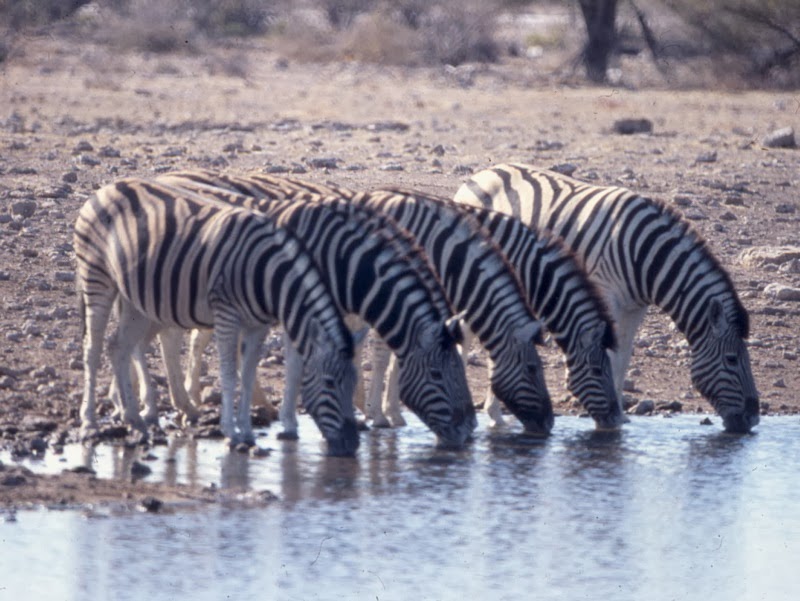
Its prey however must be more efficient than that, and many antelope and horses for instance form a tube with their lips and 'suck' by using the tongue as a pump. (The following photos have been scanned from old slides, hence the ordinary quality.)

Black-faced Impala Aepyceros melampus petersi, Etosha NP, Namibia.
Gemsbok Oryx gazella, Etosha NP, Namibia.
This desert antelope rarely needs to drink.
male Kudu Tragelaphus strepsiceros, Etosha NP, Namibia.
Springbok Antidorcas marsupialis, Etosha NP, Namibia.
It is quite likely that fully entering the water makes it safer with regard to lions and other predators
- though not crocodiles!

Plains Zebras Equus quagga, Etosha NP, Namibia.
Giraffe drink similarly, but must go to much more trouble to get down, and are particularly vulnerable once in the drinking position.
Giraffe Giraffa camelopardalis, Etosha NP, Namibia.
And elephants of course have a particular advantage.
African Bush Elephant Loxodonta africana drinking, Okavango Delta, Botswana.
Closer to (my) home it seems that kangaroos have evolved the same drinking method, though I can't be sure that they don't discretely lap.
Euro Macropus robustus, Idalia NP, central Queensland.
And finally for vertebrates today, this big goanna just walked in and gulped!
Lace Monitor Varanus varius, Pilliga forest, New South Wales.
Butterflies have a proboscis primarily for absorbing nectar by osmosis, but it works equally well for water. 
Butterflies taking water from Amazonian riverbank mud;
Manu River, Peru (above) and
Yasuni NP, Ecuador (below).
The proboscis of the animal below is clearly visible.


All this blogging has made me thirsty, and the temperature here has crept up to 37, so I might say 'cheers' for now. But I'll be back later in the week, when it will be at least as hot, to look at animals bathing.

BACK ON FRIDAY

Friday, 10 January 2014

On This Day, 10 January; death of Aylmer Bourke Lambert

Aylmer Bourke Lambert never visited Australia, but he contributed quite significantly to the early understanding of its botany, in the golden days when a torrent of plant and animal specimens, mostly new and utterly wonderful to European scientific eyes, was flowing north to museums and other collections. Born in Bath in 1761, he died on this day in 1842, one of the most respected botanists of his day, though less remembered now than are some of his contemporaries. Two of these contemporaries assisted and encouraged him considerably - Sir James Smith, who was virtually the same age, and Sir Joseph Banks, a generation older.

Also of great assistance to him were the circumstances of his childhood. He was an only son whose mother (from whom came the 'Bourke') was of wealthy Irish background and her death when he was twelve brought to him the income from estates in both Ireland and Jamaica. His father and his step-mother encouraged him in his natural history interests; her family, the Seymers, included enthusiastic amateur botanists who also gave him a leg-up. When his father died, further inheritance came his way, ensuring that he never had to work for a crust, and could devote his life to his passion. (Sigh... just a personal comment.)
Aylmer Bourke Lambert, courtesy National Portrait Gallery, London.
He didn't actually graduate from Oxford, but he did meet Banks and Smith while there, and John Sibthorp. Smith in particular smoothed his way. In 1788, when Smith was already well-established and had recently been instrumental in founding the important Linnean Society, he invited Lambert to become one of its first members. Eight years later Lambert became one of four vice-presidents, a position held until he died. By then he was also a member of the Royal Society, and in 1801 Banks had him appointed to its prestigious Council.

But why? Well, he was an assiduous researcher and collector, and importantly used his position and major reference library and herbarium to help young scientists. His herbarium contained in excess of 50,000 specimens and represented the work of more than 130 collectors around the globe. Botanists came from far and wide to consult it. Sadly it would seem, after his death the herbarium was broken up and sold to institutions across Europe and the USA. He developed gardens and greenhouses to grow and exhibit exotic plants.

His most-cited works - and the ones on which he built his reputation - were monographs on the genus Cinchona (quinine trees from South America) and Pinus. His herbarium was swelled by material in Australia from contributors who included Governors Phillip and King, Lieutenant-Governor William Paterson and Surgeon-General John White. 

His zoological interests are greatly understated (the estimable Wikipedia seems unaware of them), but his writings included articles on the Indian Gaur (the so-called 'Indian Bison'), the Irish Wolfhound and a new kangaroo from New Holland, at a time when Europe still mostly thought in terms of 'the kangaroo'. He somehow acquired a collection of bird skins from the Matthew Flinders expedition, and passed them on to the Linnean Society. He also built up an invaluable collection of bird paintings from the New South Wales colony in the 1790s, many of them by Thomas Watling, convict forger and artist. This collection, of over 700 works, was bought by the NSW State Library in 2011.

He died, today, at Kew 174 years ago, but in an important sense he lives on in Australia. Lambertia was named in his honour by his friend James Smith in 1798, from specimens collected by Banks and Solander on the Cook Endeavour expedition in 1770. It comprises a genus of ten or so species of dramatic flowering shrubs in the family Proteaceae (Banksias, Grevilleas, Proteas etc), all but one of which are from south-western Australia. The exception is well-known in the sandstone country of near-coastal New South Wales.
Mountain Devil Lambertia formosa, Nowra, New South Wales.
The typical tube flowers with rolled-back perianth tubes and spiky leaves are evident here.
Mountain Devil? The answer to that lies in the spectacular woody seed capsules,
often used as toys and sold as souvenirs, suitably (or not!) decorated.

Like many heathland plants, Mountain Devils resprout after fire from underground shoots.
In the west, one of the first Lambertia species described was not at all spiky, so was called inermis - 'unarmed'.
Chittick, Lambertia inermis, Cape Le Grande National Park, southern Western Australia.
Another, also growing in sandy heathland, grows north almost to Geraldton. Like several other species its vernacular name is honeysuckle, for the nectar-rich flowers.
Many-flowered Honeysuckle Lambertia multiflora. The common name is taken directly from the species name, but neither is very helpful as it is not generally possessed of more flowers per head than other species.
It's a shame Aylmer never got here; I think he'd have liked it. Either way, it would be a pity to forget him altogether. 

BACK ON TUESDAY


Tuesday, 7 January 2014

Ghost Gums; spirits of the desert

Of all the things that thrill me when I go to central Australia - and there are many - the first sight of a Ghost Gum is particularly special. Like many Australians - I'd like to think most of us, but that may be optimistic - I knew of Ghost Gums before I saw them, courtesy of the truly great Arrernte Australian artist Albert Namatjira. (An image search on your favourite search engine for 'Namatjira ghost gum' will give you lots of examples.)

Their superbly white trunks, powdery to the touch, against red cliffs or vast dry plains catch at the breath and the heart every time.

Roadside Ghost Gum, west of Windorah, south-west Queensland.
Coming from the south-east, this is one of the first examples you'll encounter.
For much of my life I knew them as Eucalyptus papuana, but two things happened then. Firstly, the respected botanist Lawrie Johnson of the Royal Botanic Gardens in Sydney grasped a very large and forbidding nettle indeed when he tackled the problem of what to do about Eucalyptus. The problem, in a gum-nut shell, is that the differences between Eucalyptus and Angophora are no greater than between the various sub-groups of Eucalyptus. Logic demanded either incorporating Angophora into Eucalyptus, or splitting Eucalyptus; Lawrie boldly chose the latter. Before his sad death from cancer in 1997 he had got as far as separating out the bloodwoods, spotted gums and ghost gums as Corymbia; they remain in most books now as the only other non-Eucalyptus eucalypt. This is an interesting enough subject in itself, but I'll leave it at that for now.

The other development was the realisation that 'Eucalyptus/Corymbia papuana' in fact comprised several closely related species. The species was based on a specimen described by Ferdinand von Mueller from New Guinea; as now recognised that species is limited to New Guinea and Cape York Peninsula in Queensland, so the others needed their own names. The central Australian one, our subject today, growing cross the harsh central deserts from eastern Western Australia to central Queensland, was delightfully called E. (or Corymbia) aparrerinja, that being a name used by the central desert peoples.

But thereby hangs a tale, for which I am very grateful to David Nash (see below in Comments, under 'Unknown' - that's due to a glitch in Blogger). David is a highly regarded authority on Northern Territory languages and I can do no better than quote him. "How aparrerinja came to be applied is a bit mysterious. It was recorded as the word for 'Ghost Gum' only by Basedow (in 1925 near Gosse's Bluff). In his orthography nj is the palatal nasal. It is not understood why he did not record the common Arrernte ‘Ghost Gum’ word ilwempe, and why instead his term is built on the ‘River Red Gum’ term apere (in modern orthography), meaning "similar to apere". Note that the River Red Gum is commonly considered in central Australia to be the most similar tree to the Ghost Gum." It doesn't seem that this one is soluble, but it's good to know the questions at least.

Uses recorded by indigenous people (which may include other closely related Ghost Gums) include its value as a very good firewood, resistant even to rain; gum was used further north as a leech repellant, and more generally as antiseptic and topical relief for burns; bark infusions were drunk to assist in fighting chest infections, and to bathe sore eyes.

You're most likely to first encounter Ghost Gums on the plains.
Ghost Gums towering over the plains near Simpsons Gap, MacDonnell Ranges.

Ghost Gums by the Plenty Highway, far eastern Northern Territory.
Ghost Gum estimated to be 300 years old (by the Northern Territory Parks Service)
near Trephina Gorge, East MacDonnell Ranges.
However to my eye, it is among the rocks, in the gorges and on the cliffs of the ranges that Ghost Gums are at their most dramatic and striking. It is remarkable where such big trees can gain a toehold, and the white trunk against red rock and bluest sky is just stunning.
Above and below, Standley Chasm, West MacDonnell Ranges.


Kings Canyon Rim Walk, George Gill Range, central Australia.
Ormiston Gorge, West MacDonnell Ranges.
In the film Man From Snowy River, the famous ride down the precipitous mountain was purportedly filmed by sticking smallish trees into the ground at an angle, then tilting the footage to make it look steep. No such trickery is necessary for this amazing tree, though it takes a while to persuade the eyes what they are seeing!
As you will have divined, I love Ghost Gums; please go and see for yourself one day.

BACK ON FRIDAY

Monday, 6 January 2014

Cicada Update

This is an unscheduled posting, prompted by an observation in Nowra again over the weekend. A few weeks ago I discussed cicadas here, after a previous visit there when the dominant - indeed only evident - species there was the hyper-abundant Redeye.

This time I found what appears to be the beginning of the emergence of another species, the magnificent Double Drummer Thopha saccata. I am tempted to use the term 'fearsome' because the volume of sound produced by this one is startling, even relative to the massed choirs of Redeyes. In an area of dry forest my eardrums literally seemed to be vibrating with the sound (well fair enough though, I guess that's what eardrums do!).

My cicada book, M.S. Moulds' Australian Cicadas 1990, describes the song as "Particularly loud... When populations are large the noise is almost unbearable to be near... On very hot days singing continues for many minutes with only occasional momentary breaks." I certainly don't feel inclined to dispute any of that; bird watching was nearly impossible, as I was pretty much unable to hear their calls.
Double Drummer.

The choir gathers; the Redeyes still have the numbers, but two Double Drummers can be seen at the bottom, and a couple more higher up. Soon enough they'll have the majority.
As I've said before though, I can't really begrudge them, as they've only got four weeks to eat, drink, sing and otherwise make merry.

BACK TOMORROW

Thursday, 2 January 2014

Bladensburg National Park

I'm always keen to highlight Australian national parks, and I've been meaning to focus on Bladensburg for some time. This park is a treasure; I'd been there a couple of times, both with 'fair weather only' vehicles in terms of Bladenburg's terrain, and both times it rained, necessitating an ignominious retreat. Finally last year we planned our holiday route to central Australia to enable a couple of nights camping there; it does require some planning as it is in a fairly remote part of the country.
Location of Bladensburg National Park, at the end of the red arrow in central Queensland, just north of the Tropic of Capricorn. It is some 15km south of the town of Winton, via perfectly good two-wheel drive roads, as long as it's dry!The Lark Quarry dinosaur 'stampede' site and museum is in the general vicinity too.
It covers some 85,000 hectares of the north-eastern edge of the Channel Country, a vast area of grassy plains, broken by low eroding ranges and mesas ('jump ups' locally), dominated by a complex network of braided creek lines draining into central Australia via rivers including the Georgina, Diamantina and Cooper Creek - names redolent of Australian folklore and folksong! Here they disappear into a series of waterholes, all but the deepest of which dry out in drought times, though in exceptional years - a very few times per century - the waters reach Lake Eyre in northern South Australia. Last year was certainly not such a year (and there has been very little rain since) and the country was parched. A few of the photos below were taken on a previous brief visit, in May 2010. 

The only really significant watercourse in the park is Surprise Creek, which cuts across the north-west corner of the park - the only camp ground in the park is here, extending along a few hundred metres of the bank, with basic facilities, but totally appropriate to the situation.
Bough Shed Hole camp, among (but never directly under!) River Red Gums, Eucalyptus camaldulensis.
Surprise Creek Top Hole. Both waterholes were already isolated, and would certainly be a lot lower now.
But one day - perhaps with luck even soon if the aftermath of Cyclone Christine gets that far east - they will fill again and Surprise Creek will even flow for a while.
The property, part of the land of the Koa people, was taken up as a pastoral lease by one Henry Cory in 1874. In 1993 it was bought by the Queensland government, and declared as national park - the name being that of the station - in 1994. The station homestead is now the park headquarters.
Old Bladensburg Homestead, in the midst of a vast and currently dry plain.
The plains comprise cracking black soils which expand and contract as they soak and dry, making it nearly impossible for trees to establish. Tough grasses tend to dominate. 
Mitchell Grass Astrebla spp. plains, very droughted.

Cracking soils in the Mitchell Grass prevent tree establishment by breaking rootlets.

Spiky hummocks of spinifex, or porcupine grass, Triodia spp, are hardier and less prone to grazing than the Mitchell Grass. Such hummock grasslands comprise nearly a quarter of Australia's land area.
Some of the more spectacular big birds of Bladensburg live out on these plains.
Brolgas Grus rubicunda; it often surprises me to find these cranes, essentially wetland birds, in such arid landscapes.

male Australian Bustard Ardeotis australia.
Black Falcon Falco subniger.This redoubtable hunter is relatively thinly scattered across Australia, and is our second least common falcon.
 It is easier however, especially in the dry times, to find life around the jump-ups and eroded gorges.
Jump-up capped with Ironwood Wattle Acacia estrophiolata.
Scrammy Gorge. With the thin hard cap breached, the softer underlying material is crumbling,
undermining the walls and widening the gorge.
It is purportedly named for stockman Scrammy Jack, for his crushed right hand - 'scrammy' is alleged to mean 'left-handed' in an English dialect, but I can't confirm that.
Spinifex Pigeons Geophaps plumifera are typically associated with spinifex on and around rocky ridges.
They are one of the most delightful of all pigeons, both in appearance and their whirring runs across the ground.

Spinifex Pigeons with a friend, a Euro Macropus robustus, which shares their habitat preferences.
Red-winged Parrot Aprosmictus erythropterus female inspecting a nest hollow along Surprise Creek.
This Spotted Bowerbird Chlamydera maculata hung around camp with an optimistic expression.
And surely the long-promised posting on bowerbirds must be getting closer!
In addition to the bold and handsome Yellow-spotted Goanna that I introduced you to here, another, smaller, lizard lived along the creek too.
Gilbert's Dragon Amphibolurus gilberti.
Also known as the 'ta ta lizard'; males, like this one, sit up and wave to competitors
to announce that the territory is still occupied.
I was tempted to tell you that the lizard is waving goodbye for the day from me, but that would be altogether too twee. Instead I'll finish with three of the characteristic eucalypts of the park (along with the River Red Gum, along all the creeks, that I mentioned above in the second caption).
Ghost Gum Eucalyptus (Corymbia) aperrerinja, struggling on a stony plateau, but prevailing as this tree always does.
The wonderful species name is taken from the Pitjantjatjara language of the central deserts
- still very much a living language.
Coolabah E. coolabah, made famous by its appearance in Waltzing Matilda, Australia's 'unofficial national anthem'.
(It would be fair to say however that most Australians haven't actually seen one.)
They live on the flood plains, but where the River Red Gums are absent they grow along the creek lines too.
Desert Bloodwood E. terminalis, a particularly elegant tree which grows right across the central deserts.
But I can't always help being corny, and I have a weakness for sunrises, especially as a New Year symbol.

Sunrise over camp, Bladensburg NP.
But corn aside, Bladensburg is a special park and I'd commend it to you very highly indeed. Let me know if you get there.

BACK ON TUESDAY