About Me

My photo
Canberra-based naturalist, conservationist, educator since 1980. I’m passionate about the natural world (especially the southern hemisphere), and trying to understand it and to share such understandings. To that aim I’ve written several books (most recently 'Birds in Their Habitats' and 'Australian Bird Names; origins and meanings'), and run tours all over Australia, and for 17 years to South and Central America. I've done a lot of ABC radio work, chaired a government environmental advisory committee and taught many adult education classes – and of course presented this blog, since 2012. I am a recipient of the Australian Natural History Medallion, the Australian Plants Award and most recently a Medal of the Order of Australia for ‘services to conservation and the environment’. I live happily in suburban Duffy with my partner Louise surrounded by a dense native garden and lots of birds.

Thursday, 14 August 2014

The Pollination Story, Part 5; beyond birds - other vertebrate helpers

This is part of an ongoing series on pollination, which I truly believe is one of the world's great stories. Last time we got as far as looking at the role of birds, dream customers for a plant wanting pollen to be taken to distant flowers of the same species by highly mobile animals able to remember subtle cues to make sure they deliver to the right species.

It's only surprisingly recently that the role of other vertebrates, notably mammals, has been likewise recognised. Back in the 1970s research began into the possible role of mammals as pollinators in both South Africa and Australia, but while the South Africans showed that a range of small mammals, notably rodents, small primates and elephant shrews, were effective pollinators, the Australian research petered out for a while.
Cape Rock Elephant-shrew (or Sengi) Elephantulus edwardii with Cytinus visseri.Photo courtesy BBC.
More recently however, long-term studies by the University of Wollongong on the south coast of New South Wales dramatically changed our perception of the importance of mammals as pollinators here. They put traps by flowers of Waratahs Teleopea speciosissima and various Banksia species, all large showy-flowering members of the family Proteaceae, hitherto assumed to be solely bird pollinated.
Sydney Waratah (above) and Heath-leafed Banksia B. ericifolia;two of the seven flower species studied in coastal southern New South Wales.
Mammals were trapped by all seven species, and all of them were carrying pollen in their fur and their droppings. The most abundant species was the supposedly carnivorous Brown Antechinus A. stuartii, followed by Sugar Gliders Petaurus breviceps, Eastern Pygmy Possums Cercartetus nanus and Bush Rats Rattus fuscipes.
Bush Rat, a perhaps unexpected pollinator.

Sugar Gliders, probably less of a surprise.
A further surprise was the observation that they were feeding thoroughly and non-destructively; these were very effective and obviously non-incidental pollinators. The commonest pollinating honeyeater in the area was the Eastern Spinebill Acanthorhynchus tenuirostris - the one most of us would probably have nominated as the most important pollinator operating there. In fact on average the spinebills were carrying around 40 pollen grains each, while the antechinuses were bearing over 400 grains and the Sugar Gliders more than 2000! The gliders were carrying pollen up to 60 metres from the flower, while antechinuses were travelling about half that. (Determined, incidentally, by attaching little spools of thread to their backs and following them the next day.)

The real clincher however came with the application of exclusion experiments - covering flowers with bags by day or night, since all the mammal pollinators were nocturnal, and all the birds (and nearly all the insects) were diurnal. Mammal-only pollinated flowers had three times the seed set of flowers only visited by day.

We now now know of at least 25 Australian marsupials and two rodents which visit flowers; the two rats, six little possums and the strange Western Australian Dibbler Parantechinus apicalis, a carnivore, do so regularly. Of these the best-known is probably the remarkable Honey Possum, or Noolbenger, Tarsipes rostratus, the only mammal in the world known to be entirely dependent on nectar and pollen.
Honey Possums on Eucalyptus macrocarpa.
(Photo from web.)
In general mammal-pollinated flowers will have characteristics including the following. They are likely to have tight inflorescences with strong stems and a high nectar flow - all these characteristics are shared with bird-pollinated flowers. Other characters however, to deter birds, include nocturnal flowering, dull colours, flowers close to the ground or hidden inside foliage. Some are reported to have musky 'mouse-like' scents.

Creeping Banksia Banksia repens, Stirling Ranges NP, Western Australia.
One of several WA mammal-specialising banksias whose dull-coloured flowers grow from
stems on or just under the ground.
In addition to South Africa, studies have also been carried out in Madasgascar and South and Central America, with equivalent results. In Madagascar the key mammal pollinators unsurprisingly were lemurs (both large ones and mouse lemurs); in the Neotropics small monkeys were significant, along with marsupials, rodents and climbing carnivores.
Golden-mantled Tamarin Saguinus tripartitus, Napo Lodge, Yasuní NP, Ecuador.
The tamarins are particularly significant Neotropical pollinators.
It is highly likely that many mammal pollinators in Asian forests remain to be identified, but already there are over 60 pollinating non-flying mammal species known - and this is without considering the most significant furry pollen-transferers.
Grey-headed Fruit Bats Pteropus poliocephalus, Canberra (above)
and Bellingen, northern New South Wales (below).
Scores of bat species feed on blossoms, as well as fruit, and carry the pollen (and seeds)
for tens of kilometres.

In the tropics too, many species of micro-chiropterans (the essentially insectivorous echo-locating small bats) have secondarily also adopted flower-feeding habits, and have become highly specialised pollinators. A lot more work seems to have been done in the Neotropics than elsewhere, so doubtless we have much to learn. Probably thousands of tropical plants rely heavily or even solely on bat pollinators. Many have strong complex scents, including some described as 'plasticky'. Unlike the big fruit bats which visit flowers by climbing nimbly among branches, the little bats simply hover briefly in front of flower after flower. 

One bat-flower story however has grabbed my attention since I first read about it a decade ago. It concerns a tiny Central American blossom bat called Glossophaga commissarisi and a night-flowering vine called Mucuna holtonii.The vine hangs its flowers in clearings and attracts distant bats with a strong sourish-garlicky smell. When the bat gets closer however the bat starts to 'ping', as it would if navigating in tight spaces or hunting insects. In this case though it is examining the flowers. When the flower is ready for pollination, when it also provides nectar, it erects a strange concave petal which perfectly reflects the bat's sonar back to it - the bat can hear that the flower is worth visiting! It briefly grasps the front of the flower and inserts its head, where its long tongue probes the nectar. This act however also sets off a trigger, which causes anthers to emerge and dust the bat's back with pollen... Amazed? I am!

Mucuna holtonii flowers.
Courtesy of La Selva Florula Digital.
There are some amazing pictures on the web of the bat actually pollinating the flower,
but understandably the owners are pretty protective of them, so I can't show you here.
They're worth looking for though!

More recent ingenious experiments with artificial bat heads, emitting and collecting ultrasonic sound directed at a range of tropical flowers, have indicated that each flower tested could at least theoretically be distinguished by a flying bat.

But astonishingly it's not just birds and mammals among vertebrates which pollinate - reptiles, notably lizards, are involved too! This is apparently especially true on islands, where presumably the plants have less choice. In New Zealand and Mauritius geckoes are known pollinators, visiting the flowers for energy in the form of nectar. 
Gecko Phelsuma cepediana on Roussea simplex, Mauritius.
(The plant incidentally is now threatened following the introduction of exotic ants, which
feed on the flowers and repel the geckos.)
Photo courtesy National Geographic.
I'll end though with another Australian story, which I also find almost incredible, of a lizard which doesn't actually pollinate but is essential for the event to take place. On Mount Wellington above Hobart in Tasmania life is tough, and the Honey Bush Richea scoparia protects its reproductive parts in a capsule of fused petals.
Typical Mount Wellington habitat in the foreground, above Hobart (above).
Richea scoparia below.


So how do pollinating insects enter? The answer is - a lizard!

Snow Skink Niveoscincus microlepidus.Courtesy Australian Reptile Online Database.
Snow Skinks are common insect hunters on Mount Wellington (not when I was there last - too cold for any sensible animal to be above ground level!). However in summer they switch almost exclusively to Honey Bush nectar, which they obtain by ripping open the capsules, allowing insects to access anthers and styles. The flowers must mature at the mildest time of the year (on Mt Wellington that is relative!), and advertise the fact to the lizards by turning brown. How I love nature's remarkable stories.

More on pollination in coming weeks; I do hope you're as captivated by the nuances of the story as I am.

MEANTIME, BACK ON TUESDAY

Sunday, 10 August 2014

On this Day, 10 August, Ecuador Independence Day; El Cajas NP

Just recently I chose to celebrate Peru's national day here - how could I do less for Ecuador?! There is some confusion - though of course not in Ecuador! - about the actual day, as 24 May is also often mentioned. This was the day in 1822 of the brief, chaotic and crucial Battle of Pichincha on the volcano above Quito, where armies from the newly independent Gran Colombia to the north and Argentina to the south joined with Ecuadorian forces to defeat the Spanish garrison. A brigade of Scots, Irish and English volunteers played an important role. The anniversary of that victory, which marked true independence, is certainly celebrated, but 10 August is officially Independence Day. This celebrates an earlier, though short-lived, declaration of independence by the citizens of Quito in 1809.

As I did on Peru's day, I won't attempt to give a national overview - that would be silly and superficial - but will introduce you to a very special national park high in the Andes above the lovely old World Heritage town of Cuenca in the south.
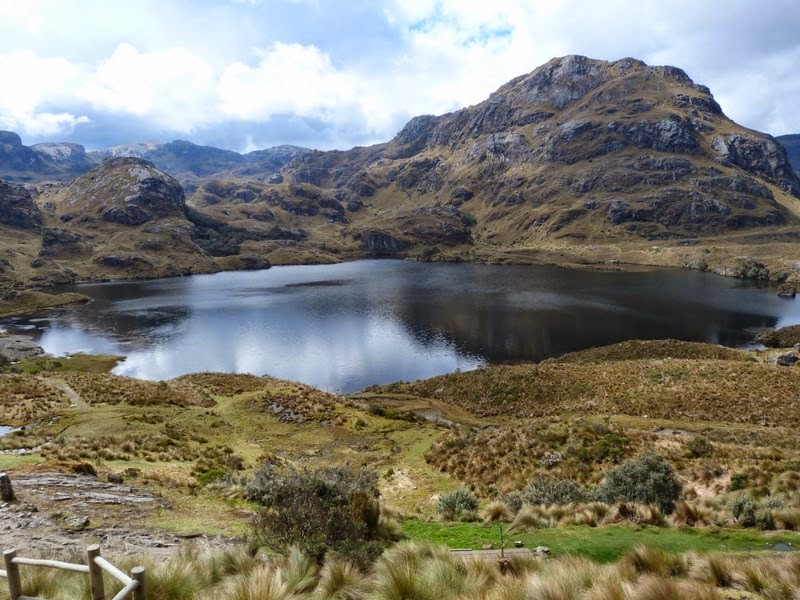
Mountain peaks, lakes and heathland of El Cajas NP.
This landscape is 4200 metres above sea level; for those of us from lower down, this is high enough for our lungs to know that things aren't normal!
It protects some 30,000 hectares from 3000 to 4500 metres above sea level, of montane forest, páramo (near-treeless tundra) and around 300 lakes. It straddles the continental divide, with some water running to the Pacific, with the rest, including the Tomebamba River which provides Cuenca's water supply, ending up in the far distant Atlantic. 

While cajas means boxes in Spanish this seems to be a red herring here (or 'false friend' as the etymologists would say), as the word is from indigenous Quichua, though surprisingly its actual meaning is debated.

It is a remarkably biodiverse park; it protects 19 endemic plant species (ie endemic to the park itself!), two endemic mammals (a mouse and a small marsupial) and the Violet-throated Metaltail, a hummingbird which is actually found in adjacent valleys too. 

The lakes are generally part of the páramo landscape, but of course have their special fauna too. 
Lake below the visitor centre.
Andean Ruddy-Duck Oxyura ferruginea, above, and
Andean Teal Anas andium below, are both restricted to the high Andes.
While the ruddy-duck is found all the entire length of the range,
the teal is only found in the north.
Both belong to groups found throughout much of the world.
 

The montane forests range from diverse cloud forests lower down, to simpler Polylepis forests higher up.
El Cajas cloud forest.
Creek in the cloud forest.
Polylepis forest is found in stands at high altitudes - here at 4200 metres, though they are found as high as 5000 metres, where they are the highest known flowering trees. Members of the rose family, they are wind pollinated - too cold for many insects up here. Their shaggy red bark, up to 2cm thick, helps with insulation but in general
we don't really understand the secret to their survival up here. We do know however that they provide key habitat for a range of plant and animal species.
As everywhere in the Neotropics, hummingbirds are always present.
Sapphire-vented Puffleg Eriocnemis luciani, above and below (on Passiflora flowers)
at the edge of El Cajas cloud forest. The lovely fluffy 'trousers' which give its name can be seen in both pics.


Great Horned Owl Bubo virginianus, roosting in big old Polylepis.
This owl is found throughout much of the Americas;
this one was a most exciting find on our most recent visit to El Cajas.
Orchids are most prominent in the forests, compared to the Páramo.
Elleanthus sp. above, and
Epidendrum sp. below, El Cajas cloud forests.
(As ever, any help with more specific identification appreciated.)


Odontoglossum sp. above, and unidentified (by me) orchid below.

Pleurothallis sp.; I love this genus, with the charismatic little flowers apparently growing
out of the huge leaf.

There are of course other interesting plants in these high forests too.
This epiphytic lycopod - which I think is Huperzia sp. - is a representative
of an ancient lineage which long predates the flowering plants around it, including those on which it grows.
Bomerea sp, family Alstromeriaceae.
This lovely vine is in the same general group as lilies.
Then there are the wonderful open spaces of the páramo, rich indeed when we start to look more closely at it. One of the features of South American birding is the shock to outsiders of finding that most of the passerines don't fit into any group that we're familiar with. One of the two major groups of these special songbirds is the ovenbirds, or funariids, and they are well-represented on the páramo.
Both Many-striped Canastero Asthenes flammulata (above)
and Stout-billed Cinclodes Cinclodes excelsior are ovenbirds
which specialise in these high cold wind-swept grasslands.

Flowers tend to be flatter to the ground out here than in the relative shelter of the forests.
Valeriana rigida; valerians are found throughout the Americas and Europe.
Gentian, Gentiana sp.

Finally, perhaps my personal highlight of this superb park. Chuquiraga jussieui, a daisy known as Chuquirahua or Flower of the Andes, is often cited as the National Flower of Ecuador. I'm not certain how official this is, but it's good enough for me!
National flower? Maybe it's not official, but I reckon it should be!
But there's even more to the Chuquirahua than that. Hillstars, high mountain hummingbirds, are specialists on Chuquiraga, and one, the Ecuadorian Hillstar Oreotrochilus chimborazo, is particularly attracted to Chuquirahua. And we saw it!
Ecuadorian Hillstar on Chuquirahua. This tough little hummer doesn't deign to descend below 3500 metres.
Until recently it was regarded as an Ecuador endemic, but perhaps annoyingly it was recently recorded
just across the Colombian border.

So, happy day Ecuador! I look forward to getting back there in the fairly near future, and El Cajas is certainly high up on my must-go-back-to list.

BACK ON THURSDAY, WHEN WE'LL RESUME THE POLLINATION STORY

Wednesday, 6 August 2014

Ormiston - one of the great walks

I had the privilege of redoing one of my favourite walks recently, during our trip to central Australia. Ormiston Pound and Gorge walk is one of the most spectacular half-day circuits in the entire country, and readily accessible to most people - unlike some other red centre walks it is reached by bitumen road, and the 7km walk itself is well within the capacity of anyone moderately fit person.

It's 130km west of Alice Springs along Larapinta and Namatjira Drives, involving a drive along the southern face of the superb West MacDonnell Ranges. You can do it as a day trip from The Alice but the drive itself warrants a day of your time, and you can either camp at the start of the walk (in the Parks Service camp ground) or stay in basic units at nearby Glen Helen Resort (don't think of planted palm trees and waiters - it's actually quite nice!).
Typical roadside panorama of the West MacDonnells from Larapinta Drive, en route to Ormiston.
The circuit walk starts in the (mostly dry) bed of Ormiston Creek, and begins with a steady but well-graded climb to a spectacular lookout over the Ormiston Pound, a broad sandy plain ringed with sandstone hills. It descends to the pound and crosses it through open woodland and spiky hummock spinifex grass, before entering Ormiston Gorge and returning to the start with some rock-hopping, depending on the water level. This was the fifth time I've done the walk, and the only time the gorge has actually been closed because of high water; on each other occasion I've avoided even getting wet feet. 
Taken just after the start of the walk, looking back at the dry bed of Ormiston Creek.
The grass in the foreground is spinifex, Triodia spp., which dominates much of arid Australia.
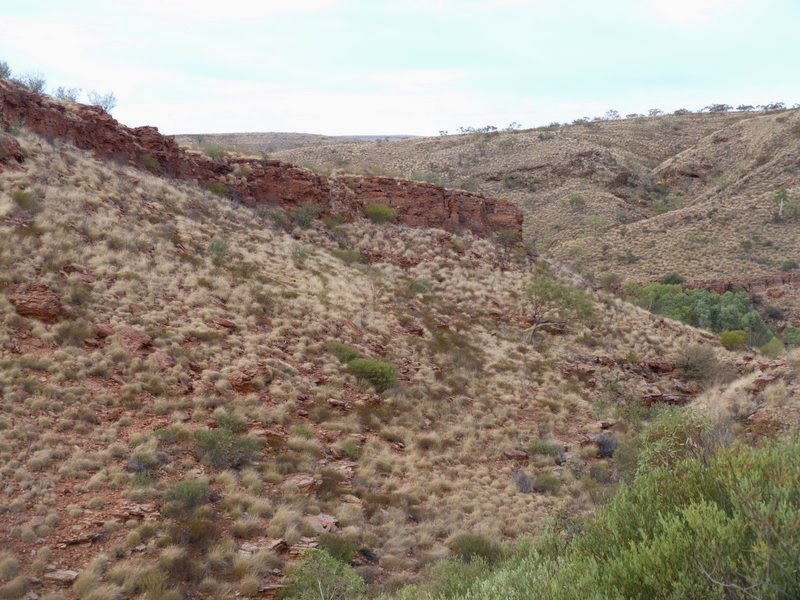
Below is typical of the hillsides for the first part of the walk

The gullies in particular - which the path follows and crosses - support a variety of plant and associated animal life. 
Curry Wattle Acacia spondylophylla (above) really smells wonderfully of curry spices;
it and Red Wattle A. monticola (below) thrive on the exposed rocky slopes.
 

Native Cotton Gossypium australe family Malvaceae; a true cotton.
Butterfly Bush Petaloystylis cassioides Family Caesalpinaceae.
A far more abundant genus in this family - which is sometimes now included in the huge pea family Fabaceae -
is Senna (formerly included in Cassia). It can also be found along the walk, as with everywhere else in inland Australia.
Senna artemisioides; this is an extraordinarily variable species, with at least nine named subspecies in central Australia
all with entirely different foliage and many of them co-existing and forming hybrids...
Spinifex Pigeon Geophaps plumifera, one of the delights of the far inland, where
it can be found on any rocky, spinifex-clad habitats. This one was enthusiastically displaying
to his intended, hidden behind the spinifex clump; neither party was at all interested in us.
Grey-headed Honeyeater Lichenostomus keartlandion Corkwood Hakea lorea.

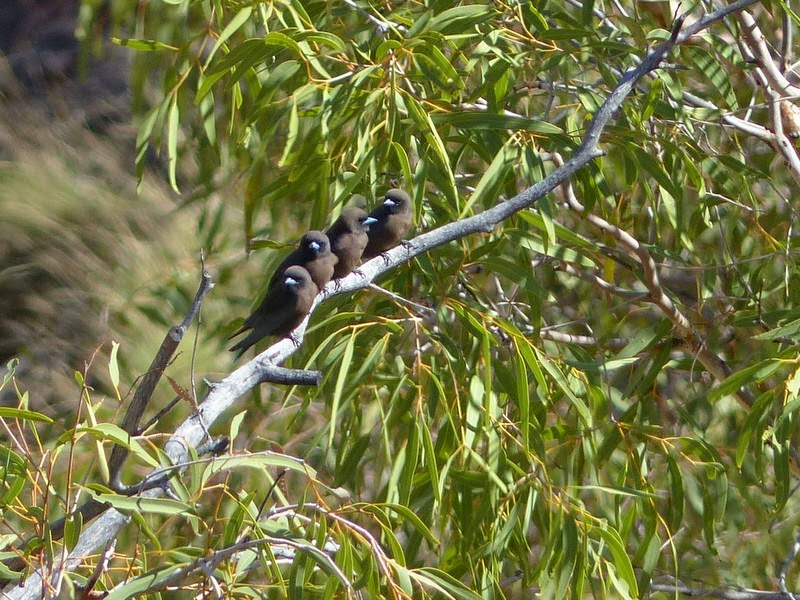
Little Woodswallows Artamus minor, the smallest of the six Australian woodswallow species - all are
closely related to Australian magpies and currawongs, and not at all to true swallows.
This species is sometimes regarded as hard to find, but its apparent scarcity is simply
a function of its remote habitat. Like all woodswallows they huddle endearingly
in between aerial sorties.
Panther Skink Ctenotus pantherinus.This robust skink was hunting insects while staying close to the safety of the spinifex clump.
After all this excitement - and the climb - the short detour up a narrow ridge to sit and look out over the panoramic pound is very welcome.
Ormiston Pound, ringed by the rugged folded sandstone hills of the West MacDonnells, above and below.


The view back to lovely Mount Sonder, made famous by sublime Arrernte artist Albert Namatjira,
is pretty splendid too.
From here we descend to the open plains, passing through spinifex and low rocky ridges.
Sharp-capped Mallee Eucalyptus oxymitra in spinifex grassland.
'Mallee' is a term for multi-stemmed shrub-form eucalypts found in drier low soil nutrient situations.
Finally we enter the deep shady gorge, with tumbled boulders on the sandy creek bed. It is a truly beautiful section of the walk- and the shelter is welcome on a hot or windy day.
Ormiston Gorge; the trees in the creek bed are River Red Gums Eucalyptus camaldulensis,which have managed to establish themselves despite infrequent but severe floods.
Determined River Red Gum seedlings.
The tumbled boulders in the bed are comprised of purple quartzite, formed from sandstone under immense pressures, often those associated with orogeny - mountain building.
I'm no geologist, but I find these exquisite.


Up on the rock walls are plants clinging to life but above the floodwaters.
Variable Daisy Brachycome ciliaris.

Ghost Gum Eucalyptus aparrerinja.
These are wonderful trees at any time; this one is truly extraordinary and I have not tilted the camera!
Towards the end of the gorge pools appear, deep and cold.
If you're lucky you'll be able to walk around them - mostly you can.
 

These of course attract life and species not seen elsewhere on the walk.
Little Pied Cormorant Microcarbo melanoleucos.
One of the world's smallest cormorants, found anywhere in inland Australia.
Scarlet Percher Diplacodus haematodus; I am always delighted to find dragonflies in the far inland
(and indeed anywhere!).
Blue Skimmer Orthetrum caledonicum
Shortly after these pools we meet people pottering along for a short walk from the carpark - we feel a bit sorry for them, and what they've missed - and a nice formed path. It means lunch and shelters and seats are near to hand, but it's not quite the same as where we've been, with the butcherbirds fluting from the cliffs and emphasising silence, and the colours of rock, tree trunk and sky.

But please, don't just take my word for it....

BACK ON SUNDAY, TO CELEBRATE ANOTHER ANNIVERSARY