About Me

My photo
Canberra-based naturalist, conservationist, educator since 1980. I’m passionate about the natural world (especially the southern hemisphere), and trying to understand it and to share such understandings. To that aim I’ve written several books (most recently 'Birds in Their Habitats' and 'Australian Bird Names; origins and meanings'), and run tours all over Australia, and for 17 years to South and Central America. I've done a lot of ABC radio work, chaired a government environmental advisory committee and taught many adult education classes – and of course presented this blog, since 2012. I am a recipient of the Australian Natural History Medallion, the Australian Plants Award and most recently a Medal of the Order of Australia for ‘services to conservation and the environment’. I live happily in suburban Duffy with my partner Louise surrounded by a dense native garden and lots of birds.

Wednesday, 6 January 2016

Australian Parrots and Cockies; some one-hit wonders

It seems appropriate to start the year with an Australian topic, and this is one that's been on my mind for a while. Australia (which includes New Guinea for most biological purposes) is a world hot-spot for parrots and cockatoos, the other being South America. I'll be using 'parrots' loosely here, to include all members of the Order Psittaciformes - ie cockatoos, 'true' parrots, and the New Zealand parrots. Australia has 55 species (41 true parrots and 14 cockatoos), representing some 14% of the world's total in roughly 5% of the earth's land area. (By comparison, South America has 2.31 times the area and 2.36 times the number of parrot species, which I find intriguing.)

However, of Australia's 55 species, 11 are the only members of their genus, meaning they divided off from their nearest relatives a long time ago. (I also find it curious that South America has only 12 single-species parrot genera, a much lower percentage, though offhand I can't think what the significance is!)

I find taxa, be they genera or families, with only one member to be particularly interesting, which doubtless tells you something about me; today I want to introduce you to those 11 singular Australians. (The Eclectus Parrot Eclectus roratus could be regarded as an 12th, with the only other species, the Pacific Eclectus Parrot E. infectus of Tonga and Vanuatu, becoming extinct apparently some 200 years ago.)
Male Eclectus Parrot (the female is red), Adelaide Zoo - sorry about that.
I have seen them in their natural habitat in tropical Cape York Peninsula but not managed a photograph.
There are six other genera with only one Australian species, but with other members elsewhere in the region, so I'll leave them for today.

The same is true for me regarding the Palm Cockatoo Probosciger aterrimus as it is for the Eclectus Parrot - that is I've seen it on Cape York, but no photos, sadly. The rest however I can offer you.

The four other cockatoos include two familiar pink species, which both apparently split from the main white cockatoo line long ago.
Galahs Eolophus roseicapilla, Forbes, New South Wales.
These lovely birds today suffer from over-familiarity, but half a century ago they were much less familiar
in the most populated parts of Australia, as they spread south-east with croplands and watering points.
Major Mitchell Cockatoos Lophochroa leadbeateri, north of Bourke, New South Wales.
Named for the controversial explorer Major Thomas Mitchell, whose rhapsodising of them
brought them to popular attention. They are limited to the dry inland.
Gang-gang Cockatoos Callocephalon fimbriatum, by contrast, apparently arose early from the black-cockatoo line.
Gang-gangs (male above, female below), Canberra.
One of the smallest cockatoos, we are particularly fortunate here in Canberra,
the only city where one can see these delightful cockies throughout suburbia.
The name is of indigenous origin - though as is so often the case we are not even sure from which language - and
beautifully captures the creaky-gate call. (I actually am minded of a cork emerging from a wine bottle,
though that is a dying sound in Australia as screw-top caps take over.)
 
The last of our singleton cockies is not always even recognised as one, though it is the world's second-most popular cage bird. (It is no secret that I find the concept of birds alone in small cages to be an immensely depressing one.) The Cockatiel Nymphicus hollandicus is found throughout inland Australia except for the deepest central deserts. Like the Gang-gang its origins are with the black-cockatoos.
Cockatiels, Sturt National Park, far north-western New South Wales.
As seed-eaters they must find water daily.
They are the world's smallest cockatoo.
Male Cockatiel, Mount Magnet, Western Australia.
The name is a diminutive form of 'cockatoo', as adapted from Malay.
And so to the 'true' parrots. The first four of the 'stand alones' we're visiting today are pretty universally agreed to share a common ancestor with each other and the rosellas (that is, more than with other parrots).
The Ringneck Parrot Barnardius zonarius is found over much of the continent; it has four distinctive races, which in the past were regarded as separate species.
Port Lincoln Parrot, race zonarius, Lincoln National Park (appropriately) ,
southern Eyre Peninsula, South Australia. Despite the name, it is found throughout much of
central and western Australia.
Twenty-eight Parrot (for the call), race semitorquatus, north of Perth.
It is limited to the south-west.
Eastern, or Mallee, Ringneck, race barnardi, south-west Queensland.
This is the familiar form in inland eastern Australia.
There is also a very green race, macgillivrayi, called the Cloncurry Ringneck, from a small area of north-western Queensland.

Another widespread inland south-eastern species is the Blue Bonnet Northiella haematogaster; despite the name its most conspicuous feature is its red belly in flight. It is a relatively sombre-coloured parrot, but I'm very fond of them.
Blue Bonnet, Theldarpa Station, north-western New South Wales.
Sometimes the isolated race called Naretha Blue Bonnet, from the Nullarbor Plain,
is regarded as a separate species.
Red-capped Parrot Purpureicephalus spurius, Albany, Western Australia.
Endemic to the south-west corner of the country, the remarkable beak
(which can be almost overlooked in admiration of the colours) is adapted for extracting
the tiny seeds from Marri Eucalyptus (or Corymbia) calophylla.
The relationship of the fourth member of this quartet to the others and to rosellas is less obvious, but I'm happy to accept the DNA evidence. The little Swift Parrot Lathamus discolor is in terrible trouble from a range of causes, including logging in its Tasmanian breeding grounds in the Blue Gum Eucalyptus globulus forests, loss of woodlands on the mainland where it spends winter, and predation on the nest by imported Sugar Gliders. 
Swift Parrot, Mount Majura, Canberra. In the mainland woodlands they are nomads, following the eucalypt blossoms.
The genus name is for John Latham, English ornithological giant (albeit somewhat erratic) at the turn of
the 18th-19th centuries.
Another inland parrot in this club is the Bourke's Parrot Neopsephotus bourkii, a subtly-coloured and retiring bird found sparsely across a huge swathe of the arid lands. The name commemorates Governor Richard Bourke, a nineteenth century liberal-minded New South Wales governor with a tragic life.
Bourke's Parrot, above and below, Thargomindah, south-west Queensland.
I find it very hard to get good pictures of these; even having found them, it is
very difficult to get close to them.
 

And finally, another desert-dweller and probably Australia's best-known parrot - though ironically most of the people around the world who keep Budgerigars in cages (see comment above under Cockatiels!) are probably unaware that they are either Australian or even parrots. When I see wonderful flocks of Budgies flashing past the vehicle in the vast outback, I feel very sad to think of them kept in solitary confinement far from home. For it is the Budgerigar which has the dubious honour of being the world's most popular cage bird.
Budgerigar Melopsittacus undulatus, Mullewa, Western Australia.
The male is on the left, with the blue cere (the waxy structure above the bill).
Budgies have such wonderful stories that they deserve their own posting, and
will receive it one day.
So, there they are - 11 parrots which are the sole members of their genus. I hope you've enjoyed meeting them as much as I've enjoyed presenting them to you. Even more, I hope you can meet them one day on their own ground, if you've not already done so.

And so 2016 has started! Perhaps a visit to South America next time.

BACK ON WEDNESDAY

Thursday, 31 December 2015

Farewell to 2015!

As I have made traditional, to mark the changing of years I've selected just one photo from each month of 2015 to commemorate the year past. As ever I don't make any pretences to photographic excellence, but have chosen the pictures because of their associations, and in most cases they are ones I've not previously used this year in a blog posting.

It's been a busy and enjoyable year - as all years should be as far as we can make them so - and I hope this selection of photos reflects this.

JANUARY
Chestnut-quilled Rock Pigeon Petrophassa rufipennis, Burrunggui
(formerly known, erroneously, as Nourlangie Rock), Kakadu National Park.
We spent a week visiting my sister and brother-in-law in Darwin in 'the Wet', an experience in itself.
The highlight however was a couple of nights in Kakadu, one of the world's great parks.
This beautiful pigeon is endemic to the Top End sandstone, almost exclusively within Kakadu.
It is hard to see without climbing into the escarpment, but this one emerged almost at our feet. Very special.

 FEBRUARY
Tall Wasp Orchid Chiloglottis trilabra, Mongarlowe, New South Wales.
I made a specific trip to a grassy site here, about an hour east of Canberra, to look for some orchids, including
this one. It's one of those which fool male wasps into attempted mating by simulating a female, both
in appearance and scent. I found the resemblance of the remarkable structure on the labellum to an insect
surprisingly compelling.
 MARCH
Highland Copperhead Austrelaps ramsayi, south of Canberra.
For some reason March was a quiet month photographically - I always seem to have one of those -
but I like the scale detail and colouring of this beautiful, venomous but amiable frog-specialist.

APRIL
Brolgas Grus rubicunda near Clermont, inland central Queensland.
In late April I drove a bus north to Cairns in tropical Queensland to meet a tour group.
It was a long drive with limited stops, but early one morning I was stopped by a series of small
groups of Brolgas, one of our two native cranes, flying in from the west, passing low over the road
and landing to feed in the sorghum. I watched for some 20 minutes, by which time there were hundreds
on the ground, but still they came. Many, including these, were young birds.

MAY
Frill-necked Lizard Chlamydosaurus kingii, Mareeba Wetlands, north Queensland.
Not easy picking just one photo from the richness of the Wet Tropics, but this is it. Nearly a metre long,
I've long wanted to see this magnificent lizard, but it's only possible in summer - in winter it goes into a torpor in
the tree canopies. It was a specific goal in January in Kakadu, but no luck. This one was a complete surprise;
I have no idea why it was active in May, but I am very glad it was!

JUNE
Sunda Colugo Galeopterus variegatus, Bako National Park, Sarawak.
Another difficult month to decide on just one photo, because this was when I was 'sent' to Malaysian
Borneo to do some reconnaissance for a potential future tour. This is another animal I'd long wanted to see,
but never hoped to actually to do so. Also called a 'flying lemur' (though it doesn't fly and is absolutely
not a lemur!) it is an accomplished glider, roosting during the day on a tree trunk. Two species
are recognised, though this one may well be divided into three. It has no close relatives, but is
distantly related to the primates.
JULY
Morning frost on a native daisy bush in our Canberra garden.
Another quiet month for photography - a lull between periods of frenetic activity.
Though this was yet another record-breaking warm year (does any sane person still not accept that
we're warming the place up?!), we had some hard winter frosts.
AUGUST
Lago Miscanti, Atacama Desert, northern Chile, at 4,100 metres above sea level.
Travelling again, this time to northern Chile and southern Peru, again accompanying a group.
The Atacama has long been on my must-see list, so another special trip. Despite a distinct shortage of oxygen in the air
and bitter cold, this was one of the most stunning scenes I'd ever seen.
SEPTEMBER

Marvellous Spatuletail Loddigesia mirabilis, Huembo Lodge, northern Peru. Northern Peru (a post-tour reconnaissance for the future) was another eye-opener. Again I could have offered any of dozens of pictures, but this extraordinary hummingbird was yet another on my wish-list since seeing it featured in an Attenborough series. This picture doesn't
do justice to the surreal tail, but you get the idea. It is limited to a very small area on the eastern slopes
of the Andes in north Peru.
OCTOBER
Shingleback Lizard Tiliqua rugosa amid Hoary Sunrays Leucochrysum albicans, Forbes Creek near Canberra.
Back home for the year and glad to be. I've been a fan of Sleepy Lizards (as we called them in South Australia) since
I was a child, and I couldn't resist this one ambling insouciantly through the daisies on a warm afternoon.
NOVEMBER
Native Bee at (exotic) Passiflora flower, Nowra.
One of my great pleasures when we visit my partner's parents on the edge of Nowra, near the coast a couple
of hours to the north of Canberra, is to wander the extensive gardens looking for both birds and smaller
animals, both of which abound. I was fascinated by the parade of tiny native bees (which were avoiding
the far bigger exotic Honeybees) attracted to these passionfruit flowers.
DECEMBER
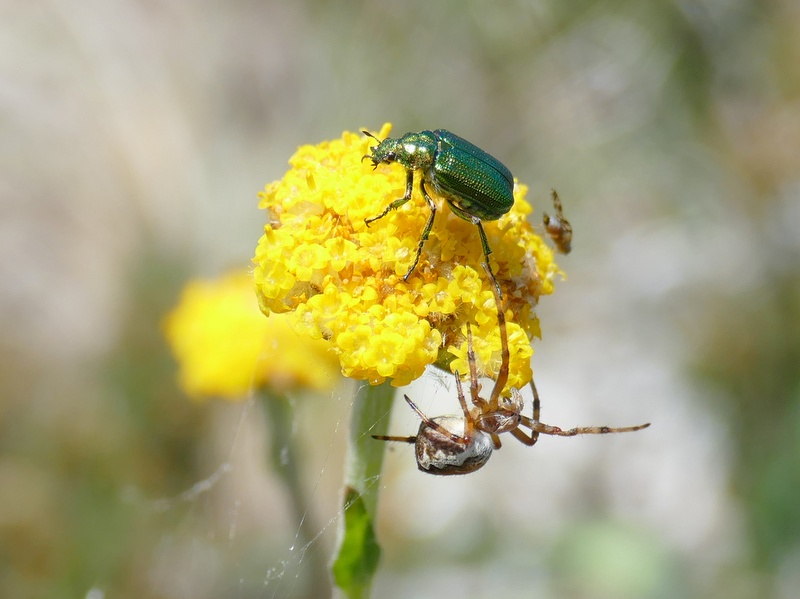
Diphucephala sp. (a scarab beetle), fly and flower spider sharing a Billy Button Daisy Craspedia sp. head,
Mount Ginini, Namadgi National Park above Canberra.
It was an excellent flower day, but it was this little grouping which really caught my attention.
I don't think the beetle was at risk, but I'm not nearly so sure about the fly!
So, that was my 2015 (or at least one version of it); I hope you got as much fleeting pleasure from rewalking it with me as I did in putting it together. I hope too that your year will also live on in happy memories for you, and that 2016 can bring us all more of the joys of nature, and a more peaceful planet.

BACK NEXT YEAR - SPECIFICALLY, ON WEDNESDAY!

Wednesday, 23 December 2015

Kosciuszko in December

I've just realised, with something of a shock, that it is now nearly three years since we last went to Kosciuszko National Park, subsequent to which I wrote a series of three postings on this wonderful mountain park south of Canberra. Rather than repeat myself now, if you're interested in the history, nature and significance of the park, and a map, see here. That visit was in February, towards the end of summer and the flowering season; this time we opted to go earlier in the summer - just last weekend in fact - to catch the earlier flowering. It should no longer be a surprise to see that the flowering in the Snowy Mountains, as in the Brindabellas above Canberra, is noticeably getting earlier. Accordingly the flowers were especially magnificent. This has been a very busy time of year, and our weekend provided a welcome respite. As I foreshadowed in my most recent post I'm starting to run down a bit too, so this will be a low-key posting, comprising basically a photo-record of the flowers and some animals that we enjoyed. I hope you can find time to enjoy them with me.

We did the Main Range walk again, a 13km return walk on a metal walkway - to protect the plants, and keep above the boggy ground - from the top of the Thredbo chairlift to Mt Kosciuszko.
Going down - 600 metres from top to bottom. I'm not a great fan of heights, but this one's worth it.
It's always good to be up there, where the Snowy River rises, and this day was warm (apart from the wind!) and sunny, but it was still early summer up there, and snow drifts persisted.

Headwaters of the Snowy River.
 As I said, the flowers were stunning, as you can see in the background of that photo.
Massed Silver Snow Daisies Celmisia sp., above and below.


Flowers in front of the Ramshead Range.
Daisies provided much - but by no means all - of the spectacle; the Silver Snow Daisies were the stars in terms of dominance, but here are some others. 
Alpine Sunrays Leucochrysum alpinum.This has recently been raised from a subspecies of L. albicans.
Silver Ewartia Ewartia nubigena.Named for Alfred Ewart, Australia's first Professor of Botany as a stand-alone position,
appointed to Melbourne University in 1905.
Cascade Everlasting Ozothamnus secundiflorus.
Dusty Daisy-bush Olearia phlogopappa.
Heaths - formerly Family Epacridaceae in Australia, now mysteriously subsumed in the northern hemisphere Ericaceae - are another important part of the alpine flora; here are just a couple.
Candle Heath Richea continentis, above and below, form massed prickly colonies in swampy ground.

Snow Beard-Heath Leucopogon montanus grows as an erect shrub lower down the mountain,
but above the tree-line it lies flat to the ground or sprawls over rocks.
This mat form is typical of many species in these harsh wind-swept environment.

Alpine Stackhousia Stackhousia alpina.
Sky Lily Herporlirion novae-zelandiae.Of course one shouldn't have favourites, but I can't help it in the case of this delightful ground-hugging
blue-tinged lily, found, as the name suggests, in New Zealand as well as Australian mountains.
Mountain Celery Aciphylla glacialis.Surely one of the most spectacular members of Apiaceae, the celery and carrot family.

Purple Eyebrights Euphrasia collina.
Euphrasia
means 'delighting', and it always works for me!
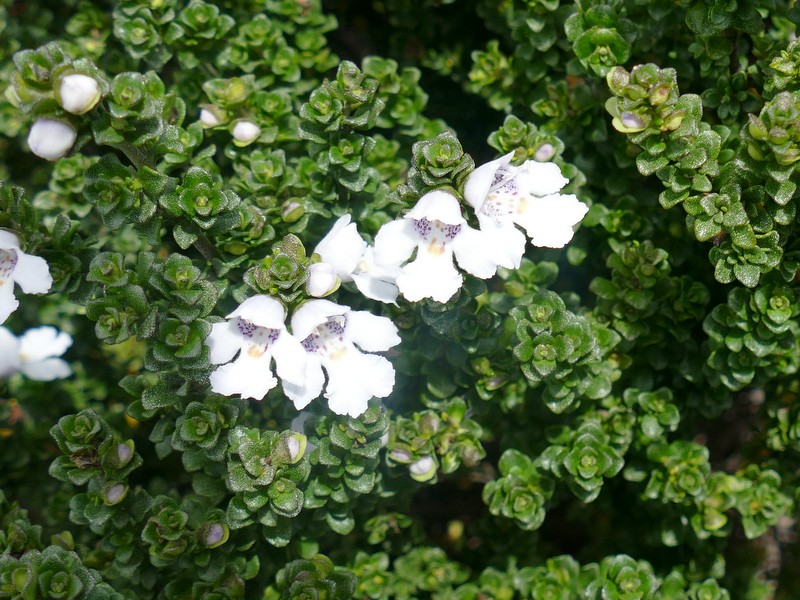
Alpine Mintbush Prostanthera cuneata.A beautiful aromatic shrub which grows close to the rocks, allowing it stand upright.
Alpine Rice-flower Pimelea alpina, a tiny herb.
Bitter-cress Cardamine sp.
Alpine Water-Fern Blechnum penna-marina.I'm always surprised to see ferns growing in a situation where they spend weeks of every year
buried in snow, but these are hardy, and grow among the rocks which provide a heat sink.
Yellow Kunzea Kunzea muelleri.This low-growing shrub can dominate vast areas of hillside - see below.


Another impressively-flowering shrub at the moment - though not nearly as widespread as the kunzea - is Alpine Orites, Orites lancifolia.
Alpine Orites is in the Family Proteaceae, not well-represented at these elevations.
And, far from least, the mighty Snow Gums were flowering too.
Its always seemed a mystery to me that Snow Gums (above and below) are called
Eucalyptus pauciflora - 'sparse-flowering'!
Clearly not named by someone who knew the tree.
 
This time there were some animals to be seen too, though mostly one has to look. The Alpine Mintbush is a good place to start.
The Alpine Spotted Grasshopper Monistria concinna is regularly found feeding on the mintbush,
despite its aromatic supposedly insect-repelling foliage.
Spotted Alpine Xenica Oreixenica orichora;
thanks for the i.d. Suzi!
Unidentified moth.
And it wasn't until I looked at the moth photo more closely that I noticed
this tiny flower spider lurking with intent.
Vertebrates are much thinner on the ground. Only two birds are regularly seen high on the mountains.
Australasian Pipits Anthus novaeseelandiae work across the ground taking insects from foliage.
Little Raven Corvus mellori enjoying the last light of day in a Snow Gum.
As well as gleaning the mountain insects, they have adapted well to human habitation.
Much rarer is the little Mountain Galaxias Galaxias olidus, now found in the high streams pretty much only where the voracious introduced trout have not ventured.
This little fish is also found at lower altitudes, in waters too warm for the trout.
I hope this has been of some interest or enjoyment, and even more I hope that, if it is possible for you, it encourages you to get up there sometime this summer.

Meantime, I hope that Christmas, if it has significance for you, is a time of happiness and peace - and that you can get out and enjoy nature wherever you are.

Old Snow Gum, Charlottes Pass, with Main Range behind.

BACK ON THURSDAY FOR MY TRADITIONAL REVIEW OF THE YEAR VIA A PHOTO PER MONTH.