About Me

My photo
Canberra-based naturalist, conservationist, educator since 1980. I’m passionate about the natural world (especially the southern hemisphere), and trying to understand it and to share such understandings. To that aim I’ve written several books (most recently 'Birds in Their Habitats' and 'Australian Bird Names; origins and meanings'), and run tours all over Australia, and for 17 years to South and Central America. I've done a lot of ABC radio work, chaired a government environmental advisory committee and taught many adult education classes – and of course presented this blog, since 2012. I am a recipient of the Australian Natural History Medallion, the Australian Plants Award and most recently a Medal of the Order of Australia for ‘services to conservation and the environment’. I live happily in suburban Duffy with my partner Louise surrounded by a dense native garden and lots of birds.

Monday, 15 February 2016

Queen Elizabeth National Park, Uganda. Part 2; across the plains

This is the second installment of my tribute to this magnificent east-central African park. The first part can be read here. With 198,000 hectares, there's a lot of exploring to do by vehicle and pretty much anywhere you go is likely to be of interest. Like all Uganda's parks, Queen Elizabeth suffered badly during the Amin years, with most large mammals being shot by the military for food and fun, but they are all repopulating well now. While this park is not Kruger, it's very well worth while visiting, and worth leaving time for driving, as well as the mandatory launch trip on the Kazinga Channel - which will be the subject of the third episode in this series. There are apparently nearly 100 mammal species living in the park and over 600 birds - that's not a lot short of the Australian total!
Uganda Kob in savannah landscape, Queen Elizabeth NP; hazy Rwenzori Mountains in background.
The park is in the Albertine Rift, the western arm of the Great Rift Valley of East Africa, which is gradually tearing open and will one day see north-eastern Africa floating off as a separate land mass. More information, especially including a map, can be found here.

While obviously a park of that size will not be uniform, the overwhelming impression is of vast grassy savannah lands supporting stands of trees, especially Candelabra Trees Euphorbia candelabrum and Paperbark Acacias Vachellia (formerly Acacia) sieberiana.
Candelabra Trees; this Euphorbia woodland is very typical of much of the park.

Thorntree 'acacia' woodland; also very characteristic.
In the far south of the park, the Ishasha section is famed for a population of lions which regularly climb into the big figs - not to be seen on the day we were there however. Here the Ishasha River is the border with the Democratic Republic of the Congo.
Hippos in the Ishasha River, with the Congo just behind them.
And birders really can be nerds; as we watched, a Hamerkop flew from our bank to the other side,
and a spontaneous cheer arose - we all now had a Congo bird list!!
Another feature of the park is the group of Katwe Crater Lakes, just to the north of the Mweya Peninsula (see map in previous post). They are relatively recent - no more than 10,000 years old - and are volcanic explosion craters, reminders of the volatile nature of lying on a rifting zone.

One of more than 70 crater lakes in the park; salt has traditionally been mined from some of them.
 
Lesser Flamingoes Phoeniconaias minor, Lake Munyanyange, above and below.
(This species has recently been moved from genus Phoenicopterus to being a single-species genus.)
Lake Munyanyange
Lake Munyanyange


And while we're on birds, this is an appropriate time to introduce some more - as mentioned previously, there are a lot to choose from!
Long-crested Eagle Lophaetus occipitalis in thorny acacia.
At the risk of being anthropomorphic, there seems something incongruous about that wispy crest blowing
in the breeze, behind that ferocious stare and wickedly hooked bill!
Also the only member of its genus, it is found widely in sub-Saharan Africa.
Blue-naped Mousebird Urocolius macrourus, also utilising a thornbush.
This mousebird (see previous post for another species) is found in east Africa
and then in a narrow strip westward across the continent to the Atlantic in Senegal.

Grey-headed Kingfisher Halcyon leucocephala, a truly beautiful dry country kingfisher,
here perched on a Euphorbia while scanning for lizards and insects.
African Pygmy Kingfisher Ispidina picta, a tiny and exquisite woodland insect-eater.
White-browed Scrub Robin Cercotrichas leucophrys, another inhabitant of the dry savannahs.
Neither a robin, nor a relative of the Australian scrubrobins, but an Old World Flycatcher.
Lovely warm colours.
Temminck's Courser Cursorius temminckii, perched on a termite mound in recently burnt grassland.
This is typical incidentally, as they seek out burnt ground, often arriving within hours of a fire.
They lay their eggs on the burnt ground, or if unburnt, often hidden among antelope droppings.
Coursers (and pratincoles, in the same family) are waders which have adapted to dryland living,
chasing insects along the ground.
I have fewer mammals photos from this park than I'd thought - perhaps I'd taken most of them elsewhere previously, though I'll make up for it in the final posting of this series.
This elephant (and I'm afraid I'm not sure from this angle if it's a female or young male) was not
happy at our presence, as indicated by the direct gaze, spread ears (above) and lowered head (below).
Being in a vehicle gives you less confidence than you might imagine in such a situation!
 

Uganda Kob Kobus kob thomasi, a lovely antelope which appears on the Ugandan coat of arms.

Female Waterbuck Kobus ellipsiprymnus, in recently burnt grassland.
One of the most exciting animals for me however was encountered crossing the road at night while we were returning from a drive.
The African Rock Python Python sebae is Africa's largest snake, and one of the world's largest.
Lengths of over six metres and weights of 50kg are accepted - and of course bigger ones are claimed!
This was nothing like that size, but was impressive enough.
Next time, in my last posting on this beautiful park, we take to the water.

 BACK ON FRIDAY; you find this post here
Euphorbia candelabrum, Acacia seberiana

Wednesday, 10 February 2016

Queen Elizabeth National Park, Uganda. Part 1, Mweya Lodge.

It's been far too long since I offered a post about Africa (and even longer since I've been there!). I can rectify the former more readily however. 

Queen Elizabeth National Park was declared in 1952, and enlarged soon afterwards. It covers 198,000 hectares of rolling grassy and wooded plains in the far south-west of Uganda, some 380kms south-west of Kampala. It lies between Lakes George and Edward - the border with Democratic Republic of the Congo runs through Lake Edward. 
Queen Elizabeth National Park marked (somewhat crudely!) in red.
More detailed park map. (Courtesy Safari Bookings.)
For a while the name changed to the arguably more appropriate Rwenzori National Park (the Rwenzori Mountains provide a backdrop to the south) but curiously it changed back again more recently; I can't get the details, but I suspect it coincided with the declaration of the nearby Rwenzori Mountains National Park in 1991.

We stayed at the very nice Mweya Lodge on a peninsula between Lake Edward and the Kazinga Channel which joins the two big lakes. There are several other lodges and camps, as on the map above, but I have no experience of them.
Approaching Mweya Lodge, above and below.
The euphorbias in the foreground are typical of the park vegetation.
 
I very much like the life-sized statue that greets us on arrival!
The view from the outdoor restaurant, over Lake Edward and the Kazinga Channel, is superb.
Slender-billed and Yellow-backed Weavers work the tables, hoping for left-overs.

Dawn views, above and below, over Lake Edward.


Meals were good, though I confess I didn't try this one.

The lodge grounds are excellent for an array of wildlife - birds, mammals and reptiles.
Yellow-backed (or Black-headed) Weavers Ploceus melanocephalus are bold and ubiquitous.
This seems to be a male moulting into (or out of) breeding plumage.
Swamp Flycatchers Muscicapa aquatica are also prominent here;
they are found right across central Africa.
Grey-capped Warblers Eminia lepida are not nearly as easy to see, though their lovely song
is often present. They are the only member of the genus, in the cisticola family.
Speckled Mousebirds Colius striatus are common enough garden birds in much of Africa, including Mweya,
but they always delight me. There are just six species of mousebirds comprising the family Colidae.


Warthogs Phacochoerus africanus appreciate the watered grounds, where they play havoc with lawns
by digging for roots and tubers. This kneeling posture while foraging is typical.
As can be seen here, they are not at all reticent about approaching the cabins!

Another mammal moves through the grounds en masse too, hunting smaller animals attracted by the amenities offered by the lodge grounds, with a particular fondness for beetles and millipedes. The latter is an unlikely delicacy as many species exude noxious chemicals for protection. They will however eat pretty much whatever comes their way, including frogs, lizards, small snakes, birds and eggs.

Banded Mongooses Mungos mungo are found widely across central and eastern Africa.
Unlike most mongooses they habitually forage in groups of up to 40.
 

The spectacular Blue-headed Tree Agamas Acanthocercus atricollis loll around the grounds too, though their apparent sloth is in fact an established hunting strategy - they wait for their prey (especially grasshoppers, ants and beetles) to come to them. Like the Banded Mongooses, they too can cope with bitter millipede chemicals.
Male Blue-headed Tree Agama above, female below.
Another characteristic of this lovely dragon lizard is its social structure - unusually among lizards
they live in colonies, with a dominant male and several females and immature animals.

I don't normally do promotions for establishments, but Mweya really is an excellent place for wildlife and scenery. Obviously however there is much more to the park than the lodge, and too much for just one posting; indeed I've realised that I'm going to need three! So, next time I'll look at life across the plains, and in a third installment I'll share a most remarkably wildlife-rich boat trip, along the Kazinga Channel.

BACK ON MONDAY; you can find it here

Wednesday, 3 February 2016

Gulls; the wailers

'Gull' is a strange word, one of those back-formed in English through both misunderstanding and attempted Anglicisation of a foreign word. (Think of Spanish naranja, heard by English ears as 'an aranja', which became 'an orange'.) In the case of 'gull', it is not at all clear why the word even arrived in western England, from Welsh or Cornish Gaelic, in the 15th century. English is always borrowing words from other languages, and invaders (notably the Norman French) imposed new words on the populace, but Gaelic was certainly not a conquering language, and there is no obvious reason why the doubtless conservative folk of the west felt a need to replace the old cob and mew with another word. The fact stands however that they did. Gullen in Cornish and gwylan in Welsh were words for gull - both meant 'wailing'. However, they were interpreted as plural - like children or oxen - and gull was back-formed as the singular. 

Gulls are everywhere, breeding on every continent including Antarctica. They are fairly uniform in appearance - we have no difficulty in recognising a gull, even one we've not previously seen. Indeed for a long time nearly all gulls were placed in the genus Larus, though DNA work has shown this to be too simplistic, and around 10 genera are now recognised. Overall they tend to be black, grey or white (often white head and darker back mantle) with coloured long legs and heavy bills. There are of course exceptions, and we'll come to some of those. Here are a couple of examples, modelling typical 'large gull' and 'small gull' outfits.
Pacific Gull Larus pacificus, Binalong Bay Tasmania, above. As is common for the larger white-headed species,
this bird's legs and beak are yellow, the latter with a red tip.
Below is a beautiful Dolphin Gull Leucophaeus scoresbii, in Ushuaia on Tierra del Fuego, Argentina.
Like many smaller gulls, it has red legs and bill.
Both birds show the fairly standard heavy gull bill, contrasting dark mantle and the pale eye
that is typical of many species when adult.


As I mentioned above, these patterns are by no means universal however. The Arctic-dwelling Ivory Gull Pagophila eburnea, is pure white. On the other hand the Galápagos endemic Lava Gull Leucophaeus fuliginosus is entirely grey-brown.
Lava Gull at sea, Galápagos.
This is the world's scarcest gull, with population estimates of less than 250 birds.
Some, in different genera, have dark heads or caps - these species often lose these dark caps when not breeding.

Brown-hooded Gulls Chroicocephalus maculipennis, Isla de Chiloé, Chile.
This elegant little gull is found in much of southern South America.

Andean Gull Chroicocephalus serranus, Lago Miscanti, Atacama Desert, northern Peru.
This species - seen here at over 4,100 metres altitude - is most unusual among gulls in
breeding only at high altitudes.
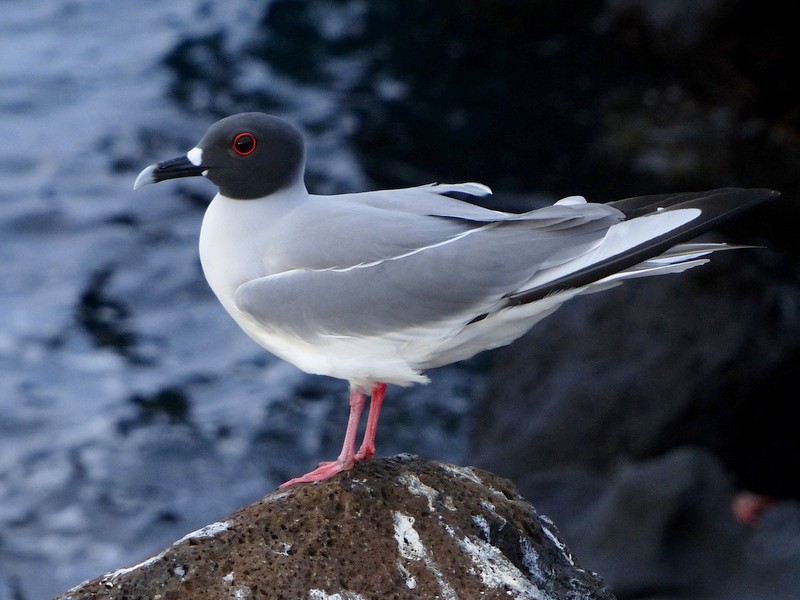
Swallow-tailed Gull Creagrus furcatus, North Seymour, Galápagos.
This exquisite bird is virtually a Galápagos endemic too, though a few pairs also nest on an island
off the Colombian coast. Its large eyes hint at another claim to fame - that of being the world's only
nocturnal gull (I have a strong memory of looking out the cabin window at night and seeing one flying
alongside, illuminated by the boat's lights).
With its markedly hooked bill it takes squid as they rise to the surface.
Wings are long and relatively slender, for soaring above the ocean, and sometimes hovering, albeit somewhat clumsily.

Band-tailed (Belcher's) Gull Larus belcheri, Pisagua, northern Chile.

Brown-hooded Gull, Isla de Chiloé, Chile.
Gulls have independently evolved the response to needing to drink salt water that many other seabirds have also done; glands above the eyes, which filter the blood flowing through them. The resultant salt solution runs in ducts down to the nasal passages, and drips off the end of the bill. (They have this in common with groups as disparate as penguins, petrels, pelicans, cormorants, frigate-birds and sea-ducks, among others.)

Like many different groups of swimming birds too, they have developed webbed feet, by bringing three toes to the front of the foot, and joining them with flexible skin.
Silver Gull Chroicocephalus novaehollandiae, Nowra, New South Wales.
The three forward-facing toes joined by webbing are clearly on display.
This, one of the world's smallest gulls, is seemingly ubiquitous in Australia, including sometimes
far inland. Due to its proclivity for roosting on open spaces - including cricket grounds - it has
become perhaps the most televised bird in Australia!
It's a curious thing that Australia has only 3 of the world's 55 gulls species (not counting vagrants)
but approximately half of the 45 tern species.

This penchant for roosting in flocks is another characteristic; they may gather on the beach or inland.
Grey Gulls Leucophaeus modestus on the beach near Iquique, northern Chile.
Remarkably, this gull breeds inland in the harsh Atacama Desert, where presumably
the lack of predators outweighs the disadvantages.


A very small part of a huge flock of Pacific Gulls roosting in a paddock near the Tamar River, northern Tasmania.
Among the adult Pacific Gulls above are scattered dark brown immatures. This change from dark or mottled plumage to adult garb over a couple of years for smaller species, or double that for larger ones, is typical of most gulls.
Second year immature Pacific Gull, Esperance, Western Australia.
Immature Silver Gull, Nowra, New South Wales.
The plumage is 'clean' and nearly adult, but the eye, bill and legs are still dark.
 
Dolphin Gulls, adults and immatures (dark heads) Ushuaia, Argentina.

Franklin's Gull immature, Española, Galápagos.
In this case the adult (below) does have a black head and young birds don't!
 

Juvenile Swallow-tailed Gull with parent, Genovesa, Galápagos.
A strict hierarchy is maintained in the flocks, especially with regard to food access, and aggression, both threatened and actual, is common.
Dolphin Gull aggression (adult bullying immature, as is usual), Ushuaia.
Breeding may take place in colonies or, more rarely, individually. Nests are often just a lined scrape on the ground, but there are variations on this theme.
Kelp Gull Larus dominicanus colony (with Magellanic Penguins),
Isla Magdalena, Strait of Magellan, Chilean Patagonia.

Kelp gull on nest, a ground scrape lined with grass and feathers, Isla Magdalena.
Brown-hooded Gulls over breeding colony, Laguna Coluco, Isla de Chiloé, Chile.

Brown-hooded Gull on floating nest, Laguna Coluco.
Swallow-tailed Gull chick, Genovesa, Galápagos, above and below.
Gull chicks hatch with eyes open and with down feathers; they can move around but
stay in or near the nest to be fed.

Mating tends to be for life, and pair bonds are maintained by displays and mutual grooming.

Swallow-tailed Gull pair allo-preening, South Plaza, Galápagos.
Gulls are widely seen as scavengers - as indeed they are - but they are also quite capable of catching live food (eg the Swallow-tailed Gulls discussed earlier). 
Brown-hooded Gulls scavenging spilt fish-meal, Puerto Montt, Chile.

Pacific Gull eating dead fish, Esperance, Western Australia.

Silver Gull with discarded fish-head, Cairns, tropical Queensland.
Kelp Gulls (and Black-browed Albatross) fishing, Strait of Magellan.
Immature Dolphin Gull with shellfish, Ushuaia, Argentina.
I have seen Kelp Gulls in Chile carry mussels into the air
and repeatedly drop them on the rocks to smash them open.
Sometimes I think that familiarity, and the ability of some species to make a living on our scraps and garbage, leads to some contempt, or at least a lack of respect, for gulls. Like any animal though they are worthy of our attention - and there are some pretty handsome characters in their ranks!

BACK ON THURSDAY