
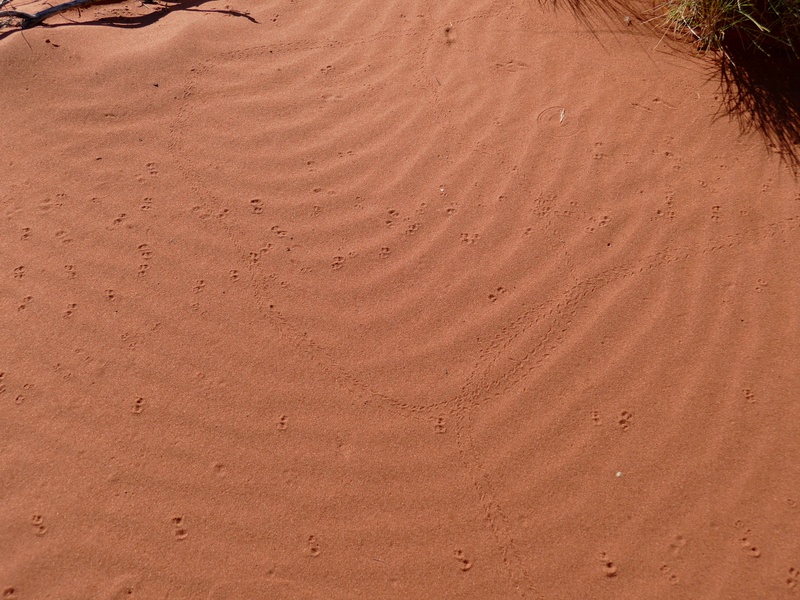
I'm going to either assume you've read last week's post which told you why I was recently in this remote and wonderful part of Australia (plus a bit about the desert itself), or invite you to have a look here. For obvious reasons of heat and water conservation, plus safety, a lot of desert activity happens at night; we may not see much of that, but in the morning the evidence is there! I saw some of most richly-tracked sandhills that I have ever seen.
 |
| Such stories, if I only knew how to read them; the women who accompanied us for the first couple of days, traditional owners, could certainly have done so, but they were no longer with us by this time. |
 |
| Even I can see where a small snake has passed across this one from top left to bottom right. |
For this reason - plus the fact that we there to survey birds! - it was the birds that were most conspicuous. And on our very first afternoon of surveying we hit a veritable jackpot. There are three species of emuwren (not named for some strange symbiosis but because their filmy tail resembles an emu's plume in their lack of interlocking barbules), and while I've managed to see them all I've never managed to lay camera on or anywhere near them. That has now changed, I'm delighted to be able to say!
 |
| Male Rufous-crowned Emuwren Stipiturus ruficeps; worth waiting for! This tiny scrap of a bird - at 6 grams probably the smallest Australian bird - is found across a vast swathe of the central and western deserts where it inhabits impenetrable citadels of old growth spinifex. Their wispy high-pitched calls are now of too high a frequency for me to hear, sadly. |
Some other species were a lot commoner - there weren't many surveys that we did that didn't turn up either woodswallows (Black-faced or Masked drifting overhead), or the ubiquitous Singing Honeyeater.
 |
| Black-faced Woodswallow Artamus cinereus. A member of the family of Australian magpies, currawongs and buthcerbirds, widely found across the arid inland. |
 |
| Singing Honeyeater Gavicalis (or Lichenostomus) virescens.Its cheery 'prrip' could scarcely be called 'singing', but it's heard everywhere across most of the continent except for the humid north-east and south-east coasts. Many a 20-minute site survey on the trip was saved from being a blank by the reliable Singer! |
Where there were flowers - and after the rains there were a lot in some places, as you'll see when I conclude this series by looking at plants next week - there were other honeyeaters too, notably another pan-Australian species (absent only from the south and south-east), the Brown Honeyeater Lichmera indistincta. Both common and species names might seem a little harsh, but they do have a point I'm afraid...
 |
| Brown Honeyeater feeding on Grevillea wickhamii. |
Another group of honeyeaters are known as chats (not at all related to various Old World groups containing the name), though they were long regarded as a separate family. Crimson Chats in particular are widespread nomads, and we often encountered small flocks moving through. Others though had stopped to breed!
 |
| Male Crimson Chat Epthianura tricolor with grasshopper, destined for hungry mouths in a nest. |
The Grey-headed Honeyeater Gavicalis (or Lichenostomus) keartlandi is another desert specialist of the west and centre.
 |
| Grey-headed Honeyeater coming in for a drink at Murrawa Bore. |
Other species also came in to drink here, from an old bathtub kindly provided for the purpose, filled with water pumped from a subterranean aquifer. Prominent among these were the ever-delightful Zebra Finches Taeniopygia guttata, another supreme desert survivor, but one which, as a seed-eater, must drink daily, so is always on the move.
 |
| Zebra Finches gathering to ensure the coast is clear at Murrawa Bore... |
 |
| ... before dropping down to suck up a quick drink. Zebbies suck by using the rapidly moving tongue as a pump. |
Little Button-quails Turnix velox were encountered quite regularly too, but usually in the form of a small bird exploding from near our feet and disappearing rapidly into the distance. It was a lot easier to find their characteristic feeding scrapes, or 'platelets'.
 | |
| Little Button-quail platelet. |
Sometimes though you can get lucky.
 |
| This little chap pottered round camp early one morning, but wasn't keen to be approached. |
Raptors drifted over sometimes, but not often.
 |
| Little Eagle Hieraaetus morphnoides carefully checking us out. |
 | |
| Spotted Harrier Circus assimilis, one of the loveliest Australian birds of prey. |
And some birds we only saw the tracks of!
 |
| Bustard tracks, both in sand and ironstone pebbles, were regularly seen, but never the big birds. |

Other tracks were much less welcome - in particular Feral Cats tracks were seen almost every time we walked. Feral Camels too were everywhere.
 |
| Camel tracks above, and droppings below. |

 |
| The culprits. All of the world's wild Dromedaries are in Australia - over a million of them, despite culling efforts, a number that is estimated to double every decade. This is a very large grazing animal in a land subject to drought as a part of life; they do immense damage. |
The most exciting animal however was one we didn't see. Bilbies Macrotis lagotis are astonishingly beautiful desert bandicoots (though they were once widespread in better-watered habitats, and it may well be that they are now just hanging on in what is marginal habitat for them), greatly reduced in numbers and range. The western deserts are their stronghold however, and one day we came across a colony of their burrows.
 |
| Bilby burrow above, and tracks below. I found it both thrilling and moving to be within metres of a special animal that I don't ever expect to see in the wild. |

 |
| Just in case you don't know what they look like. Photo courtesy Alice Springs Desert Park, per ABC. |
The lack of daytime reptiles seemed puzzling, though I feared that the ubiquitous cats had a lot to do with that. One lizard species only was common - the Central Military Drago Ctenophorus isolepis was so lightning fast across the sand and into the spinifex sanctuary that I doubt even a cat could catch them very often.
 |
| Central Military Dragon male (above) and female (below). |

And of course there were invertebrates, though again many of them were nocturnal, based on the tracks. For instance ant nests were abundant, but we rarely saw the occupants.
 |
| Ant nests, above and below. |

The exceptions, as everywhere, were the Meat Ants Iridomyrmex purpureus (or more probably a related species) whose presence throughout the day is a major reason that the others forage at night.
 |
| Meat Ants. |
Termites too were hugely abundant, as they are throughout the arid lands of Australia, feeding on the spinifex and in turn feeding large numbers of larger animals.
 |
| Two types of mound, representing different termite species. |

Termites eschew light and dryness, even to the extent of building covered corridors to move between spinifex clumps.

Understandably there were very few butterflies or dragonflies.
 |
| I think this one is a Lemon Migrant Catopsilia pomona. |
 |
| And this one I think is a Wandering Glider Pantala flavescens.As ever I would welcome being corrected! |
 |
| A truly magnificent grasshopper which, based on information received, is certainly a pyrogomorph, but either the magnificently name Blistered Pyrgomorph Monistria pustulifera!, a specialist on Eremophilas, or the closely related Painted Pyrgomorph Monistria (or Greyactis) picta. (My thanks to Susan, below, and Marita for assisting with this one; my fault that I can't pin it down to the species, though I'm tending to the latter, based on photos I can find.) |
 |
| A pair of Robber Flies (family Asilidae) seeking to increase their population. |
And they of course are not the only hunters to be found out there.
 |
| A small wasp hunting across the surface of a Desert Paperbark; not doing well for identification today, am I? |
 |
| A big colourful potter wasp, family Vespidae (the yellow notch in each eye gives it away), sharing Murrawa Bore with the Zebra Finches, collecting water for its mud nest. |
 |
| Golden Orbweb Spider Nephila edulis and lunch. This magnificent big spider is found across much of Australia. |
And finally a mystery that has now been resolved. In the inhospitable salt flats of Lake Mackay we found these partial circles of tiny balls of mud, surrounding, at some distance from them, very small apparent burrows in the salt. They are included here because at the time I assumed they were the work of an animal - I suspected a small crustacean. However, since posting, I've been corrected by my friend Patrick de Dekker, recently retired Professor of Geology at the Australian National University and expert on salt lakes (among many other things). He tells me the structures are due to seepages and bubblings of methane produced by organic material trapped under the salt and 'fermenting' in rare wet times. The black organic mud can extend 50 centimetres below the surface. While Patrick didn't specifically say so, it seems to me that if there were occasions when the methane actually erupted from the salt, because the surface layer allowed pressure to build up, it could explain the mystery of the far-flung ring of material around the little hole.
 |
| One of the mystery rings, seemingly of excavated material. |
 |
| A close-up of the central hole - the salt crystals give an idea of its size. |
So, a mystery explained, always satisfying.
Meantime I'll leave you to it, and finish this series next time with a post on some of the flowering plants we found.
BACK
ON THURSDAY
(And remember that you can get a reminder when the next post appears by putting your
email address in the Follow by Email box in the top right of this screen.)


