
The Pantanal is one of those places I'd always wanted to see (courtesy primarily, as with so many other things, of David Attenborough), but never expected to do so. That changed when, late last year, we were sent to do a reconnaissance with my Peruvian friend Juan, preparatory to accompanying a tour there later this year. And it is every bit as extraordinary as I'd been led to believe, truly one of the world's great wildlife spectacles! I can't wait to get back there for further exploration.
 |
| Yacaré Caiman Caiman yacare and Capybara Hydrochoerus hydrochaeris, Pousada Piuval, Pantanal. The Pantanal is said to have the largest concentration of crocodilians in the world, and Capybaras, the planet's largest rodent, are also abundant and ubiquitous. |
Today I want to give you a flavour of the place, or at least to start to - even that is too big a task for one day - but first some background. Firstly, it's huge - it has no clearly defined boundaries, but estimates vary from 140,000 to 210,000 square kilometres - but just where is it?
 |
| The end of the arrow indicates approximately the heart of the Pantanal, which is located just inside the tropical zone, pretty much in the centre of South America, mostly in south-western Brazil. |
 |
| The Pantanal lies mostly in the Brazilian states of Mattto Grosso and Matto Grosso do Sul, though it spills over to minor a degree into both Bolivia and Paraguay. The Rio Piquirí forms the boundaries between the two Brazilian states. As is obvious, road access is very limited - more on that anon. Today's post will deal only with the northern section, in Mato Grosso. (Map courtesy hot-map.com). |
The Panatanal is essentially a vast ephemeral wetland - some 80% of the flood plains disappear under about a metre and a half of water each year, though it can be up to five metres deep in places. Its area is 15 times that of the (justly) famed wildlife haven of the Okavango Delta in Botswana. However an area that large is not homogenous, and various habitats are recognised, including several major rivers with associated gallery forests, permanent lakes, swamps which expand and contract with the rains, open grasslands and the woodlands of the cerrado, which both flood annually, and drier deciduous and semi-deciduous forests on higher ground.
 |
| Grassland and forest patches on higher ground, from observation tower, Pousada Piuval. (Pousada simply means a guesthouse, or lodge; like the others, this one is a working cattle station, but supports remarkable wildlife.) |
In 1976 an ambitious plan was launched to build a highway right through the Pantanal, from Cuiabá in the north to Corumbá in the south-west. Unfortunately the planners seem to have overlooked the existence of the impressive Cuiabá River, or perhaps they simply ran out of money at that stage; either way the Transpantaneira Highway ends, after 148km and 120 bridges, at tiny Porto Joffre (also known as Porto Jofre). The southern section - 60% of the Brazilian Pantanal - has no access road to join lodges, so travel is much more difficult; as mentioned, I'll be able to report further on that later in the year!
It's probably more than time now to deliver the promised brief overview of the habitats and some of their particularly striking inhabitants. There is, as I've mentioned, too much for one posting, so I'll start with the drier habitats. That may well be leaving the best to last, but there was plenty to enthrall us in the grasslands, woodlands and drier forests!
 |
| Cerrado, Pousada Alegre. As elsewhere the grasslands and open woodlands tend to merge into one another. They have some very exciting inhabitants. |
 |
| Greater Rhea Rhea americana, Pousada Piuval. Common and tolerant of people, this is a much bigger bird than the little Darwin's Rhea R. pennataof the far south that I'm more familiar with. |
 |
| Red-legged Seriema Cariama cristata, Pousada Piuval. One of the first birds we saw, and was I excited?! (Yes.) Big mostly ground-living hunters of small animals, this one and the closely-related Black-legged Seriema are the only members not only of their Family, but an entire Order. |
 |
| Campo Flicker Colaptes campestris.The flickers are group of seven species of mostly ground-dwelling American woodpeckers in this genus, and I think this one is especially handsome! |
 |
| Pale-crested Woodpecker Celeus lugubris.This beauty is not found much outside the Pantanal. |
 |
| Cream-coloured Woodpecker Celeus flavus, Pixaim River. She (he has a red moustache, or malar stripe if you'd prefer) was in gallery forest along the river bank. |
 |
| White Woodpecker Melanerpes candidus, Pousada Piuval. This one, a specialty of grassy woodlands, instantly became one of my favourite woodpeckers! |
 |
| Green-barred Woodpecker Colaptes melanochloros, Pousada Arara, a flicker relative from the dry forests. |
 |
| White-wedged Piculet Picumnus albosquamatus, along the Transpantaneira Highway. Tiny, like all piculets, this one is only 10cm long and weighs around 10 grams. |
 |
| Hyacinth Macaws, Pousada Arara; arara is Portuguese for macaw, and most lodges have at least one pair breeding in the vicinity. |
 |
| Golden-collared Macaw Primolius auricollis. This much smaller macaw's range extends from the Pantanal west into Bolivia. |
 |
| White-eyed Parakeet Psittacara leucophthalmus, Pousada Piuval. Unlike the previous two parrots, this one is found across much of the northern part of the continent, and flocks of them hang around the lodges. |
 |
| Monk Parakeets Myiopsitta monachus, at the entrance (or one of them) to their big colonial stick nest along the Transpantaneira. They are unique among parrots in this. Escapes from cages in Europe and North America have formed big urban populations. |
 |
| Bare-faced Curassows Crax fasciolata, Pousada Arara; female above, and male below. These birds have become habituated to people. |

 |
| Chestnut-bellied Guan Penelope ochrogaster.A Brazilian endemic, it is a listed Threatened Species, and even in the Pantanal it is scarce. |
 |
| Red-throated Piping Guan Pipile cujubi, a big handsome guan. Some sources suggest that only the Blue-throated Piping Guan P. cumanensis is present; others that White-throated Piping Guan P. grayi is also present, plus hybrids! I understand why some taxonomists just hide their heads in their hands and lump them all as one species, Common Piping Guan P. pipile! However both Avibase and Handbook of the Birds of the World make it clear that this is within the range of Red-throated, so I have no reason to call this anything else; despite a blue trim to the throat in this bird, neither of the other species has red there, so I'm going with the evidence. (My thanks to my friend Martin for helping me through this taxonmic tangle.) |
 |
| Chaco Chachalaca Ortalis canicollis. There are gangs of these everywhere, and like all chachalacas they comment loudly, rudely and incessantly on everything. |
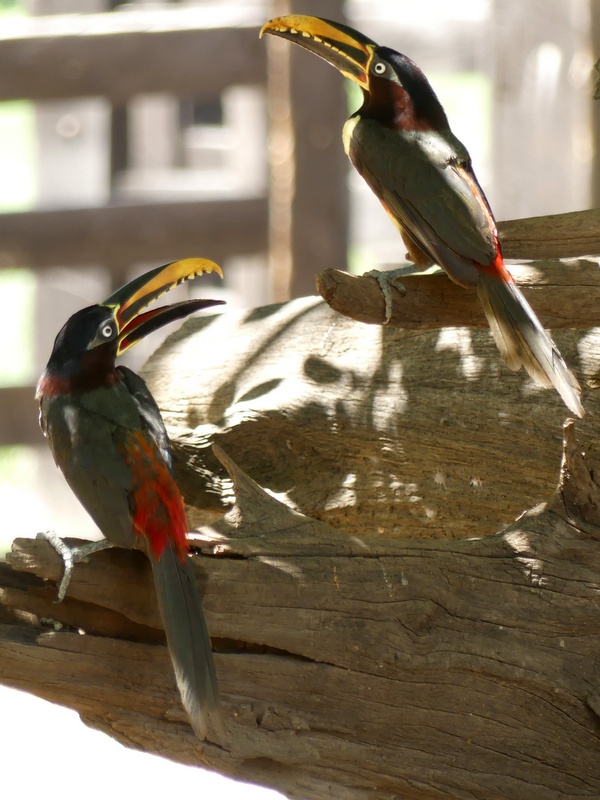 |
| Chestnut-eared Aracaris Pteroglossus castanotis; aracaris, all in this genus, form a group of smaller colourful toucans. Toucans will get their own post here one day. |
 |
| Crested Oropendola Psarocolius decumanus. Oropendolas are a group of large, colonial-nesting icterids (or North American blackbirds, whose ancestors arrived in South America a few million years ago when the Isthmus of Panama arose). This is an impressive bird, but the crest? Well not quite so much.... |
 |
| Purplish Jay Cyanocorax cyanomelas; not at all shy! |
 |
| Yellow-billed Cardinal Paroaria capitata. One of the most prominent birds in the Pantanal, and a delightful one. |
 |
| The Streaked Flycatcher Myiodynastes maculatus, is widespread in the Pantanal and beyond. |
 |
| Grey-necked Wood Rail Aramides cajaneus.While this big rail is far from the hardest rail to see, it's not usually this easy! |
 |
| Crab-eating Fox Cerdocyon thous, hunting frogs in the grounds of the lodge at Pousada Piuval. These South American foxes are not very closely related to northern hemisphere foxes. |
 |
| South American Coatis Nasua nasua. Highly sociable members of the raccoon family, they hunt a range of prey. I couldn't get very near to this group. |
 |
| Black-striped Tufted Capuchin Sapajus libidinosus (formerly lumped with the more widespread Brown Capuchin). This chap was eating green mangoes, which might explain his grumpy demeanour. |
 |
| Black-tailed Marmoset Mico melanurus, a diurnal tree sap specialist whose range is centred on the Pantanal. |
 |
| Brown (or Grey) Brocket Deer Mazama gouazoubira Pousada Alegre; a small deer and one of four species found in the Pantanal. |
 |
| Black (or Black and White) Tegu Salvator merianae, Family Teiidae, along the Transpantaneira Highway. These are big lizards, up to a metre long and massive, filling the niche of goannas (or monitors) in some other parts of the world. They are often seen around the lodges. |
 |
| Another member of the same Family, which I've not yet been able to identify. |
 |
| Red-footed Tortoise Chelonoidis carbonarius, sprinting across the Highway. This lovely tortoise - and we only saw one - is another Threatened Species, and again the illegal pet trade is complicit in its decliine. |
 |
| Wasp nests: Pousada Piuval above, armadillo wasps, along the Transpantaneira, below. I was advised that both are well worth not disturbing! |
 |
 |
| Butterflies enjoying the benefits of cow pats, above and below. |

OK, I'm sorry that wasn't perhaps the most tasteful way to conclude, so perhaps something a little more romantic to end on.
 |
| Amorous millipedes, Posada Piuval. |
NEXT POSTING THURSDAY.
(And
remember that you can get a reminder when the next post appears by
putting your email address in the Follow by Email box in the top right
of this screen.
And I'd love to receive your comments - it's easy and you don't need to sign in!)
And I'd love to receive your comments - it's easy and you don't need to sign in!)


