About Me

My photo
Canberra-based naturalist, conservationist, educator since 1980. I’m passionate about the natural world (especially the southern hemisphere), and trying to understand it and to share such understandings. To that aim I’ve written several books (most recently 'Birds in Their Habitats' and 'Australian Bird Names; origins and meanings'), and run tours all over Australia, and for 17 years to South and Central America. I've done a lot of ABC radio work, chaired a government environmental advisory committee and taught many adult education classes – and of course presented this blog, since 2012. I am a recipient of the Australian Natural History Medallion, the Australian Plants Award and most recently a Medal of the Order of Australia for ‘services to conservation and the environment’. I live happily in suburban Duffy with my partner Louise surrounded by a dense native garden and lots of birds.

Thursday, 18 March 2021

Gluepot Reserve; one of the great Australian conservation success stories

The mallee comprises a vast swathe of semi-arid woodland stretching from the dry inland of south-eastern Australia to south-western Australia, reaching the coast in South Australia and across to the west. It is characterised by a multi-stemmed form adopted by many eucalypt species growing in low phosphate soils. More on the mallee in general in another post. I grew up in South Australia and identify strongly with the mallee. I once had the privilege of talking on radio to Graham Pizzey, the great naturalist and author of the first world-class Australian bird field guide, and was thrilled when he nominated the mallee as his favourite habitat.

Mallee form at Gluepot Reserve, either Eucalyptus oleosa or E. gracilis
(both are present and I didn't check which this was at the time).
Notwithstanding its significance, the mallee has not been treated kindly, and huge areas have been razed by broadscale clearing and burning for agriculture. In the higher rainfall areas of its range wheat and sheep production is quite successful if chemical fertilisers are applied - however the plants which evolved to lower levels of the nutrients do not do well when levels are raised. In particular old-growth mallee - ie unburned for 50 years or more - is a scarce treasure now, and some of the most threatened species (notably birds, but other animals as well) rely on this habitat. 
 
This map (courtesy of the Australian National Botanic Gardens) gives an indication of
the current (green) and estimated former (pink) distribution of mallee woodlands.
However we should note that the current range by no means implies continuous or
undamaged mallee. Most is fragmentary.
 
Which brings us to Gluepot, literally, as well as in this blog! The Murraylands north of the Murray in South Australia contain a reasonable area of remnant mallee, mostly subject to low-level grazing. It was here in 1997 that someone recorded, on Gluepot Station some 60km north of Waikerie, a population of Black-eared Miners Manorina melanotis, one of the rarest species in Australia. It is an old-growth mallee specialist, threatened by mallee clearing in an unexpected way, as well as the obvious. As gaps appear in the mallee, creating edges along with associated stock watering points, the closely related and abundant Yellow-throated Miner Manorina flavigula invades and interbreeds with the previously isolated Black-eareds. It is only in the area north of Waikerie and Renmark that Black-eared Miners are hanging on in any numbers, though these numbers are still small. 
Approximate location of Gluepot, at the end of the red arrow.
Gluepot had been taken up for grazing in 1887, under legislation dealing with 'Waste Lands of the Crown'! The name supposedly refers to the state of the clay areas after the infrequent rain. It had been grazed lightly but the lessee in 1997 had applied for permission to burn the mallee to increase his grazing. By then it was established that viable populations of another five nationally endangered bird species were also present, and that none of it had burnt signifcantly since the 1950s and much of it seemingly not for centuries. This was a conservation treasure and Birds Australia scrambled to crowd fund to buy the property; the owner wasn't averse to selling but was also quite willing to burn to get a few more years of grazing out of the mallee. Incredibly the $360,000 was raised in ten weeks, along with pledges of $30,000 a year for the next five years to manage the reserve. Volunteers worked hard and still provide management to this day. 

Perhaps counterintuitively at first sight, the key job initially was to fill in dams and remove watering troughs. These enabled dangerous increases in numbers of Western Grey Kangaroos and survival of feral goats, anathema to the mallee. On the other hand the old mallee specialists got along perfectly well without permanent water. There is a lot more about the history and management of the reserve on its excellent web site. 

Access is good, two-wheel drive is generally enough. Visitors are welcome and are greeted by a very good information centre. There are three basic campgrounds, featuring cleared sites, long drop toilets and a couple of tables. We had a campground to ourselves, but this was in early autumn, not the most popular time of year to visit, for reasons we can confirm! (Though we went into it with eyes open.)

Sunrise in the campground. Much of the mallee in the reserve seems to be
recovering from some form of canopy dieback, about which I'm hoping to find out more.
It was still a wonderful scene to awake to.

I've only mentioned the mallee, but even that isn't at all uniform and there are other habitats present.

Mallee with a relatively sparse chenopod understorey - ie saltbushes and bluebushes.
This is good habitat for fairywrens, thornbills, babblers etc.

Mallee over spinifex or porcupine grass, Triodia spp. I wrote more about this
very important component of arid Australia here. This is key habitat, with specials like
grasswrens and heathwrens and numerous reptiles and invertebrates sheltering in
the dense prickly strongholds.

Belah, or Black Oak, Casuarina pauper, a species which was formerly
included with C. cristata, though that is now recognised only from further east.
One species which specialises in this habitat is the White-browed Treecreeper.
Birds of prey may hide among the relatively dense foliage.
This is a somewhat shadier, cooler environment than that provided by the more open mallee.
We took our chance going now, just after the end of summer, and though it had been relatively cool prior to our stay it was mid-30s while we were there and the birds were pretty elusive - fortunately I know from previous visits that this is the not the norm there.

We saw a few reptiles, but doubtless would have seen more if we'd been willing to venture out into the sun during the day! There are 42 species so far recorded from Gluepot.
Common Snake-eye Skink Morethia boulengeri, which is found in a remarkable range
of habitats across Australia.

Eastern Mallee Dragon Ctenophorus spinodomus. South-eastern populations of
mallee dragons have recently been recognised as separate from those
across most of Australia.

Eastern Tree Dtella Gehyra versicolor living in the camp toilet block.
This pretty little gecko is found across much of inland eastern Australia.
Western Grey Kangaroo Macropus fuliginosus on a track. These inland kangaroos
are really brown rather than grey, but were lumped in with Eastern Greys M. giganteus
until relatively recently. Numbers at Gluepot are lower than we're used to seeing
of Eastern Greys in wetter country, but that's an artificial situation.

 
Chestnut Quailthrush Cinclosoma castanotum; a male crossing the entrance
track (and stopping for a quick song). A bird of arid scrublands, especially
mallee. I associate it with sandy substrates.
190 bird speces have been recorded from Gluepot, and in additon to the six nationally threatened species, another 17 are listed as threatened by one or more of the three eastern mallee states. Our birding however largely concentrated on the series of hides set up in front of raised water troughs to attract birds. And there is no contradiction here with the comments earlier about closing dams etc - the hide troughs are raised so that goats and kangaroos can't reach them. They are fed from nearby closed tanks of water maintained  for fire fighting. 
The view from Josie's Hideaway Hide; the hide is raised so that viewers
are looking straight at the trough. The following photos were taken
at Josie's in late afternoon. Most of the visitors are honeyeaters.

Yellow-plumed Honeyeater Ptilotula ornata; this was the most prominent
bird at all hides while we were there, and is found across southern inland Australia.

Brown-headed Honeyeater Melithreptus brevirostris, a softly-coloured little
short-beaked honeyeater of drier forests and woodlands. They usually
hang out in flocks.
White-eared Honeyeater Nesoptilotis leucotis. The distribution of this handsome
honeyeater fascinates me; in South Australia I grew up thinking of it as a mallee bird,
but when I went east to live I found it up in the Snow Gums! I find this remarkable.

Yellow-throated Miners Manorina flavigula. There's always a thrill of excitement when these
turn up - will they turn out to be the fabulously rare Black-eared?
For me so far - no.

Red Wattlebird Anthochaera carunculata, another mallee bird with a broad
range of habitat preferences; they are resident in our Canberra yard.
This is a young bird, whose red wattle is just starting to appear behind the eye.

Mulga Parrots Psephotellus varius, a pair, with the spectacular male on the left.
They're a parrot of the dry inland, but are as likely to be seen in mallee as in mulga
(which is an acacia). Josie's was the first hide we visited and this pair was the first thing we saw -
an excellent introduction indeed!
In the morning early we tried Froggy Dam Hide (love it!), tucked into a dense stand of Belah. We only saw a few hesitant White-eared Honeyeaters come in, but then a young Collared Sparrowhawk Accipiter cirrocephalus swooped in and glowered near the water. It was partly hidden but was clearly inexperienced and kept fidgetting and moving position. We suspect it might have been hanging around before we saw it, explaining the lack of action at a usually busy time of day.
Collared Sparrowhawk; a youngster learning its trade.
Incidentally the best clue to distinguishing it from the very similar
(but smaller) Brown Goshawk from this angle is the notched,
not square, tail.
After breakfast we drove out again to the two remaining car-accessible hides (the fifth, the John Martin hide, requires a 5km walk, and these were not the conditions for that). The Don and Chris Lill Hide (the names commemorate people who have contributed to the reserve through their work) is set in very nice mallee woodland and was attracting plenty of activity, despite the morning now advancing.
Don and Chris Lill Hide, with trees and shrubs all around.
The drinkers prevalent at the previous hides (especially Josie's) were here too and I won't repeat them. One that was at Josie's but very reticent, uncharacteristically, was also one of my favourite honeyeaters. The Spiny-cheeked Honeyeater Acanthagenys rufogularis is a lovely bird and I was pleased to see that those frequenting the Lills' hide were much more relaxed.
Spiny-cheekeds are striking, fairly large honeyeaters with creamy 'spiny' cheek feathers,
salmon breast, pink bill and blue eyes (which show up better in a photo below).
Their musical fluting and loud 'pops' and quiet 'ticks' are part of the inland sound track;
in fact they are found throughout the continent except for the south-eastern,
south-western and northern coasts and hinterlands.
However on this occasion they were just about upstaged by what is probably my favourite honeyeater, an eastern dryland specialist, though like some other inland species it comes to the coast further north.
The Striped Honeyeater Plectorhyncha lanceolata doesn't really look like a honeyeater
at first, and the colour pattern, with dark-centred feathers forming stripes, is like no other.
It too has a lovely warbling call.

Lovely to see these two side by side (note the Spiny's blue eyes).

The lovely Mallee Ringneck (a subspecies of the widespread Australian Ringneck
Ringneck Barnardius zonarius) hung around a couple of the hides but didn't come
to drink while we were there.
Not all was peace and harmony at Lills' hide though. First a pugnacious Grey Butcherbird - and what a name to live up to! - came in to drink and quite unnecessarily harried the honeyeaters. However it could take one if it tried and they were wise to retreat.
Grey Butcherbird Cracticus torquatus; note the wickedly hooked beak. 
The group name comes from its habit of storing surplus prey on thorns or in
branch forks, though it had been brought by the new settlers from Britain, where
it was applied to shrikes for the same reason. I can hear its lovely tune at home in Canberra too.

But the air of menace was to darken considerably more at Lills' hide. The three arrivals who muscled in next had no need to do any chasing or threatening; their mere appearance was threat enough.
Grey Currawongs Strepera versicolor are big, tough and swaggering. This is the all-black
mallee subspecies - the eastern subspecies is ashy grey as you'd expect. 


I don't share the antipathy which many people feel towards currawongs (which is due mostly to
their habit of feeding their own chicks on others' nestlings in spring)
but I can understand their reaction when looking into those wild yellow eyes.
Finally the Wally and Betty Klau hide, in a more open situation and with the day warming now in earnest. There were still plenty of birds, but most were the 'usual suspect' honeyeaters. In fact the only 'new' species was another old familiar from back home. 
Willie Wagtails Rhipidura leucophrys are found virtually throughout Australia
and I think just about everyone is happy to see them.
The Yellow-plumed and Brown-headed Honeyeaters are bonuses here - you're welcome!

This Weebill Smicrornis brevirostris hung around the hide (though rarely stopping for a photo)
but didn't come down to drink. It is often cited as 'Australia's smallest bird'
but I'm not getting into that one!
That evening we returned to the busy bar at Josie's hide - it was lovely to see the swirl of drinkers.
There are four honeyeater species here; I'll leave you to sort them out.

It has long been my belief that conservation on non-government reserves is a key part of the future of conservation here, and in many other places I've seen. This is no bad thing of course; the problem here is that it has been rendered necessary by the accelerating abdication of governments from their role in biodiversity protection and management. Resources are continuously cut from research programmes, compliance agencies and management of public reserves. Even legislation is being weakened to make exploitation easier and to diminish responsibility of government agencies and landholders. Destruction and extinctions are the inevitable results. In these grim times a project like the Gluepot Reserve is a light of hope and an indication of what can be achieved. It could even be seen as an inspiration to governments who are not doing their job, but I'm not going to get too carried away!

In any case it deserves your support, and it's a real joy to visit in difficult times.

NEXT POSTING THURSDAY 1 APRIL (no, really!).
And remember that you can get a reminder when the next post appears by putting your email address in the Follow by Email box in the top right of this screen.

I'd love to receive your comments - it's easy and you don't need to sign in!
However, this reminder service is becoming increasingly unreliable and I have
no control over it. I keep hearing of people who are no longer getting
notifications of new postings and I'm losing readership presumably as a result.
You might like to set a calendar alert as a back-up to avoid missing out.
Alternatively, if you'd like to send me an email (to calochilus51@internode.on.net)
I can put together a mailing list to send out whenever a post goes up;
I guarantee never to use your address for any other purpose.

Thank you!

Thursday, 25 February 2021

Blue Beasts of Happiness #3; anything but feathers!

For the last two postings (starting here) I've introduced some blue birds (including one bluebird) which I hope brought you some happiness in these challenging times. Well they brought some to me, so in the absence of any suggestions to the contrary I'm going to assume that it's worth concluding this bluey series with a post on other animal groups and other blue parts of birds apart from feathers. Like 'blue' feathers virtually of these other blue animals achieve their blueness not by blue pigments, but by some very clever physical properties at the nanoparticle level. (And no I don't really understand the intricacies of it either, but there's plenty more information on that out in webland.) The essence however is that layers of cells (or tiny bubbles in the feathers) are arranged precisely so that blue light only is reflected, and often reinforced to make the effect even stronger. 

However I'm going to start today with a couple of very special examples indeed of blue animals. As I've stressed, there are no known blue pigments in any birds, or in almost any other animals either. But not quite...  Here are two animals from very different groups which, shockingly after all I've said, do have blue chemicals to colour themselves.

Blue Triangle Graphium sarpedo Currarong, south coast New South Wales.
This is one of a very small handful of butterflies worldwide which contains the pigment pterobilin;
a very few others contain blue phorcabilins and sarpedobilins, but that's about it.
All other blue butterflies - and we'll meet some below - just play with physics and our eyes.

Bluebottle, or Portuguese Man o' War, Physalia physalis, beached on the south coast
of New South Wales. They drift on the ocean surface, their float at the mercy of
the winds and currents. Here the mercy gave out and this one died on the beach. Its stinging
tentacles must still be avoided at all costs though! However you're seeing it now
because, like some other marine organisms, it too has genuine blue pigment, in this case
complex combinations of carotenoids (common plant-derived pigments which
many birds, for instance, appropriate to produce red and yellow feathers) with proteins.
And these pale blue crabs may or may not fit this category; some crabs do have blue pigments, and these Soldier Crabs could well do so too.
 
Soldier Crabs Mictyris longicarpus, south coast New South Wales.

For the rest however we're back to familiar theme of cleverly reflected light. We started with a butterfly so let's meet some others; there are many blue (or part-blue) butterflies and moths to choose from, all of which use precisely aligned two-layered scales which together reflect and reinforce blue light.
 
Maybe I could have shown fewer butterflies, but you can't really have too many, can you? And I'm sorry that I can't identify all of them - as ever any help will be appreciated.
 
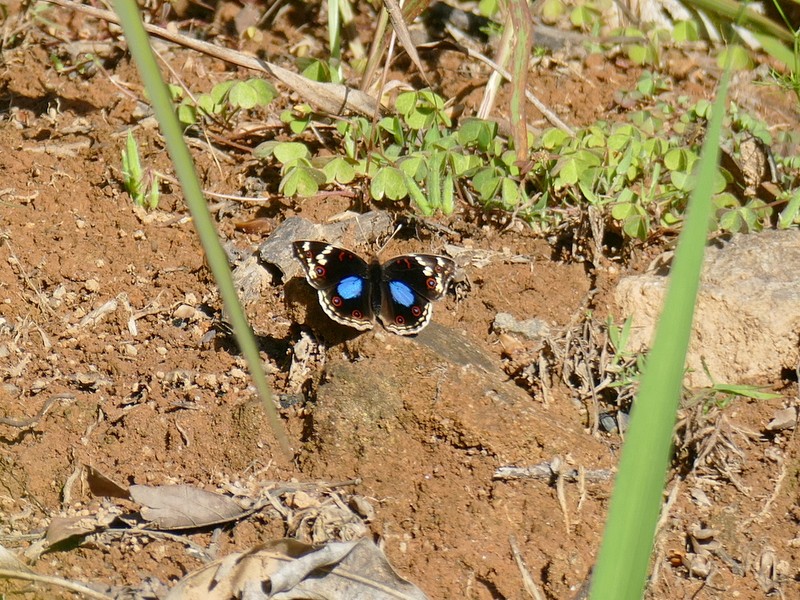
Blue Pansy Junonia oenone Peyeria, Madagascar.

Unidentified nocturnal moth drawn to the lights of the Tambopata Research Centre,
southern Peruvian Amazonia.

Sucking water from the sand by the Rio Madre de Dios, southern Peru.

At Amazonia Lodge, Manu Biosphere Area, southern Peru.

At Huembo Lodge, north-eastern Andes, Peru.

Brilliant Blue Junonia rhadama Lac Alarobia, Tananarive, Madagascar.

 Blue-banded Eggfly Hypolimnas alimena Cairns Botanic Gardens.

Shining Oak-blue Arhopala micale Cairns Botanic Gardens.

Rajah Brooke Birdwing Trogonoptera brookiana Mount Kinabalu NP, Sabah,
Malaysian Borneo. This magnificent creature is even more spectacular than
it looks from this angle.

Satin-green Forester Pollanisus viridipulverulenta Yeldulknie CP, Eyre Peninsula,
South Australia. This iridescent beauty can be blue or green, depending on the angle.
And iridescence is a topic I'll come back to one day.

Unidentified night moth that came to the lights of Owlet Lodge,
north-eastern Peruvian Andes. I think this one's extraordinary.

Turquoise Emperor Doxocopa laurentia Iguaçu Falls, Brazil.
Blue Tiger Tirumala hamata Bundjalung NP, north coast NSW.

Staying with insects, butterflies and moths aren't the only ones with blue wings, though others (including some dragonflies) tend more towards flashes of blue iridescence, rather than permanent blue.
Carpenter Bee Xlyocopa sp. Gomantong Caves, Sabah, Malaysian Borneo.

This dragonfly however, west of Sepilok in Sabah, seems to have solid scales on part of the wings.
In the case of blue in insect bodies, the mechanism seems mostly to involve particles suspended in a waxy layer within the cuticle, above a melanin-darkened background, to reflect and intensify blue light. I have no reason to suppose that any of the blues of the insects that follow don't derive this way, but I don't suppose many of them have been specifically studied either.

Blue Ant Diamma bicolor Orroral Valley, Namadgi National Park, near Canberra.
Despite the name this is a spectacular wingless wasp (which apparently has a
formidable sting). From the shine, this might be a case of iridescence too.

Mountain Grasshopper Acripeza reticulata, Namadgi National Park.
If disturbed she raises her wing covers to expose the dramatic blue and red abdomen;
she wasn't sufficiently worried about me however.

Unidentified grasshopper (by me anyway), Peyeris, Madagascar.

Blue Ringtails (damselflies) Austrolestes annulosus Canberra.

    
Grasshopper, Mt Kupé, Cameroon. I like the blue side bar; I also thought
it was fairly likely you've not seen this one, given where it was.


Tropical Rockmaster Diphlebia euphoeoides, north Queensland.

Frog skin colours are very complex, with often three layers of different cells in the skin. In the case of blues, iridophores sit above melanin-filled melanophores and reflect blue light back.
Ecuadorian Poison Dart Frog Ameerega bilinguis, Sacha Lodge, Amazonian Ecuador.
Fortunately I'm not likely to be putting anyone at risk by attempting to emulate this local guide, who
seems to have developed a resitance to the potentially lethal toxins carried by the frog.
You're not likely to encounter the frog without such a guide to warn you off.
Reptile scales can have similar structures.
Skink, Manglares Churute NP, Ecuador.
Presumably the blue tail is to attract attention of predators, who are
then left with the tail, but no skink. It's one of the most beautiful
skinks I've ever seen.
In lizards, especially dragons (agamids) where males display with bright colours in mating season, the blues can often be switched on and off by contracting the melanin cells below the light-scattering layers.
 
Kenyan Rock Agama Agama lionotusm, Tarangire NP, Tanzania.

Blue-headed Tree Agama Acanthocercus atricollis, Queen Elizabeth NP Uganda.

Australian Water Dragon Intellagama lesueurii, National Botanic Gardens, Canberra.
The large population of these impressive lizards, quite habituated to people, is
a feature of these magnificent gardens.

And I can find no information on how a creature produces a blue tongue, but I imagine the layer priniciple applies here too.
Eastern Blue-tongued Lizard Tiliqua scincoides, Kakadu NP, Northern Territory.
The bluetongue group comprises the world's largest skinks; the blue tongue is part
of a threat display which, unfortunately for them, relies entirely on bluff.
There are very few examples of true blue in mammals. Among them the face and buttocks of male Mandrills are well-known (though other colours complement them), as are the testicle of Vervet Monkeys Chlorocebus pygerythrus. Sorry to lower the tone, though they are very striking...

Male Vervet Monkey, Serengeti NP, Tanzania. This common ground-feeding
monkey is found throughout east Africa from the Horn to the bottom of South Africa.
Blue skin in mammals follows a now-familiar theme, though the structure comprises an array of collagen fibres over a melanin layer.

Which brings us back to birds, in which bare blue skin is not as uncommon as you might reasonably imagine. Here the collagen fibre layers also are the basis of it, though it must have evolved quite separately from the same system in mammals. A perhaps surprising number of birds display an attractive ring of bare skin around the eye. Here is a selection from a wide array of families (meaning they developed it independently of each other, as well as of mammals) and three continents.

Blue-faced Honeyeater Entomyzon cyanotis preening, Griffith, NSW.

Channel-billed Toucan Ramphastos vitellinus Chapada dos Guimarães, Brazil.

Yellow-throated Toucan Ramphastos ambiguus Wild Sumaco Lodge, north-eastern Andes, Ecuador

Chabet Vanga Leptopterus chabert Itafy, Madagascar.

Hoatzin Opisthocomus hoazin, Manu Bioshere Reserve, Peruvian Amazonia.
This is truly one of the most extraordinary birds in the world, which has had
no close relatives for at least 64 million years - about the time the non-bird
dinosaurs unwillingly left the stage.


Little Corella Cacatua sanguinea, Mutawintji NP, western NSW.

Madagascan Paradise Flycatcher Terpsiphone mutata Ankarana NP, Madagascar.

A few bird species have actual blue eyes, whose blueness is (like mine) due to particles suspended in fluid.
Crested Orependola Psarocolius decumanus Sacha Lodge, Ecuador.
These magnificent birds are large tropical members of the North American
blackbird family.
Blue bills, feet and extensive area of skin are all due to the layered collagen structure, and can be quite dramatic.
Blue-billed Duck Oxyura australis, Canberra. Only the males have this impressive adornment.
    
Dusky Woodswallow Artamus cyanopterus, Canberra.
This blue bill is not such a striking feature, but worth looking for.

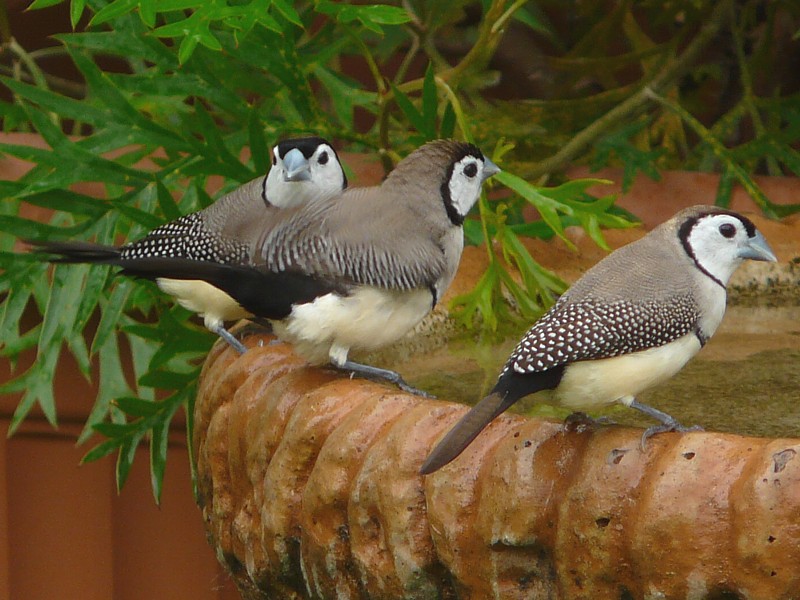
Double-barred Finches Stizoptera bichenovii, Darwin.
Another bird which doesn't flaunt its little blue bill, but it's an attractive accoutrement.
Blue-footed Booby Sula nebouxii, Puerto Ayoras, Galápagos.
Surely one of the most admired bird appendages in the world; they really are amazingly blue.
 
But I'm going to end with an Australian bird, the mighty Southern Cassowary Casuarius casuarius. Only a tropical bird, and a large one (which doesn't lose as much heat as a smaller one) could afford to dispense with all of its head and neck feathers in order to flaunt a truly dramatic colour display.

Southern Cassowary, Mount Hypipamee National Park, north Queensland.
It's not easy to get a clear photo in its rainforest home but I think this
does justice to its featherless finery.

Well that will do us for blue creatures for a while. I hope it's give you something to smile at, and perhaps ponder over. Keep your eyes out for nature's wonderful blues.

Previous post in this series here.

NEXT POSTING THURSDAY 18 MARCH.
And remember that you can get a reminder when the next post appears by putting your email address in the Follow by Email box in the top right of this screen.

I'd love to receive your comments - it's easy and you don't need to sign in!
However, this reminder service is becoming increasingly unreliable and I have
no control over it. I keep hearing of people who are no longer getting
notifications of new postings and I'm losing readership presumably as a result.
You might like to set a calendar alert as a back-up to avoid missing out.
Alternatively, if you'd like to send me an email (to calochilus51@internode.on.net)
I can put together a mailing list to send out whenever a post goes up;
I guarantee never to use your address for any other purpose.

Thank you!