About Me

My photo
Canberra-based naturalist, conservationist, educator since 1980. I’m passionate about the natural world (especially the southern hemisphere), and trying to understand it and to share such understandings. To that aim I’ve written several books (most recently 'Birds in Their Habitats' and 'Australian Bird Names; origins and meanings'), and run tours all over Australia, and for 17 years to South and Central America. I've done a lot of ABC radio work, chaired a government environmental advisory committee and taught many adult education classes – and of course presented this blog, since 2012. I am a recipient of the Australian Natural History Medallion, the Australian Plants Award and most recently a Medal of the Order of Australia for ‘services to conservation and the environment’. I live happily in suburban Duffy with my partner Louise surrounded by a dense native garden and lots of birds.

Thursday, 25 November 2021

Woodswallows, the original grey nomads?

A long time ago, a popular 'getting to know you' game involved a series of  'if you were type of a XXX, what would you be?'. Seems a bit quaint now, but maybe it's still played? Anyway, in my circles at least XXX usually came round to 'a bird'. My answer would usually be 'a woodswallow, because they wander the great inland plains of Australia' - I was then a romantic too. I was also somewhat disingenuous, as only a couple of the six Australian species actually do that, but the person I was talking too probably wouldn't know that. (These days, if asked my favourite bird, and believe it or not it happens, usually on radio, I say 'the one I'm looking at', which is pretty much true, even if unsatisfactory to the enquirer.)

Firstly, and because this is Australia where such confusions in bird names are common, woodswallows are not swallows! From the early days of the Sydney colony the name Wood Swallow was used to distinguish them from 'real' swallows. Their only connection is that both bird groups are superb aerialists, making a living by snatching small insects out of the air. George Caley, the early Sydney botanical collector who reported to Sir Joseph Banks in London, noted that ‘Their resting places were on the stumps of trees which had been felled’, which seem to have spurred the 'wood' part of the name. After a while however many people failed to see the point of this distinction, so for the next century they were just lumped with 'other' swallows. Confusing indeed. 

White-breasted Woodswallow Artamus leucorynchus, Toompine, south-west Queensland.
The silvery-blue black-tipped bill is typical of woodswallows (and of the rest of the family), as
is this habit of perching in the open to watch for passing flying insects.
I also reckon that they typically look very alert, like this, but I guess any bird that survives has to!
So if not swallows, what are they? We now know that they are in the same family as the much bigger Australian magpies, currawongs and butcherbirds, which in turn is an old Australasian family, going back perhaps 45 million years. While we think of that as a recent revelation, in fact it had been suggested long ago. Back in 1907 a connection between woodswallows and Australian magpies had been suggested by William Pycraft of the British Museum; this was largely ignored, but eventually confirmed and extended to currawongs and butcherbirds by Allan McEvey in 1976. McEvey, from the Museum of Victoria, based his conclusions on skeletal studies (as had Pycraft 69 years previously). In particular he noted, uniquely among Australian passerines, a shared strange extension of a cheek bone – a ‘bifurcated zygomatic process’ if you’re that way inclined. For the intervening 70 years however the best Australian ornithologists were admitting they had no idea where woodswallows fitted into the bigger picture. It took the pioneering DNA-DNA hybridisation work of US ornithologists Charles Sibley and Jon Ahlquist in the late 70s and early 80s to settle the question.

Black-faced Woodswallow Artamus cinereus (and orb spider), west of Winton, central Queensland.
This is an inland species, found throughout the continent except for the moist south-east,
but not one of the wanderers.

There are eleven species of woodswallow, all in the same genus, and six of them are Australian. One of these - the White-breasted Woodswallow above - is found as far north as Malaysia and the Philippines. Most of the others are restricted to New Guinea, plus one each in Sulawesi and Fiji.

White-breasted Woodswallow on a wet tropical morning from a hotel window in
Kota Kinabalu, Malaysian Borneo.
The Latin name for the group, Artamus, is a somewhat curious one too. It's Latin for a butcher, or murderer. Seems a bit extreme, though they certainly do away with a lot of insects. But if I was one of their bigger relatives, like a currawong or butcherbird, with a tough reputation to uphold, I might be a bit put out that my little cousin had that fearsome name, while mine translated as 'loud-mouthed' or 'noisy' in both cases! (Strepera for currawong, Cracticus for butcherbird). It comes down to history. In 1771 Linnaeus himself placed the White-breasted Woodswallow in the Old World genus Lanius, the shrikes. Lanius itself is another word for butcher, so when the esteemed French ornithologist Louis Vieillot recognised the error and gave woodswallows their own genus in 1817 he used another 'butcher' word, Artamus. Whether he did this out of respect to Linnaeus, or because he also thought they were shrike-related, is unclear.
Dusky Woodswallow A. cinereus delivering a butcher's meal to chicks
in the nest, Canberra.
Not all woodswallows however go to the trouble of catching their own meals. Kleptoparasitism (what a wonderful word!) is practised by at least a couple of species, and thus probably more. This means stealing someone else's food, and observations have ranged from a White-browed Woodswallow snatching food from a much bigger Black-faced Cuckooshrike about to deliver it to its chick, to various stories of Dusky Woodswallows mugging a range of smaller birds for their hard-earned meals.
This female White-browed Swallow A. superciliosus is definitely catching her own food,
in the form of this locust on the streets of Karumba, far north Queensland.

However there is another, also fascinating, aspect of woodswallow diet. As well as being primarily aerial insectivores, they also forage on nectar and pollen, even to the extent of having evolved brush-tipped tongues like honeyeaters. It seems that they could be important pollinators of some inland plant groups, though I'm not aware that this has been much studied. While all Australian woodswallows sup on nectar from time to time, only the inland nomads, the White-browed and Masked Woodswallows, do so regularly and across their range. But this tongue is a very sophisticated and specific tool, taking up liquid by osmosis like a paint brush, so why is it possessed by species which seemingly rarely use it? Perhaps the ancestral woodswallow was much more nectar-dependant, before its descendants diversified into chasing insects across the skies? If so, why retain it if you're not using it? It's all very satisfyingly puzzling.

Female White-browed (above) and male Masked Woodswallow A. personata hanging out, as
these species often do, at Cobbold Gorge Station near Georgetown, northern Queensland.
The relationship of these two species is another delicious puzzle. They are the only two woodswallow species which specialise in wandering across the vast arid inland plains, following the rains and resources, though drought will bring them closer to the coast to breed, including in Canberra. A thunderstorm in the dry country is likely to bring big flocks of these birds, along with swallows, martins and, in summer, swifts when they are visiting from the northern hemisphere, to feast on the insect hosts caught up in the turbulence. 
 
These woodswallows are usually found in mixed flocks, calling down from the skies. Their calls are indistinguishable to our ears but given our poor aural acuity this doesn't mean much. Significantly and most surprisingly however their mitochondrial DNA cannot be reliably distinguished either. This is not unexpected in species which have only recently separated, but in that case we would expect them to be isolated geographically, or to interbreed readily. Neither is the case here. They often breed in mixed colonies, but rarely if ever form a mixed pair. Most peculiar. Those much more erudite than I cannot explain this situation. Here are some typical flocks of these two species.
White-browed and Masked Woodswallows often gather in large numbers on exposed
branches, flying out to harvest insects. This image and the next are also from Cobbold Gorge.
Masked and White-browed Woodswallows coming to drink at a waterhole.
(And a bonus Budgerigar for the sharp-eyed reader.)
Even this is interesting, as insect-eaters often find enough moisture in their food
and don't need to drink.
Part of a huge flock of these species in western Queensland.
One difference between these two nomads is that Masked Woodswallows are much harder to pin down in a photograph in my experience, but of course that's likely just to be me and is not a reliable taxonomic character! In both species the sexes are distinctly different (which is unlike the other Australian species where they are indistinguishable), the females being a washed-out version of the sharper males.
White-browed Woodswallows during a relatively rare breeding event in Canberra,
at Mount Ainslie NR. Female above, male below.
The most familiar inland woodswallow is the Black-faced, which doesn't seem to move around much, but is spread across the entire continent except for the moist south-eastern strip, coming to the coast especially in the tropics. I love seeing the first ones as we drive west or north-west, as it means we've reached 'the inland' which we love. They are common on the power lines.
Black-faced Woodswallow, Great Sandy Desert, Western Australia.
The least familiar of the Australian woodswallows is the Little Woodswallow, which is rather like a small chocolatey version of the Dusky Woodswallow. I suspect that it isn't that scarce, but it lives where there are relatively few observers, especially in association with cliffs, ranges and rocky outcrops. 
Little Woodswallows A. minor, West MacDonnell Ranges, central Australia.
The snuggling behaviour is common to most woodswallow species - in fact there are
plenty of accounts of up to 200 woodswallows clustered together, clinging to the bark
of a tree, to spend the night. Such roosts have also been reported during the daytime,
even on warm humid days, so it's not primarily about keeping warm.
Yet another sweet woodswallow mystery.
In the south-east the only regular woodswallow is the Dusky, which arrives every spring to breed here from its wintering grounds in Queensland - that is, it is a migrant rather than a nomad. In Canberra it is very familiar in the hill reserves of Canberra, around the urban lakes and in the lower slopes of the ranges, though I don't often see it over suburbia. It has a very distinctive silhouette, with diamond-shaped wings as it soars out from a perch to catch its next snack.
Dusky Woodswallow by Lake Burley Griffin, Canberra.
Dusky Woodswallow feeding chicks, Canberra. This site, in an upright broken spout,
is typical of the species, though other species have other preferences.
The white wing edges and tail tips are prominent in flight.
White-breasted Woodswallows are especially smart I think (speaking only of their attire, not their intellect). They are found throughout the eastern inland, west to central Australia, and are found around the northern coastline from about Sydney to Shark Bay in Western Australia. Inland they are nearly always associated with water. 
White-breasted Woodswallows, Winton, central Queensland.
These photos were taken just a few seconds apart, and I loved the sudden switch of
focus to their right as something caught their attention.
White-breasted Woodswallows at Neweys Reserve, Cobar, central western NSW.
They are especially snuggly, even for woodswallows.
It's hardly a secret - especially now - that I'm a huge fan of woodswallows, old Australians which I find especially characterful. I hope you enjoy them too, and that maybe I've even given you a couple more reasons to do so. Enjoy summer (or winter, depending on where you are).

NEXT POSTING THURSDAY 16 December
I love to receive your comments and in future will be notifying you personally by email when a new posting appears, if you'd like me to. All current subscribers have been added to this mailing list and have already been contacted.
This will mean one email every three weeks at the current rate of posting. 
I promise never to use the list for any other purpose and will never share it.
Should you wish to be added to it, just send me an email at
calochilus51@internode.on.net.
You can ask to be removed from the list at any time,
or could simply mark an email as Spam, so you won't see future ones.
Thank you!

Thursday, 28 October 2021

Tidbinbilla; Canberra's favourite picnic spot. And much more!

When I arrived in Canberra to live over 40 years ago, Tidbinbilla was well established as a place you took your visitors, especially if they were from overseas - as many were, be they diplomats, academics, scientists, government officials or tourists. Canberra is the national capital after all and 'Tid' is just 40 km from the city centre. Back then of course it was much more of a rural drive - the suburbs have marched much further south in the intervening decades, but despite periodic pressures it's hard to imagine any government daring to allow the urban tide to cross the Murrumbidgee River. 

Despite being familiar to so many generations of Canberrans, Tidbinbilla is also a much-misunderstood concept. The ranges that surround the Tidbinbilla Valley on three sides are visible from all over Canberra, but are near-universally misidentified as the Brindabellas, which form the high western spine of the Australian Capital Territory (ACT) and are mostly hidden from view by the Tidbinbillas.

Looking further south-west from the south-western edge of the suburb of Duffy, (just around
the corner from where we live) across the remnant woodlands of the plains.
The Murrumbidgee flows in front of the low forested Bullen Range, behind which is
the Paddy's River Valley. Finally the snow-dusted peaks and ridges of the Tidbinbilla and
Gibraltar Ranges rise on the horizon. (They are only sporadically snowy in winter -
this photo was taken in June.)

Another view, from nearby Cooleman Ridge Nature Reserve. This higher angle shot
shows more clearly the distinction between the Bullen Range in the foreground
and the Tidbinbillas behind.

Parts of the area have been reserved, albeit somewhat informally, since the 1930s, primarily for wildlife enclosures - the 'zoo' theme continued until relatively recent times. Freehold land was acquired as the basis of a formal reserve in the early 1960s and the Tidbinbilla Nature Reserve was gazetted in 1971 under Federal legislation. Since self-government in 1988 the reserve has been managed under ACT legislation. The reserve is fairly modest in size, covering slightly less than 6,500 hectares, but it is contiguous with the far larger Namadgi National Park (106,000ha) and through it with the rest of the Australian Alps National Parks system in NSW and Victoria.

Map of southern ACT, with Tidbinbilla in teal, indicated by the red arrow, and
Namadgi NP in blue and brown. The green curve north-east of the red arrow
marks the approximate southern limit of suburbia. Map per ABC.

The use of Tidbinbilla by visitors varies dramatically from person to person. A large proportion of them probably go no further than the excellent picnic areas and playground not far inside the entrance. Many do the circuit drive indicated on the map above and quite a few of these visit the fenced Sanctuary in wet forest - more below. Some use the truly lovely walking tracks in wet forest at the foot of the range and a few do the longer, more demanding walks on walking tracks and management tracks up to the ridges.
The entrance, off Paddy's River Road.
The excellent Visitors' Information Centre (built to the highest bushfire safety standards).
 
Lovely carving of Brush-tailed Rock-Wallbies outside the information centre;
until the 1950s they were common in the ranges here. Now there is a captive
breeding program for them at Tidbinbilla.
Much of the circuit drive is through the open valley encircled by ridges on both sides and at the end of the valley.
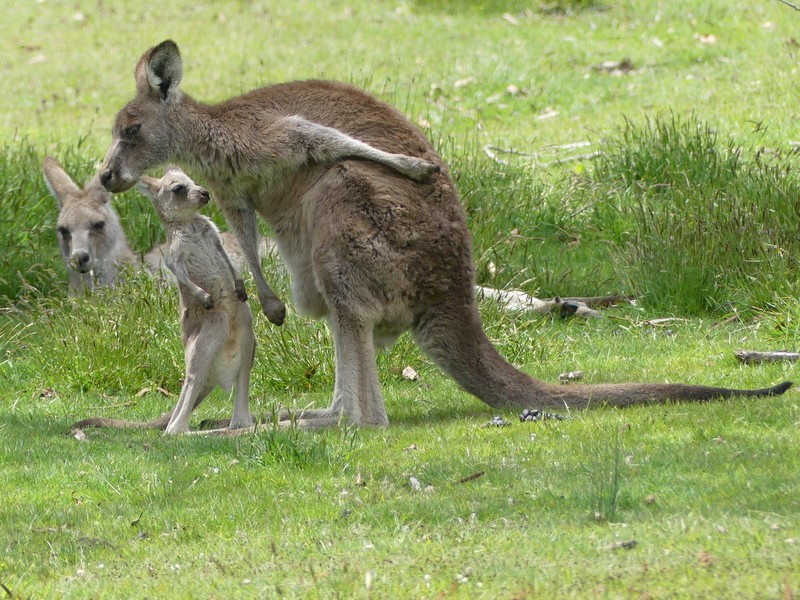
Typical view from the road - and the Eastern Grey Kangaroos are numerous and totally blasé about
visitors. The valley floor was partially naturally treeless, due to the frost hollows along the
stream lines, but small landholders cleared the surrounding trees and shrubs to make
more space for their grazing animals.
Young joey, just out of the pouch.
Looking north up the valley to the Tidbinbilla Range; the circuit road runs right along the foot
of these mountains.
Tidbinbilla in a very different mood - and this was in drought too, in 2015.
Looking back to the north, out to the plains, from an elevated site along the drive.
A feature of the reserve is the massive granite tors which dominate parts of the skyline along the ridges. The older underlying rocks were formed by layers of sediments in deep oceans some 460 million years ago, in the Ordivician. The tors are newer, from when the massive Murrumbidgee Batholith (a vast 'blob' of molten magma) forced its way through the older material during the late Silurian, 417 million years ago. As the softer sediments eroded away the tors became exposed. Some are enormous.
Tors in the Gibraltar Range, east of the valley.

Views of the huge granite pile known as 'Hanging Rock', above and below,
readily reached from a short walking track by the circuit drive.

The shelter formed by a vast overhang; this area was doubtless of great significance to
the people who lived in this area from at least 20,000 years ago, at the time of
the last glaciation.
Granite outcrops in Ribbon (or Manna) Gum, Eucalyptus viminalis forest.
This is the dominant tree in much of the wet eucalypt forest on the lower
slopes of the ranges.

Old Ribbon Gum in regenerating forest. Most of Tidbinbilla (along with
70% of the whole ACT) was burnt in the great fires of 2003, and is still recovering. In January 2020 another fire, totally unnecessary, and caused through remarkable carelessness by an outside agency, burned 80% of Namadgi, and 22% of Tidbinbilla, though in Tidbinbilla this one was mostly in the ranges away from the areas frequented by most visitors.

The drier forests have vegetation which is quite similar to that of the forested hills around Canberra, so the relatively few plant photos I have from Tidbinbilla are either in grasslands or the wet forests.

Yellow Rush Lily Tricoryne elatior in moist grassland behind the Visitors' Centre.

Parson's Bands Orchid Eriochilus cucullatus, also in wet grassland.
And here are a couple from the wet forests of the walking tracks past the big Koala enclosure. That area was ferociously burnt in 2003, and while of course it is recovering I've never really been minded to take many photos of the forests since, preferring to remember them as they were.

Snowy Daisy Bush Olearia lirata. A small tree, one of the biggest daisies,
gleaming white in the wet forest understorey in late spring.

Bristly Helmet Orchid Corybas (or Corysanthes) hispidus. I love the strange little helmets,
lurking in dim wet places, and mostly flowering in autumn or winter.
These conditions are also good for greenhood orchids too.

Montane Leafy Greenhood Pterostylis (or Bunochilus) montanus.
Summer Greenhood Pterostylis (or Diplodium) decurvum.
Maroonhood Pterostylis pedunculata. This one can grow in colonies of hundreds of plants.
The wet forests are also rich in fungi, especially in a wet autumn. Here are a few examples, mostly from one April walk a few years ago.
Velvet Parachutes Marasmias (or Collybia) elegans growing from
a burnt tree trunk.
Rosy Rozites Cortinarius roseolilacinus, a large fungus, beautifully coloured.
My initial assumption was that it had been nibbled by a wallaby, but Susan (see comments
below) tells me that this genus is toxic to mammals, so the nibbler is more likely
to have been a slug. I always appreciate learning things from my readers!
Yellow Navel Lichenomphalia (or Omphalina) chromacea.
Puffball (any of several possible genera) 'puffing' out thousands of minute spores.
Salmon Coral Fungus Ramaria formosa.

Finally, to the Sanctuary. This was a great idea that arose from post-2003 fire recovery planning. Basically it took an existing substantial area of forest, already fenced to contain kangaroo species in particular (not all of which were native to the area) and greatly enhanced it through design. The fence is now predator-proof to allow reintroductions of locally extinct species such as bandicoots and potoroos and an existing weir on the Tidbinbilla River has been used to maintain a series of quite large downstream ponds. A 2.1km wheelchair-accessible walking track (plus side tracks) provides a circuit around the water and through the forest. There is an emphasis on education via signage - and originally strongly complemented by a large number of intensively trained volunteer guides. The excellent Australian Conservation Volunteers organisation provided high quality training and provided ongoing support for those who graduated. 

It worked well but sadly financial exigencies, whether driven by necessity or changed priorities, drove the Department to bring the training and day to day operation in-house, with the result that the whole program collapsed. For some time there were no annual training intakes, no support and few if any of the scores of trained guides persevered. It was for a while a sad loss and a very false economy indeed, but I am assured that things have taken an upturn again (within the constraints of COVID) and there are again dedicated and trained volunteers, though not yet as many as before and they are not all deployed in the Sanctuary. However it is certainly an important step or two back in the right direction.

The eight million dollars spent on the original consultancy to plan and build the infrastructure was certainly not wasted and many visitors (including us) visit regularly.

Looking out from a viewing platform near the entrance to the Sanctuary,
through the forest to the ponds.
From there the track descends to pass alongside the ponds.

Part of the excellent wheelchair-friendly track.
Scattered along the track are some very compatible sculptures, both of recycled metal and wood; here are some examples which we like. I'm not a fan of human artefacts in truly wild places, but these seem appropriately complementary to me.

This eagle is viewed through a gap in the roof of the shelter at the viewing platform
mentioned above.
Pelican, just metres from the water where the real ones live.
Likewise the metal platypus.
This rock-wallaby references the nearby breeding colony, which supplies
wallabies for release in areas (mostly in Victoria) where they used to live.
The hope is that one day this will include the ACT, but that will require effective fox control.
And Red-bellied Black Snakes, slow and placid (unless you're a frog or lizard)
are regularly encountered along the walkway.
There are some animals present which have been released into the Sanctuary, though anomalies such as arid land Red Kangaroos are no longer here.
Actually the Magpie Geese Anseranas semipalmata are pretty anomalous; they used
to be fairly common in southern wetlands (and can still be seen occasionally to the west
of here) but there are no records that I'm aware of from the ACT, and they wouldn't
have come to the mountain forests. However they have been kept at Tidbinbilla for a long time.

Another tradition has been the presence of a lone male Musk Duck Biziura lobata in Tidbinbilla ponds.
The original bird, known part-affectionately as Ripper, was notorious for hunting other waterbirds
(it's something Musk Ducks do) but I doubt that the current 'Ripper' is the same bird.
They engorge the flap beneath the bill with blood and perform dramatic and noisy
courtship rituals on the water; it has been suggested that these helped enforce the Bunyip
legends amond earlier European settlers.

As mentioned earlier, the predator-proof fence has enabled the reintroduction of
locally extinct small mammals such as Southern Brown Bandicoots Isoodon obesulus,
which seem to be thriving and are active during the day.

However of course there are many other naturally occuring species that also thrive in the sanctuary. Some rely on the ponds and associated waterways. The most eagerly sought of these are the resident Platypuses - Tidbinbilla is without doubt the Platypus-sighting hotspot of the region. (Though a respected reader - see the first comment below - suggests the Queanbeyan River from weir to suspension bridge merits an equal claim. I won't argue.)

A little patience will almost certainly reward you with at least a distant view of a Platypus lolling
on the water, but they will often also swim near the paths. Rakali, or native Water Rats, are
also present, but the flat bill and tail of the Platypus, and the curious rolling dive with which
they disappear are characteristic.

Eastern Long-neck Turtles Chelodina longicollis are present all year round, though will
go into torpor in cold spells (such as most of winter!). However they can often be seen
sunning on logs or rocks, as well as in the water.

Australian Pelicans Pelecanus conspicillatus come and go, but some are generally present.
This one was bathing vigorously to maintain good feather condition.

Australian Reed Warblers Acrocephalus australis are annual migrants from the north,
arriving in spring to breed in reed beds throughout the south-east, including Tidbinbilla.

Southern (or Yellow-bellied) Water Skinks Eulampris heatwolei can be seen
everywhere on warm days, flicking over logs and rocks, or just basking.
Mostly they're pretty alert, like this one.

This one however was not paying due care and attention, providing this
Red-bellied Black Snake Pseudechis porphyriacus with brunch.
The paths of the Sanctuary are good places to observe, in complete safety,
these good-natured snakes going about their business. There are no records of
people dying from a bite from this teddy bear of a snake.
I'm going to end very soon with my favourite Tidbinbilla Sanctuary reptiles, but a couple of bush birds first; these you're likely to find on any walk in the Sanctuary, at least in the warmer months.

Male Rufous Whistler Pachycephala rufiventris. Another spring migrant, breeding
on the hills around Canberra and in the ranges. Their song is part of the spring
soundtrack of Tidbinbilla.
White-eared Honeyeaters Nesoptilotis leucotis are present all year round,
though they move up and down between plains and mountains with the seasons.
Like for their ringing melodious 'chock' call, like a low-pitched guitar chord.
Alongside the viewing platform near the entrance to the Sanctuary is a huge boulder stack immediately on your right. Most visitors walk past it to the view, but I always linger a bit here, as it is home to a family of big Cunningham's Skinks Egernia cunninghami. They live in the crevices, where their spiny tail discourages predators from entering after them; they also puff up their bodies to wedge themselves safely in. Even on a cool sunny day there are often a few of them basking on their relatively warm rock surface.
I have a particular fondness for these lizards, having kept some in a big outdoor enclosure
when I was a child; that was before you needed a permit to do so. They have some unusual
social characteristics too. For instance males are apparently entirely monogamous.
They are also highly sociable, unlike most lizards, living in large social groups.
I can't imagine a year when we wouldn't make several trips to Tidbinbilla, to walk the tracks, to look for flowers and birds, to search for Platypus or visit the Cunningham's Skinks in the Sanctuary, or to picnic in one of the many quiet and leafy places available. In summer (during daylight saving hours) the reserve is open until 8pm, and we will sometimes dine there before coming home in the evening. It's a special place and deserves your attention, whether you live in Canberra or are just visiting.

NEXT POSTING THURSDAY 25 November
I love to receive your comments and in future will be notifying you personally by email when a new posting appears, if you'd like me to. All current subscribers have been added to this mailing list and have already been contacted.
This will mean one email every three weeks at the current rate of posting. 
I promise never to use the list for any other purpose and will never share it.
Should you wish to be added to it, just send me an email at
calochilus51@internode.on.net.
You can ask to be removed from the list at any time,
or could simply mark an email as Spam, so you won't see future ones.
Thank you!