About Me

My photo
Canberra-based naturalist, conservationist, educator since 1980. I’m passionate about the natural world (especially the southern hemisphere), and trying to understand it and to share such understandings. To that aim I’ve written several books (most recently 'Birds in Their Habitats' and 'Australian Bird Names; origins and meanings'), and run tours all over Australia, and for 17 years to South and Central America. I've done a lot of ABC radio work, chaired a government environmental advisory committee and taught many adult education classes – and of course presented this blog, since 2012. I am a recipient of the Australian Natural History Medallion, the Australian Plants Award and most recently a Medal of the Order of Australia for ‘services to conservation and the environment’. I live happily in suburban Duffy with my partner Louise surrounded by a dense native garden and lots of birds.

Thursday, 14 April 2022

Weddin Mountains; a national park above the plains

North of Canberra, and a bit to the west, is an arc of four parks rising out of the plains of the western slopes of New South Wales. The western slopes comprise a broad belt of woodland (now mostly cleared for agriculture) falling gently to the west between the Great Dividing Range near the coast, and the vast inland semi-arid plains which stretch for thousands of kilometres to the Indian Ocean. The rich deep soils attracted graziers and farmers and the only reserves of any size are based on steep rugged ranges, unsuitable for agriculture, and the surrounding woodland fringes. The woodlands and grasslands of the plains in which the ranges stand are probably the most altered of any NSW habitat.

From outside looking in. Weddin Mountains NP from the north-west;
this photo sets the scene for the isolated park. The highest point from this angle is
Eualdrie Peak which, at 733 metres asl, stands some 400 metres above the surrounding plain.
The range dominates the nearby regional centre of Grenfell, a former gold town.

From inside looking out. The view from Peregrine Lookout on the eastern side, looking north-east.
Beyond the fringe of woodland at the base of the range are paddocks with scattered trees,
glowing yellow with canola crops.

And another from the park looking out, this to the north-west from Ben Hall's Cave.

This rocky overhang is reached by an easy climb from the camp site. It is reputed that
the bushrangers used this as a lookout over the plain to watch for approaching police.

Map of Weddin Mountains NP, from the excellent (but sadly out of print) National Parks Association's Guide to National Parks of Southern NSW (1996). You'll see it better if you click on it. Grenfell
is approximately 15k to the east, and the curved range is 19k long. The north and eastern sides
feature steep cliffs, while the western and southern sides slope more gently but are deeply
cut by creek gullies.

There are two campgrounds, one (now known as Ben Hall's Campground) is on the north-western edge marked Seaton's Camp on the map above, the other is at the end of Holy Camp Road in the north-eastern sector. This is a walk-in camp ground with no specified sites, at a spot where people go to picnic and begin a popular walk. Our preference is for Ben Hall's, which is very spacious with individual fairly well-spaced sites and lots of shady trees, especially spreading Kurrajongs.

Weddin Mountains, plus Conimbla, Nangar and Goobang National Parks to the north, are part of the larger Lachlan Fold Belt, a band of sandstones and shales laid down as the Hervey Terrestrial Basin under a shallow sea some 350 million years ago, and then lifted and twisted. Vast periods of erosion has left harder sections as ranges and outcrops above the plains. Until the end of the 19th century this was the land of the Wiradjuri people whose country stretched right across the plains. Their dispossession began in the early 1830s and was completed long before the end of the century. Folk heroes, the bushrangers Ben Hall, Johnnie Gilbert  and Frank Gardiner, with associates, are closely associated with the range. A modest 8300 hectare Wildlife Refuge was gazetted in 1962, and declared a national park in 1971,

Enough background, let's go there! The sandstone ridges form a constant backdrop - all photos are from the Ben Hall's Cave area unless specified otherwise.

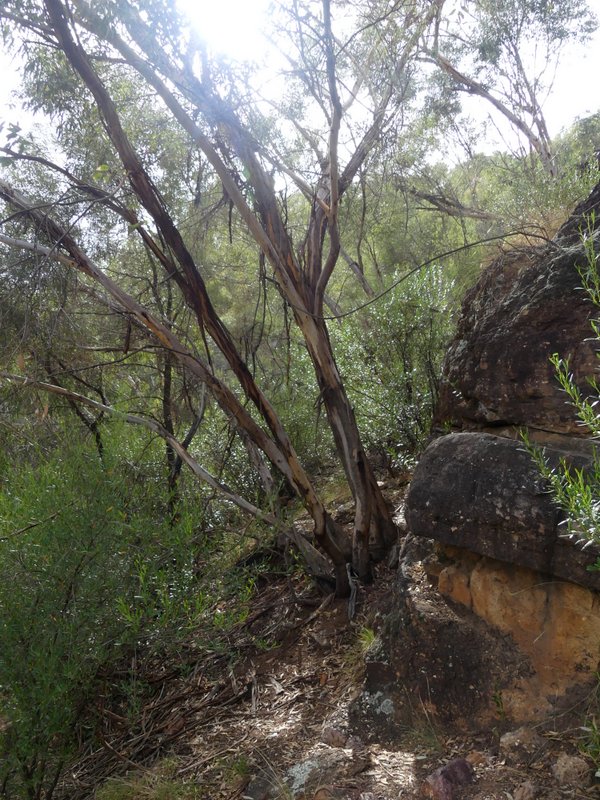
I love the glimpses of the sandstone through the trees that can be encountered anywhere.
In some areas stubbornly erosion-resistant sandstone outcrops loom in the woodland floor.

This is a well-known outcrop - and truly massive, metres tall - by the walking track from
the end of Holy Camp Road through an open-ended amphitheatre and up the range to
Peregrine and Eualdrie Lookouts.

The woodland in this amphitheatre is typical of much of the lower regions of the park, being dominated by Mugga Ironbark Eucalyptus sideroxylon and Black Cypress Pine Callitris endlicheri.

Black Cypress Pine and the majestic Mugga Ironbark in the Holy Camp section of the park.
The Black Cypress can also form dense stands of forest in its own right.
Black Cypress stand on the Ben Hall's Cave side; the dense stands of native grasses
(from a very recent trip there) are by no means typical over time, but a response to the current
wet La NiƱa phase of the cycle.
Also present is White Cypress Pine Callitris glaucophylla, named for the dusty bloom on the foliage.

White Cypress, with its termite-resistant timber, supports a forestry industry
in this part of the world, with significant state forests put aside for the purpose.
The entire park was burnt in the summer of 1974-5, and the northern half in January 2006. We were pleased to see quite vigorous cypress regeneration in the grassy areas near Seaton's Farm (by the Ben Hall's Cave campground). While cypress is fire-sensitive, some of this area was probably also cleared while it was part of the 60ha Seaton's Farm, founded by Jim Seaton in the 1930s and run by him and Bertha from when they married in 1948. Jim died in 1983 and Bertha sold the land to the parks service.
Regenerating cypress seedlings, spurred by the recent rains.
Such woodlands can be surprisingly diverse in tree species for those unaccustomed to them.
Blakely's Red Gum Eucalyptus blakelyi woodland; again note the healthy grassy
understorey. This is a key component of the critically endangered grassy
woodland type of the slopes.
Fuzzy Box E. conica; this is one of the very few parks which contains this species,
and it's quite common here.
Dwyer's Mallee Gum E. dwyeri, growing right alongside Ben Hall's Cave.
This small eucalypt, often in multi-stemmed mallee form, is most at home
on rocky hillsides on the western slopes.

Kurrajongs Brachychiton populneus are among my favourite trees, and grow profusely
and healthily around the Ben Hall camp ground. Jim Seaton planted them all over his
property too, well knowing their value as stock food during drought when branches
are lopped, a practice still widely practised. (More about Kurrajongs here, though it
could probably do with updating some time.)

During the warm afternoons we were happy to seek the shade of the
Kurrajongs alongside our camp.
There was obviously a splendid flowering there this summer, though it was rapidly drying out by the time we got there. There were vast areas of drying everlasting daisies and a few fresh flowers, including the ever-reliable bluebells.
Wahlenbergia sp, perhaps stricta, growing in a profuse scramble in the Ben Hall campground.
One we were very pleased to have only just found before it dried out completely was represented by a couple of flowering spikes of Garland Lily Calostemma purpureum in a wet shady spot by a creek near our campsite.
 
Garland Lilies are in the family Amaryllidaceae(ie with daffodils). It grows on flood plains
but apparently also on ridges, west from here into South Australia.
The Holy Camp side is noted for its orchids and, while we didn't see any this time, here are a couple from a previous (spring) visit. This far inland orchids aren't as prolific as they are nearer the coast, so all the more welcome. 
Sikh's Whiskers (or more prosaically but possibly more safely Boorman's Rusty Hoods
Pterostylis boormanii), a striking inland greenhood.
Scented Sun Orchid Thelymitra megacalyptera.
For a park renowned for its birds, we didn't see as many as we expected on this occasion, and I don't seem to have many photos from previous trips either - something to rectify in the future! Ones we did see regularly included the local family of Apostlebirds Struthidea cinerea which paraded through camp, commenting loudly on everything and ducking for cover under the trailer when harassed by the local magpies.
Apostlebirds are uniquely Australian (in a family shared only with White-winged Choughs),
mud-nest builders who are among the most developed cooperative breeders in the world.
Common Bronzewing Pigeon Phaps chalcoptera high in a tree, showing off its iridescent
wing panels. A common bird but always good to see.
From camp we could see resident Wedge-tailed Eagles Aquila audax soaring over and along the ridges, thrilling!
Young Wedge-tail (older birds are dark above) just above the treetops...
... and showing its distinctively fingered wingtips and diamond-shaped tail
(I really can't accept that it's wedge-shaped) as it soared overhead.
And of course they're far from the only raptors present.
 
Peregrine roosts, marked by streaks of white droppings, on the cliffs on the way
to Peregrine Lookout, naturally enough. We've seen them soaring below the lookout.
And a very poor photo of a very common bird, but it comes with a story.
Willie Wagtail Rhipidura leucophrys disposing of an Australian Painted Lady.
The previous day while driving down a back street of Grenfell we'd been startled
(and perhaps a little shocked) when a young Collared Sparrowhawk fluttered briefly in
front of us, nearly over the bonnet, then plunged onto a luckless Willie Wagtail which may
also have been young, but clearly wasn't paying due care and attention. The incident and the
one with the butterfly reminded us of just what a food chain means -
one day a Willie is a victim, the next a predator. Should we have felt sorrier
for the dead Willie than the dead butterfly? Take your time...
Of course there are plenty of reptiles, active according to the weather, from very large to very small.
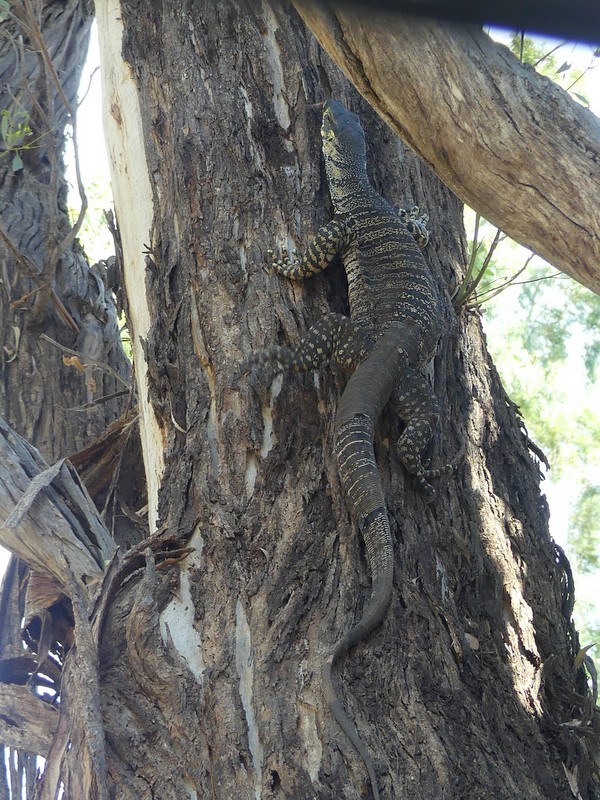
Lace Monitor Varanus varius on an ironbark, near the Holy Camp carpark.
It has nearly finished shedding its skin - patches of old skin are left on the tail,
especially at the base.
Young Bearded Dragon Pogona barbata among Jim Seaton's home-made fencing
(from salvaged scraps of wire) at Seaton's Farm.
Another young dragon, this time a Jacky Lizard Amphibolurus muricatus, on
the track just below Ben Hall's Cave.
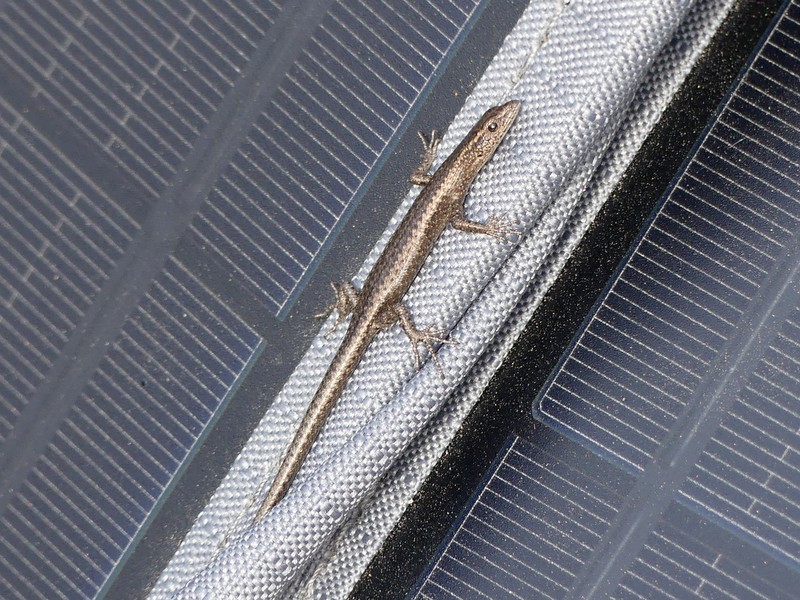
And yet another youngster I think, though I've not identified this little skink yet.
To give you some idea of its size, it was on our solar blanket (a flexible sheet of
solar panels) featured in the photo of the camp site above, though that might not help much.
The weave on the cloth might be of more use.
And naturally, especially after such a wet summer, lots of smaller creatures (including many mosquitoes).
Australian Painted Lady Vanessa kershawi, which were present in huge numbers.
Their preferred larval food plant is everlasting daisies, of which there was
a virtually infinite supply present.
Heliotrope Moth Utetheisa pulchelloides. This is a striking, common little moth which even
amateurs like me can readily identify! Its main food plant now is probably Paterson's Curse
Echium plantagineum, an abundant weed which is much commoner than the native
members of the family Boraginaceae on which it evolved.

Another moth which we didn't see, though its larvae were all around us, was the Kurrajong Bag Moth Dichocrocis clytusalis whose 'bags' were adorning the Kurrajongs, especially younger trees.

The caterpillars bind the leaves with silk to make the bags, then live in silken tubes
within them, emerging at night to feed on the leaves, leaving only skeletons. The couple
of bags I opened seemed empty apart from the frass (droppings), which makes
sense as the adults appear in autumn. We didn't see any of them, so most were
probably still pupating.
Small Kurrajong covered in the bags. The tree is still healthy, and its
ordeal is pretty well over until next summer.
And of course, this wealth of small prey means plenty of predators.
Wandering Ringtail Austrolestes leda, a widespread damselfly.
I had a lot of trouble identifying this apparently distinctive dragonly until my friend
and dragonfly guru Harvey Perkins informed me that it's a young male
Scarlet Percher Diplacodes haematodes. The only dragonfly field guide doesn't
mention this minor detail - below is a photo I took of an adult male elsewhere
to show you why I was confused!

Adult male Scarlet Percher, Central Australia - this is a very widespread species,
found throughout Australia and extending north to Timor, New Guinea and New Caledonia.
Orbweb spider Araneus sp. This is a very large genus, with some 85 species
in Australia and 650-odd worldwide.

Another orbweb, Nephila sp. I assume, though neither the light or my lack of
expertise are helping! If you click on the photo to enlarge it, you'll see the
tiny male cautiously approaching her from above to mate. His chances of surviving
the encounter are slim.
But, harking back to the sparrowhawk/Willie Wagtail/butterfly food chain, spiders turn out to be far from the top of this particular pyramid.
A small spider wasp Fabriogenia sp., Family Pompilidae. She specialises in
spiders, especially big huntsmen, which she disables with a sting and stores in a mud cell previously
prepared (each one takes about day) and lays an egg on it. The grub which hatches grows by eating
the living spider. At least some species bite the spider's legs off to immoblise
it; this would be irrelevant if the spider were paralysed (as most are) but these wasps only temporarily
incapacitate their prey. By the time it recovers it is locked into the mud cell.
Unpleasant to contemplate I must agree.
The most dramatic event however took place mostly on the wooden picnic table provided with the campsite. For a long time a female wasp of a different spider-hunting family, Sphecidae, the thread-waisted wasps, dragged a paralysed orbweb spider around while she presumably searched for the mud cells she'd have previously constructed. She spent quite a bit of time looking in the gaps between the table-top planks but we never did see where she'd placed them - unfortunately she didn't seem to know either! It was fascinating to watch but a bit frustrating to not know how it turned out.
Slender Mud-dauber Sceliphron laetum with paralysed orbweb spider,
destined to be wasp baby food.
And of course many animals, including Willie Wagtails, eat wasps...

The Weddin Mountains are an excellent place to spend a day or three; as we are able to move around again, please put them on your to-do list - you won't regret it.

NEXT POSTING THURSDAY 5 MAY

I love to receive your comments and in future will be notifying you personally by email when a new posting appears, if you'd like me to. All current subscribers have been added to this mailing list and have already been contacted. This will mean one email every three weeks at the current rate of posting. I promise never to use the list for any other purpose and will never share it.
Should you wish to be added to it, just send me an email at calochilus51@internode.on.net. You can ask to be removed from the list at any time,or could simply mark an email as Spam, so you won't see future ones.
Thank you!

Thursday, 24 March 2022

Feather Care; it's life or death

A feather is a truly wonderful thing. Birds, the most numerous group of land vertebrates, owe their spectacular success to their feathers, which evolved from the scales of their dinosaur ancestors. The original function of these finely-divided scales was to provide insulation by trapping a layer of air around the owner's body (like the principle of double-glazed windows). In time they developed further to enable flight (one of only four times this has happened in the history of life on earth), and to form the basis of sometimes spectacular courtship displays. (And I have that in mind for a future blog post too.) Small wonder then that a considerable part of every bird's day is devoted to high-grade care and maintenance of its feathers. 

I don't want to spend a lot of time on the feathers themselves, though it wouldn't be hard to do so, but I do need to show you the basic structure, so you can get a better idea of what the birds in the following photos are actually doing.

This shows the basics of a feather (which I found on an outback roadside, in this case
the former property of an Australian Bustard). The most important single point
is that a feather isn't a solid vane, but comprises hundreds of fine barbs growing
from the central quill (or rachis).

If you click on this close-up to expand it, you can see the individual barbs.
What you can't see without a microscope is that the barbs are 'zipped' together by
rows of barbules along each side of the barb, lined with hooks along each edge,
which mesh like velcrose. If you gently pull on the feather to make an opening
like the one on the right, you can feel the resistance as the zips are opened.
If you run your fingers along the opening you will rezip the barbules.

And every bird must spend a considerable amount of time every single day in feather maintenance, including 'rezipping' every feather. Here are just a few of many photos I could have chosen, in a wide range of different birds, showing the attention to detail associated with the daily preen. The first three clearly show a single feather being rezipped.

Black Swan Cygnus atratus, Pambula, south coast New South Wales.
This bird is moulting its flight feathers, so is temporarily unable to fly.
Eurasian Coot Fulica atra, Canberra, attending to its wing feathers.
Yellow-billed Spoonbill Platalea flavipes, Jerrabomberra Wetlands, Canberra,
also paying careful attention to its crucial flight feathers.
 
Mistletoebird Dicaeum hirundinaceum, Milang, South Australia,
conscientiously working on his secondary flight feathers.
However there are very many more smaller feathers which play other roles, equally important, especially the contour feathers which cover the entire body and provide streamlining. These include the coverts which cover the base of wing and tail feathers, and the ear openings. Beneath the body contour feathers are fluffy down feathers for insulation. All of these also require care, but much of this preening occurs beneath the layer of feathers so it's not easy to see the detailed action. It's obvious what the bird's doing though! Much of this activity occurs during the day when the bird's finished its morning feeding, and while so occupied it can become quite absorbed in its work and relatively unaware of us watching it.
Blue-faced Honeyeater Entomyzon cyanotis, in a street tree in Griffith, NSW.
Brown Pelican Pelecanus occidentalis, Puerto Ayora, GalƔpagos,
low in a mangrove in the port.
GalƔpagos Flightless Cormorant Nannopterum harrisi, Isla Fernandina, GalƔpagos.
Obviously it doesn't need to work on its flight feathers, but insulation is critical in
the cold waters of the Humboldt Current.
Little Raven Corvus mellori, Kosciuszko National Park, NSW.
Again this bird was quite close to us, but engrossed its task.
Spinifex Pigeons Geophaps plumifera, indulging in some group preening near Alice Springs.
Many species, especially waterbirds, use an oily secretion from a gland on the back to spread on the feathers. This not only cleans but assists with waterproofing and acts as protection against fungi and bacteria, while keeping the feathers flexible.
Male Australian Darter Anhinga novaehollandiae taking preening oil from the gland at the base
of his tail, before anointing his feathers with it.
As an alternative, many birds utilise powder down, derived from special feathers which grow constantly and never moult, and whose tips crumble into a talc-like powder which is used for cleaning and conditioning.
 
These Southern Mealy Parrots (or Amazons) Amazona farinosa,  here at Blanquillo Clay Lick
in the Peruvian Amazon basin, are so named for their abundance of powder down,
‘mealy’ meaning ‘floury’.
Not all preening is done with the bill however. Many species in a range of families have a serrated edge to the claw on the middle toe, which is used to ‘comb’ those feathers which can't be reached by the bill, to remove dirt, lice and used powder down.
 
Pacific Heron Ardea pacifica, in Grenfell, NSW, scratching a part of her body which is
inaccessible to her bill. The use of the middle (front) toe is clear.
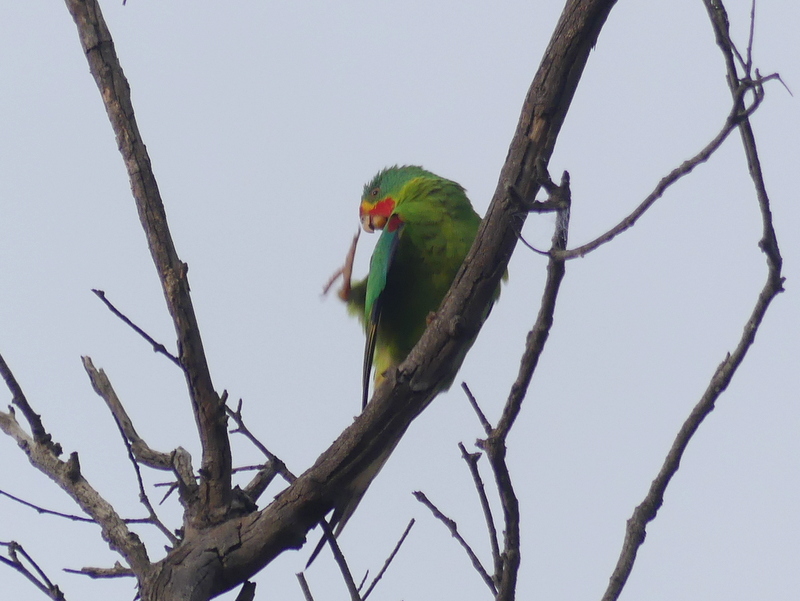
Swift Parrot Lathamus discolor scratching its face, Callum Brae NR, Canberra.
It was an exciting time when a flock of at least 60 of this beautiful but Critically Endangered
little parrot spend some weeks in this woodland reserve in suburban Canberra in May 2021.
Olive-backed Oriole Oriolus sagittatus scratching, somewhat awkwardly, in a backyard tree
in Nowra, NSW.
A Golden-headed Cisticola Cisticola exilis which emerged from its reedbed habitat
at the Jerrabomberra Wetlands in Canberra to have a good scratch.
Equally essential to a feather's well-being - and thus to its owner's - is regular bathing, to remove dust, feather particles and perhaps parasites. All birds practise this regularly, even in cold climates or weather, which tells us that cooling isn't the main purpose (though of course in some situations it can be.) 
Austral Negrito Lessonia rufa, Argentinian Patagonia. She is bathing in a stream
fed by a nearby glacier, at 50 degrees south, so staying cool is not her chief issue!
May in Canberra isn't quite that cold, but this Eastern Rosella Platycercus eximius
wasn't trying to escape the heat either.
Any shallow water can be used, from the edges of a lake...
Red-rumped Parrot pair Psephotus haematonotus, Lake Cargelligo, central NSW.
... to a small rockhole in the desert...
Crimson Chats Epthianura tricolor at Willie Rockhole, near the edge of the
Great Sandy Desert, Western Australia. This hole, unsurprisingly, was attracting
a regular parade of bathers.
 ... or even a fallen palm leaf that has caught some rain water.
Young Grey Fantail Rhipidura albiscapa in palm leaf bath, Coffs Harbour Botanic Gardens,
north coast of NSW.
However bathing isn't the passive process that these photos might suggest. The bird works to force water between the feathers, pushing the breast into the water, rocking hard from side to side and flinging water around with the wings. Water is then thrown onto the back, first with feathers raised to let the water in, then the feathers are pressed flat to squeeze the water through them. This vigorous activity can make it hard to get a decent photo, and I've never claimed photographic expertise!
Male Golden Whistler Pachycephala pectoralis, Canberra.
Silver-crowned Friarbird Philemon argenticeps in a Darwin back yard.
Australian White Ibis Threskiornis molucca, bathing at a popular human swimming
spot at Howard Springs, near Darwin.
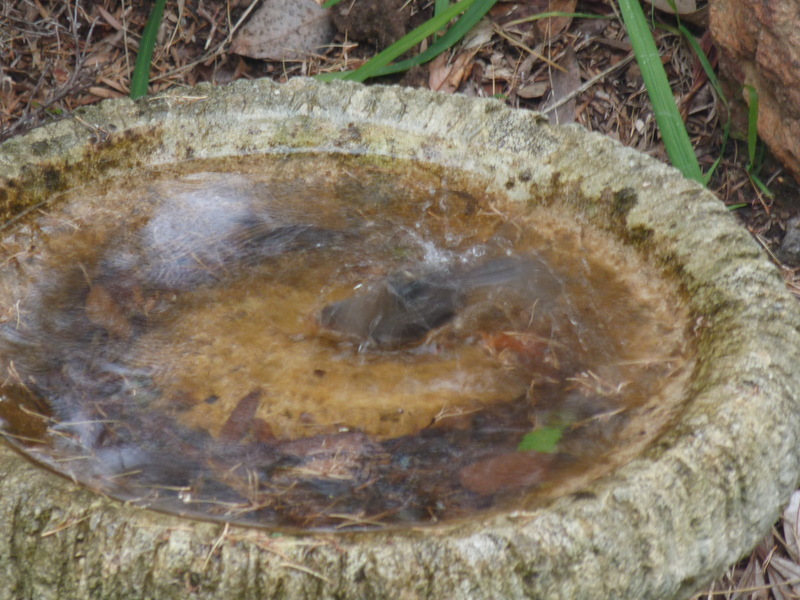
Unlike the other bathers featured above, the friarbird in the Darwin back yard is using a small bird bath provided by the human inhabitants. This is perhaps the most important thing you can offer the birds in your yard, along with local plantings. And for reasons already explained it's important in both summer and winter. Here are a few birds enjoying the bath on offer.
Female Superb Fairywren Malurus cyaneus completely submerged (top right of the bath) in our
Canberra yard on a frosty June morning - indeed there had earlier been ice on the bath.
I took this photo from our balcony above it.
Double-barred Finches Stizoptera bichenovii and Chestnut-breasted Mannikin
Lonchura castaneothorax on the same Darwin bath featured in the friarbird photo above.
Eastern Spinebill Acanthorhynchus tenuirostris in a garden near Mount Clunie NP,
far northern NSW.
Metallic Starling Aplonis metallica at renowned bird lodge Kingfisher Park,
near Julatten in northern Queensland.
It might seem counter-intuitive initially for water birds to need to bathe in additon to their normal swimming, but it makes good sense when you consider that most water birds are well-waterproofed so must make an active effort to get the water into their feathers.
Magellanic Penguins Spheniscus magellanicus bathing in a flock, in the icy
waters of the Strait of Magellan at the very tip of South America. The roiling water
is evidence of their intense activity to get the dense oily feathers soaked.
Australian Pelican Pelecanus conspicillatus vigorously splashing at
Tidbinbilla Nature Reserve near Canberra.
A variant of this activity is leaf-bathing, where a bird hangs in foliage during or after rain, sometimes upside down, opening wings and feathers to allow the water through.
Sulphur-crested Cockatoo enjoying the rain.
It's not at all surprising that many urban birds have learned to use sprinkler hoses in the same way, flying through the spray or splashing in dripping leaves. Some will simply stand side-on to the spray, raising the wing on the sprinkler side to accept the shower.
Crested Pigeon Ocyphaps lophotes making the most of the hose in our back yard.
This is obviously fairly recently learned behaviour.
In the absence of water - but often when there is a choice too - birds will sometimes engage in a thorough dust bath, taking as much trouble to work the dust into the feathers as they do water. There seems to be no consensus as to why, but it is suggested that it might help to remove excess preening oil which might otherwise gum up the feathers, as well as perhaps playing a role in parasite removal.
House Sparrow Passer domesticus, deep in a dust bath
in a village on the island of Anchao, southern Chile.
Speckled Mousebirds Colius striatus crowding into a patch of dried mud
to conduct their dusty ablutions on Mount Kenya.
Finally there is the practice of sunning - spreading out the wings and opening the feathers in full sunshine - to assist in feather care. This one is a bit more complex as there are probably more than one purpose to it. For instance these vultures are certainly spreading out in the early morning sun, but I suspect that their major motive is to warm up before taking to the air in order to reduce the energy cost of getting such a big body aloft.
Black Vultures Coragyps atratus catching the early sun at Muyuna Lodge on the Amazon River,
northern Peru. Even in the tropics nights and early mornings can be cool.
True sunning for feather care however is quite different. I'm sure we've all got a fright at coming across a bird spread out and unresponsive on the ground (Australian Magpies are frequent practitioners), and being startled when it suddenly comes out of its stupor and hops away, perfectly healthy. Again the exact purpose has not been studied, but it seems as though it is an anti-parasite strategy. Sunshine can be fatal for fungi and bacteria, and it may force lice to leave the body, or expose themselves in moving away from the sun, where they may be more readily removed by the bird (though being in an apparent torpor probably precludes this idea!). Here are a few birds deeply engaged in their sunning. All four of the Australian birds featured were sunning in mid-summer so unlikely to be doing it for warmth.
Bar-shouldered Dove Geopelia humeralis, Kingfisher Park Lodge, north Queensland.
This one has raised its wing to allow better sun access to its flanks, a posture very
reminiscent of the Crested Pigeon in the hose above. We watched a few different birds
sunning in this spot - see the Macleay's Honeyeater below.
Common Bronzewing Pigeon Phaps chalcoptera sunning on a big granite boulder in
Namadgi NP south of Canberra.
Macleay's Honeyeater Xanthotis macleayanus enjoying the popular sunning site
at Kingfisher Park already mentioned. This bird was quite contorted.
Red Wattlebird Anthochaera carunculata sunning in the garden below our balcony.
This one really did look dead or dying for a while!
Social Flycatchers Myiozetetes similis sunning on a log in southern
Peruvian Amazonia.
And perhaps that's more than you wanted to know on the subject, but I do think we get even more enjoyment out of nature if we understand - or even just try to do so - more about what we're seeing. If so I hope I've been able to help a little with that. And I am just a little obsessed with how absolutely amazing are feathers and everything to do with them!

NEXT POSTING THURSDAY 14 APRIL

I love to receive your comments and in future will be notifying you personally by email when a new posting appears, if you'd like me to. All current subscribers have been added to this mailing list and have already been contacted. This will mean one email every three weeks at the current rate of posting. I promise never to use the list for any other purpose and will never share it.
Should you wish to be added to it, just send me an email at
calochilus51@internode.on.net.
You can ask to be removed from the list at any time,or could simply mark an email as Spam, so you won't see future ones.
Thank you!