About Me

My photo
Canberra-based naturalist, conservationist, educator since 1980. I’m passionate about the natural world (especially the southern hemisphere), and trying to understand it and to share such understandings. To that aim I’ve written several books (most recently 'Birds in Their Habitats' and 'Australian Bird Names; origins and meanings'), and run tours all over Australia, and for 17 years to South and Central America. I've done a lot of ABC radio work, chaired a government environmental advisory committee and taught many adult education classes – and of course presented this blog, since 2012. I am a recipient of the Australian Natural History Medallion, the Australian Plants Award and most recently a Medal of the Order of Australia for ‘services to conservation and the environment’. I live happily in suburban Duffy with my partner Louise surrounded by a dense native garden and lots of birds.

Thursday, 18 August 2022

Butterflies are Suckers!

Well, so am I actually, where butterflies and moths are concerned, though I think I came to them a bit late in life to be any good at learning to identify them with any ease. I can go to a new country and readily recognise new birds from having studied them in the field guides, but even in my own back yard I have trouble fixing in my mind and my eyes the necessary cues and patterns and other essential skills and information for identifying the butterflies. It's very frustrating. I think the issue is that I've been watching and identifying birds for most of my life, and we learn (and perhaps more importantly, we learn how to learn) so much more easily when we're young. All of which of course has nothing to do with the actual topic of today's post!

We're well aware of the ability of most moths and butterflies to suck - or more accurately and elegantly, to extract nectar from a flower's nectary gland, and thus perform a crucial pollinating role for many flowering plants. However it's not so easy to see how they manage it. The essential sucking tool for a butterfly is a proboscis, rather like a flexible coiled drinking straw with a sensory apparatus at the end. Here are a couple coiled up out of the way.
 
Male Cairns Birdwing Ornithoptera euphorion Lake Barrine, North Queensland.
Borneo Birdwing Troides andromache, Sabah, Malaysian Borneo.
We don't get much idea of the proboscis from those, but here are couple partially uncoiled and ready for use.
Yellow Admiral, Vanessa itea, National Botanic Gardens, Canberra.
 
Tanna Longtail Urbanus tanna* (Family Hesperiidae), Waqanki Lodge, northern Peru.
Many tropical American lodges plant verbena as being an excellent butterfly/moth attractor.
[* in this and the following captions mean that my friend and Australian butterfly guru Suzi Bond has
identified this for me, but notes that while she is pretty confident of the genus, the species may
not always be exactly right. It's well out of her familiar area and I'm very grateful for the work
she's done on this.]
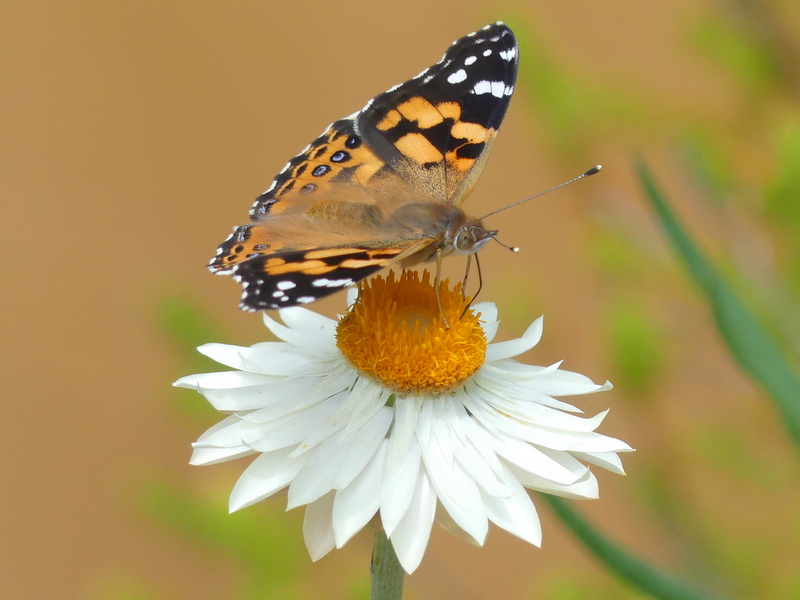
So what is this elegant and sophisticated structure, the proboscis? (I think it's fair to say that our name for it is less elegant than the structure itself!) It comprises two trough-like structures called galeae; in other insects, and presumably the ancestral butterfly, these are small cup-like structures attached to the floor of the mouth. By a remarkable process, the butterfly/moth's two galeae begin extending and coiling as soon as the adult emerges from the pupa, aligning themselves to form a single tube. When this happens a temporary liquid glue holds them in place until fringing structures zip them permanently together. Inside is fibrous material like blotting paper; liquid is drawn up by a mixture of passive capillary action and active muscular pumping, using a 'bellows' in the butterfly's head. When required the proboscis unfurls and can be very delicately applied. Both the following images of the proboscis in action feature Australian Painted Ladies Vanessa kershawi at the National Botanic Gardens in Canberra.
On an Istotoma sp., Family Campanulaceae

On a paper daisy, Xerochrysum sp. Here the butterfly has the choice of numerous tiny flowers,
or florets, which each provide a tiny droplet of nectar. The reward from each floret is minute, but it
can reach many florets without having to move. This nectar is a simple sugar solution,
which provides a butterfly (or other animal) with an energy source, a valuable commodity indeed.
Here are a few more pictures, just because you can't really have too many photos of butterflies on flowers, can you? The Costa Rican ones I can't put a name to, and if you can I'd be glad to hear from you - even a family would be helpful.
Tiger Moth Amata sp. on eucalypt flowers, National Botanic Gardens, Canberra.
(Plus a bonus Soldier Beetle Chauliognathus lugubris, which is probably also just interested in
the flowers here. They are omnivorous but I'd expect the moth to be too big a mouthful for it.)
Short-tailed Flasher Astraptes brevicauda* (Family Hesperiidae) on verbena flowers,
Cerro Lodge, Costa Rica. Note the earlier comment about planting verbena in lodge gardens.
Dorantes Longtail Urbanus dorantes (Family Hesperiidae) at Puerto Morales
on the Pacific coast of Costa Rica.
Cabbage White Pieris rapae on Kunzea ambigua, Ulladulla Heathland Reserve
NSW south coast. This is an abundant introduced species, but it's the caterpillars which
fancy cabbage leaves (and other members of the family Brassicaceae); the adults
are happy to take nectar from native shrubs such as these.
Small Alpine Xenica Oreixenica latialis on Prostanthera cuneata,
Kosciuszko National Park, NSW.
Neotropic Glass-wing Butterfly Methona confusa, Milpe Reserve, Ecuador.
Presumably the transparent wings help with camouflage against their background,
though it's not clear what the role of the distinctive black stripes is in that case.


Butterflies as a group evolved at least 190 million years ago, but the proboscis seems not to have appeared until somewhere between 100-145 million years ago. The strong implication of this is that it coincided with the development and dramatic spread of flowering plants at this time. On the other hand it could as validly be proposed that the butterfly proboscis developed to take up water or sap, and the subsequent adaptation to nectar actually assisted the dominance of flowering plants; either way both have flourished together.

Either way too, a familiar pattern has emerged, of a structure arising for one purpose and later becoming harnessed for other purposes. Butterflies regularly use this wonderful structure for taking up other liquids - from protein of dead animals and nutrient from animal droppings to soft fruit and water from mud. Once you get your eye in it's surprisingly easy to see butterflies and moths drinking water from mud, sand or other wet soil, or even from other materials. By clicking on the pics to enlarge them, you should be able to see the proboscises at work in most of them.
Broad-banded Swallowtails Heraclides astyalus Iguazu Falls Argentina.
Red Flashers Panacea prola helpfully showing their top and bottom views, Peruvian Amazon.
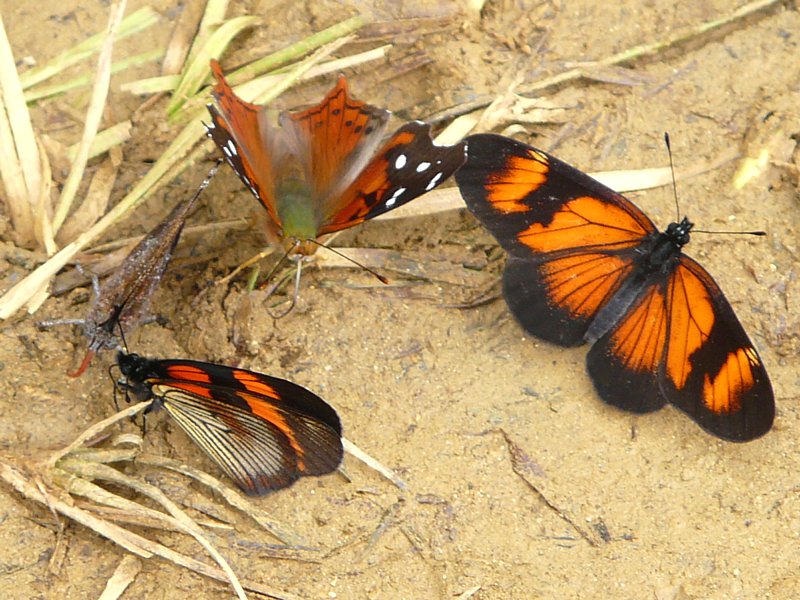
On the riverbank, Manu Reserve, Peru. At the back an admiral or mapwing, Hypnartia sp.*;
the other two are Altinote sp.
Mud-sippers, Yasuní National Park, Ecuador.
In the foreground is a Dido Longwing Philaethria dido and behind it a
Mimic Skipper Cabirus procas*.
Sipping the roadside, northern Peruvian Andes.
Common Small Lemon Eurema deva Iguazu Falls Argentina.
Green-banded Urania Urania leilus on the riverbank mud, Yasuní National Park, Ecudaor.
And they do it in Australia too!
Male Orchard Swallowtail Papilio aegeus sipping from wet soil, Rosedale, south coast NSW.
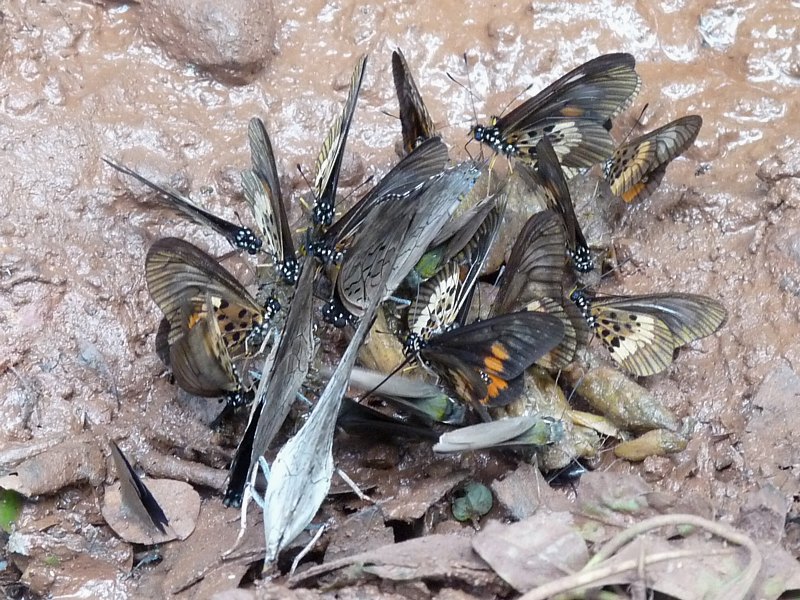
Sometimes large numbers will gather to drink in this way, providing a wonderful spectacle.
 
Drinking from mud, Budongo Forest, Uganda.
(The following comment might apply here too.)
Suzi thinks the large ones with worn wings are an Acraea sp., with some smaller ones
of the same genus (the brownish ones), possibly Acraea circeis or peneleos.
She thinks the black-spotted white ones are Forest Caper Whites Belenois theora.
These are probably sulphurs Phoebis sp. drinking from wet sand, Manu River, Amazonian Peru.
Suzi Bond suggests that these and the ones in the following couple of pics are actually concentrating on
a patch of urine. There are large mammals here, including Tapirs, Jaguars and Capybaras.
A wonderful gathering (don't overlook the numerous inconspicuous brown
Waiter Daggerwings Marpesia zerynthia*) along the Manu River again.
This trip was my first into the Amazon basin, and it was truly memorable.
Grass Yellows Eurema sp., from the same boat trip.
Unfortunately I can't remember or recognise what these two Harmonia Tigers Tithorea harmonia*
were sipping on at the Tambopata Research Station in southern Peru, but it looks like a wet patch
on either cloth or bark.
Hydaspes 88 Callicore hydaspes Iguaçu Falls Brazil, sipping on the hand rail, probably for
the salt from numerous visitors' hands. This must be one of the oddest names among
very many very odd butterfly names. The Hydaspes is just for the species name (though apart from being a river in India, its origin is a mystery to me),but the 88 in the group name refers to the wing pattern, which in some species (but not this one) does resemble the number 88...
There's also the question of the two different spellings of the falls. It's Iguaçu
in Brazil (ie in Portuguese) and the Spanish Iguazu on the Argentinian side.
 
And here's another one at the falls getting its sweat-salt from the source.
I think this might be the only time a photo of me has appeared in the blog.
But other liquids, containing nutrients, are also taken up via the proboscis - and as suggested earlier, perhaps butterflies were doing this even before flowers came along.
 
Female Morpho Butterfly Morpho sp. sucking up watermelon juice in a butterfly house
at Sacha Lodge in Ecuadorian Amazonia. The males are brilliant blue above.
And then there are other foods not normally associated with butterflies!
Butterflies and flies above on Civet droppings, Budongo Forest, Uganda.
The one on the right is a False Chief Pseudacraea lucretia (yet again, butterfly names
are truly weird and wonderful - up there with hummingbirds - but this one is a reference
to toxic species that it mimics) and the pale one at the back is a glider
Cymothoe sp.
(possibly C. caenis). The orange one is an Acraea sp., perhaps A. orina.
[This time my informant is my 'other' butterfly guru, Steve Holliday - thanks Steve!]

 
Another cluster of butterflies at the same site. I was told that Civet droppings
are especially attractive to them, but if so I'm not sure of the reason. Presumably
there is more protein in a carnivore dropping than a herbivore's and this is probably the
commonest medium-large carnivore in the forest. Any other suggestions welcomed!
This time most of them are Acrea sp. (or maybe Acrea spp.), a very large and
widespread African genus. (Thanks again Steve.)
Butterfly on cow pat, Pantanal, in south-western Brazil.
Suzi assures me - with a straight face as far as I can tell - that this is
a Confusing Sister Adelpha iphicleola!!
Finally I should acknowledge that a couple of other insect groups have proboscises for much the same reason, but they developed quite separately, from different mouth parts. True bugs (ie Hemipterans, not the catch-all way we sometimes use 'bug' to refer to any creepy-crawly animal) have one formed from the chewing mouth parts - the maxillae and mandibles - extended into a piercing structure and sheathed by the labium, the floor of the mouth. This can be used for piercing either plant tissue or animals. 
 
Sap-sucking hemipteran, Kata Tjuta NP, Northern Territory.
Assassin Bug (very small!) with prey (even smaller!!), Jervis Bay, south coast NSW.
In flies which have a proboscis it is comprised of the labium, with the maxillae and mandibles providing the stabbing function where required. (I am endlessly intrigued by the different ways in which nature comes up with solutions to the same problem.) Many flies are nectar feeders and flower pollinators. Rather than suck, many flies with proboscises have a sort of sponge on the end to mop up the liquid (thanks Susan).
Bristle Fly (Family Tachinidae) Canberra.
Bee Fly Comptosia apicalis on paper daisy Xerochrysum sp. in our Canberra yard.
Fly (Family Acroceridae) on Xerochrysum paper daisy, National Botanic Gardens, Canberra.
Other flies, including mosquitoes, favour protein over sugar hits.
March Fly (Family Tabanidae) about to pierce my trouser leg in Kosciuszko NP,
in the hope of obtaining some of my nutritious blood.
You might think that weevils with their long snouts might be in the proboscis club too, but in fact their rostrum contains the chewing mouth parts common to most other beetles.
 Rhinotia sp. (suturalis or brunnea) Bluetts Block, Canberra.
The fact is that butterflies and moths own most of the proboscises in the insect world and I've had a lot of fun poking my own proboscis into their business. I hope you've enjoyed this post too.

NEXT POSTING THURSDAY 15 SEPTEMBER
 
I love to receive your comments and in future will be notifying you personally by email when a new posting appears, if you'd like me to. All current subscribers have been added to this mailing list and have already been contacted. This will mean one email every three weeks at the current rate of posting. I promise never to use the list for any other purpose and will never share it.
Should you wish to be added to it, just send me an email at calochilus51@internode.on.net. You can ask to be removed from the list at any time,or could simply mark an email as Spam, so you won't see future ones.

Thursday, 28 July 2022

Warrumbungle National Park; a volcanic splendour in the plains

Back to Australia for this one, and to one of the most spectacular and most-visited parks in inland New South Wales. The Warrumbungles boast dramatically jagged volcanic skylines, short strolls and Serious Challenges for Serious Walkers. The flowers in spring are magnificent (though I've not been there in spring since I've had a digital camera) and the birding is very good. The range provides a fascinating merging of plants and animals of the inland plains with those of the near-coastal ranges. 

The view of the Warrumbungles skyline from the west (the 'back entrance' from the road through
Tooraweenah). Most people probably come at it from the east, along the Newell Highway north
through Dubbo and Gilgandra, or south through Narrabri, to Coonabarabran then west along
the John Renshaw Parkway. Either way all roads are sealed. It's only 35k from Coonabarabran
so day trips are very 'doable' indeed.

For those less familar with Australian geography, the location of the Warrumbungles is
indicated above (approximately!) by the end of the red arrow.

For a more accurate indication, click on this map of NSW to enlarge it, and look for
the purple star to the east of the NEW SOUTH WALES label in the centre of the map.

The base rocks of the park are formed of sediments laid down under vast lakes some 150 million years ago in a steamy world dominated by dinosaurs. These layers can still be seen where the more recent overlaying volcanic rocks have eroded away.

Sandstones in Burbie Canyon, an easy walk not far from the road.

And a sandstone gorge along Wambelong Creek on the Nature Walk
near Canyon Camp,

Much more recently - but still between 17 and 13 million years ago - volcanic activity, sometimes comprising slow flows of lava across the landscape, at other times featuring spectacularly violent explosions, redefined the Warrumbungle landscape. Laval flows and a rain of ash and lumps of glowing semi-molten rock covered the old sandstones and mudstones. Where the exuded lava was heavy and viscous it piled up around the vent to form domes which have since eroded to lose their smooth conical shape. In other places the vents become clogged with cooling lava and erosion revealed these 'plugs' standing alone. The famous Breadknife is a long narrow ridge of volcanic rock, a dyke, which cooled in a crack in the sandstone. The best easily accessible view of landscape can be had from the White Gum Lookout, a short walk from the carpark.

Refer to numbers in pic below to read this interpretation of key points of the view above.
1. Crater Bluff, a volcanic plug: 2. Belougery Spire - a volcanic spire can be formed either by
viscous lava flowing slowly out of the vent, or setting within it. This was one of the central vents
of the Warrumbungle volcano: 3. The Breadknife, a volcanic dyke - see above for an
explanation of its formation: 4. Bluff Pyramid: 5. Bluff Mountain, a dome of viscous lava
which piled up around the vent; the cliffs to the right of the mountain are 250 metres high.

If we follow the skyline round to the right beyond the scope of this photo, we come to Mount Exmouth.

Mount Exmouth, at 1200 metres above sea level is the highest point in the park,
300 metres above the surrounding plain. It represents the remnant of a broad flow of
less viscous lava which cooled in a thick blanket and is gradually eroding away.

Our camp at Wambelong Campground was below another magnificent volcanic plug, Belougery Split Rock. Here it is glowing superbly in the sunset.

We didn't see much sun in our recent stay but this rock lit up at sunset on two
consecutive nights, which cheered us immensely.

Here are a couple more volcanic features, either outside or just inside the eastern boundary.

A plug by the road outside the park boundary.

A spire on a wet cloudy day in 2015.
This was just two years after devastating bushfires which burnt 90% of the park,
hence the tree skeletons in the foreground.

River Oaks Casuarina cunninghamiana recovering from the fire nine years after the event.

Our most recent visit was in early June 2022 when La Niña still held sway. In fact very heavy rain and winds delayed our arrival and we lost a couple of precious camping nights. The rain finally finished but the temperature never climbed into double figures; however you've got to make the most of what you get!

Flood debris in Burbie Canyon above, and along Wambelong Creek below; a lot
of this was from fire-killed trees.
This walk was closed by the high water just a little further along.
There are two options for camping in the park (aside from hiker camping). There is a very large complex of campgrounds near the visitors' centre, complete with showers and power. It is always busy there and we avoided it (though we may have taken advantage of the showers on one occasion). We opted for Camp Wambelong a couple of kilometres down the road, a lovely quiet open space by the creek with toilets and tables, but not enough to attract the hordes.
Our very pleasant little nook and set-up.
The view was dominated by the splendour of Belourie Split Rock (remember the sunset above), and views of the forest on the slopes across the road.
The White Cypress Pine Callitris collemularis in the left foreground is typical of
the woodlands of the slopes, as is the old Kurrajong Brachychiton populneus below.

Narrow-leaved Ironbark Eucalyptus crebra is another typically inland species
in this part of the world, though it does go to the coast further south.
Along the creek by our camp were big Rough-barked Apples Angophora floribunda which fit the same pattern - coastal north to about Sydney, then they spread inland across the north-western slopes.

A particularly interesting association can be seen in the creekline near the visitors' centre (which incidentally is well worth a visit for the park information available). Across most of inland Australia streamlines are dominated by River Red Gums Eucalyptus camaldulenis. As we approach the coast in this part of the world however they are replaced by the River Oaks that we met above. At this site they do the 'changeover' and both grow together - I'm sure it must happen elsewhere but I haven't seen it.

The light really was awful but at least you can see the two species growing
atypically together, with the River Red Gum on the right.
Grass Trees Xanthorrhoea glauca are features of the drier forests, and always a delight.
     
The double-headed specimens I find especially satisfying.
You can find a whole post on them here.     
There was a bit more flowering than I'd expected, but the wet autumn prompted that. The three I've featured below are all widespread and common species, but nonetheless always welcome.
  
Watrer Bush Myoporum montanum.
Parrot Pea Dillwynia retorta.
Bitter Cryptandraa Cryptandra amara.
Mosses and lichens will always be found where there are rocks (and elsewhere of course!). It's too easy to overlook these exquisite little rock gardens, and I always try to make a point of stopping to admire them.             
Fungi were responding well to the wet autumn, unsurprisingly, but I've not been able to identify these yet - maybe we can just enjoy them instead!
                                                                      
Bracket fungi (here growing on an ironbark still showing the effects of the 2013 fire,
and in the next  two photos) put out their spore bodies from inside the trunk. Unlike
most other fungi spore bodies (such as toadstools or mushrooms) these are
woody and long-lasting.
                    
These were growing among the low herbs of the campground...
... these from a fallen log...
... and these from the ground litter.

The vegetation of the park is not typical of the region as a whole. As with most other parks of the slopes the range was eventually preserved because of its unsuitability for agriculture, while the surrounding rich woodland plains were largely cleared and deprived of most of their natural values. (To the north of the Warrumbungles the vast ironbark/cypress pine woodlands of the Pilliga are an exception to this rule.) The range was little known, despite calls in 1936 by the National Parks and Primitive Areas Council for a 'Warrumbungles National Monument'. A very modest little park of 3400 hectares was finally declared in 1952 for the purpose of public recreation but it only became widely known after famed photographer and film-maker Frank Hurley walked and camped there, and took photos which became familar to many. But I can't find any date for this that is more accurate than 'the first half of the 20th century'! After the purchase of surrounding properties as they came on the market, the size of the park is now 23,300 hectares - still modest but a definite improvement!

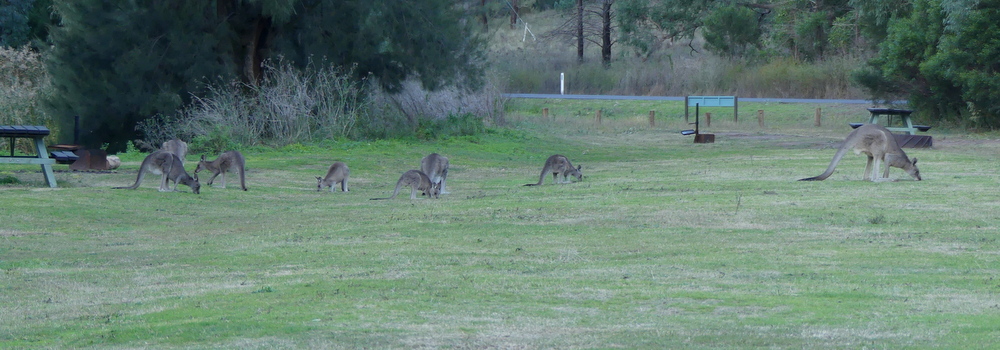
Animals were for the most part staying low during our recent stay, understandably given the pretty miserable conditions! As in any cleared area in eastern Australia, Eastern Grey Kangaroos were plentiful in campgrounds and picnic areas.

Some of the mob which shared Camp Wambelong with us, taken early one morning.
A couple of other kangaroo species were present, both common and widespread but nowhere near as abundant as the Eastern Greys. They are also mostly solitary or in small family groups.
Red-necked Wallaby Macropus (now widely called Notamacropus) rufogriseus;
found throughout most of eastern Australia.
A battle-scarred Wallaroo Macropus robustus, a dark stocky hill kangaroo of the
eastern ranges. Across the rest of dry Australia is a reddish form usually called a Euro.
A mammal we didn't see was the Koala, though until 20 years ago the park was a noted site for them. In 1953 when the park was declared there was little Koala habitat present and very few Koalas in and around the park. As the vegetation recovered through the 1970s and 80s the Koala numbers grew and by 2000 any visit to the park was almost certain to produce Koala sightings. Then the savage Millenial Drought of 2001-9 devastated the population, and it seems that the fire of 2013 wiped them out entirely. It can only be hope that in time they will naturally recolonise the park from populations which may have survived both those events. However the lesson seems to be that the park is too small to support a viable Koala population through the vicissitudes of nature.

Naturally there were no reptiles active in those temperatures, and only a few invertebrates appeared.

It seems that there'll nearly always be a mosquito somewhere; this one was lurking
with intent on the toilet wall.
I think this one - on the point of succumbing to the cold - was a ghost moth,
Family Hepialidae, but I'm happy to take other suggestions.     

There were certainly birds around but many of them were staying safely in cover; however a few were quite willing to be captured for posterity (images only, you understand!). As with most of our camps in recent times, Apostlebirds featured strongly.

Bold garrulous larrikins which (quite rightly) treat a campground as their own,
Apostlebirds Struthidea cinerea are old Australians, mud-nesters which are among
the most strongly developed cooperative breeders in the world.
Babblers are unrelated, but also highly sociable, including in sharing breeding responsibilities.
Grey-crowned Babbler Pomatostomus temporalis foraging in the campground.
More on them here.
One of the busiest places for birds was around the visitors' centre, where native plantings and flowering ironbarks attracted a good array of species.
A pair of Jacky Winters Microeca fascinans, plain-coloured but highly
engaging Australian robins, had set up territory here and found the boundary
fence a highly satisfactory vantage point.
The highlight of the entire trip however was finding a population of Turquoise Parrots Neophema pulchella which were hanging an otherwise deserted picnic area, snacking on grass seeds and drinking at the creek. This is an exquisite little bird mostly found in woodlands of the western slopes of NSW, though extending into Victoria and Queensland. It is listed as Threatened in NSW. I last saw one 20 years ago and had never laid camera on it. We've camped recently in a few parks where they occur, and put some effort into finding them but hitherto to no avail.
Male Turquoise Parrot, the highlight of our time in the Warrumbungles.
They were feeding some of the time with the little Red-rumped Parrots,
which looked positively hulking by comparison!
This photo just shows the lovely red wing patch which is almost hidden by the wing coverts.
The Warrumbungles have much more to offer you than what I've been able to show you here, but I hope that I've done enough to convince you that you really need to go there if it's at all possible. Spring would be a very good option, so do yourself a favour and build a trip there into your upcoming plans.
Rainbow over Camp Wambelong.
 
NEXT POSTING THURSDAY 18 AUGUST
 
I love to receive your comments and in future will be notifying you personally by email when a new posting appears, if you'd like me to. All current subscribers have been added to this mailing list and have already been contacted. This will mean one email every three weeks at the current rate of posting. I promise never to use the list for any other purpose and will never share it.
Should you wish to be added to it, just send me an email at calochilus51@internode.on.net. You can ask to be removed from the list at any time,or could simply mark an email as Spam, so you won't see future ones.