About Me

My photo
Canberra-based naturalist, conservationist, educator since 1980. I’m passionate about the natural world (especially the southern hemisphere), and trying to understand it and to share such understandings. To that aim I’ve written several books (most recently 'Birds in Their Habitats' and 'Australian Bird Names; origins and meanings'), and run tours all over Australia, and for 17 years to South and Central America. I've done a lot of ABC radio work, chaired a government environmental advisory committee and taught many adult education classes – and of course presented this blog, since 2012. I am a recipient of the Australian Natural History Medallion, the Australian Plants Award and most recently a Medal of the Order of Australia for ‘services to conservation and the environment’. I live happily in suburban Duffy with my partner Louise surrounded by a dense native garden and lots of birds.

Thursday, 21 September 2023

Not an Owl; some of the other night birds

It's a common, and perfectly understandable, assumption that all nocturnal hunting birds must be owls. Most of us don't usually get a good look at these birds unless we happen upon them when they're trying to sleep in the daytime, while hoping to escape the notice of the noisy day birds which always want to move them on. Moreover, even if we do get a decent look, they still look rather owl-like - big eyes, soft plumage, delicately patterned plumage, often mottled or streaked for camouflage. These 'not owls' are the potoos of South and Central America, the Oilbird of northern South America, the nightjars and nighthawks, found across most of the world, the frogmouths of Australia and south-east Asia and the owlet-nightjars of New Guinea, plus a few nearby islands (including Australia). Each of these groups forms a Family, and until recently all were placed in the same Order, but in 2021 it was broadly agreed that each of these Families was better understood as a full Order in their own right (see here and find Version 11.2).

Hopefully you've read this far! If so, please persevere - that's pretty much the end of the taxonomy lesson, and the rest is just about these very interesting groups of birds.

Tawny Frogmouth Podargus strigoides near Canberra; they typically spend
the day in the open, relying on their impressive camouflage for protection.
While we're on frogmouths we might as well continue with them. There are 16 species, and through most of their extensive range, which stretches from Australia to India, they are rainforest dwellers, many of them very hard to find. However the Tawny Frogmouth is the exception, being a bird of drier forests and woodlands throughout Australia, including the arid inland, wherever there are trees and open ground for hunting. They are found in suburbia, including in all Australian capital cities, and I'm sure that they are the most familiar night birds to most Australians.
Tawny Frogmouth and large chick, about to fledge (indeed it flew just a day after this),
in a park near our Canberra home.
Despite the apparent similarities with owls, there are significant differences. Whereas owls have forward-looking eyes (like us), frogmouths' eyes are more on the side of their head, like most other birds. They have broad shallow beaks for scooping up food (insects, plus some frogs and mice, taken mostly from the ground), whereas an owl's beak is sharp and narrow for tearing up prey. Owls hunt primarily with their feet, which are powerful and taloned like a hawk's; a frogmouth's feet are comparatively weak and are not used to seize food. Much the same comments could be made about the other 'not owls' we'll be meeting today.
 
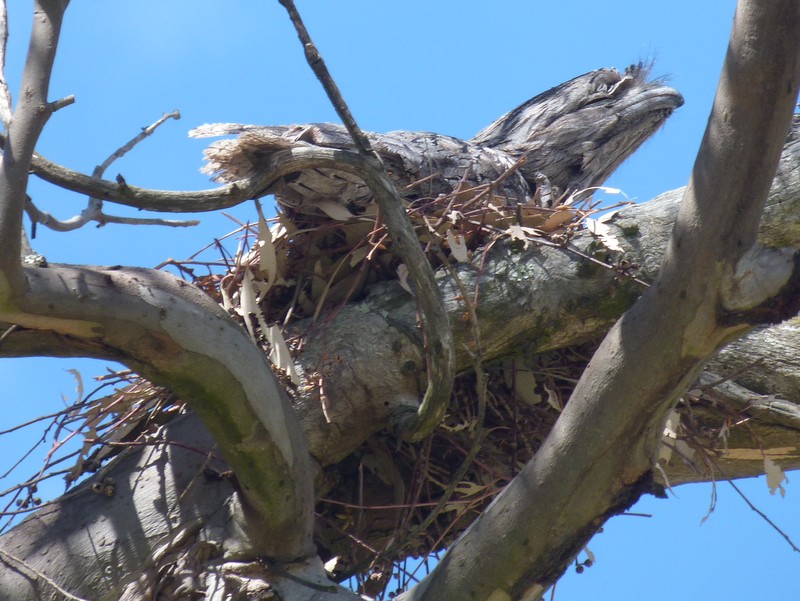
While these photos don't show it to best advantage (mostly because these birds didn't choose a well-matching branch to roost or nest on), the frogmouth's camouflage is remarkable. The streaks in the plumage can resemble cracks in bark to a remarkable degree. The head is held upright to reinforce the impression of a broken branch. The eyes are closed, though, if the bird is approached too closely, they will open to slits, and the head will turn ever so slowly to keep the intruder in sight.    
 
As the previous photo suggests, nests are very flimsy and placed on a horizontal branch or a flat fork.
Adult on nest, Narrabunda Hill, Canberra.
Sometimes old nests of other species are repurposed by frogmouths.
 
Tawny Frogmouth on old White-winged Chough nest, Mulligans Flat NR, Canberra.
It may just have been perching, but it was in November when I'd expect them to be breeding.
The three Australian/New Guinea species are all in the genus Podargus; Marbled and Papuan Frogmouths are found in both islands, while Tawnies are only in Australia. I find this surprising though, given that they occur almost to the tip of Cape York, just across the narrow Torres Strait from New Guinea. Going further north-west, the 13 Asian species are only found on the other side of Wallace's Line; all are smaller and restricted to rainforest.

Papuan Frogmouth P. papuensis, Centennial Lakes, Cairns, above and below.
This tropical species is found north from about Townsville to the tip of York Peninsula,
and throughout New Guinea. It is usually found along rainforest edges and in
drier rainforest, which is generally known as monsoon, or vine forest. This pair was
roosting in mangroves, where they were surprisingly hard to see.
The third Australian species, the Marbled Frogmouth P. ocellatus, is notoriously hard to find in its rainforest habitat. It has two very separate small Australian populations, on Cape York Peninsula, and in the border ranges of near-coastal NSW and Queensland, as well as throughout New Guinea.

It seems logical to me to go from frogmouths to potoos, though the latter are in a different Order, as we have seen, and only found in the American Neotropics. Whenever I see them though I am struck by how much they resemble frogmouths, though that's entirely due to adaptations to similar lifestyles. Like frogmouths they hunt from a perch, but unlike them they take prey almost exclusively from the air, and never from the ground. Their camouflage is just as good but rather than perch on horizontal branches they use vertical stumps or broken branches, positioned upright so as to seem like an extension of the stump.
Great Potoo Nyctibius grandis, Pantanal, south-western Brazil. This is the largest
potoo, up to 60cm long, and is found from south-eastern Brazil to southern Mexico.
The seven species are found between them in every Central and South American country, though they are most prevalent in the Amazon Basin.
The Long-tailed Potoo Nyctibius aethereus, here at Tambopata Reserve in the southern Peruvian
Amazon, is found throughout the Amazon basin, and in the southern Brazilian Atlantic forests.
I love how the white wing patch resembles lichen on a tree trunk!
Common Potoo Nyctibius griseus, Muyuna Lodge, northeastern Peru. It is found
almost throughout South America except for the far south and the higher Andes,
and in much of Central America.
They don't build a nest, simply laying a single egg in a depression on a branch, or on top of a stump. The pale chicks have their own camouflage, resembling a lichen-covered branch.
Common Potoo chick, Yasuní NP, Ecuadorian Amazon.
Great Potoo chick, Muyuna Lodge, Peru.
Unsurprisingly, I am a big fan of potoos, not to mention the amazing guides who can reliably spot them!

The smallest of these 'not owl' Orders is represented by just one species, the somewhat enigmatic Oilbird Steatornis caripensis, found along the slopes of the Andes and in the lowland forests of northern South America. While distantly related to the other Orders, it differs from those birds in almost every way except for being nocturnal.
Oilbird above a rainforest waterway in Yasuní NP, Ecuadorian Amazonia.
My friend and guide extraordinaire Juan Cardenas were in a canoe doing
reconnaissance for a tour when we saw what we thought was a nightjar above
our heads. When we arrived back at our lodge, we both realised what we'd
really seen, for the first time for both of us.
 
For a start, of all these 'non owls' only the Oilbird is fully vegetarian, living on fruits of palms and laurels. Along with the New Zealand Kakapo, a flightless parrot, it is the world's only nocturnal fruit-eating bird. It finds the fruit by night by smell, and can travel up to 120km from their roost to feed. Moreover it not only has the remarkable night-sight that we'd expect, but it also uses echo-location, like a microbat. This is because, like the bats, it breeds and largely roosts in caves, and needs the 'super power' to navigate in the total darkness. This is not unique among birds, but it is very rare - the only others that I am aware of using it are some swiftlets, which also nest in caves. If caves are not available, Oilbirds will also roost in deep rock crevices and ravines, and it has recently been discovered that they regularly roost in trees in the rainforest too.
Oilbird roost in a deep slot canyon, at the Quiscarrumi Bridge near Moyobamba
in northern Peru. The birds look like brown rice grains on the ledge
in shadow in the left foreground.
A closeup, somewhat hazy, view of the roosting Quiscarrumi Bridge Oilbirds.
Of the five 'non owl' orders in the torch light today, the delightful little owlet-nightjars form something of an outlier - in fact their closest relatives (though still distant) are the swifts and hummingbirds! They are essentially a New Guinea group, where are seven species. One of these extends to and throughout Australia, and there is an endemic species in each of the Indonesian Moluccas and New Caledonia. (There was also a flightless New Zealand species which became extinct in about 1400 when rats arrived in New Zealand with humans.)
 
The elegant little Australian Owlet-nightjar Aegotheles cristatus (also found in the savannas of southern New Guinea) is less than 25cm long and is found in open country throughout the continent. Its musical churring call is a familiar night sound, including in suburbia near bushland. It is the only open country member of the group, the rest being rainforest birds. It hunts insects like a flycatcher does, taking off from a perch to seize prey in the air or from a branch or the ground.
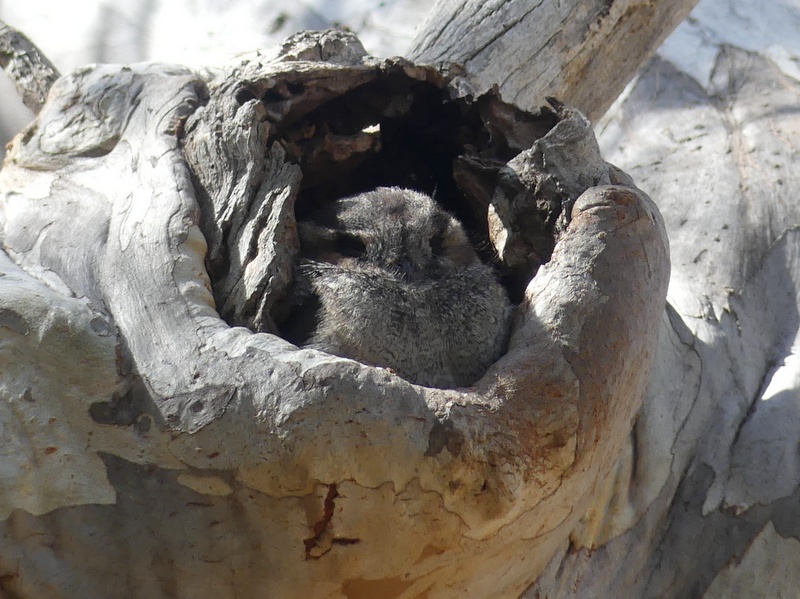
Australian Owlet-nightjar catching the sun in a eucalypt hollow in the
Australian National Botanic Gardens in Canberra. This is typically how we
see them, though I've also seen them roosting on a branch. They rely heavily
on such tree hollows for both roosting and breeding.
Finally there is the biggest family of 'non owls', the nightjars (which includes the American nighthawks). There are 96 species found on every vegetated continent, quite a few being inter-continental migrants. They live in forest and deserts and big cities. All are superb aerialists, hunting insects by sight in apparent complete darkness, though many can also be seen hunting in the dusk, when their elegantly long wings and aerial virtuosity are there to be admired. I have enjoyed many an evening in camp watching a nightjar hunting, swooping past in the gathering twilight, working up and down the open area of the campground, or flashing repeatedly over a pool or river, intercepting the insects rising from it. And listening! Nightjars have the most amazing calls, wild rising, accelerating bursts of gobbling and bubbling. The Large-tailed Nightjar of northern Australia sounds like someone repeatedly hitting a hollow log with an axe.
Blackish Nightjars Nyctipolus nigrescens, eastern foothills of the Andes in
northern Ecuador. Roosting on or near the ground is typical of nightjars,
and this one specialises in rocks or fallen tree trunks.
And now for the very embarrassing and embarrassed confession. I have quite a few photos of nightjars, some of them reasonably acceptable (though you may judge that below), but, but... I have never managed to take one of any of the three Australian species, though I've seen them all. The one I've seen most often is the Spotted Nightjar which occurs across most of the inland of the mainland Australia, in dry open habitats. By day you typically you first see them when they flush from the ground. They spend the day roosting, often in the shade, among ground litter or rocks, where they effectively disappear, courtesy of their superbly camouflaged plumage. I have watched carefully to see where they've landed (they often don't go far) and cautiously approached to get a photo - and have failed to find them every single time! I know. As I said, embarrassing. Let's move along to some that I have managed to see (with help on each occasion I should add), in Africa and the Neotropics of America.
Common Pauraque Nyctidromus albicollis (the origin of the common name seems to be
something of a mystery) is the commonest American nightjar pretty much throughout its range,
which includes most of Central and South America. The far-flung sites of
these two photos gives some indication of this. The one above was roosting near
our room at Muyuna Lodge on the edge of Amazonia in northern Peru...
... while this one was by the track in the northern Panatanal, south-western Brazil.
They are often encountered on tracks or roads at night.
Also in the northern Pantanal is this one, which I am very cautiously suggesting
is a Rufous Nightjar Antrostomus rufus, but without much confidence.
At the time it was called as a Little Nightjar Setopagis parvula, but
that doesn't convince me either. Any suggestions welcomed.
(Frankly it doesn't much resemble anything in the Pantanal field guide!)
I mentioned earlier that nightjars often hunt insects over water, so it's no surprise to see them along rivers, though the sheer numbers of these Sand-coloured Nighthawks Chordeiles rupestris along the Manu River in the southern Peruvian Amazon basin astonished me. (Nighthawk is a name used in the US for nightjars that are members of the genus Chordeile).
This was just a small part of a loose roosting flock.
A closeup of a couple of members of the same flock, roosting on flood debris.
It is found along river corridors in the western Amazon basin.
More surprising was seeing this Lesser Nighthawk Chordeiles acutipennis on the beach in Costa Rica, though apparently this is one of its normal habitats while overwintering there. It breeds in deserts in the south-western US and Mexico, and then flies south to Central and South America for the rest of the year, where it prefers watery habitats.
Lesser Nighthawk roosting on driftwood at the mouth of the Tarcoles River,
eastern Costa Rica.
Some nightjar males have spectacularly long and elaborate tail feathers or flight feathers for display purposes; here are some, though the first couple are unfortunately for us not adult males.
Fledgling Ladder-tailed Nightjar Hydropsalis climacocerca, Yasuní NP, Ecuador.
It is found throughout the Amazon Basin. When older, especially if it's a male,
it will have a curious tail structure, with the longest feathers being the central and
outermost ones. I confess that this doesn't say 'ladder' to me, but that comes from the
translation of the Latin name (not that that helps us of course). More importantly,
males fan the tails while flying slowly low over water to attract a female's attention.
It evidently worked for this one's parents!
Scissor-tailed Nightjar Hydropsalis torquata, Peruibe, on the coast north of
Sao Paulo, Brazil. Adult males have a pair of long slender outer tail feathers
which often break, so this could be such an unfortunate male, or a female.
Oddly the tail doesn't seem to feature in courtship displays, which
take place on the ground in an open space, while he claps his wings overhead!
This one was roosting in coastal heath just above the ground.
  
Pennant-winged Nightjar Caprimulgus vexillarius, Murchison Falls NP, Uganda.
This bird seemed to be injured, perhaps by another car. The extraordinary
pennants are hugely extended second primary feathers (ie growing from
about the centre of the wing) which grow longer each year, being shed
with the annual moult after breeding. They are used in courtship displays both
in flight and while perched on a rock or termite mound, with his back to the female.
Standard-winged Nightjar Caprimulgus longipennis, Ngaoundaba Ranch,
central Cameroon. His camouflage is exquisite. He is facing right, with his
head just under the two green leaves at the centre right of the photo. His
ornamentation also features a greatly extended flight feather on each
wing, though in this case much of the length comprises a bare shaft,
with the two black 'standards' at the tip, and clearly visible here.
The standards trail behind him in normal flight but are held straight up
when displaying, which occurs in leks, with many males gathered to compete.
It must be a spectacular event!
Lyre-tailed Nightjar Uropsalis lyra, Mindo Valley, north-western Ecuador.
This unlikely beauty is found along most of the Andes from Ecuador to northern
Argentina. Its behaviour doesn't seem to be well known, though males apparently
also form leks, competing with females through their flight display. To this end the
males' tails are up to 60cm long.
And I think that's probably enough, but hopefully you've been able to find something of interest here. One day I'll do a post on birds that are owls, but the not-owls are, I think, also fascinating and diverse. Thanks for bearing with me, and them.
Tawny Frogmouths by the Murrumbidgee River south of Canberra.

NEXT POSTING THURSDAY 19 OCTOBER
for more on Costa Rica - some animals

 
I love to receive your comments and in future will be notifying you personally by email when a new posting appears, if you'd like me to. All current subscribers have been added to this mailing list and have already been contacted. This will mean one email every three weeks at the current rate of posting. I promise never to use the list for any other purpose and will never share it.
Should you wish to be added to it, just send me an email at calochilus51@internode.on.net. You can ask to be removed from the list at any time,or could simply mark an email as Spam, so you won't see future ones.

Thursday, 31 August 2023

Costa Rica; where the Americas meet #1

How to talk about an entire country - especially one as special as Costa Rica - in a single blog post? Well of course I can't meaningfully do so, so I'm going to break it into three posts, the second and third being on birds and other animals. This one will be something of a scene-setter, briefly introducing the origins, habitats and regions of this tiny land  -  well, tiny by Australian standards at least, only about 75% of the area of Tasmania, our smallest state. However it is bursting with diverse tropical life, especially in the rainforests which rise from sea level on both coasts high into the mountains.

Moreover it is fascinating too in other ways, even within the already fascinating context of Latin America. Since independence in the early 19th century there has been a strong narrative of social welfare and justice that put it ahead of much of its time, such as the introduction of eight-hour working days, tenancy protection laws and workplace safety laws in the 1920s. Famously Costa Rica abolished its military in 1949, and diverted a good part of the money saved into education and health, in both of which it is a leader. More recently it committed itself to 'decarbonising' the economy and achieving carbon neutrality, which it had virtually reached when we were first there in 2019. Unfortunately the current president has backed away from that, and weakened Costa Rica's previous excellent stance in responding to COVID, citing a need to 'reassure the private sector'. But in Costa Rica, presidents come and go and it's hard to see this country abandoning lofty social and environmental goals for long. 

That's not my area of competence though, so we'll return to the more natural aspects of the country.

Rich cloud forest at 1400 metres above sea level at Monteverde, on the
northern central Pacific slopes.

Central America is a somewhat amorphous concept - it is certainly not a continent, but the southern end of North America. The UN defines it as the area (including eight countries) between the top of Mexico and the top of Colombia; another definition excludes Mexico, leaving only, from north to south, Belize, Guatemala, Honduras, El Salvador, Nicaragua, Costa Rica and Panama.

The not-Mexico version (low resolution) of Central America, which is fine for our purposes.
Map courtesy of geology.com.
Until recently - probably no more than 4.5 million years ago - as South America drifted west, North and South America were separated by the Central America Seaway, between the Pacific and Atlantic Oceans, in which were volcanic islands being pushed up from the sea floor by the movement of the Cocos Plate (west of South America) forcing itself beneath the Caribbean Plate. Sediments from both continents washed into the narrow sea, gradually filling the gaps between islands and forming a bridge between them. South America's ancient isolation had ended, and nothing would be the same again for its unique fauna.
Nine-banded Armadillo Dasypus novemcinctus, one of the very few ancient South American
larger mammals to not only survive the collision with North America, but to establish
itself in the north as well.
This fauna included a rich and varied mammal array, such as large marsupial carnivores like the doglike borhyaenids and Thylacosmilus, which looked surprisingly like a saber-toothed cat. There were giant sloths and hoofed mammals with passing resemblances to elephants, horses and tapirs, but entirely unrelated to those groups. Very few of these fabulous beasts survived the invasion of the tough North American invaders when the isthmus closed and formed a bridge; these invaders were very used to competing with invaders from Asia while the South Americans had long had the place to themselves. Among the large mammals only the giant sloths survived - at least until humans arrived. The northern birds on the other hand had much less success in establishing themselves in the south. 
 
The movement was in both directions of course but, apart from the fierce competition, those rainforest dwellers who moved north had to contend with the deserts and a barrier range of high volcanoes across Mexico. More on this in the next couple of posts, with reference to specific groups, but it goes a long way to explaining why Central America, including of course Costa Rica, is so rich in wildlife, as animals (and plants) from both north and south mingle there. Many South Americans got this far north but not much further.

There are is no single mountainous spine, such as the Andes provide in South America, but there are three actively volcanic main ranges being, from north to south (or more precisely north-west to south-east), the Cordilleras de Guanacaste, Central and de Talamanca. Within the central range is the big Central Valley, within which lies the capital San José and the other major cities and most of the population, and much of the important coffee crop.

Part of the Cordillera Guanacaste, from Monteverde.
The country is entirely within the tropics, so it's warm and humid all year round, though of course cooler in the mountains. The Caribbean coast is very wet throughout the year (6000mm a year at Tortuguero for instance), while the Pacific coast is more seasonal, with rainfall decreasing to the north.

Rainforest forms the predominant original vegetation, and the country has done a superb job in protecting what is left and also undertaking massive reforestation projects, beginning in the 1980s when forest cover had fallen to about 24%. The program was based in large part in rewarding farmers for foregoing clearing and replanting, at an agreed rate per hectare. Today the forest cover is up to 57%, which is apparently the maximum possible given both the land that was never forested, and land which is either urban or agriculturally productive (coffee, pineapples and bananas are important export earners). It is striking, when driving around the country, how much of the time is spent within forest. 25% of the country is protected in public conservation reserves, the highest proportion in the world and three times the developed world average, in addition to many private reserves.

Lowland rainforests dominate up to about 500 metres above sea level (masl) all along the Caribbean coast, and the southern half of the Pacific coast.

Massive buttress in primary rainforest in Carara NP, on the mid Pacific Coast.

One of the many walking tracks through Carara NP. Wildlife, from poison dart frogs
to big Spiny-tailed Iguanas and Fer-de-lances to antbirds and woodpeckers, is everywhere
in this forest, and in all the rainforests
Here are some more low elevation rainforest photos from different parts of the country. 

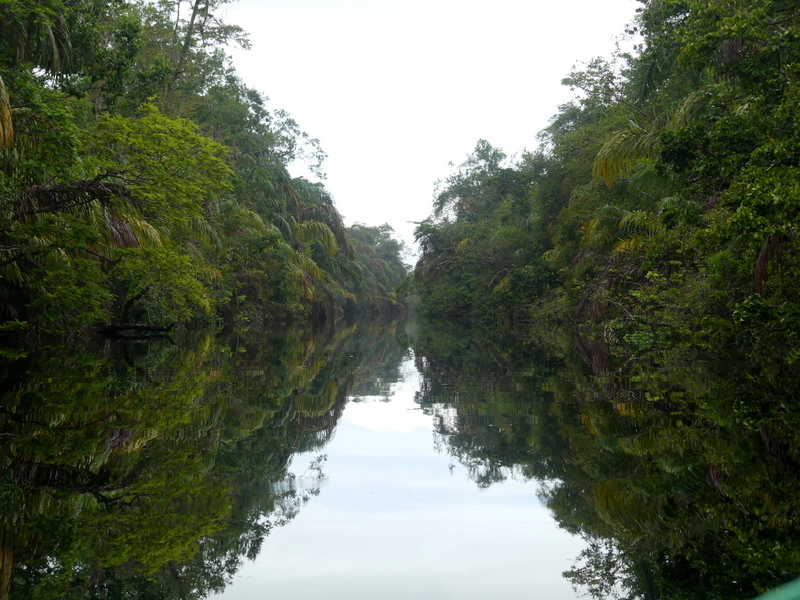
Rainforest crowding the banks of the canals in Tortuguero NP, which provide the only
access to the coast here. These canals were dug in the 1940s to connect natural
waterways, and Tortuguero to the towns to the north and south along the coast.
They were originally designed to move rainforest timber; this logging
industry ended in the 1970s and now tourists flock here, especially to see
the Green Turtles which lay eggs on the beaches at night.
A small forest pool in rainforest at Esquinas Lodge in Piedras Blancas NP
in the far south near the Pacific coast.

Rainforest along the Puerto Viejo River, from the footbridge over it at La Selva
Biological Research Station, just 60masl, though it is 60km inland from Tortuguero.
This superb destination (which provides public accommodation) is run by the
Organisation for Tropical Studies, a consortium of over 50 universities in Costa Rica,
the US, Mexico, Peru and South Africa. Its 1600ha of largely primary rainforest adjoins
the northern edge of the 47,000ha Braulio Carrillo NP, and contains some 60km of
walking tracks. A must for anyone reading this blog when you visit Costa Rica!

Baird's (or Central American) Tapir Tapirus bairdii, a widespread though not usually
easy to see
inhabitant of the rainforests, though it can also be found
to above the tree line.

Rainforest canopy at Tapirus Lodge, a private reserve to the south of La Selva,
still on the Caribbean slope and on the eastern boundary of Braulio Carrillo NP.
This was taken from the remarkable canopy-level cable car (or 'aerial tram')
which offers an hour return trip, with the option of disembarking at the top.
Morning mist over the rainforest along the access road to Tapirus Lodge.
The lodge is at 500masl, so at about the elevation where lowland rainforest
gives way to highland cloud forest on the Caribbean slopes, though this
happens at somewhat higher elevations on the Pacific side.
Cloud forests cover some 16,000ha of mountainous Costa Rica, from the upper level of the lowland rainforests to the tree line at about 3000masl. In the north they are dominated by many species of laurel (family Lauraceae) while further south two species of oak provide up to 80% of the canopy cover. I find this particularly interesting, having never thought of oaks as being tropical, though I now belatedly know that there are species throughout south-east Asia as far as New Guinea.
Cloud forest living up to its name at 1800masl on the Pacific slope
of the Talamanca Mountains, above and below.
Climbers are characteristic here, as they are at lower elevations.
Also characteristic of cloud forests are epiphytes - both these and the climbers are using
the structure of the trees to get up to the essential sunlight. This superb display of bromeliads
is seen from the deck at the excellent Paraiso Quetzal ('Quetzal Paradise') Lodge.
This wonderful lodge is perched on the mountainside at 2650masl at the head of the
Savegre Valley, south of San José on the Pacific slope of the Cordillera Central.
Canopy epiphytes from the cable car at Tapirus Lodge - this really is an
excellent way to experience the canopy.

Another way is from the three kilometres of walking tracks at Selvatura Park in Monteverde, featuring eight suspension bridges over deep gullies, so that we're looking down on the canopy.

Cloud forest from above; Selvatura Park suspension bridges, Monteverde.
A remarkable perspective of a female Mantled Howler Monkey Alouatta palliata
and baby from a Monteverde suspension bridge.

The walking tracks between the bridges are also deep in rich cloud forest.
The Savegre Valley, below Paraiso Quetzal, is a superb introduction to the southern oak cloud forests.

Walking tracks through the oaks follow the Savegre river and its streams...
... while vantage points enable us to admire the distinctive oak canopy.
The most famous of the cloud forest dwellers is undoubtedly the wonderfully-named Resplendent Quetzal Pharomachrus mocinno, a magnet for birders everywhere. It is the largest of the trogons, a family of colourful birds found throughout the tropical forests of the Americas, Asia and Africa.
Male Resplendent Quetzal, Savegre Valley. This was from the balcony of a restaurant!
The iridescent feathers look blue in this dim under-canopy light, but bright green in the sun.

Above where the cloud forests end, at about 3000masl, is the páramo, a relatively small treeless region beginning with a zone of dwarf bamboo and low shrubs and grading into heathland and grassland.

Bamboos Chusquea spp. at the edge of the páramo at 3200masl in the Talamanca Range.
Heathland páramo at 3400masl.

Green Spiny Lizard Sceloporus malachiticus at 3400masl (and it was bleak and
cold at the time!), one of the few reptiles that can survive at this altitude and
quite common in the highlands.
At Carara National Park (see above) the southern lowland rainforests begin to give way to drier forests - there is still a high annual rainfall but there is also an extended dry season. In Australia we would call this more open dry rainforest 'monsoon forest', such as is common around Darwin. Much of it has been cleared for agriculture, but there are still significant areas of it protected in the north.

Partially cleared dry forest west of Monteverde.

The understorey - here in Rincón de la Vieja NP in far north-western Costa Rica -
is more open than in rainforest, with often thorny small trees and shrubs.

Overstorey trees however can be 30 metres high, like this fig...
... and many species of pea, such as have covered the forest floor with
flowers here (and below).
As we might expect, there are many animals in these north-western dry forests that are not found elsewhere, such as this beautiful motmot.
Turquoise-browed Motmot Eumomota superciliosam, Rincón de la Vieja NP;
this is the national bird of Nicaragua.
Rincón de la Vieja is also the name of an active volcano in the park - we were however not there in the dry season, and I didn't ever get a chance to take a photo of it without a total cloud shroud. However we walked on its lower flanks, and saw plenty of evidence of its activity.
Steam and gases being emitted from a fumarole on the hillside above a bubbling pool.
Bubbling mud in a hot pool of it, above and below.

Irazú Volcano, very close to San José, is Costa Rica's highest active volcano, at 3400masl. It has erupted more than 20 times in the past 300 years, most recently in 1994. Due to its proximity to the national capital, and its easy access, it is a popular destination. Technically you can see both coastlines from the top, but I suspect that doesn't happen very often, and certainly didn't while we were there.  Everything you will read about it mentions the chemically-green lake in the crater, but in fact at the moment it is dry.

This, the main crater, is 750m across and 270m deep, and currently the floor
is covered with volcanic sand and ash. The rim and surrounds are covered
with typical páramo vegetation.
Probably more famous however is the Arenal Volcano at the eastern end of the Guanacaste Range, in a 12,000ha national park. A classic volcanic cone, it is very much alive and in 1968 exploded spectacularly, killing 87 people in nearby villages. The Arenal Observatory Lodge, which is a very nice place to stay indeed, grew from a small accommodation centre provided on private property for scientists studying the aftermath of the explosion. The deck outside the restaurant looks down on a busy fruit feeder for birds, and up at the still largely bared slopes of the volcano.
Arenal Volcano from the Observatory Lodge.
Much of the surrounding forest, with many excellent walking tracks, is secondary forest recovering from the 1968 eruption.
Post-eruption regrowth forest on the lower slopes of Arenal Volcano.
50km to the north, Arenal still dominates the southern horizon, from the open spaces of the lakes of Caño Negro which are the focal point of a Ramsar-listed wetlands site up near the Nicaraguan border. The Frio River feeds it, and flows on into mighty Lake Nicaragua, just across the border. In the wet season the river overflows the plains. This wonderful complex of swamplands, forests and grasslands is only accessible by boat.
Arenal Volcano, 50km away, seen from the lakes at Caño Negro.
Forest-lined lake shore from a boat at Caño Negro.
Another wetland a little to the east, near the cryptically named town of
Medio Queso (ie middle cheese!).
Least Bittern Ixobrychus exilis from the boat in the Medio Queso channels;
this is not an easy bird to see normally. It is the smallest American heron,
and one of the world's smallest.
So far when I've briefly mentioned rivers, it's been in the context of the forests surrounding them, but of course any river trip, of which there are some worthwhile ones in Costa Rica, has its own interest and habitats. One good one is the trip from La Pavona, which is literally the end of the road, via the Rio Suerte ('Lucky River') to the channels which eventually take us to Tortuguero on the Caribbean coast. Here was our highlight of that trip.

Neotropical River Otter Lontra longicaudis focussed on a fishy snack by the Rio Suerte.
Another very worthwhile river trip is on the Tarcoles River. Your first sight of this river is likely to be where the highway crosses it near to Carara NP on the Pacific coast, and where every tour bus stops and disgorges its passengers to walk onto the bridge (just centimetres it seems from passing trucks) to admire the very rare American Crocodiles which loaf hopefully below.
American Crocodile Crocodylus acutus below the Tarcoles River bridge.

However a much more relaxing, rewarding and safe way to see the river is by tour boat, several of which leave from downstream and go through the forest to the river mouth.
Mangroves with 'stilt roots' by the Tarcoles River.
Roseate Spoonbill Platalea ajaja - surely the world's most beautiful spoonbill -
preening by the Tarcoles River. (And the apparenly odd species name is based
on a Tupi name for the bird, from Brazil.)
Brown Pelicans Pelecanus occidentalis at the mouth of the Tarcoles River,
with the Pacific Ocean behind.

Well that's a brief introduction to a fascinating - and to my mind entrancing - country. As I've already promised, there will be two more offerings to introduce some of its superb wildlife, but I'll probably come back to Australian topics before and between them. Meantime, if you have a world wish list and are as fascinated by the natural aspects of as much as I am, Costa Rica deserves a place on that list. 

NEXT POSTING THURSDAY 21 SEPTEMBER
 
I love to receive your comments and in future will be notifying you personally by email when a new posting appears, if you'd like me to. All current subscribers have been added to this mailing list and have already been contacted. This will mean one email every three weeks at the current rate of posting. I promise never to use the list for any other purpose and will never share it.
Should you wish to be added to it, just send me an email at calochilus51@internode.on.net. You can ask to be removed from the list at any time,or could simply mark an email as Spam, so you won't see future ones.