About Me

My photo
Canberra-based naturalist, conservationist, educator since 1980. I’m passionate about the natural world (especially the southern hemisphere), and trying to understand it and to share such understandings. To that aim I’ve written several books (most recently 'Birds in Their Habitats' and 'Australian Bird Names; origins and meanings'), and run tours all over Australia, and for 17 years to South and Central America. I've done a lot of ABC radio work, chaired a government environmental advisory committee and taught many adult education classes – and of course presented this blog, since 2012. I am a recipient of the Australian Natural History Medallion, the Australian Plants Award and most recently a Medal of the Order of Australia for ‘services to conservation and the environment’. I live happily in suburban Duffy with my partner Louise surrounded by a dense native garden and lots of birds.
Showing posts with label Orchids - Australia. Show all posts

Thursday, 7 November 2024

Magnificent Mallee #2: some plants of the mallee

Last time, I offered something of a blogging ode to one of my favourite habitats, the wonderful mallee lands of inland semi-arid Australia. If you missed it you might want to look at it for some background before reading this addendum to it, but if you don't feel like doing that then this post can stand alone - it's really just a photo homage to a range of plants other than the mallee eucalypts themselves that I've encountered and enjoyed over the years across the country. I do notice now that plants from Western and South Australia dominate here, but those states do have a lot of the mallee too! To avoid appearing to be showing favouritism (or actually doing so!), I'm going to offer the poster plants below alphabetically in order of Family (though even that's not simple these days). 

The current trend among plant taxonomists is to lump previous Families into sometimes vast 'super-families'. It's not a matter of right of wrong - the actual relationships don't change - but the question of where to draw the lines between related Families is ultimately a human conceit. But enough of that, the important thing is the plant themselves. The plants I've selected were photographed in mallee habitat, and many of them are mallee specialists. In each family there are other - sometimes many other - mallee species I could have chosen.

It's really pretty much just a photo essay to celebrate some rather lovely plants that you may not be familiar with unless you're another mallee meanderer, in which case I hope it brings some good memories.

ANTHERICACAE
One of several families of Australian lilies; I talked more about them in a series beginning here. I see though that that was a decade ago, so things might have changed again, but I don't think very significantly.
Mangles' Fringe Lily Thysanotus manglesianus, Kalbarri NP, near Geraldton, Western Australia.
It grows widely in the south-west, but especially in the mallee.

ASTERACEAE

The familiar daisy family, which no-one has tried to redefine as far as I know!
Invisible Plant (or Wiry Podolepis) Podolepis capillaris Pinkawillinie Conservation Park,
Eyre Peninsula, South Australia. I love this name and, though it's not
terribly invisible here, the threadlike stems and pale flowers can be hard to
see in some lights. I do have another photo that illustrates this, but then you
wouldn't be able to see much! It does have a wide distribution in sandy
soils in southern and central Australia, but I've mostly seen it in mallee.

Poached Egg Daisy Polycalymma (fomerly Myriocephalus) stuartii,
Hattah-Kulkyne NP, north-western Victoria. Another sand-lover, found
widely in the mallee and beyond.

FABACEAE
The peas, one of the most familiar and largest plant families in the world, at least until the recent conglomerations of families.
Cockies' Tongues Templetonia retusa, Dhilba Guuranda–Innes National Park,
Yorke Peninsula, South Australia. This has always been a favourite of mine, partly
because it really is a striking shrub, and partly because it was one of the first
native plant names I learned. It grows in coastal limestone (and in the Flinders
Ranges), much of which is among mallee.
Granny Bonnets Isotropis cuneifolia, Badgingarra National Park,
south-western Australia. Again the species grows in a variety of sandy
and gravelly habitats (especially soon after fires), but this one was in mallee.
Common Eutaxia or Mallee Bush-Pea Eutaxia microphylla, Wyperfeld NP,
north-western Victoria. Mostly found in the mallee

GOODENIACEAE
The goodenia family in eastern Australia is probably best-known for yellow-flowered herbs and shrubs of Goodenia, and the purple-flowered Dampiera. In Western Australia however the various Lechanaultia species are truly dramatic. It's worth noting that in honouring the splendidly named chief botanist on the mighty Baudin scientific expedition to Australia in 1801, Jean-Baptiste Louis-Claude-Theodore Leschenault de la Tour, the great Scottish botanist Robert Brown, normally so meticulous, misspelt his name. Too late though, once it was published.
Blue Lechenaultia L. biloba, Yandin Hill Lookout, north of Perth.
Here it was growing near another WA special, the amazing
Mottlecah mallee E. macrocarpa. See the previous posting for photos of it.
Red Lechenaultia L. formosa, Stirling Ranges NP, south-western WA.
Sandhill Goodenia G. Goodenia willisiana is a much more modest member of
the family, found in mallee in north-western Victoria and adjacent South Australia
and NSW. Here it is in Wyperfeld NP.
Velvet Dampiera V. marifolia, also in Wyperfeld NP.
This striking plant, abundant on a recent spring trip to the area,
has a similar mallee lands distribution to the previous species.

HALORAGACEAE

A relatively small family, mostly in Australia but also has species spread across much of the world, ranging from aquatic herbs to small trees. No species is likely to be familiar to non-specialists, and this lovely mallee herb is the only one I could readily name.

Golden Pennants Glischrocaryon behrii, Pinkawillinie NP, Eyre Peninsula,
South Australia. It is found in mallee from here east to western Victoria
and south-western NSW. It can grow in extensive golden colonies, and
always brings a smile to my face.

 LAMIACEAE
A much more familiar family, including many garden culinary herbs and well-known native shrubs such as Prostanthera and Westringia.

West Coast Mintbush Prostanthera calycina, High Cliffs, at the southern tip
of Eyre Peninsula. A true mallee specialist, it is endemic to Eyre Peninsula,
growing on limestone outcrops.
Stiff Westringia W. rigida, Nullarbor cliffs, South Australia.
Usually on limestone and in mallee, though it also extends to dry forests from
Western Australia to NSW.
MALVACEAE
This is one of the newly defined 'superfamilies' that I mentioned at the start of this post. Already a large family, Malvaceae (based on hibiscuses and hollyhocks) now has a mind-numbing 4200 or so species, after the 1500 or so species of the family Sterculiacae were moved into it. All four species featured here were previously included in that family.
Pink Velvet Bush Lasiopetalum behrii, Caralue Bluff Conservation Park,
Eyre Peninsula, South Australia. It is found in mallee from
Western Australia to south-western NSW.
Coast Velvet Bush Lasiopetalum discolor, Dhilba Guuranda–Innes National Park,
Yorke Peninsula, South Australia. It grows along much of the south coast,
in Western and South Australia, though also in the Bass Strait and northern Tasmania.
On the mainland it is found primarily in mallee, and on dunes.
Paper Flower Thomasia petalocalyx, growing in mallee in the Coorong NP, South Australia.
It is also found in other habitats along the coast and hinterlands in the
south-west and south-east.
Trailing Commersonia Androcalva (formerly Commersonia) tatei,
Heggaton CP, Eyre Peninsula, South Australia.
An interesting little plant which is almost endemic to the mallee of Eyre Peninsula
- disqualified only by one totally isolated population in far north-western Victoria.
MIMOSACEAE
Yes, I'm going to break my self-imposed rule by not using the official family taxonomy for this one. A little while ago the wattles (ie family Mimosaceae) were lumped in with the already huge pea family Fabaceae to form a mighty megafamily of almost 20,000 species. While wattles are certainly closely related to peas (look at the pods), they form such an obviously distinct and familiar group that I'm going to be pragmatic and look at them separately from the (other) peas. There are of course very many wattles growing in the mallee; here are just three typical species.
Grey Mulga Acacia brachybotrya, Wyperfeld NP, north-west Victoria.
I'm not sure of the significance of the 'mulga' appellation, it certainly doesn't
resemble 'real' Mulga, Acacia aneura. It is an important part of mallee
communities from the edge of the Nullarbor Plain in South Australia
across to Victoria and NSW.
Wallowa Acacia calamifolia, Rudall CP, Eyre Peninsula, South Australia.
A distinctive wattle, it is found throughout the mallee lands of South Australia
and Victoria, and beyond into woodlands of NSW. It is said that its seeds are
important food of Mallee Fowl, but I suspect that this could be said of many
other wattles too.
Sandhill Wattle Acacia ligulata, Gawler Ranges NP, South Australia.
(I learnt it as Chainpod Wattle for its constricted seed pods but in retrospect
I think that this was a descriptive name coined by a clever teacher.)
While it is found in all the mallee lands of Australia, it is also found
far to the north, in every mainland state and the Northern Territory.
 MYRTACEAE
A very familiar family, and of course the one to which the mallee eucalypts themselves belong, but we met some of them last time. Here are three others.
Common Fringe-Myrtle Calytrix tetrogona, Dhilba Guuranda–Innes
National Park, Yorke Peninsula, South Australia. Another plant which,
while found in most of the mallee lands, also grows well beyond them too.
But, far too attractive to be left out!

Black Teatree Melaleuca lanceolata, growing alongside mallee in Coorong NP,
South Australia. It often grows within the mallee itself, and is especially
common near the coast and inland watercourses.
Woolly Featherflower Verticordia monodelpha, Kalbarri NP, central west coast
of Western Australia. This species isn't found far from Kalbarri. The genus is,
in my opinion at least, one of the most glorious in Australia; indeed 'verticordia'
means 'heart-turner'! It is endemic to the west.
ORCHIDACEAE
Well, anyone who knows me will know that I'm not going to miss a chance to allow some orchids to flaunt themselves, and I'm not going to disappoint you! There isn't the variety of orchids in mallee that we find in moister habitats, but here are some good ones to look for.
Long Golden Club Spider Orchid Caladenia (Arachnorchis) aurulenta,
Yeldulknie Conservation Park, Eyre Peninsula, South Australia.
This is a fairly rare species and limited to the northern Eyre Peninsula.
(Of course I could be wrong about this one - there are several quite similar species -
but it seems to meet all the relevant criteria.)
West Wind Spider Orchid Caladenia (Arachnorchis) zephyra, Wanilla Conservation Park,
Eyre Peninsula, South Australia. Apologies for the photo, but it's the only one
I've seen. (Therefore I'm obviously not familiar with it, so again any corrections
would be welcomed.)
Zebra Orchids Caladenia cairnsiana, Stirling Ranges NP.
This is one of the orchids I most look forward to seeing when I go west (not often enough!).
These were growing in mallee but they are also found in a range of habitats.
The same comments about habitat could be made about the Ant or Clown Orchid
Caladenia roei, here in roadside mallee near Hyden, south-west WA.
Tiny Rustyhood Oligochaetochilus pusillus, here in Gawler Ranges NP in South Australia,
is scattered in mallee and open forest across semi-arid southern Austalia.
    
PITTOSPORACEAE
Members of this diverse family, of a couple of hundred species of shrubs, trees and vines, are generally found in moister habitats than the mallee, but one species is very much at home there.
Berrigan or Native Apricot (and many other local names) Pittosporum angustifolium,
Mungo NP, south-western NSW. I am fascinated by its story. Nearly all Pittosporum
species live in east coast rainforest or wet eucalypt forest, but this one adapted as the country
dried out and, instead of retreating with the forests, evolved to the drying conditions.
It is an elegant small tree with weeping foliage found throughout the mallee lands,
and also well beyond to the north.

PROTEACEAE
This is one of the dominant Australian families, an old Gondwanan, found in every Australian habitat. Here is a selection of four, all from different genera (three of them very familiar), which are found in the mallee.
Gland Flower Adenanthos terminalis, Heggaton CP, Eyre Peninsula, South Australia.
It belongs to a genus of over 30 species, all but two of which are endemic to WA.
This species is limited to the mallee lands of South Australia and western Victoria.
Like most of the family it is bird-pollinated.
Fox Banksia B. sphaerocarpa Badgingarra NP, south-western WA.
This low shrub grows in deep sand in mallee, heath and woodlands.
Its dull colours and ground-hugging nature (to hide from birds) suggest that
this flower is one of the many pollinated by native mammals.
Candelabra Grevillea G. candelabroides Kalbarri NP, mid-west coast, WA.
A spectacular grevillea which is restricted to the mallee and heathland
of the northern sandplains in this region.
Emu Tree (I have no idea why, sorry!) Hakea francisiana, Pinkawillinie CP, South Australia.
Most hakeas have fairly small white flowers, so this one is especially impressive.
It grows in mallee and associated heathlands across southern WA and as far
east as Eyre Peninsula (where this one was).

RUTACEAE
A familiar family even if we don't realise it - eg citrus fruit, boronias, correas etc. 

Boronia (also now known as Cyanothamnus) coerulescens, Wanilla Conservation
Park,  Eyre Peninsula, South Australia. This attractive species has flowers ranging
from bright blue (very unusual in Boronias) to greenish to pink to white;
this one appears to be on the bluish end of that spectrum. It is also the only boronia
that I know of that grows in mallee, but there are probably some I don't know
about in the west. It is found in mallee from WA through South Australia
to Victoria. (It was recently determined that Boronia contains more than
one distinct group of species, and 24 of them were moved to Cyanothamnus.)
Desert Phebalium P. bullatum, Gawler Ranges NP, South Australia.
Another mallee specialist, found from the Eyre Peninsula to western Victoria.
The yellow flowers and long stamens are unmistakably Phebalium.
('Desert' in southern Australian plant names is often a codeword for mallee -
see more in the previous posting, and also the next two species.)
SANTALACEAE
The sandalwood family is a widespread one, whose members are all at least partially parasitic on other plants - photosynthesising their own sugars, but pilfering other nutrients, especially from the roots.
Quandong (or Desert or Sweet Quandong, to distinguish it from other related Australian species)
Santalum acuminatum, Nambung NP, south-west WA. Quandongs grow throughout
the mallee lands, but also in woodlands well to the north. There is now quite an
industry (especially around the Flinders Ranges in South Australia) selling jams
and chutneys from the fruit. When I was a child, my grandmother had a cheap
Chinese Checkers set using painted quandong seeds as the moving pieces.
SAPINDACEAE
This is a large world-wide family, best known elsewhere for lychees, maples and horse chestnuts, and in Australia for the native hops, Dodonaea spp. Here there are some 60 species, with another 10 elsewhere in the Southern Hemisphere.
Desert Hop-bush Dodonea stenozyga, near Yalata, eastern end of the Nullarbor Plain,
South Australia. The three-corner papery fruits are typical, but this one is
pretty well limited to the mallee.
SCROPHULARIACEAE
An unlovely name for this large cosmopolitan family. In this post all three members of the family I am introducing are species of (the 'desert lovers', in my Big Three of favourite Australian plant groups, along with orchids and banksias). Previously eremophilas, along with boobiallas (Myoporum) and a small WA genus, comprised the family Myoporaceae, but all have been moved into Scrophulariaceae. All Eremophila are arid-land plants, including the mallee.
Tar Bush Eremophila glabra, here at the eastern end of the Nullarbor Plain in South Australia,
is found right across southern arid and semi-arid Austalia.
Weeooka Eremophila oppositofolia, Whyalla CP, South Australia.
It has a similarly wide distribution to Tar Bush, above.
Scotia Bush Eremophila scoparia, Lake Gilles CP, South Australia.
Again grows very widely across the mallee lands, and into the adjacent Mulga.
And I'm sure you'll agree that that's probably enough for today! If you're really not that interested in Australian wildflowers you'll have given up reading this long ago, so I don't really know why I'm addressing you... :-) If you are still here, thank you and I hope you've enjoyed this floral display that the mallee has produced. I'll be back once more with some more mallee delights, this time some animals. I hope you'll come back then.

NEXT POSTING THURSDAY 28 NOVEMBER; you can find it here
I love to receive your comments and in future will be notifying you personally by email when a new posting appears, if you'd like me to. All current subscribers have been added to this mailing list and have already been contacted. This will mean one email every three weeks at the current rate of posting. I promise never to use the list for any other purpose and will never share it.
Should you wish to be added to it, just send me an email at calochilus51@internode.on.net. You can ask to be removed from the list at any time,or could simply mark an email as Spam, so you won't see future ones.
If you do leave a comment - and I love it when you do - please remember to click the
box below your comment that says 'Email follow-up comments to...[your address]'
so you'll know when I reply - and I always do!

Thursday, 10 November 2022

Gariwerd/Grampians National Park; a range of flowers

[See notice at end re resumption of posts]

In my most recent post, I introduced the wonderful Gariwerd (or Grampians) National Park in western Victoria, one of our favourites. There wasn't room in one post to do it justice, so I left most of the flower photos to this second instalment. Accordingly this is simply a celebration of some of the wildflowers we enjoyed there in a couple of spring visits - one in the dry September of 2019, just before La Niña began to drench Australia and COVID changed everything, and the other only a few weeks ago in the very wet October of 2022. It's really just an annotated photo gallery. For the most part you'll be able to tell which photos were from which trip - the most recent ones tend to be in very dull light and often with raindrops still on the flowers!

In the last post I introduced some plants that are endemic to Gariwerd, but many of those that follow are quite widespread. However the ranges are particularly rich in spring flowers and worth celebrating for that, so quite of lot of flowers follow! There are also some species here that are only found in western Victoria. There's no particular rationale for the order in which the photos appear, though I have kept members of the same plant families together. Let's start with some wattles, and why not?

Spike Wattle Acacia oxycedrus growing among the rocks near Boroka Lookout,
above and below.
The wicked thorns and flowers in (much more benign) spikes make this wattle
very distinctive. It grows in heathy dry forest along the coast and hinterlands
of south-eastern Australia.

Myrtle Wattle A. myrtifolia grows in near-coastal areas (at its closest point Gariwerd is
only 85k from the sea) from south-western Australia all the way to south-east Queensland.

Golden Wattle A. pycnantha which, as I'm sure you're aware (if you're Australian at least),
is our national floral emblem. It does occur in six of the eight states and territories,
being only absent from Queensland and the Northern Territory.

Wirilda Acacia retinodes, which can produce the very pale flowers at almost any
time of year (here in September) but peaks in summer. The long slender single-veined
phyllodes have a distinctive bluish tinge.
The heaths are prominent (as they are in the understorey of many south-eastern drier forests and coastal heathlands). I've just used 'heath' in two different senses in that sentence. The Australian plants related to the northern hemisphere family Ericaceae were long put into their own family Epacridaceae, but as is the wont of modern botanical taxonomy it has been subsumed into a huge and somewhat amorphous enlarged Ericaceae. (I've quietly lamented the loss of nuance in this trend, and won't do so again here.) The other use of 'heath' is as a habitat descriptor, referring to an understorey or near-treeless expanse of hard-leaved shrubs growing in low-nutrient wet or dry sandy soils. (Members of the heath family are often prominent in such habitats.)

Here are three heath species which are commonly found in Gariwerd, the first of which is the Victorian floral emblem (though it also grows in South Australia, south-eastern NSW and throughout Tasmania).
Common Heath Epacris impressa (above and below) ranges in colour from
deep red to pale pink to white. Here are a couple of variants. It is very (and
pleasingly) common throughout Gariwerd and well beyond.

Pine Heath Astroloma pinifolium really does have very pine-like foliage, as well as
unusual green-tipped yellow flowers.

Golden Heath Styphelia adscendens is another striking heath species, with long
stamens and furry rolled-back petals. Like many other species featured here
it is also found well beyond the ranges of Gariwerd.

Members of the Proteaceae family are prominent here, as pretty much everywhere in Australia. Last time we met the lovely Flame Grevillea, which is restricted to Gariwerd, and the Rock Banksia, which is found only here and on Mornington Peninsula. Here are a couple of other family members.

Mountain Grevillea G. alpina, a very attractive, widespread and variable species found in drier
forests of Victoria and south-eastern NSW (including the ACT). At times it's been suggested
that more than one species is involved, which seems intuitively plausible,
but it seems the genetics doesn't support the idea.
Holly Grevillea G. aquifolium, a striking species found mostly in western Victoria, and
to a lesser extent in south-eastern South Australia.
Beaked Hakea (or Turkey-gobbler) H. rostrata (all three names come from the
distinctively shaped large woody fruit). Found from central Victoria
to well into South Australia.

Victorian Smokebush Conospermum mitchellii. Of 52 named species of smokebush,
only eight are found outside of WA; this one is limited to western Victoria, especially
Gariwerd. Many of the WA species have blue-grey flowers which, en masse, look
like smoke haze from a distance, but this one is gleaming white.
Pea plants are of course everywhere, and last time I featured the Gariwerd endemic Grampians Parrot-Pea. Here are three other, more widespread peas of Gariwerd.
Showy Parrot-Pea Dillwynia sericea, found from Kangaroo Island to the far
north of NSW. I don't get bored with it though...
Rough Bush-Pea Pultenea scabra, a familiar pea on the south-eastern mainland,
with very distinctive leaves.
Spreading Eutaxia E. microphylla, also found far beyond Gariwerd.
Running Postman Kennedia prostrata, always a pleasure to encounter, which can
be done virtually right across southern Australia.
In a prolonged wet period like this one sundews are found almost everywhere, but in other times they are restricted to perennially damp situations, where they trap and digest insects with their sticky-haired leaves baited with sugary droplets, to compensate for low nutrient soils. 
Tall Sundew Drosera auriculata; its long-haired leaves can be seen at the bottom
of the picture. The flower is held high above above them to prevent accidental
digestion of the pollinators!
Scented Sundew Drosera whittakeri, whose deathtrap leaves are all lying
on the ground. No flowers in this photo, but the leaves are beautiful in themselves.
From here until the last bundle of offerings, each family is represented by just one species.
Rough Star-hair Astrotricha ledifolia (Family Araliaceae), a widespread family which
includes ivy and ginseng. A very distinctive shrub with hairy flower stems, found in
scattered locations across Victoria.
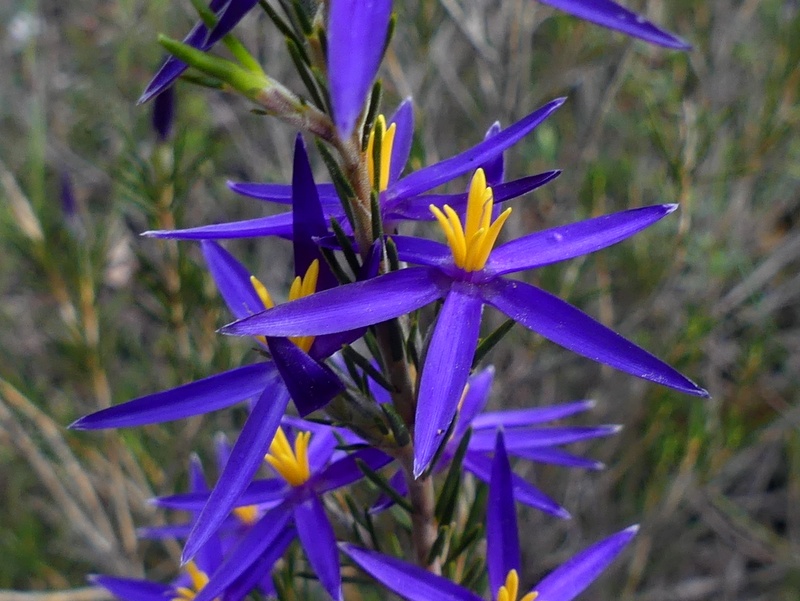
Pale Grass-Lily Caesia parviflora, a widespread and attractive little lily.
By contrast with some previous widespread species, this glorious Blue Tinsel-Lily
Calectasia intermedia
is found only from Gariwerd west to the SA border, and in adjacent
areas of that state. Moroever it is the only Calectasia - and indeed the only member of the family
Dasypogonaceae - found outside of Western Australia.
Snow Myrtle Calytrix alpestris, another lovely plant, especially in flower, has a
similar (though slightly wider) distribution to the Calectasia, in heathlands of
western Victoria and adjacent South Australia.

Bundled Guinea Flower Hibbertia fasciculata is probably the most conspicuous
of the several species of guinea flower in Gariwerd, with dense furry cylindrical
leaves up the often erect stem. Family Dillenaceae.
Wedge-leaf Hop Bush Dodonea cuneata has very inconspicuous little
green flowers but beautiful big glossy red winged fruits.

Large-leaf Ray Flower Cyphanthera anthocercidea is a rare and Endangered species, found
only in Gariwerd and nearby Mount Arapiles, and on the other side of the state in a few
localities in Gippsland. It is in the Solanaceae family, with tomatoes, potatoes and tobacco,
plus quite a few Australian species.
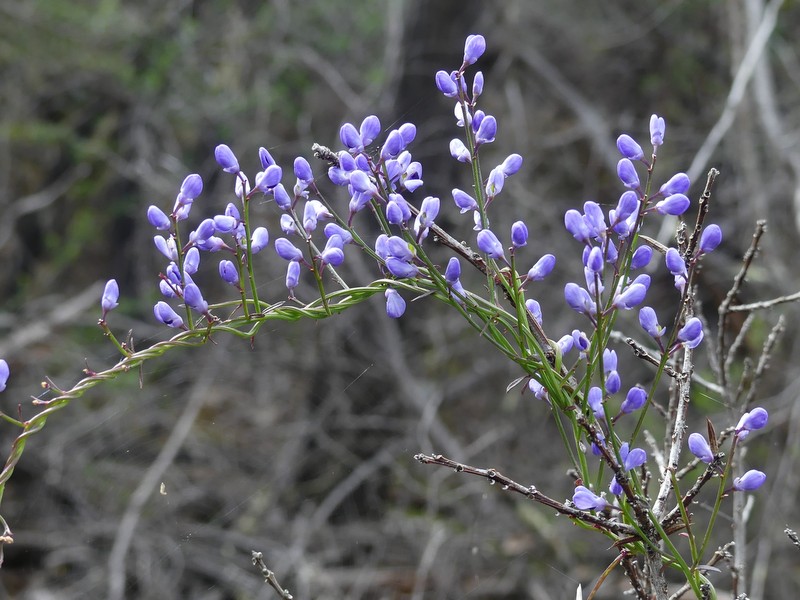
Love Creeper Comesperma volubile, a very pretty climber in the family Polygalaceae.
Unlike the previous species this one has a huge range across near-coastal southern
Australia from Brisbane to Tasmania to north of Perth.
Shrubby Velvet Bush Lasiopetalum macrophyllum Family Malvaceae (though until fairly
recently it was in the much smaller family Sterculiaceae, and who knows what is yet to
come?). In Victoria it is found mostly in the far east, except for a few populations
in Gariwerd - including this one at Golton Gorge.
Bendigo or Fairy Waxflower Philotheca (formerly Eriostemon) verrucosa, another beautiful
snowy white flower. Found in Victoria mostly in Gariwerd and the central Goldfields, and
in Tasmania, plus outliers in the Mount Lofty Ranges. Family Rutaceae (like citruses and boronias).
Round-leaf Mintbush Prostanthera rotundifolia, a profusely flowering beauty
found in rocky areas throughout south-eastern Australia.
Dusty Miller Spyridium parvifolium at Boroka Lookout.
The 'dusty' pale leaves surrounding the inconspicuous flowers draw attention
to them. I like to think this gives us an indication of how petals originally developed.
Pink Bells Tetratheca ciliata, found everywhere in Gariwerd and a constant source of pleasure.
Its flowers are bigger than those of other Tetratheca I know. Tetratheca's family Tremandraceae
has been subsumed into the bigger and ancient Gondwanan family Eleocarpaceae, following
a common pattern in botanical taxonomy in recent times.
Fairy's Apron Utricularia dichotoma. These tiny flowers grow in wet areas (this one
was part of a colony growing in thick moss on a rock sheet). They prey on very small
organisms in the water beneath them, by means of little 'bladders' which 'suck' in water
and tiny organisms.
Grass Tree Xanthorrhoea australis; this is a familiar sight in many places (though I never
tire of them) but I was intrigued by the oddly chopped-off flower spike, present on
several of these plants in the area near Mount Zero in the north.
And finally, those who know me will not be at all surprised that I'm going to end this Gariwerd floral odyssey with a selection of the orchids we saw. Some are common and widespread, others not nearly so much, but I enjoy them all every time; I hope you do too!
Waxlip Orchid (or Parson-in-the-Pulpit) Glossodia major; this orchid
is familiar to anyone who goes into the south-east Australian bush in spring,
but I can never ignore it! On both our most recent visits to Gariwerd we saw these in swathes.

Leopard Orchid Diuris pardina, another very common Gariwerd orchid,
and also widespread in south-eastern Australia.

Trim Greenhood Diplodium (or Pterostylis) concinum; for more on the fascinating
greenhoods, see my recent post on them here. This one has a similar broad
south-eastern distribution to the last two species.
Emerald-Lip Greenhood Bunochilus (or Pterostylis) smaragdynus, here coming to the
very end of its flowering. It was the only plant we found, and only the top couple of flowers
are still fairly fresh; the lower ones have swollen ovaries and shrivelled flowers, having
been fertilised.
Gnat Orchid Cyrtostylis reniformis, yet another species widespread in the south-east but,
despite growing in colonies, it's not always easy to see in the shady situations where it often grows.
Rabbit Ears Thelymitra antennifera; the odd name refers to the red-brown erect lobes
on the column in the middle of the flower. It's one of the sun orchids, but is a bit more
willing to open on cloudy days than many others in the group.
A widespread orchid across southern Australia, but not as far north as NSW.
Pygmy Caladenia, or Tiny Fingers, Caladenia pusilla, a very small finger orchid indeed;
it is found scattered across south-eastern Australia, but is rarely apparently common.
However its diminutive size and similarity to other, much commoner, caladenias
probably confuses the situation. We only found this one, up near Mount Zero.
And to finish, a beautiful spider orchid which is giving me considerable angst
regarding its identity. I enquired on a very knowledgeable orchid facebook
group, where I was assured by a couple of authorities that it is the Critically
Endangered Dainty Spider Orchid Caladenia ampla. I'd have no argument with that,
and it certainly looks like it, but the Flora of Victoria tells me that while it
grows nearby it doesn't actually live in Gariwerd itself. If anyone reading this
can advise me of what I'm missing here I'd be very grateful indeed!

And that might just about do us on some of the fabulous flowers of this fabulous park; it's turned out to be a longer post than even I'd anticipated! If you've gone the full journey with me I'm very grateful, and I hope you've enjoyed it as much as I have. And it's worth bearing in mind that while spring is clearly peak wildflower season there, any time of year it's a great destination, including for flowers. Please do drop by when you can, you won't regret it.

I'M TAKING A SHORT BREAK FROM BLOGGING UNTIL JANUARY.
I'LL NOTIFY YOU, AS USUAL, WHEN THE NEXT ONE GOES UP;
SEE BELOW IF YOU'RE NOT ON MY NOTIFICATIONS LIST AND WOULD LIKE TO BE.

 
I love to receive your comments and in future will be notifying you personally by email when a new posting appears, if you'd like me to. All current subscribers have been added to this mailing list and have already been contacted. This will mean one email every three weeks at the current rate of posting. I promise never to use the list for any other purpose and will never share it.
Should you wish to be added to it, just send me an email at calochilus51@internode.on.net. You can ask to be removed from the list at any time,or could simply mark an email as Spam, so you won't see future ones.