About Me

My photo
Canberra-based naturalist, conservationist, educator since 1980. I’m passionate about the natural world (especially the southern hemisphere), and trying to understand it and to share such understandings. To that aim I’ve written several books (most recently 'Birds in Their Habitats' and 'Australian Bird Names; origins and meanings'), and run tours all over Australia, and for 17 years to South and Central America. I've done a lot of ABC radio work, chaired a government environmental advisory committee and taught many adult education classes – and of course presented this blog, since 2012. I am a recipient of the Australian Natural History Medallion, the Australian Plants Award and most recently a Medal of the Order of Australia for ‘services to conservation and the environment’. I live happily in suburban Duffy with my partner Louise surrounded by a dense native garden and lots of birds.

Thursday, 19 October 2023

Costa Rica; where the Americas meet #2. Animals, frogs and scales.

A little while ago, following a visit to this special country, I posted here an introduction to it. You might want to start with that post, though it isn't essential to reading this one; you will however find there more information on most of the localities mentioned here. My original intention was to put up two posts on animals of Costa Rica - one on the birds, the other (this one) on 'the rest'. However, when I was about three quarters of the way through this one I realised that it was just too long and unwieldy, even before I'd got to the mammals! So I've gone back and split this post in two, in the hope that some of you will find your way through both rather than giving up in exhaustion. (Though I confess that I did then take the opportunity too to slip a few more photos in...)

Here then is an introduction to some of the numerous and fascinating frogs and reptiles of the country; the tropics abound in these groups which are fascinating and often very photogenic. It's mostly a 'photo essay', with most of the information in the picture captions. For no good reason - other than 'why not?' - I'm going to start with some frogs, then go on to reptiles.  

The first five frog species belong to the very large and widespread tree frog family Hylidae.

Crowned Tree Frog Anotheca (or Triprion) spinosa, Tapirus Lodge, central mountains.
A spectacular arboreal frog found in scattered locations in Central America, it breeds
in above-ground puddles in tree hollows or bromeliad leaves. The female
provides unfertilised eggs as food for the growing tadpoles!

Golden-eyed Tree Frog (it goes by several different names though) Agalychnis annae,
in the grounds of the Hotel Bougainvillea on the outskirts of the capital, San José.
It is a highly Endangered species, living only in the heavily populated and
cultivated central valley; this population in the hotel grounds is apparently
the only one in the vicinity.

Red-eyed Tree Frogs Agalychnis callidryas on the other hand are very
common in Central American rainforests. The spotlight has messed with
its glorious colours, and the eyes in particular, which are really a glowing bright red.
We were there in the rainy season and, like these two, many frogs were engaged
in producing even more frogs!


Hourglass Tree Frogs Dendropsophus ebraccatus. The smaller male in this case lacks the
hourglass shape on the back of most of the species; the top of it can be seen on the female's
head. They can be found throughout Central America and as far south as Ecuador.
Masked Tree Frog Smilisca phaeota, Tapirus Lodge. A common (and rather
winsome) tree frog found throughout the moist lowlands and lower mountains,
and from Honduras to Ecuador.
The other well-known tropical American frog family is that of the poison dart frogs, Dendrobatidae, with some 170 species. These are diurnal frogs, often brilliantly coloured, a very few of which were used by Native Americans to extract poison for blowpipe darts. The alkaloid toxins (which are very potent) are produced by the frog from chemicals in their insect diet, and stored in skin glands for use in protection against enemies. Their striking visibility is a warning. Two species are common in Costa Rica, though not found everywhere there.

Green-and-black Poison Dart Frog Dendrobates auratus. It is found in southern
Central America to Colombia, but in Costa Rica only on the southern Pacific coast.
This one was in rainforest in Carara National Park. It really looks like porcelain!

Strawberry Poison Dart Frog (also known as Blue Jeans Frog!) Oophaga pumilio,
until recently included in the larger genus Dendrobates. This frog can be found
in almost any Costa Rican lowland forest or plantation. It has a range of colour
variants, some of which lack the blue legs, and others are not red at all.
Their range is centred on Costa Rica, and extends into Nicaragua and Panama. This one
was at the wonderful La Selva Research Station, in the Caribbean lowlands.
Finally, before I get too carried away with these frogs, a nod to one of the many other families present.
Foam frog Leptodactylus sp. at Esquinas Lodge in the Piedras Blancas NP
in the far south near the Pacific coast. This is a substantial group of mostly large
frogs, and I'm not able to identify this one further, though would welcome
suggestions. Eggs are laid in a protective bed of foam on the water surface
and the tadpoles fall into the pond below when they hatch.
Reptiles are numerous and diverse throughout the tropics, and Costa Rica is no exception. We encountered a good selection of both snakes and lizards, so let's meet some of them.
 
Some of the snakes were non-venomous...
Northern Cat-eyed Snake Leptodeira septentrionalis, Esquinas Lodge.
This little snake (found from the far south of the US to Costa Rica) hangs around
ponds, hunting frogs and their egg masses.
Common Snaileater  Sibon nebulatus, Tapirus Lodge. Another small snake that
lives on slugs and snails, extracting these from the shell with specially adapted jaws.
... others less so.
Hog-nosed Pitviper Porthidium nasutum, Tapirus Lodge. This venomous little snake was
on the concrete by the stopping platform at the top of the 'aerial tram' ride through the rainforest
canopy. The young fellow staffing the platform reckoned it was 'just there'. Well, maybe.
Normally they lie still in leaf litter awaiting a meal of a small mammal, frog or lizard.
Eyelash Pitviper Bothriechis schlegelii, rainforest canopy walk, Monteverde. This is a surprisingly
common snake in Costa Rica, nearly always encountered on branches, which may be nearly
at ground level or high in the canopy (like this one, which is peeping out at us through the
coils). There is also a bright yellow version, which I've not seen. It waits patiently - for
weeks sometimes - for birds, small mammals or lizards. Young ones tend to be close to
the ground, and ascend the trees as they get older and switch prey from mostly frogs.
Here is a closeup of the same species, close to the ground, displaying its 'eyelashes'.
Young Eyelash Pitviper, Tapirus Lodge. The 'eyelashes' are of course no such thing, but
modified scales. Their purpose is unclear but it is suggested by those who've studied them
that they help to break up the outline of the distinctive head to better hide from potential prey.
Fer-de-Lance Bothrops asper, Carara NP. This can be a huge snake, up to 2.5 metres long, and
highly venomous. It was curled up in the dark under a park bench by a well-used walking track.
The park staff had simply put a ribbon barrier up for the duration of its stay to prevent us from
taking a rest there. (The vertical pupils distinguish it from the similar False Fer-de-Lance
Xenodon rabdocephalus which has round pupils.)
Many of the lizards encountered - and they are abundant - belong to a cluster of families that include the iguanas and anoles (and the Australian dragons).
Green Iguana Iguana iguana, San Isidro. This is a common big lizard (to more than
1.5 metre long) found naturally from Mexico to southern Brazil. It comes in a range
of colours in addition to green, and is a adept at climbing, swimming and burrowing.
Fortunately for small animals it is mostly vegetarian.

Spiny-tailed Iguana Ctenosaura similis, Carara NP - a group of these big iguanas
was running the carpark when we first visited. They also climb trees well, but have an
affinity for rocky areas...
... as evidenced by this young one in the north at Rincon de la Vieja, displaying
the bright green colouration typical of juveniles.

There are three common species of the extraordinary basilisks in Costa Rica, and throughout most of Central America (plus another in north-western South America). The aspect of them which is most often remarked upon is their ability - especially of smaller individuals - to run several metres on the surface of water, flailing their hind legs very fast and spreading their long toes to distribute the weight.

Green Basilisk Basiliscus plumifrons, Tortuguera on the Caribbean coast. This is a spectacular
animal and quite common, especially along waterways.

Brown Basilisk Basiliscus vittatus in the grounds of Esquinas Lodge.
This one is only found (but very commonly) on the Pacific side of Costa Rica.
Green Spiny Lizard Sceloporus malachiticus, Savegre Valley on the Pacific slopes.
This a common lizard in the mountains; indeed we first saw it basking at some 3400 metres
above sea level, above the tree line in conditions that we reckoned were uncomfortably cold.
The anoles, in the same general grouping, are abudant, mostly small quick lizards found on tree trunks and branches.
Slender Anole Anolis limifrons, in the rain at Esquinas Lodge. This little fellow was
very agile, leaping between leaves.
Bridled Anole Anolis frenatus, seen at night at Tapirus Lodge. My impression is that
most anoles are active in the daytime; this is also large for an anole, at around 15cm long.
Another commonly seen Costa Rican lizard group is the whiptails (or ameivas, from a former genus name), in the family Teidae. They are very common along forest tracks, on logs and in the litter. They are long-tailed and quick and some are brightly coloured. This one however was in our cabin, living on and in the totally superfluous bed doona that was on the floor.
Central American Whiptail Holcosus festivus, La Selva Research Station.
Geckoes were less obvious than I might have expected, but maybe that was just me. Here is a rather lovely daytime species which was dining out too, on one of the wooden supports of an outdoor restaurant.
Yellow-headed Gecko Gonatodes albogularis, a widespread species of drier
tropical forests, here at Caño Negro in the northeast.
I find it surprising that there are only four species of freshwater turtle in Costa Rica (though I have no real reason to be surprised, I must admit). This appears to be the commonest one, but is only found on the Caribbean side.
Black River Turtles Rhinoclemmys funerea, beneath the pedestrian bridge across the
Puerto Viejo River at La Selva Research Centre.
Finally there are two species of crocodilians, one quite common, the other definitely not.
Spectacled Caiman Caiman crocodilus, in the wetlands of Caño Negro.
This smallish caiman (generally less that two metres long) is found thoughout Central
America and the north of South America. It keeps to itself in the rivers and
wetlands, mostly being active at night, and hunting fish.
American Crocodile Crocodylus acutus, Tarcoles River on the central Pacific coast. This is about
the only place in Costa Rica that this magnificent animal - up to six metres long and weighing almost
 a tonne for very large males - is still relatively common. Here there is a thriving
business in running crocodile tours (very reminiscent of the Daintree River in Queensland).
There is also a constant stream of  tourists disgorged at the end of the highway bridge over the river
to walk on the narrow footpath, with heavy traffic seemingly only centimetres away,
to gaze down at the crocodiles which are usually lying below, facing the current to harvest
unwary fish. Overall there are probably no more than 3000 in the wild, from Florida
to northern South America.
And you may well be relieved that that's all for today (though not too relieved I hope....). Back soon to complete this series with some invertebrates and mammals. The birds can then wait for a slightly later date, while I post on something a bit closer to home. Thanks for accompanying me!

NEXT POSTING THURSDAY 2 NOVEMBER
I love to receive your comments and in future will be notifying you personally by email when a new posting appears, if you'd like me to. All current subscribers have been added to this mailing list and have already been contacted. This will mean one email every three weeks at the current rate of posting. I promise never to use the list for any other purpose and will never share it.
Should you wish to be added to it, just send me an email at calochilus51@internode.on.net. You can ask to be removed from the list at any time,or could simply mark an email as Spam, so you won't see future ones.
If you do leave a comment - and I love it when you do - please remember to click the
box below your comment that says 'Email follow-up comments to...[your address]'
so you'll know when I reply - and I always do!


Thursday, 21 September 2023

Not an Owl; some of the other night birds

It's a common, and perfectly understandable, assumption that all nocturnal hunting birds must be owls. Most of us don't usually get a good look at these birds unless we happen upon them when they're trying to sleep in the daytime, while hoping to escape the notice of the noisy day birds which always want to move them on. Moreover, even if we do get a decent look, they still look rather owl-like - big eyes, soft plumage, delicately patterned plumage, often mottled or streaked for camouflage. These 'not owls' are the potoos of South and Central America, the Oilbird of northern South America, the nightjars and nighthawks, found across most of the world, the frogmouths of Australia and south-east Asia and the owlet-nightjars of New Guinea, plus a few nearby islands (including Australia). Each of these groups forms a Family, and until recently all were placed in the same Order, but in 2021 it was broadly agreed that each of these Families was better understood as a full Order in their own right (see here and find Version 11.2).

Hopefully you've read this far! If so, please persevere - that's pretty much the end of the taxonomy lesson, and the rest is just about these very interesting groups of birds.

Tawny Frogmouth Podargus strigoides near Canberra; they typically spend
the day in the open, relying on their impressive camouflage for protection.
While we're on frogmouths we might as well continue with them. There are 16 species, and through most of their extensive range, which stretches from Australia to India, they are rainforest dwellers, many of them very hard to find. However the Tawny Frogmouth is the exception, being a bird of drier forests and woodlands throughout Australia, including the arid inland, wherever there are trees and open ground for hunting. They are found in suburbia, including in all Australian capital cities, and I'm sure that they are the most familiar night birds to most Australians.
Tawny Frogmouth and large chick, about to fledge (indeed it flew just a day after this),
in a park near our Canberra home.
Despite the apparent similarities with owls, there are significant differences. Whereas owls have forward-looking eyes (like us), frogmouths' eyes are more on the side of their head, like most other birds. They have broad shallow beaks for scooping up food (insects, plus some frogs and mice, taken mostly from the ground), whereas an owl's beak is sharp and narrow for tearing up prey. Owls hunt primarily with their feet, which are powerful and taloned like a hawk's; a frogmouth's feet are comparatively weak and are not used to seize food. Much the same comments could be made about the other 'not owls' we'll be meeting today.
 
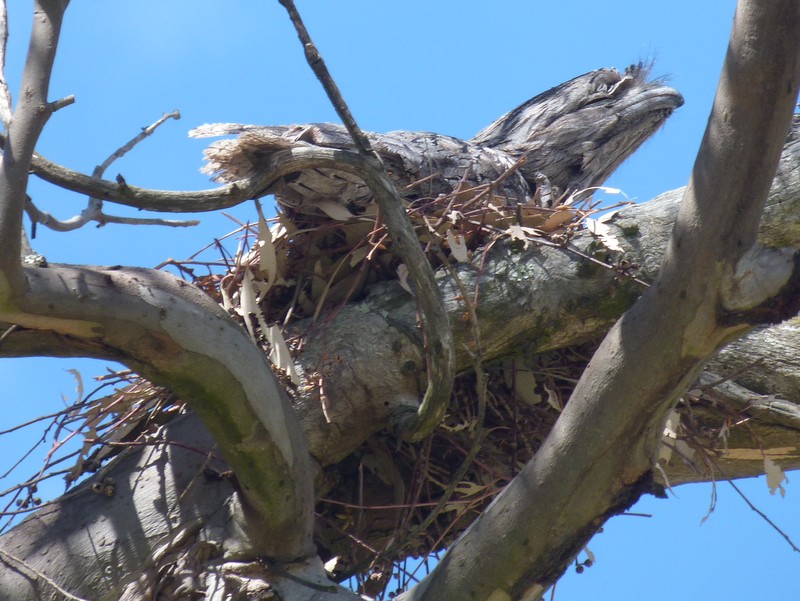
While these photos don't show it to best advantage (mostly because these birds didn't choose a well-matching branch to roost or nest on), the frogmouth's camouflage is remarkable. The streaks in the plumage can resemble cracks in bark to a remarkable degree. The head is held upright to reinforce the impression of a broken branch. The eyes are closed, though, if the bird is approached too closely, they will open to slits, and the head will turn ever so slowly to keep the intruder in sight.    
 
As the previous photo suggests, nests are very flimsy and placed on a horizontal branch or a flat fork.
Adult on nest, Narrabunda Hill, Canberra.
Sometimes old nests of other species are repurposed by frogmouths.
 
Tawny Frogmouth on old White-winged Chough nest, Mulligans Flat NR, Canberra.
It may just have been perching, but it was in November when I'd expect them to be breeding.
The three Australian/New Guinea species are all in the genus Podargus; Marbled and Papuan Frogmouths are found in both islands, while Tawnies are only in Australia. I find this surprising though, given that they occur almost to the tip of Cape York, just across the narrow Torres Strait from New Guinea. Going further north-west, the 13 Asian species are only found on the other side of Wallace's Line; all are smaller and restricted to rainforest.

Papuan Frogmouth P. papuensis, Centennial Lakes, Cairns, above and below.
This tropical species is found north from about Townsville to the tip of York Peninsula,
and throughout New Guinea. It is usually found along rainforest edges and in
drier rainforest, which is generally known as monsoon, or vine forest. This pair was
roosting in mangroves, where they were surprisingly hard to see.
The third Australian species, the Marbled Frogmouth P. ocellatus, is notoriously hard to find in its rainforest habitat. It has two very separate small Australian populations, on Cape York Peninsula, and in the border ranges of near-coastal NSW and Queensland, as well as throughout New Guinea.

It seems logical to me to go from frogmouths to potoos, though the latter are in a different Order, as we have seen, and only found in the American Neotropics. Whenever I see them though I am struck by how much they resemble frogmouths, though that's entirely due to adaptations to similar lifestyles. Like frogmouths they hunt from a perch, but unlike them they take prey almost exclusively from the air, and never from the ground. Their camouflage is just as good but rather than perch on horizontal branches they use vertical stumps or broken branches, positioned upright so as to seem like an extension of the stump.
Great Potoo Nyctibius grandis, Pantanal, south-western Brazil. This is the largest
potoo, up to 60cm long, and is found from south-eastern Brazil to southern Mexico.
The seven species are found between them in every Central and South American country, though they are most prevalent in the Amazon Basin.
The Long-tailed Potoo Nyctibius aethereus, here at Tambopata Reserve in the southern Peruvian
Amazon, is found throughout the Amazon basin, and in the southern Brazilian Atlantic forests.
I love how the white wing patch resembles lichen on a tree trunk!
Common Potoo Nyctibius griseus, Muyuna Lodge, northeastern Peru. It is found
almost throughout South America except for the far south and the higher Andes,
and in much of Central America.
They don't build a nest, simply laying a single egg in a depression on a branch, or on top of a stump. The pale chicks have their own camouflage, resembling a lichen-covered branch.
Common Potoo chick, Yasuní NP, Ecuadorian Amazon.
Great Potoo chick, Muyuna Lodge, Peru.
Unsurprisingly, I am a big fan of potoos, not to mention the amazing guides who can reliably spot them!

The smallest of these 'not owl' Orders is represented by just one species, the somewhat enigmatic Oilbird Steatornis caripensis, found along the slopes of the Andes and in the lowland forests of northern South America. While distantly related to the other Orders, it differs from those birds in almost every way except for being nocturnal.
Oilbird above a rainforest waterway in Yasuní NP, Ecuadorian Amazonia.
My friend and guide extraordinaire Juan Cardenas were in a canoe doing
reconnaissance for a tour when we saw what we thought was a nightjar above
our heads. When we arrived back at our lodge, we both realised what we'd
really seen, for the first time for both of us.
 
For a start, of all these 'non owls' only the Oilbird is fully vegetarian, living on fruits of palms and laurels. Along with the New Zealand Kakapo, a flightless parrot, it is the world's only nocturnal fruit-eating bird. It finds the fruit by night by smell, and can travel up to 120km from their roost to feed. Moreover it not only has the remarkable night-sight that we'd expect, but it also uses echo-location, like a microbat. This is because, like the bats, it breeds and largely roosts in caves, and needs the 'super power' to navigate in the total darkness. This is not unique among birds, but it is very rare - the only others that I am aware of using it are some swiftlets, which also nest in caves. If caves are not available, Oilbirds will also roost in deep rock crevices and ravines, and it has recently been discovered that they regularly roost in trees in the rainforest too.
Oilbird roost in a deep slot canyon, at the Quiscarrumi Bridge near Moyobamba
in northern Peru. The birds look like brown rice grains on the ledge
in shadow in the left foreground.
A closeup, somewhat hazy, view of the roosting Quiscarrumi Bridge Oilbirds.
Of the five 'non owl' orders in the torch light today, the delightful little owlet-nightjars form something of an outlier - in fact their closest relatives (though still distant) are the swifts and hummingbirds! They are essentially a New Guinea group, where are seven species. One of these extends to and throughout Australia, and there is an endemic species in each of the Indonesian Moluccas and New Caledonia. (There was also a flightless New Zealand species which became extinct in about 1400 when rats arrived in New Zealand with humans.)
 
The elegant little Australian Owlet-nightjar Aegotheles cristatus (also found in the savannas of southern New Guinea) is less than 25cm long and is found in open country throughout the continent. Its musical churring call is a familiar night sound, including in suburbia near bushland. It is the only open country member of the group, the rest being rainforest birds. It hunts insects like a flycatcher does, taking off from a perch to seize prey in the air or from a branch or the ground.
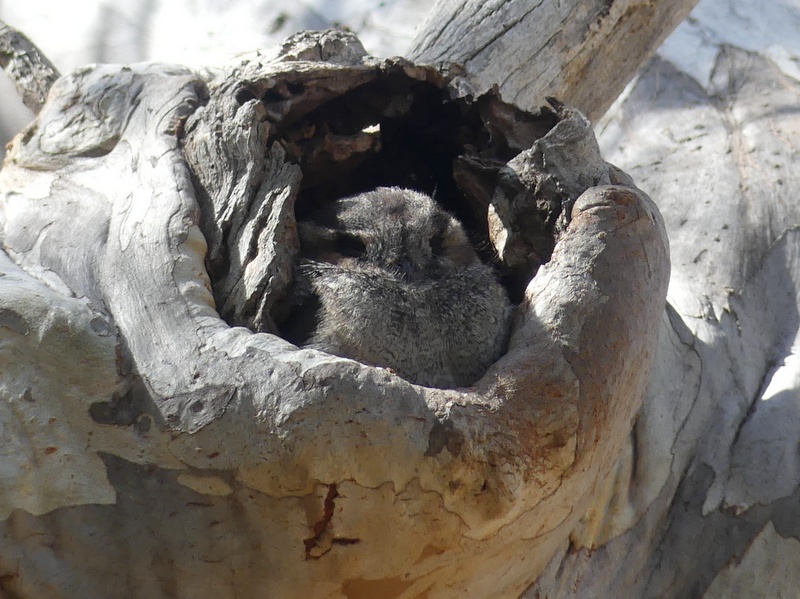
Australian Owlet-nightjar catching the sun in a eucalypt hollow in the
Australian National Botanic Gardens in Canberra. This is typically how we
see them, though I've also seen them roosting on a branch. They rely heavily
on such tree hollows for both roosting and breeding.
Finally there is the biggest family of 'non owls', the nightjars (which includes the American nighthawks). There are 96 species found on every vegetated continent, quite a few being inter-continental migrants. They live in forest and deserts and big cities. All are superb aerialists, hunting insects by sight in apparent complete darkness, though many can also be seen hunting in the dusk, when their elegantly long wings and aerial virtuosity are there to be admired. I have enjoyed many an evening in camp watching a nightjar hunting, swooping past in the gathering twilight, working up and down the open area of the campground, or flashing repeatedly over a pool or river, intercepting the insects rising from it. And listening! Nightjars have the most amazing calls, wild rising, accelerating bursts of gobbling and bubbling. The Large-tailed Nightjar of northern Australia sounds like someone repeatedly hitting a hollow log with an axe.
Blackish Nightjars Nyctipolus nigrescens, eastern foothills of the Andes in
northern Ecuador. Roosting on or near the ground is typical of nightjars,
and this one specialises in rocks or fallen tree trunks.
And now for the very embarrassing and embarrassed confession. I have quite a few photos of nightjars, some of them reasonably acceptable (though you may judge that below), but, but... I have never managed to take one of any of the three Australian species, though I've seen them all. The one I've seen most often is the Spotted Nightjar which occurs across most of the inland of the mainland Australia, in dry open habitats. By day you typically you first see them when they flush from the ground. They spend the day roosting, often in the shade, among ground litter or rocks, where they effectively disappear, courtesy of their superbly camouflaged plumage. I have watched carefully to see where they've landed (they often don't go far) and cautiously approached to get a photo - and have failed to find them every single time! I know. As I said, embarrassing. Let's move along to some that I have managed to see (with help on each occasion I should add), in Africa and the Neotropics of America.
Common Pauraque Nyctidromus albicollis (the origin of the common name seems to be
something of a mystery) is the commonest American nightjar pretty much throughout its range,
which includes most of Central and South America. The far-flung sites of
these two photos gives some indication of this. The one above was roosting near
our room at Muyuna Lodge on the edge of Amazonia in northern Peru...
... while this one was by the track in the northern Panatanal, south-western Brazil.
They are often encountered on tracks or roads at night.
Also in the northern Pantanal is this one, which I am very cautiously suggesting
is a Rufous Nightjar Antrostomus rufus, but without much confidence.
At the time it was called as a Little Nightjar Setopagis parvula, but
that doesn't convince me either. Any suggestions welcomed.
(Frankly it doesn't much resemble anything in the Pantanal field guide!)
I mentioned earlier that nightjars often hunt insects over water, so it's no surprise to see them along rivers, though the sheer numbers of these Sand-coloured Nighthawks Chordeiles rupestris along the Manu River in the southern Peruvian Amazon basin astonished me. (Nighthawk is a name used in the US for nightjars that are members of the genus Chordeile).
This was just a small part of a loose roosting flock.
A closeup of a couple of members of the same flock, roosting on flood debris.
It is found along river corridors in the western Amazon basin.
More surprising was seeing this Lesser Nighthawk Chordeiles acutipennis on the beach in Costa Rica, though apparently this is one of its normal habitats while overwintering there. It breeds in deserts in the south-western US and Mexico, and then flies south to Central and South America for the rest of the year, where it prefers watery habitats.
Lesser Nighthawk roosting on driftwood at the mouth of the Tarcoles River,
eastern Costa Rica.
Some nightjar males have spectacularly long and elaborate tail feathers or flight feathers for display purposes; here are some, though the first couple are unfortunately for us not adult males.
Fledgling Ladder-tailed Nightjar Hydropsalis climacocerca, Yasuní NP, Ecuador.
It is found throughout the Amazon Basin. When older, especially if it's a male,
it will have a curious tail structure, with the longest feathers being the central and
outermost ones. I confess that this doesn't say 'ladder' to me, but that comes from the
translation of the Latin name (not that that helps us of course). More importantly,
males fan the tails while flying slowly low over water to attract a female's attention.
It evidently worked for this one's parents!
Scissor-tailed Nightjar Hydropsalis torquata, Peruibe, on the coast north of
Sao Paulo, Brazil. Adult males have a pair of long slender outer tail feathers
which often break, so this could be such an unfortunate male, or a female.
Oddly the tail doesn't seem to feature in courtship displays, which
take place on the ground in an open space, while he claps his wings overhead!
This one was roosting in coastal heath just above the ground.
  
Pennant-winged Nightjar Caprimulgus vexillarius, Murchison Falls NP, Uganda.
This bird seemed to be injured, perhaps by another car. The extraordinary
pennants are hugely extended second primary feathers (ie growing from
about the centre of the wing) which grow longer each year, being shed
with the annual moult after breeding. They are used in courtship displays both
in flight and while perched on a rock or termite mound, with his back to the female.
Standard-winged Nightjar Caprimulgus longipennis, Ngaoundaba Ranch,
central Cameroon. His camouflage is exquisite. He is facing right, with his
head just under the two green leaves at the centre right of the photo. His
ornamentation also features a greatly extended flight feather on each
wing, though in this case much of the length comprises a bare shaft,
with the two black 'standards' at the tip, and clearly visible here.
The standards trail behind him in normal flight but are held straight up
when displaying, which occurs in leks, with many males gathered to compete.
It must be a spectacular event!
Lyre-tailed Nightjar Uropsalis lyra, Mindo Valley, north-western Ecuador.
This unlikely beauty is found along most of the Andes from Ecuador to northern
Argentina. Its behaviour doesn't seem to be well known, though males apparently
also form leks, competing with females through their flight display. To this end the
males' tails are up to 60cm long.
And I think that's probably enough, but hopefully you've been able to find something of interest here. One day I'll do a post on birds that are owls, but the not-owls are, I think, also fascinating and diverse. Thanks for bearing with me, and them.
Tawny Frogmouths by the Murrumbidgee River south of Canberra.

NEXT POSTING THURSDAY 19 OCTOBER
for more on Costa Rica - some animals

 
I love to receive your comments and in future will be notifying you personally by email when a new posting appears, if you'd like me to. All current subscribers have been added to this mailing list and have already been contacted. This will mean one email every three weeks at the current rate of posting. I promise never to use the list for any other purpose and will never share it.
Should you wish to be added to it, just send me an email at calochilus51@internode.on.net. You can ask to be removed from the list at any time,or could simply mark an email as Spam, so you won't see future ones.