About Me

My photo
Canberra-based naturalist, conservationist, educator since 1980. I’m passionate about the natural world (especially the southern hemisphere), and trying to understand it and to share such understandings. To that aim I’ve written several books (most recently 'Birds in Their Habitats' and 'Australian Bird Names; origins and meanings'), and run tours all over Australia, and for 17 years to South and Central America. I've done a lot of ABC radio work, chaired a government environmental advisory committee and taught many adult education classes – and of course presented this blog, since 2012. I am a recipient of the Australian Natural History Medallion, the Australian Plants Award and most recently a Medal of the Order of Australia for ‘services to conservation and the environment’. I live happily in suburban Duffy with my partner Louise surrounded by a dense native garden and lots of birds.

Monday, 10 September 2012

Of Broken Hearts and Purple Flowers


The contribution of broken hearts to the advancement of Australian botany has, I think, been underestimated. On the other hand very few plants bear women's names; this is a story that combines the threads, though not perhaps as you might suppose.

Carl Alexander Anselm, the Baron von Huegel, was the son of the flourishingly named Concommissarius of the Reichstag, who had to flee with his family to Austria at the turn of the 19thcentury, when young Carl was only five. Carl later fought in the Austrian cavalry against Napoleon, returning to civilian life and his passion for natural history in 1824, expressed in his magnificent Vienna garden which featured many of the then fashionable plants of New Holland. Things were about to turn sour for him however, though European appreciation and understanding of Australian plants would benefit. His beloved fiancĂ©e Melanie, apparently under extreme pressure, broke off her engagement to Carl in favour of his patron, the chancellor Prince Metternich, to whom he nonetheless managed to remain loyal. 

Hardenbergia violacea

He couldn't bear to stay in the same city however, and in his words became “a man who sought healing and oblivion in every land on earth”. Plants he collected throughout the new worlds poured back into Europe; these included the treasures gathered in 1834, which he spent in Australia. (I would recommend his diaries of this time, translated by Dymphna Clarke as New Holland Journal.) Later in his stay he was highly critical of what he saw as the crudity and crass commercialism of Australian society; he was also dismayed by the brutal convict system and the treatment of Aboriginals. Later still in his life he relented and wrote with nostalgia of his time here.

Finally back home a hero, having sent 32,000 natural history specimens ahead of him, he became a diplomat and was recognised by international scientific organisations. Before his return to Europe though, many of his specimens were received and preserved by his sister, Franziska von Hardenberg. She had married into one of Germany’s leading families, so presumably had the time and resources to devote to caring for his collections. Among the specimens was a beautiful and profuse sprawling pea shrub with rich purple flowers, on which the Dutch botanist George Schneevoogt bestowed Franziska’s married name – Hardenbergia. In south-eastern Australia, Hardenbergia violacea, known as Happy Wanderer or False Sarsparilla, adorns roadsides or colonises quarries due to the wonderful pea trick of harnessing bacterial colonies in its roots to fix atmospheric nitrogen. It also climbs through shrubbery and from late winter glows purple in the local forests (and on our back fence).
Hardenbergia violacea

Another species, H. perbrevidens, has only recently been described from the Blackdown Tableland in Queensland, while a third, H. comptoniana, brightens up the bush in south-western Australia. This one is remarkable, and perhaps unique, in commemorating the names of two women, the other being Mary Compton, Marchioness of Northampton, who apparently first grew the plant in England.
Hardenbergia comptoniana, Mount Barker, Western Australia
Hardenbergias always give me great joy, but I also reflect on the sad count; I hope he got some comfort from them.


Sunday, 9 September 2012

Spring Snakes; the glissade perfected

I was going to write about something else entirely today, but as ever nature has the last word - or rather, in this case, a completely silent message. OK, enough of the pseudo-mystical nonsense. Since our week on Lord Howe Island earlier in the year we had determined to get back on our bikes; winter made wusses of us, but we couldn't ignore today's beautiful sunny early spring weather, so we went for a ride on a nearby section of Canberra's superb bike track system, this one through paddocks (soon to be suburbs) and then along the Molonglo River to Lake Burley Griffin. Within a couple of minutes of starting (behind the RSPCA in North Weston, for those who know Canberra) a very sleek-looking Eastern Brown Snake slipped across the track just ahead of us, with the elegance unique to snakes. It was our first for the season, as clear a message of spring as the orchids we'd tiptoed among and delighted in earlier in the morning on Black Mountain.

It was perhaps a metre and a half long, so a fair-sized snake, and looking surprisingly prosperous given that winter has not really let go yet and it can't have had many feeding days yet. On the other hand the ubiquity of the Black-shouldered Kites and Kestrels suggest that the mouse numbers are still high, and we later passed an Australian Raven demolishing a young rat. (All mice and rats in Canberra are exotics, though there are a couple of native species in the ranges.)

Its ancestors having dispensed with legs long ago to facilitate slipping through crevices and dense vegetation and hunting in tight spaces, our fleeting friend has to find other ways to get around. When edging towards prey it can 'tiptoe' by flexing the belly scales forwards and pulling forward on them, but for serious travelling it flows along, constantly forming curves with its body and pushing forward from the back of each curve. It sounds as though it should be jerky but in fact it is smooth as running water, at least to our slow eyes.

Eastern Brown Snake, Yarralumla, Canberra
There will be more postings later on snakes, which are truly fascinating animals, including a bit of a character analysis of our local snakes, but it is worth noting that different tables purporting to compare toxicity of venom of snakes (a notoriously tricky business) lists our familiar suburban Eastern Brown as number two in the world, second only to the Inland Taipan, also 'one of ours'. We tend to keep our respective distances and show respect, and relatively few snakes and far fewer humans die unnecessarily round here. 

As to where it was going, apart from food the need to mate is strong at this time, and this is a strong incentive for snake movement. Fangs are fragile, and venom is precious, so snakes don't risk injury or waste on each other in the competition for mates. Instead male snakes test their relative strengths by 'wrestling'; when you see two snakes of roughly equal size tightly entwined and pushing against each other, be sure that you have two males deciding who has the local mating rights. Actual mating involves much less entanglement, and the female tends to be much smaller than her mate. We had a wonderful experience of this behaviour a couple of years ago on a busy road alongside Black Mountain, just a couple of kilometres from the centre of the national capital. Having photographed these two males, we were worried for their safety just a metre or so from the speeding traffic, so we ushered them off up the bank and into the bush; hopefully they'd already decided the necessary hierarchy.

male Eastern Brown Snake males, ritual combat.
Barry Drive, Canberra

Enough for today, and tomorrow I'll revert to today's original story - the one about the lovesick count and the plant named for two women.

Saturday, 8 September 2012

Carousel Spider Orchid

Arachnorchis arenicola, Kings Park, Perth
Sort of an IOU for tomorrow; I'll try and offer a pic as compensation on the days I'm around, but can't do a full post.

Friday, 7 September 2012

On This Day, 7 September: vale Thylacine

* 1936. Something of an elegy today, for a death that always fills me with sadness, anger and shame for things we've done. On this day the last undeniably live Thylacine died alone and in a bare pen in Hobart Zoo, apparently from exposure having been carelessly locked out of its den. Aside from the much more important reasons, I would selfishly so love to have seen wild Thylacines.

Thylacine pair, Hobart Zoo, early 1900s.
Photo courtesy of Tasmanian Museum and Art Gallery.
I was only a couple of thousand years too late to share mainland Australia with them; indigenous Australians knew them well, and left illustrations in northern cave galleries. The convergent evolution of this magnificent marsupial with wolves is remarkable, even to details of the skull; it seems that that's the way to look if you're going to make a living chasing and eating medium-sized herbivores. It is remarkable because as a placental mammal the wolf is more closely related to me than it is to the Thylacine. There's an irony too because it is likely, though unproven, that a wolf - of the sub-species we now know as the Dingo (brought to Australia some 4,000 to 4,5000 years ago) - caused the demise of mainland Thylacines.

The Thylacine's mainland nemesis?
Dingo, west of Windorah, Queensland.

Dingoes didn't make it to Tasmania, partly because they arrived after Tasmania was last joined to the mainland during the last glaciation, and the Thylacines continued to thrive there. However Europeans came, and feared and hated something that looked like a wolf (not to mention having tigerish stripes on the rump) and took the odd sheep. To farmer assaults on them was added the depredations of bounty hunters, paid by the government for corpses. As a top predator Thylacines were never common, their habitat was shrinking, and the last wild Thylacine to be shot died in 1930; the last sad captive was snatched from the wild in 1933. It's not hard to find copies of black-and-white film clips of this animal on the internet (eg here). 

Thylacine family, public sculpture, Launceston.
Long regarded as a member of the family Dasyuridae (along with the Tasmanian Devil, quolls and small marsupial carnivores such as antechinuses), Thylacines are now regarded as having belonged to their own family Thylacinidae, with the termite-specialising Numbat as probably the nearest relative.
Thylacine's closest living relative?
Numbat, Perth Zoo.

It'd be nice to think we'd learnt something from our destruction of this beautiful and spectacular animal, but I'm not optimistic.

Thursday, 6 September 2012

Craning for Attention


My attention was caught by a story from Russia, concerning machissimo President Putin and his latest wildlife-related exploit, this one involving piloting (or at least co-piloting) an ultra-light aircraft in the final training flight of a group of immature captive-bred Siberian Cranes. Like most of the world's 15 crane species, Siberians are threatened with extinction, there being only some 3,000 - 4,000 left. He had dropped by to help out at the research station in Siberia, en route to the APEC summit in Vladivostok. This might seem surprising until you recall that this is the president who found time in his busy schedule to visit, four years ago almost to the day, a Siberian Tiger research project in the far east; imagine his surprise then when, just as he arrived, a tiger escaped from her constraints and charged a TV crew! Well, fortunately he just happened to have his trusty tranquiliser gun on him and saved all their lives - and astonishingly it was all caught on film. He has also helped out apparently in-difficulty marine scientists by shooting a Grey Whale with a crossbow for them so they could take skin samples, and on his first dive in the Sea of Arzov at an ancient city site, blow me down if he didn't find two amphorae that the so-called experts had missed, just sitting there. And would you believe it, on each occasion there just happened to be a film crew on hand?! Uncanny.

RIA Novosti/Alexsey Druginyn
Photo courtesy of RT website (http://rt.com/news/putin-cranes-flying-hope-460/)
OK, two comments only from me. Firstly, whatever the motivation, I'd rather a leader thought it was desirable to associate himself with conservation efforts than to boast his prowess at killing animals for fun. Secondly, exciting as the concept of the crane-training process is - it involves habituating the chicks to the aircraft, then using it to lead them on their first migration, in this case to central Asia - we must give credit where it's due, and note that it was developed 15 years ago in the US. In 1997 highly threatened Whooping Cranes were led south in this way; prior to that the technique had been trialled with Canada Geese, then with relatively abundant Sandhill Cranes. 

Cranes represent an ancient group of birds which have not done well from the entry of humans to their world. The centre of their diversity is eastern Asia, with four species restricted to Africa, two to North America, and two found in Australia. More than half of these are regarded as threatened species, though some populations of others are also at risk. Conflicts with farming interests have led to many being shot and poisoned (especially in South Africa - Blue Cranes, the national bird; Australia - the Brolga; and the US - Sandhill and Whooping Cranes, though 'recreational' hunting has also been significant there). In these places and elsewhere habitat loss, especially of wetlands, has also been significant. In pre-Canberra in the 1870s a flock of 80 Brolgas was recorded by the post office (at Ainslie for those who know it); apart from an occasional intriguing report, there have been no Brolgas here for a very long time now.
Brolgas, near Winton, Queensland
 I have been lucky enough to see all four of the exclusively African species (two others spend winter there), and the two Australian ones (less of a challenge to those who live here!), but none of the others. The fabulous trumpeting calls are facilitated by greatly lengthened and coiled trachea, and in some cases fusion of the bony tracheal rings with the sternum to form vibrating plates.


Wattled Cranes, Okavango Delta, Botswana
(this photo and the next are scanned from old slides - sorry!)
Blue Cranes, Western Cape, South Africa
 A curious situation applies in Australia; until less than 50 years ago only one species, the Brolga, was recognised. Then, in 1966 in the Gulf country of north central Queensland, Sarus Cranes were recognised. For a while it was assumed that they'd recently turned up from south to south-east Asia where they are widespread, but in reality it seems that we just hadn't noticed. Indigenous Australians certainly had, apparently referring to 'the Brolga that dips its head in blood', or 'red-legged Brolga' - see photos below. The Australian Sarus Cranes are now regarded as a separate sub-species, whose ancestors arrived in Australia some 35,000 years ago; recent enough, but not that recent. 
Brolgas (above) and Sarus Cranes (below), both at Karumba on the Gulf of Carpentaria, Queensland.
See the Sarus's much redder head, and the red legs.
I'll never fly with the fabulous cranes like President Putin, but I'm privileged to have been as close as I have.
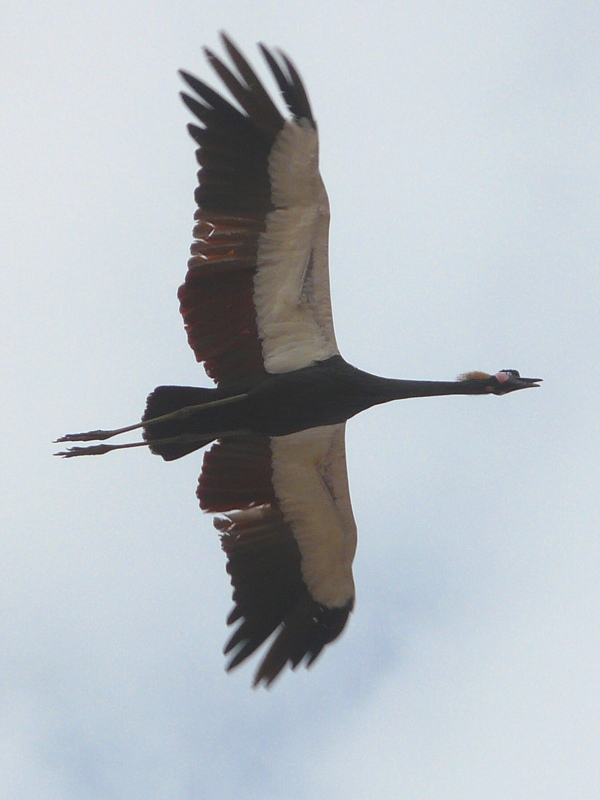
Black Crowned Crane, Waza NP, northern Cameroon
Grey Crowned Cranes, Murchison NP, Uganda
 For the Putin story, here are two links with slightly different perspectives:

http://www.guardian.co.uk/world/2012/sep/06/putin-hang-glider-endangered-cranes

http://rt.com/news/putin-cranes-flying-hope-460/

And for cranes in general, you can't go past Peter Mathieson's wonderful 2003 book The Birds of Heaven; travels with cranes.


Wednesday, 5 September 2012

On This Day, 5 September: Tasmanian Wilderness extension

* 1989, the Tasmanian government announced that the already magnificent South-west Wilderness World Heritage area was to be extended to cover 1.38 million hectares of central and south-western Tasmania; this represents nearly 20% of the state. (Tasmania is an island off the south-east coast of Australia; an integral part of the continent, it has been isolated most recently since the last glaciation 13,000 years ago.)

When the 'core' of the area was gazetted in 1982, it was listed as meeting all four natural heritage criteria and three cultural criteria; at least until recently that was unrivalled in the world. Some of these values include the most significant and extensive glacial landscapes in Australia, cool temperate Nothofagus-dominated rainforests with close affinities to other Gondwanan lands, notably South America, and Australia's most extensive and pristine alpine area, with 60% of the alpine flora being endemic to Tasmania. It has forests of Eucalyptus regnans, the world's tallest flowering plant, and ancient conifers, including the famous Huon Pine, Lagarostrobus franklinii, some of which are over 2000 years old, and has populations of the three largest living carnivorous marsupials - the Tasmanian Devil, Spotted-tailed Quoll and Eastern Quoll. Only the second of these is still found on mainland Australia. Evidence of human activity, including through the last bitter glaciation, goes back more than 30,000 years.

Unfortunately - and I must rectify this! - I've not been back there since my photography went digital, so I'll limit my photos here, which are of scanned slides and not good quality.
King Billy Pines, Athrotaxis selaginoides, at Dove Lake
Prionotes cerinthoides
Tasmanian Native Hen

Tuesday, 4 September 2012

Butterflies Suck, OK?

I'm not sure which is the greater sucker; butterflies, or me where they're concerned.

We're well aware of the ability of most moths and butterflies to extract nectar from a flower's nectary gland, and thus perform a crucial pollinating role for many flowering plants. However it's not so easy usually to see how they manage it. The trick is the possession of a proboscis, rather like a flexible coiled drinking straw with a sensory apparatus at the end. Here are a couple.
Owl Butterfly, Amazonian Ecuador.
The proboscis is just visible, tightly coiled in front of its head.
Yellow Admiral, Vanessa itea, National Botanic Gardens Canberra.
Here the proboscis is more visible, partly uncoiled.
The proboscis comprises two trough-like structures called galeae; in other insects, and presumably the ancestral butterfly, they are small cup-like structures attached to the floor of the mouth. By a remarkable process, the two galeae begin extending and coiling as soon as the adult emerges from the pupa, aligning themselves to form a single tube. When this happens a temporary liquid glue holds them in place until fringing structures zip them permanently together. Inside is fibrous material like blotting paper; liquid is drawn up by a mixture of passive capillary action, and active muscular pumping, using a 'bellows' in the butterfly's head. When required the proboscis unfurls and can be very delicately applied. Both the following images feature male Australian Painted Ladies (yes, I know that's an oxymoron!) Vanessa kershawi at the National Botanic Gardens. The top one is on an Isotoma, the lower one on a Xerochrysum paper daisy.

Butterflies as a group evolved at least 190 million years ago, but the proboscis seems not to have appeared until somewhere between 100-145 million years ago. The implication is strongly that it coincided with the development and dramatic spread of flowering plants. On the other hand it could as validly be proposed that the butterfly proboscis developed to take up dew or sap, and the subsequent adaptation to nectar actually assisted the dominance of flowering plants; either way both have flourished together.

Either way too, a familiar pattern has emerged, of a structure arising for one purpose and later becoming harnessed for other purposes. Butterflies regularly use this wonderful structure for taking up other liquids - from protein of dead animals, to soft fruit to water from mud.

drinking from wet sand, Manu River, Amazonian Peru;
both above photos
drinking from mud, Budongo Forest, Uganda
Not mention some things we don't normally associate with butterflies!

Butterflies (and flies) on Civet droppings, Budongo Forest
Finally I should acknowledge that other insect groups have proboscises for much the same reason, but they developed quite separately, from different mouth parts. True bugs (ie Hemipterans, not the catch-all way we sometimes use 'bug' to refer to any creepy-crawly animal) have one formed from the chewing mouth parts - the maxillae and mandibles - extended into a piercing structure and sheathed by the labium, the floor of the mouth. This can be used for piercing either plant tissue or animals.
Sap-sucking bug, Kata Tjuta
Assassin Bug (very small!) with prey (even smaller!!), Jervis Bay
In flies which have a proboscis (including mosquitoes) it is comprised of the labium, with the maxillae and mandibles providing the stabbing function where required.
unidentified fly on Xerochrysum paper daisy, National Botanic Gardens
March Fly (Tabanid) about to pierce my trouser leg, etc...
As ever, I could easily go on digressing, but that's enough to go on with; I'll leave to poke your own proboscis into it as it suits you.

Monday, 3 September 2012

Lake Cargelligo Weekend

Foggy sunrise, Lake Cargelligo
Lake Cargelligo is both a town and a lake - the latter a natural wetland fed by the Lachlan River, but now artificially regulated, some 420km north-west of Canberra. A school friend of Lou (she's been good at keeping in touch with her boarding school friends) has recently moved back there, and we went to visit for the weekend. Lake Cargelligo is well known in birding circles as the access town to the great central NSW mallee reserves of Nombinnie and Round Hill, but this was a social weekend, so we didn't get that far. I am on record as saying that north-west is the only sensible direction to head, but that probably contains some hyperbole; nonetheless we both love heading inland. The following comprises simply some memories worth sharing and even a couple of hints for those who may follow.

Saturday, as I mentioned recently, was the first official day of spring, and on Wattle Day the wattles didn't disappoint.


These Acacia hakeoides blazed all along the roadside verges, especially in Grey Box (E. microcarpa) woodlands.


 McCann Park on the highway at the west end of West Wyalong is always worth a stop; it's a very reliable place for Little Friarbirds and Blue-faced Honeyeaters. (On the other hand, don't be tempted by the nearby bakery, unless your tastes run to stoggy - ie both stodgy and soggy - quiches and 'salad' containing both tinned pineapple and beetroot, and shredded lettuce and tomato which have been frozen.)
Little Friarbird
North of West Wyalong the western slopes (characterised by Grey Box) subtly give way to the western plains, characterised by Weeping Myall, or Boree, Acacia pendula (as in pendulous, get it?).


We spent the afternoon at the Lake Cargelligo show; this isn't the place for those pics, but by tomorrow those who have (or want) access to my Facebook page can see them there.

An early morning drive didn't produce anything startling, but I was just pottering along and enjoying being inland. The following are a few of the quiet highlights, including many birds of prey taking advantage of the mousey bounty.
Black-shouldered Kite
Nankeen Kestrel (female, see rufous head, not grey);
both these birds are fluffed up against the very frosty morning.
Fairy Martins; I couldn't work out what kept bringing them back to this
site, as it was too dry to provide nesting mud and there were no obvious insects there.
I suspect it was just a clear sunny spot to warm up in.


Blue Bonnets are a subtly coloured (except for the tummy) inland parrot,
abundant along the roadsides.
Later a walk along a section of lake shore was also rewarding. The gorgeous Red-rumped Parrots, none the less superb for being familiar, basked in the sun, and bathed in pools left by the retreating water - the lake is still very high from floods earlier in the year.

'Red-rumped' refers only to the male (and then only with his wings up) - she is much more demure.
The high water levels reduced the number of birds along the shore, but many took advantage of the dead trees and banks to dry off and warm up.

I can see at least four species here. 
Synchronised sunning - female darters.
There was probably a greater concentration of Darters than I recall seeing before, doubtless still feasting on the cornucopia of carp and Bony Bream brought down by the floods.

Well, this has been a  pretty light-on posting, but then it was a pretty low key weekend too (and I've found myself in unexpected meetings for much of the day). If you find yourself at 'Lake', you might try the Old Bank Cafe, in the main street (there's not much else!). You can get coffee, good cake and something more filling if required; say that Lou and Ian sent you.

So, as the sun sets slowly into the west, that'll do for today. The last scene is the same as the top one, but at last light, after the sun had set...