About Me

My photo
Canberra-based naturalist, conservationist, educator since 1980. I’m passionate about the natural world (especially the southern hemisphere), and trying to understand it and to share such understandings. To that aim I’ve written several books (most recently 'Birds in Their Habitats' and 'Australian Bird Names; origins and meanings'), and run tours all over Australia, and for 17 years to South and Central America. I've done a lot of ABC radio work, chaired a government environmental advisory committee and taught many adult education classes – and of course presented this blog, since 2012. I am a recipient of the Australian Natural History Medallion, the Australian Plants Award and most recently a Medal of the Order of Australia for ‘services to conservation and the environment’. I live happily in suburban Duffy with my partner Louise surrounded by a dense native garden and lots of birds.

Friday, 12 September 2014

Homage to Kingfishers: 2

Last time I had the pleasure of introducing some of the Tree Kingfishers, by far the most numerous of the three kingfisher families as generally recognised. Today I've been looking forward to completing this little alcenid homage by meeting, with you, some members of the other two families, the ones who actually do fish as a key part of their lifestyle. The best-known of these, via the literature, calendars and Christmas cards, is probably the Common Kingfisher Alcedo atthis, found right across Europe, North Africa and most of Asia. However it's been decades since I was in those parts, and I can't offer you any pics - there are some superb shots out there in webland however!

The smaller of the two fishing families is Cerylidae, the Water Kingfishers. (This is not a very helpful name compared with the other one, Alcedinidae, the River Kingfishers, but I wouldn't have wanted to have to come up with anything more useful either!) It comprises just nine species and oddly I have photos of six of them - this is because they comprise all the American kingfishers, which are ubiquitous and evident in South America. It seems that they arose only a few million years ago when an ancestral ceryline crossed from Asia, via the Bering Strait. In the orthodox view this ancestor did not leave any direct descendants in the Old World, though this is certainly not an unheard of occurrence. 

However it has been recently suggested that this ancestral line is represented by the Pied Kingfisher Ceryle rudis, found across most of sub-Saharan Africa and southern Asia. It is a very handsome bird, without the usual bright kingfisher colours, common and evident on lakes and rivers, perching on branches and reeds, poles and buildings above water; moreover, unlike other kingfishers it greatly increases its hunting range by hovering conspicuously above the surface. Like many kingfishers they draw attention to themselves by constant calling. Less typically they roost in flocks.
Pied Kingfisher, Kazinga Channel, Queen Elizabeth National Park, Uganda (where all these Pied Kingfisher
photos were taken). This is a female, with just one breast band.
Typically, fish are carried back to a perch, battered into stillness and swallowed headfirst so that fins don't catch in the throat.
Part of a sequence, above and below, of bashing the fish then swallowing it.
(This is a male bird, with a second narrow breast band.)
 
Like many kingfishers, Pieds nest in a burrow in the bank, which they excavate themselves.
Male Pied Kingfisher at the mouth of a nesting burrow.
By one theory the American cousins then divided into two genera. Megaceryle is represented in South America by the Ringed Kingfisher M. torquata, an imposingly big bird found from the Amazon basin to the Strait of Magellan, and north into the southern USA. (Further north it is replaced by the closely related Belted Kingfisher M. alcyon.)
Ringed Kingfisher, Isla de Chiloé, Chile.
Despite its size (similar to that of a kookaburra) it's a fishing bird, diving spectacularly into the water.
In this scenario a Megaceryle kingfisher later recrossed the Atlantic to give rise to two Asian-African species, but more recent thinking has the genus arising in Africa and later arriving in the Americas. Either way the African representative, the appropriately named Giant Kingfisher M. maxima, is a most impressive bird, found throughout the non-desert lands of the continent.
Giant Kingfisher, Benoue NP, Cameroon.
This one too, despite its considerable bulk, hurls itself into the water after fish, frogs and crustaceans.
The other American kingfishers - all from the South American tropics - are very similar birds of the genus Chloroceryle, which neatly divide into two species-pairs, one pair with rufous undersides, the other with substantial white below (though males have a broad rufous breast band). In each pair there is a large and a small species, thus avoiding competition.
Male Amazon Kingfisher C. amazona, Cocha Salvador, Manu NP, Peru.
He is a big bird, 30cm long, with no white spotting in the green.

Male Green Kingfisher C. americana, Manu NP, Peru.
He is less than 20cm long.

American Pygmy Kingfisher C. aenea, Yasuní NP, Ecuador.
This scarce and tiny bird is only 13cm long; this one was seen at roost at night above a creek from a canoe.
Its 'pair partner', the Green-and-Rufous Kingfisher, also scarce, is 24cm long.
The third kingfisher family, also specialist fishers, is found throughout most of the world except the Americas. Mostly smaller birds, they are notably short-tailed and typically blue above and rufous or white below.
 
Azure Kingfisher Ceyx azurea, Barmah Forest, Victoria.
Ceyx, you may recall from last time, was one of the doomed couple who just got too happy for the liking
of the typically grumpy Greek gods, and got turned into birds.
This exquisite bird is found along streams in near-coastal eastern and northern Australia and, as here,
inland along the Murray River.
African Pygmy Kingfisher Ispidina picta, Queen Elizabeth NP, Uganda.
A tiny bird, the size of the relatively unrelated American Pygmy Kingfisher. It will sometimes hunt
insects far from water.
Malachite Kingfisher Alcedo (or Corythornis) cristata, Lake Mburo NP, Uganda.
One of the jewels of Africa, no bigger than the Pygmies, common and widespread in Africa.
Oriental Dwarf (or Rufous-backed) Kingfisher Ceyx erithaca, Gomantong Caves, Sabah.
This little gem is found across much of southern and south-eastern Asia.
Blue-eared Kingfisher Alcedo meninting (here at Sepilok, Sabah) is a little fishing kingfisher
of forest streams and mangroves, found across southern Asian.
So, this is the end of our kingfisher journey; I hope you've enjoyed meeting them as much as I have. Wherever you are, there'll be one or more not too far away. And every one's a pleasure.

BACK ON THURSDAY

[If you'd like to leave a message, I'd love to hear from you. I've changed settings so that you don't have to have an account with Google or anyone else, and you don't have to identify yourself - though I'd love to know who I'm talking to. You only have to prove you're human by copying a number; they've made these much easier to read now than they used to be. I tried it for a while with no restrictions, but got swamped by horrible spammers.
I know that lots of people read this, but very few comment. ]

Sunday, 7 September 2014

Homage to Kingfishers: 1

Kingfishers truly are one of the joys of life, with 90-95 species to be enjoyed in every continent except Antarctica. Moreover they've been brightening the planet for a long time - indeed the fossil record suggests that 60 million years ago kingfishers and their close kin were the dominant birds to be found perching above the landscapes of the Northern Hemisphere. However while both North America and Africa have been suggested as the ancestral kingfisher home, it seems likely, based on the fact that the oldest and most distinctive members of the dynasty are to be found in the south-east Asia to New Guinea area, that they arose there and spread.
This Sacred Kingfisher Todiramphus sanctus, in Mulligans Flat Nature Reserve, Canberra,
demonstrates widespread kingfisher characteristics. In particular the erect posture, long sharp heavy bill,
three toes forward and one back (like passerines) and bright colours are all recurring themes.
Also in perpetual dispute is whether kingfishers belong to one diverse family or three separate ones, though there is no argument about the three distinct sub-groups. The majority opinion is that the divisions are wide enough to merit family status, and I'm going along with that. These families, in descending order of size, are the Tree Kingfishers, Halcyonidae (approximately 60 species), the River Kingfishers, Alcedinidae (22-24 species) and the Water Kingfishers, Cerylidae (9 species, including all the American ones). (If we accept just one family it has to be called Alcedinidae, as the Common Kingfisher of Europe and Asia, the first to be named scientifically, belongs there.)

And, just before we get to the birds themselves, and to confirm the reputation of kingfisher taxonomists as a disputatious lot, there is also confusion as to which of the groups represents the ancestral kingfishers; while it has always been generally agreed on the basis of physical and behavioural evidence that the Tree Kingfishers are the oldest, and from which the other two families derived, recent biochemical work challenges that and puts the River Kingfishers in the chair of honour. The argument goes on but for now I'll adopt the majority view - which seems to coincide with logic - and stick with the Tree Kingfishers as the originals. Specialist behaviour, such as fishing, has been adopted by a minority of the group and seems likely to have derived secondarily from more generalist forest and woodland hunters of small animals. However the Common Kingfisher happens to be one of the minority and its habits gave the name to the whole group, even though most of them don't fish, or only rarely.

Today I'm going to introduce a few of the Tree Kingfishers, in deference to their numbers and their apparent venerability. Next time we'll meet the others, the fish-lovers. Why not start with the biggest ones, the kookaburras; I'm not sure if I have any African readers but I know they'll bristle at that statement. However while your Giant Kingfisher is a bit longer than the Laughing Kookaburra, the kooka is certainly more massive. 
Laughing Kookaburras Dacelo novaeguineae, Canberra. Highly sociable, they defend territories fiercely against
rival kookaburra clans with the famous territorial laugh and display flights and even physical contact if necessary.
Both of its scientific names are contentious. Dacelo is an anagram of Alcedo, the Common Kingfisher genus; such
levity was regarded at the time as in very poor taste. Novaeguineae is even worse; it isn't found in New Guinea and
Pierre Sonnerat who claimed to have collected it there was apparently being deliberately disingenuous to exaggerate
his travels - he had form, having also claimed to have shot a penguin there!
Laughing Kookaburra, south coast New South Wales. The bill can be used - as here - like a crowbar
to extract grubs from the soil. Most food is collected on the ground, as with most of the family, and ranges from insects and worms to lizards, snakes and mice.
It seems that the kookaburras arose in New Guinea and at some point the Blue-winged Kookaburra entered Australia, where it remains in the tropics, while the Laughing Kookaburra evolved as a separate species and moved south into the temperate forests and woodlands. 
Blue-winged Kookaburras Dacelo leachii (here at Katherine Gorge, Nitmiluk NP, Northern Territory, behave similarly to Laughings,breeding cooperatively with the parents assisted in chick rearing by offspring from previous years,
and sometimes by brothers and sisters. The call has been justifiably described by Graham Pizzey, the author of
the preeminent Australian bird field guide, as "appalling".
The Sacred Kingfisher - featured above - is the common smaller kingfisher of southern and eastern Australia and is also found well into the Pacific and eastern Indonesia. Around here it is strongly migratory; soon we should be hearing its insistent 'ek ek ek' in woodlands, as it returns from far north Queensland and even New Guinea and beyond.
Sacred Kingfisher with frog, Canberra. They eat pretty much any animal suitable to their size.
(Faded old slide - sorry.)
Inland the Sacred Kingfisher is replaced by the similar and closely related Red-backed Kingfisher Todiramphus pyrrhopygius, found throughout the arid inland.
Red-backed Kingfisher, Kings Canyon National Park, central Australia.
From behind (below) we can just see its eponymous back, which is the red of a brick rather than a letter-box.
Unlike Sacreds, which usually nest in tree hollows, Red-backeds generally excavate a burrow in a bank.

Forest Kingfishers Todiramphus macleayii, Darwin, Northern Territory.
This exquisitely blue kingfisher is found commonly across tropical and sub-tropical
northern and eastern Australia.
Still in the same genus the Collared Kingfisher Todiramphus chloris (here on Selingan Island, Sabah)
is a mangrove specialist, scattered from the Middle East to India, then throughout south-east Asia to
tropical Australia and Micronesia.
 Halcyon is a mostly African genus of Tree Kingfishers - and 7 of the 16 African kingfishers species belong to it. There is much mythology surrounding kingfishers - many Polynesians believed that Sacred Kingfishers controlled the waves, hence the English name - and Greek mythology was rife with it. Ceyx was the son of Hesperos, the Morning Star, married to Alcyone, daughter of Aeolus, the wind guardian. Blissfully happy, they made the mistake of comparing themselves to Zeus and Hera - big mistake actually, as Z and H turned out to be not at all happy, and punished their presumption by drowning them both with a storm. The other gods felt that this was a bit over the top and turned them into halcyons, birds generally agreed to be kingfishers. (I can't help but think they might have preferred to have been themselves again, but what would I know?) Not being very experienced in such things, Alcyone opted to nest on the beach near the waterline - her dad arranged for windless days to allow her to get away with it, hence Halcyon Days. We'll meet some of these names again next time among the fishing kingfishers.
The Blue-breasted Kingfisher Halcyon malimbica is a lovely bird found across western and central Africa,
from primary rainforest (as here, in Budongo Forest, Uganda) to dry savannahs.
As well as the normal kingfisher animal fare, it is known to eat oil palm fruits.
The Grey-headed Kingfisher Halcyon leucocephala, Queen Elizabeth National Park, Uganda, is another beauty.
This one is found widely across Africa and undertakes complex movements in different parts of this range.
Woodland Kingfisher Halcyon senegalensis, Entebbe Botanic Gardens, Uganda.
Another with a range right across sub-Saharan Africa, and migrating from the north and south into
the centre of the continent in the dry.

The Striped Kingfisher Halcyon chelicuti, central Cameroon, may not be as smartly dressed as some of its relatives,
and is smaller, but I think it has lots of character. It too has a huge distribution.
One which was until recently included in Halcyon but is now one of three large Asian kingfishers in the new genus Pelargopsis. At nearly 40cms long this is a very striking bird indeed.
Stork-billed Kingfisher P. capensis, Sepilok, Sabah.

I hope I have whetted your appetite for these wonderful birds - back next time to talk about some of their even flashier fishing relatives, from tiny to huge.

BACK ON FRIDAY

[If you'd like to leave a message, I'd love to hear from you. I've changed settings so that you don't have to have an account with Google or anyone else, and you don't have to identify yourself - though I'd love to know who I'm talking to. You only have to prove you're human by copying a number; they've made these much easier to read now than they used to be. I tried it for a while with no restrictions, but got swamped by horrible spammers. I know that lots of people read this, but very few comment. Please?]

Monday, 1 September 2014

Wattle Day - and Spring!

For reasons I don't have at my fingertips, Australia uses the agreed Meteorological definition of the seasons, which sets the change of season at the first of September (and December, March and June), while Europe and North America use the Astronomical definition, which uses the equinoxes and solstices to mark the season kick-off. I have heard people assert quite strongly that these are the 'real' seasons, but I don't really get that - they're both human conceits. There are good reasons to define the seasons by what's actually happening, as many societies have done, and as some Australian indigenous communities (such as in the Top End) still do. This would of course mean that the dates would change from year to year, and while that seems perfectly reasonable to me, I doubt that we could cope easily with it. 

I love spring and hang out for it every year. This is the time when wildflowers around here are beginning to burst forth, and the migratory birds are returning from their winter sabbatical in places north. So, today is a good day for me. It's also (semi-officially) Wattle Day, celebrated sporadically from the earlier days of our colonisation, as part of a growing sense of identity and even independence. It's an interesting story in its own right, but as this is an 'extra' posting I'll limit myself today to celebrating by way of some wattle photos - and I've selected just one from each Australian state and territory, starting here in the ACT and moving round the country clockwise.

I hope the pictures can stand alone without further commentary.

Wedge-leaf Wattle Acacia pravissima, Namadgi National Park, Australian Capital Territory.
(For more pictures of local wattles, see here, courtesy of my friend Martin Butterfield.)
Sunshine Wattle Acacia terminalis, Monga National Park, New South Wales.
Gorse-leaf Wattle Acacia ulicifolia, East Gippsland, Victoria.
Blackwood Wattle Acacia melanoxylon, Tasmania.
Port Lincoln Wattle Acacia anceps, Eyre Peninsula, South Australia.
Prickly Moses Acacia pulchella, South Beekeepers Nature Reserve, Western Australia.
Fire Wattle Acacia inaequalitara, Kata Tjuta National Park, Northern Terrritory.
Net-veined Wattle Acacia retivenea, Bladensburg NP, Queensland.
And a happy spring if you're in my hemisphere, and a happy Wattle Day to you all!

BACK ON SUNDAY

Sunday, 31 August 2014

Magnificent Murchison (the Ugandan one). Part 2.

This is to conclude an introduction to the wonders of Murchison Falls National Park in western Uganda, began here in my last posting. While we met some animals in the context of specific places last time, they were just a tiny sample of what the park offers. (As indeed are those introduced here, but hopefully this will give you a stronger taste.)

I'll start with one of the little and too-often overlooked animals.
Dragonfly, Family Libellulidae, by the Nile.
(Thanks for the i.d. Susan - see Comments below.)
From that extreme to the other, the park is rich in mammals, including very big ones!
African Savanna (or Bush) Elephants Loxodonta africana are one very good reason to stay in your vehicle!
(I specify the full name because we now recognise the African Forest Elephant as a separate species L. cyclotis.) 
Family above, and bull returning from mud bath below.

Elephants aren't the only ones to enjoy the mud, presumably both for its cooling properties and as protection against biting insects - including Tsetse Flies.
This huge Cape Buffalo bull Syncerus caffer was one of three grumpy old bachelors sharing the wallow.
Herds of buffalo are found throughout the park - another very good reason not to go wandering around!

Somewhat less nervousness-inducing but none the less impressive are Giraffes - could anyone ever tire of seeing these magnificently unlikely products of evolution?
He was more interested in her than vice versa. The Murchison Giraffes are Rothschild's,
sub-species Giraffa camelopardalis rothschildi. They have long white socks and the males are very dark,
at times the patches are almost black. This is a highly endangered sub-species and Murchison Falls NP
is a key reserve for them.
[Postscript. Four species of giraffe are now recognised, and this is now a subspecies of
Northern Giraffe, which is still Giraffa camelopardalis rothschildi.]
Cattle and antelopes all belong to the same big family of grazers, and there are plenty of 'other' antelopes wherever you drive in Murchison. Indeed near to the river the open grasslands are grazed down to a short lawn. Perhaps the honour of first mention should go to a Ugandan national emblem.
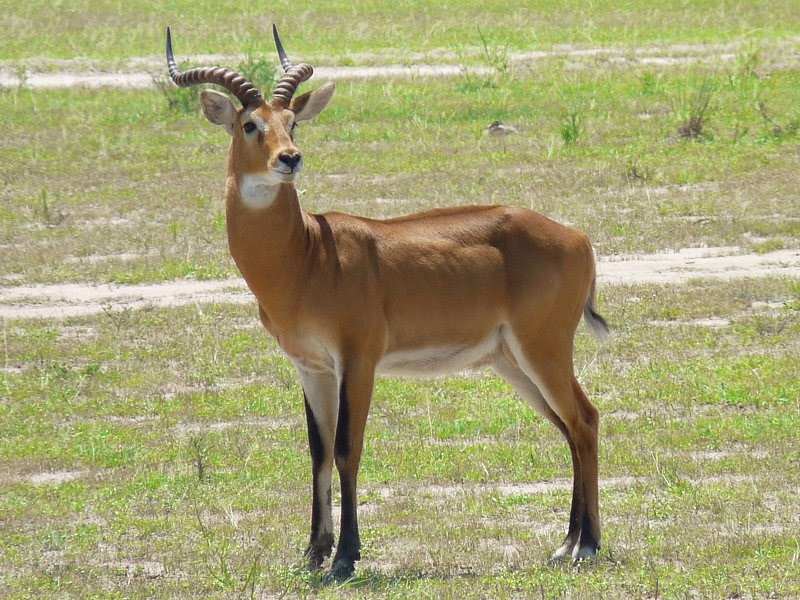
Actually the lovely Uganda Kob Kobus kob thomasi isn't officially the national emblem -
that honour belongs to a bird, which we'll meet soon - but it does appear on the national coat of arms.
Oribi Ourebia ourebi are delicate-looking little antelope, widespread south of the Sahara.
Uganda Topi Damaliscus ugandae. A very handsome stocky antelope, in a group
which has undergone a lot of taxonomic scrutiny recently. I'm almost certain I've
identified this correctly, but would be grateful to hear if you think otherwise.
And after drawing attention to the garbage sorting activities of some Warthogs last time, I feel that I should acknowledge that most of the Muchison Falls warties do live wild and independent lives!
Warthog family Phacochoerus africanus on the move.
Olive Baboons Papio anubis are another species which has recognised the benefits of human haunts, in terms of what we might leave for them to scrounge. They tend to be rather more proactive than the Warthogs however, and if you leave a car open at a picnic area, baboon retribution is likely to be dramatic!
Olive Baboon mother and baby watching events at the Paraa ferry crossing.
And there are even some small but conspicuous mammals - and coming from a place without any, I reckon that squirrels are a delight.
Striped Ground Squirrel Xerus erythropus are bold and cheeky.
The Murchison birds are slightly less obvious if you're not attuned, but they are a rich part of the landscape. And as we gave top billing among mammals to one part of the Ugandan coat of arms, so we must accord similar respect to the kob's bird counterpart. The Grey Crowned Crane Balearica regulorum is also the official national faunal emblem.
Cranes are always superb in my opinion, and the crowned cranes have something a bit extra with the wonderful
crest and the unexpectedly short bills. Grey Crowned Crane on the plains of Murchison Falls NP above and on the Ugandan coat of arms - with the Uganda Kob - below.

Unlike mammalian predators which are most active at night, bird hunters are easier to see.
Dark Chanting Goshawks Melierax metabates, are effective hunters of quite large ground birds,
plus small mammals, reptiles and insects. I'd have said it whistled rather than chanted, but that's just me.

The Grey Kestrel Falco ardosiaceus is a much smaller hunter, but scarey enough if you're in its size range!
Among the known prey of the goshawk are francolins, ground-dwelling relatives of chooks, partridges and pheasants.
Crested Francolins Dendroperdix sephaena
The open areas support many other ground-dwelling birds too.
I'm a big fan of bustards too and Africa has a pretty rich trove of these large birds, compared with
just one in Australia. This is Denham's Bustard Neotis denhami which is found across much of sub-Saharan
African, but everywhere declining.
Black-headed Lapwings Vanellus tectus doing their best to avoid a decline in their species.
African Spur-winged Lapwing Vanellus spinosus. This really is a very neat - and in-your-face - group of birds,
found over most of the world. The bony spur, in the angle of the wing, is kept hidden normally, but is used
to wicked effect when protecting the nest or chicks on the ground.
African Wattled Lapwing Vanellus senegallus, yet another member of the genus.
(It was in Uganda that I saw the last of the African species that I hadn't yet come across - at least
of those living in areas I've been to.)

Senegal Thick-knee Burhinus senegalensis, one of an intriguing group of waders found throughout the world.
Mostly they are known as stone-curlews, which may not be accurate but is at least more euphonius. The African
species however are mostly called thick-knees (based on an old species name for the European representative).
Even Australia, which toyed with this awful name for a while, reverted to 'stone-curlew' by popular protest.
'Dikkop' is an alternative in Africa too, and to my ear is pleasanter, but is mostly South African.
Abyssinian (or Northern) Ground Hornbill Bucorvus abyssinicus. These very large (a metre high) birds
stalk the grasslands in small groups, hunting small animals.
And just to show that there are some small birds there that don't spend their time on the ground!
Northern Red Bishop Euplectes franciscanus, one of the weavers, constructing
a delightful woven enclosed nest hung among grass stems.
I can't imagine that you'd go to Uganda without visiting Murchison Falls, but this is just to make sure! It's a great reserve.

BACK TOMORROW FOR A BRIEF ACKNOWLEDGEMENT OF WATTLE DAY