About Me

My photo
Canberra-based naturalist, conservationist, educator since 1980. I’m passionate about the natural world (especially the southern hemisphere), and trying to understand it and to share such understandings. To that aim I’ve written several books (most recently 'Birds in Their Habitats' and 'Australian Bird Names; origins and meanings'), and run tours all over Australia, and for 17 years to South and Central America. I've done a lot of ABC radio work, chaired a government environmental advisory committee and taught many adult education classes – and of course presented this blog, since 2012. I am a recipient of the Australian Natural History Medallion, the Australian Plants Award and most recently a Medal of the Order of Australia for ‘services to conservation and the environment’. I live happily in suburban Duffy with my partner Louise surrounded by a dense native garden and lots of birds.

Tuesday, 10 November 2015

Southern Tablelands Ecosystems Park; a tucked-away treasure

In the last days of 2001 fires roared through exotic pine plantations scant kilometres from the centre of Canberra. Just 13 months later a far greater conflagration swept away 500 homes and most of the vegetation of the Australian Capital Territory (ACT) south and west of Canberra. In the aftermath, in the midst of the recovery process, it was decided to replace the pines with an international arboretum - a sort of tree zoo. It is a large area, covering 250 hectares, and comprises a series of approximately 100 single-species plantations of trees, planted in neat grid lines. It opened in early 2013 and has since consistently attracted large numbers of visitors.

In general I've not been among them. In saying so I'm not being critical of the concept or its implementation, which has been highly professional and well-funded. It's just a personal preference; I actually think we've got enough exotic monocultures and when I get time to go out I'll always opt for one of the many natural areas enhancing Canberra, or the nearby and superb Australian-only National Botanic Gardens.

Having said that, there is one too-obscure corner of the arboretum which regularly draws me to inspect its progress; this is the Southern Tablelands Ecosystems Park (STEP hereafter), an absolutely delightful pocket of diverse native vegetation tucked away in a corner. Effectively it is a lovely, and rapidly evolving, little botanic garden of local plants, including 16 eucalypt species; in this context 'local' means the elevated Southern Tablelands of New South Wales and the ACT. 
The STEP garden from up the slope, separated from the visitors' centre, the hub of the arboretum,
by an unwelcoming expanse of weedy open space.
The gardens are not obvious in this shot, scattered among the growing trees.
The remnant woodlands in the background are to be preserved as planned suburban development
proceeds, and are to be added to the arboretum land and managed by STEP.
The idea of a STEP garden arose quite independently of the arboretum - indeed it was being discussed even before the 2003 fires. It was proposed and championed by two local community organisations, the Australian Native Plants Society (Canberra Region) and Friends of Grasslands, following a workshop in 2002 to explore the concept. Importantly, it gained the support of the then ACT Chief Minister Jon Stanhope, also a champion of the arboretum. Potential venues were explored without progress being made, until in 2005 it was proposed that STEP's future should be with the arboretum and subsequent planning and selection and propagation of plant species proceeded on that basis.

It is most significant to realise that the entire process has been carried by volunteers - in that context the progress made has been even more remarkable. Life was made harder for them by the fact that most of the development years were times of extreme drought. 
Tall Ammobium Ammobium alatum, on the edge of one of the diverse garden beds.
Well-attended weekly working bees are responsible for such beautiful and well-maintained plantings.
The STEP garden opened in February 2013, with the rest of the arboretum. At the time it was new and sparse-looking, and the weeds were not at all keen on being displaced. In less than three years since then it has been transformed. Let me share some images with you.
Some of the eucalypt plantings; no monocultures here, the designers have utilised the topography of the site
to plant the 16 species according to the relative situations they would occupy naturally.
Scrambled Eggs (not that I've actually heard anyone call it that!) Goodenia pinnatifida.
Trigger Plant Stylidium graminifolium.
Triggers have a remarkable pollination system; the style (which is initially a pollen presenter) is bent back
against the flower stem - quite visible above. A visiting insect releases the 'trigger' and the style whips over
and whacks the insect, either delivering pollen to it or collecting it from it.

Smooth Flax Lily Dianella longifolia, above and below.
Long in the family Phormiaceae, then shifted to Hemerocallidaceae; now some would put
it into Xanthorrhoeaceae. Take your pick.


Wee Jasper Grevillea G. iaspicula, above and below.
This is a rare and threatened shrub from the vicinity of the nearby town Wee Jasper;
the species name is an attempt to Latinise the town name!


False Sarparilla Hardenbergia violacea above and below.
A vigorous scrambling pea and an early coloniser of disturbed land.
 
Bulbine Lily B. bulbosa. Family Asphodeleaceae.

Rock Fern Cheilanthes austrotenuilfolia.A hardy little fern of local rocky hillsides.
Native Flax Linum marginale.

Kangaroo Apple Solanum linearifolium.
A spreading shrub of rocky sites; ignore the common name, all Solanum fruit should be treated with great respect,
though indigenous Australians have long known how to separate the edible from the toxic.
Remember that while this is the family that brought you tomatoes and potatoes,
it also boasts tobacco and Deadly Nightshade.
Amphitheatre; this is the focus of STEP's education program with visiting school groups.
Introductory sign.
Already the wildlife is accumulating, though the most obvious birds are still utilisers of relatively open space. Nonetheless they are obviously homing in on the plantings and this will only increase as the garden beds mature and the contrast grows between their naturalness, diversity and dense shelter and the comparatively unwelcoming surrounds.
Plague Soldier Beetles Chauliognathus lugubris on eucalypt blossom.
At least one family of Superb Fairy-wrens Malurus cyaneus has set up a territory in
the STEP garden, and is doubtless breeding there.
Red-rumped Parrots Psephotus haematonotus are attracted to the seeding native grasses.
This Silvereye Zosterops lateralis is on a weed (Senecio sp. I think) just outside the STEP garden,
but they regularly visit the garden to feed on both insects and nectar.
As the STEP garden matures further, I will probably revisit it in a future blog - meantime though I will certainly be doing so physically. If you live in Canberra, or next time you visit, I strongly urge you to do likewise. You won't get much help in finding it - for all the clear signage throughout the arboretum, management has not invested in one to indicate that the STEP garden even exists, let alone direct us to it. Nor can I find a map on the arboretum web site. However there are clear directions here. Basically, drive up to the visitors' centre and walk down the hill to the west. (And, as an addendum, please note the Comment below from Rob, regarding a new walking track and brochure from the Visitors' Centre to STEP - a most desirable innovation.)

It is a shame that, having offered a home to such an important, vigorous and self-sufficient initiative, the arboretum has not taken the small extra step of directing public attention to it. However I have little doubt that, in time, the word will spread, and I hope I've just made a small contribution to that.

[It is important to note that while writing this I made a conscious decision not to discuss it with anyone associated with STEP, so as not to compromise either them or me. Nor has anyone involved with the project ever expressed to me the concerns I've raised above - they are solely my own observations.]

BACK ON TUESDAY

Tuesday, 3 November 2015

Pomac; a gem of northern Peru

The key focal points for most people's visit to Peru are either high in the Andes - Machu Picchu, Lake Titicaca, the cloud forests - or to the east in the Amazon basin, in the lowland rainforests. Quite right too. Nonetheless today I want to tell you about somewhere that is west of the Andes, not much above sea level (though nowhere near the sea) and very dry. And, I found, very special.

The Pomac Forest Historical Sanctuary is an area of just 6000 hectares of arid Algorrobo Prosopis pallida forest and open semi-desert, located 30km north of the major town of Chiclayo in far northern Peru. It was declared in 2001, to protect an important biodiverse and cultural landscape. The Tumbes eco-region of north-western Peru and adjacent Ecuador is an area of tropical dry forest, greatly reduced and fragmented, which supports unique and highly threatened wildlife. Birdlife International describes it as "one of the most important and threatened of all Endemic Bird Areas"; only 5% of the area remains forested, mostly degraded.
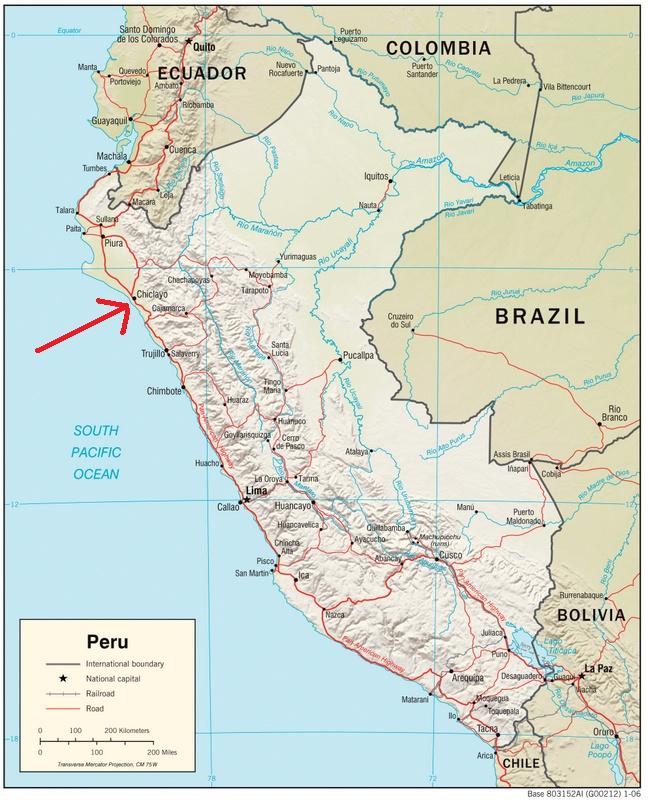
The end of the red arrow indicates Chiclayo, a city of nearly a million people, some 800km north of Lima.
On this map, Pomac is pretty much on the outskirts.
A key reason for its reservation was the presence of mighty mud brick pyramids - now softened at the edges to resemble vast piles of earth from a distance - which are tombs of the 'señors' of the pre-Inca Sicán culture, dating from 900-1200 years ago. When a 'señor' died he was buried under a pyramid - with wives and chief attendants, including chief priest and commander of his guard - then the entire pyramid was razed and another larger one built on top, starting with an extra perimeter base level.
Sicán pyramid (one of several), Pomac Forest, above and below.

However I was there mostly for the natural values - though I certainly visited the remarkable Museum of the Royal Tombs of Sipán (a similar site nearby) on the edge of Chiclayo.
Museo de las Tumbes Reales de Sipán, Chiclayo.
There are excellent walking tracks through the dense Algorrobo forest.
Algorrobo scrub, above and below.

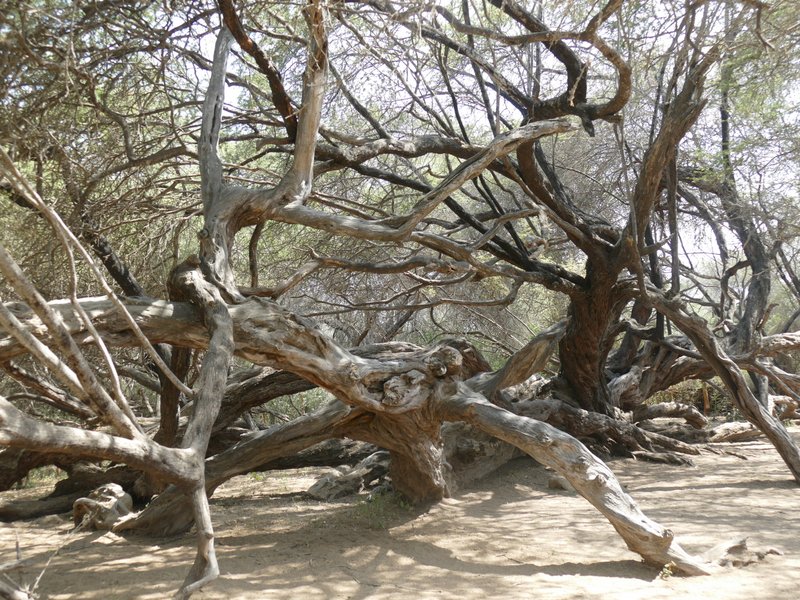
The Millenium Tree is an ancient Algorrobo tree;
some estimates put it at over 1000 years old, though others are a little more modest.
On the edge of the forest is even more arid open land, sand and rocky hillsides.
Sandy semi-desert with Prosopis spp.

Cactus on rocky slopes.
Back in the forest there are other plants in addition to the Algorrobo. 
Mistletoe on Algorrobo.
Amazilia Hummingbirds were feeding on the flowers, but I wasn't quick enough.
Grabowskia buxifolia Family Solanaceae.
This unlikely-looking tough foliage, along with the fruit, is an important food source
for the endangered Tumbesian endemic Peruvian Plantcutter.

Peruvian Plantcutter Phytotoma raimondii.After a long period of uncertainty the plantcutters are now regarded as cotingas.
The Peruvian Plantcutter is known from just eight locations in northern Peru.
Other endangered endemics present in Pomac include the Rufous Flycatcher Myiarchus semirufus and Tumbes Tyrant Tumbezia salvini. Not all residents are so rare however.
Long-tailed Mockingbirds Mimus longicaudatus are ubiquitous.
Exquisite Vermilion Flycatchers Pyrocephalus rubinus are also common in the forest.
Scarlet-backed Woodpecker Veniliornis callonotus - just about to touch down!
Burrowing Owls Athene cunicularia are among the most widespread birds in the Americas.
Around Pomac they can be seen perched out during the day, or at the mouth of their burrow.
Savannah Hawks Buteogallus meridionalis live in the open country all around Pomac.
Black Vultures Coragyps atratus hang around the pyramids, and perch on them (see large pyramid photo above).
Northern Peru isn't on every visitor's itinerary, though I reckon it should be. And when you go there, definitely don't miss Pomac!

BACK ON TUESDAY

Wednesday, 28 October 2015

Leaf Beetles and Mobile Homes

I had no intention of talking about leaf beetles today - indeed I scarcely knew anything about them and the idea had never occurred to me. Until Sunday.

On Sunday I was walking with some like-minded people along a quiet road in the Tallaganda Ranges a little to the east of Canberra. The Tallagandas contain some beautiful wet eucalypt forest, a reasonable proportion of which has now been preserved from the creeping blight of exotic pine plantations and dedicated as Tallaganda National Park.
Eucalyptus obliqua, E. viminalis and Fishbone Ferns Blechnum spp., Tallaganda NP.
On the road we found a busy crowd of odd-looking little animals, seemingly in mud-like shells, demolishing a eucalypt leaf - I was at a complete loss to explain them, to my embarrassment. There wasn't much left of their leaf, but I was concerned for their safety on the road, quiet though it was, and tried to move them and the leaf to the edge of the road. They were much more active than they first seemed however and all tumbled off to the side and proved impossible to move without risking damage to them.
A very odd little gathering!
Back in Canberra I consulted Kim Pullen, an entomologist with CSIRO (for those outside Australia, this is the Commonwealth Scientific and Industrial Research Organisation, an icon of Australian research, though shamefully starved of funds by recent governments). He put me firmly on the right track, on which I've since done a little more of my own research, though readily available information isn't plentiful.

However I think I've got enough to share a little story which I found fascinating. Our little characters are leaf beetle larvae, Family Chrysomelidae, subfamily Cryptocephalinae. Normally we don't worry too much about sub-families for day to day use, but when species numbers are as high as they are in insect families, and notably among beetles, it is a practical necessity. As a case in point, there are some 700 species of Cryptocephalines in Australia alone. 

First, a little background (bearing in mind I claim no expertise in matters invertebrate). The leaf beetles, Chrysomelidae, contain at least 3000 species in Australia, in more than 250 genera. Both adults and larvae specialise in eating plant tissue, including, as you'd expect in Australia, both eucalypt and acacia leaves.
A leaf beetle, probably of the same subfamily as our subjects, effectively
chewing an Eremophila leaf, Whyalla Conservation Park, South Australia.
The best-known are probably the numerous species of the genus Paropsis, or tortoise beetles. A major part of the secret to their success is in being one of the few groups of organisms in the world which have managed to unravel the chemical binding of proteins to the tannins in eucalypt leaves. These greatly limit the availability of essential nitrogen to those munching on them, making them pretty unattractive to most leaf-eaters.
Tortoise beetles - larvae above, adult below - demonstrating their disdain for the chemical
defences in eucalypt leaves. The larvae, moreover, exude deadly hydrogen cyanide from glands in
their rear ends - enough to kill a meat ant outright.
 
Another Chrysomelid is well-known to orchid growers - the Orchid Beetle Stethopachys formosa (subfamily Criocerinae) specialises in eating orchid flowers, notably the summer flowering hyacinth orchids, Dipodium spp. They really appreciate the nice warm conditions in greenhouses!
Orchid beetle on lunch - Dipodium punctatum, Rosedale, south coast New South Wales.
So, what's the story of our little friends on the Tallaganda road? Kim Pullen tells me that the only way to even allocate them to a genus would be to raise them to adulthood, but my fostering skills are not up that, even if I was willing to rip them from their friends and family. As the the female beetle laid each egg on the ground, she caught it in the 'foot' of her rear legs and coated it in droppings, which are composed of eucalypt leaf material. When the egg hatched, the little beetle larva broke a hole at the front of the case and with the assistance of its front 'legs' moves about the forest floor eating the litter. I am told by Kim that Dr Chris Reid of the Australian Museum in Sydney, an expert on Chrysomelids, considers them an important player in the cycle of litter breakdown in eucalypt forests 

An enlarged view of a section of the above photo shows some of the larvae protruding from their mobile homes. These homes provide both physical protection and effective camouflage in the litter.
As they grow they add to the case with their own droppings, and when the time comes they pupate within it, eventually emerging as an adult beetles.

A small story in the bigger scheme of things, but it fascinated me and I hope you found something of interest here too.

BACK ON TUESDAY

Wednesday, 21 October 2015

American Camels

I think some people are surprised to realise that there are camels in America. Even more, I suspect, are taken aback to learn that camels actually arose in North America, some 45 million years ago. Over their long history in that continent - which ended only very recently - some 90 camelid species in 35 genera arose, from tiny delicate gazelle-like animals to huge six metre high giraffe-like camels. Some six to seven million years ago one of the larger of these species crossed the then dry Bering Strait into Asia; its descendants eventually reached Spain. Two descendant species still live, both in the genus Camelus, inhabiting some of the harshest lands on earth. The Bactrian Camel (C. bactrianus) adapted to the summer-baking and winter-freezing stony deserts of the central Asian steppes, while the Dromedary (C. dromedarius) settled in the hot sandy deserts of south-western Asia and north Africa. Both were domesticated between four and six thousand years ago (Bactrians first), to the extent that there are now no wild Dromedaries in their home range, and very few wild Bactrians, though there are nearly 20 million domestic Dromedaries and about a million domestic Bactrians.
Feral Dromedary, Musgrave Ranges, central Australia.
The ancestors of inland Australia's feral camel population - the only wild Dromedaries in the world -
were brought here from British India as pack animals in the nineteenth century.
There are at least 600,000 of them, representing a serious environmental problem, especially to scarce water sources.
Probably less than a thousand wild Bactrian Camels survive, deep in the Gobi Desert.
Recent genetic work suggests that domestic Bactrians have changed enough that the wild animals
merit different species status, as C. ferus.
Photo courtesy of National Geographic.
More recently - some three million years ago - another opportunity arose for the North American camels to expand their range. This was the collision of South America with the North, providing major two-way access between the continents via the Panamanian Land Bridge. 

Two species derived from the invasion. Widespread in open habitats of the continent was the Guanaco Lama guanicoe; more specialised is the much smaller and more delicate-looking Vicuña Vicugna vicugna which is limited to the high northern Andes, over 3500 metres above sea level.

 
Guanacos, Torres del Paine NP, Chilean Patagonia.

Vicuña near Chivay, southern Peruvian Andes.

It has been estimated that 50 million Guanacos once roamed the plains and mountains, but now perhaps 1% of that number survive, mostly in the far south; only in the southern tip of Argentina do they maintain a presence in the plains. Vicuña numbers are slightly lower than that, but they were never as numerous and numbers actually appear to be increasing. However many, even most, wild Vicuña populations are heavily managed for regular shearing, with some even kept permanently in large corrals, which prevent natural gene flow. A second domestication of most of the remaining wild Vicuñas may be underway.

The Guanaco hot-spot is Torres del Paine, where large herds are still ubiquitous. Further north things are dire for them. The northern sub-species L. g. casilensis numbers less than 4000 animals now, in southern Peru and northen Chile.
Northern Guanacos, above and below, Atacama Desert near San Pedro, northern Chile.

These harsh high deserts support both species.
Vicuñas, Aguada Blanca National Reserve, southern Peru.
Guanacos live either in family groups - a male defending several females and offspring, or as troops of males waiting their chance, sometimes for years, or as solitary mature males, hanging around the periphery of territories, challenging the incumbent males. 

(All subsequent Guanaco photos were taken in Torres del Paine NP.)
Guanaco herd, females and young.
The single young - called chulengos - are born in summer after an 11 month gestation, weighing up to 15kg, a sixth of adult weight. They are suckled for 15 months; all these characteristics are adaptations to a harsh climate. Nonetheless mortality is high (up to 15% in the first 10 days in Torres del Paine), the main cause being Puma predation.
Chulengos on the park boundary - the adults easily leap the fence (below).

Fresh Puma-killed chulengo.
Males will fight viciously for hours with intruders, with exhausting chases; just when the struggle seems to be over with one party completely beaten, the tables can turn in an instant and it all starts again.


Despite these dramatic scenes, when we moved on after nearly an hour
neither party seemed to have any ascendancy.
As with their Old World relatives, both species were domesticated early - thousands of years ago. Both of the domesticated animals have evolved so far from their wild ancestors that they are now regarded as separate species. Guanacos gave rise to Llamas (Lama glama) and Vicuñas to Alpacas (Vicugna pacos). The much larger Llamas were developed as pack animals - huge caravans of Llamas traversed the vast Inca empire, carrying goods for hundreds of kilometres. Alpacas on the other hand were bred to be producers of valuable fibre. Large herds of both roam the high Andes, usually in the care of shepherds.

Llamas, Machu Picchu, Peru.

Alpacas (and Andean Geese) near Chivay, southern Peruvian Andes.

Mixed mob of Llamas and Alpacas with young shepherd, near Chivay, southern Peruvian Andes.
The Llamas have nearly bare faces.
The coloured ear tags, denoting ownership, are a part of a very old tradition.
And the ancestors of all these animals, back in North America? They survived until very recently, perhaps only 15,000 years ago, during the last glaciation. Savage climate change alongside hunting pressures and perhaps changed fire regimes from newly arrived humans probably interacted to eliminate them, along with many other large grazing animals, including several South American camel species.

So now, if you want to see wild camels in the land they evolved in, you're going to have to go to South America. And really, that's not a hardship...


BACK ON WEDNESDAY