About Me

My photo
Canberra-based naturalist, conservationist, educator since 1980. I’m passionate about the natural world (especially the southern hemisphere), and trying to understand it and to share such understandings. To that aim I’ve written several books (most recently 'Birds in Their Habitats' and 'Australian Bird Names; origins and meanings'), and run tours all over Australia, and for 17 years to South and Central America. I've done a lot of ABC radio work, chaired a government environmental advisory committee and taught many adult education classes – and of course presented this blog, since 2012. I am a recipient of the Australian Natural History Medallion, the Australian Plants Award and most recently a Medal of the Order of Australia for ‘services to conservation and the environment’. I live happily in suburban Duffy with my partner Louise surrounded by a dense native garden and lots of birds.

Thursday, 12 November 2015

Living Rainbows; animal iridescence

[This posting originally appeared on 13 June 2015, but while trying to update it with the addition of three extra photos, it inexplicably and totally disappeared! With the gratefully received help of David Nash I've retrieved it - and added the extra pictures.]

This is another in the sporadic series on colour in nature. You can find the most recent one here and trace it back therefrom. However for this particular installment you might also like to cast a glance at the first posting on blue in nature; the reason for this is that iridescent colours - where parts of an animal appear to shine, and even to change colour with a slight change of viewing angle - are formed in somewhat similar ways to blue (and combinations of blue, such as give yellow and purple). The colours have nothing to do with pigments, but are down to structures in the feather or skin of the animal, which reflect certain wavelengths.

However while non-iridescent blue for instance is always the same blue from any angle, iridescent structures give varying colours and rely on layers of cells that have different light-reflecting or refracting properties. We see the different colours by looking at different angles, and seeing light coming from the different surfaces. Moreover subtle aspects of these adjacent layers can cause effects to be reinforced or neutralised. Iridescence relies crucially on a reflecting base layer of melanin, or the light just keeps going through. 

An oil layer on water produces similar effects, with light reflecting back from the bottom surface and the top one, creating a rainbow effect as light wavelengths suppress or reinforce each other. (The word is based on Greek iris, a rainbow.)

For a more thorough analysis of the basis of the phenomenon in nature, this is a very comprehensive review.
Iridescent speculum in the wing of the Australian Pacific Black Duck Anas superciliosus.The photos above and below were of the same bird, taken just seconds apart.
 

It seems that iridescence can be used by species to convey information about the individual which includes sex, age, fitness as a mate, fitness to defend territory against an intruder and even species identification for very similar species. It may also play a role in camouflage (breaking up outlines, or in underwater situations), scare or confuse predators, for instance by making it hard to judge the exact distance to the prey, or by alternately flashing and hiding wing patterns in flight. Blues, purples, greens and bronze dominate iridescent colours.

But for the rest of today, let's just enjoy some examples of iridescence in bird feathers - leaving aside for now just one very important family which employs iridescence so comprehensively that they warrant their own posting next time. Let's continue with ducks, which are significant employers of the technique, on heads and backs as well as in wing speculums.
Feral Mallard Anas platyrhynchos, Canberra.
Chiloé Wigeons Anas sibilatrix, Puerto Natales, Chile.
The male is on the right.
Male Muscovy Duck Cairina moschata, Manu NP, Peru.
Even in the dull rainforest light which is my excuse for a poor photo, the iridescent back gleams.

Mandarin Duck Aix galericulata, Taronga Park Zoo, Sydney.
The most widespread ibis in the world is the iridescent Glossy Ibis Plegadis falcinellus, but it is not the only iridescent ibis. 
Glossy Ibis, Jerrabomberra Wetlands, Canberra.
Hadada Ibis Bostrychia hagedash, Queen Elizabeth National Park, Uganda.
A very familiar African bird, named for its compellingly loud call.
Austral Parakeet Enicognathus ferrugineus, Cuevo del Milodon, southern Chile.
The lightly iridescent head of this parrot is found further south than any other parrot's,
to very tip of South America.
Pigeons also feature impressive iridescence, mostly in the wings in Australia at least.
Common Bronzewing Phaps chalcoptera, Canberra.A very common bird, including in urban situations, across most of Australia.
Crested Pigeon Ocyphaps lophotes, displaying in central Australia.
Another very common and familiar bird which probably thereby often fails to receive the admiration it deserves
(though this one wasn't interested in human admirers!).
Spinifex Pigeon Geophaps plumifera, central Australia.
The similarity of the display of these two species is striking.
Squatter Pigeon Geophaps scripta, Mareeba, Queensland.
Asian Glossy Starling Aplonis panayensis, found across southern and south-east Asia,
here at Sepilok, Sabah. Many starlings are gloriously iridescent.
Common Starling Sturnus vulgaris, Canberra.
An unwelcome exotic here, but the green to purple iridescence of the breast is still striking.
Greater Blue-eared Glossy Starling Lamprotornis chalybaeus, one of the
many stunningly iridescent African starlings.
Ethiopian Swallows Hirundo aethiopica, Waza NP, northern Cameroon.
Many swallows show such iridescence.
 
The green iridescent sheen of the wing covers of the male Great Frigatebird Fregata minor is one feature that distinguishes it from similar species. Here on Genovesa, Galápagos.
Leaden Flycatcher male Myiagra rubecula, Canberra.
This familiar bird catching the light took me by surprise; in most lights it's a more sombre and well, leaden colour.

Malachite Kingfisher Alcedo cristata, Lake Mburo NP, Uganda.
Kingfishers also commonly display iridescence, but I especially love the highlights of this one.
Masked Flowerpiercer Diglossa cyanea, Yanacocha Reserver, Ecuador.
These lovely birds 'cheat' by stabbing the base of a flower to steal nectar without
offering pollination services.
Shining Bronze-Cuckoo Chrysococcyx lucidus, Canberra, one of the world's smallest cuckoos.
All bronze-cuckoos have the strikingly iridescent wings.
Superb Fairy-wren Malurus cyaneus, Canberra.
One of south-east Australia's most familiar and loved birds whose iridescence
is often not recognised - until the sun catches them and 'flash'!
Ruby-cheeked Sunbird (or just Rubycheek) Chalcoparia singalensis, Batang Ai NP, Sarawak.
Many sunbirds are strikingly iridescent.
Olive-backed Sunbirds Cinnyris jugularis, Cairns, Queensland.
This species, Australia's only sunbird, is presumably a recent arrival, being also found through southern Asia.

I hope this has brightened up your day a little, as preparing it has mine.

MEANTIME I'LL LEAVE SOMETHING MORE FOR YOU ON IRIDESCENCE, FEATURING THE AMAZING HUMMINGBIRDS, ON SATURDAY 13 JUNE.

Tuesday, 10 November 2015

Southern Tablelands Ecosystems Park; a tucked-away treasure

In the last days of 2001 fires roared through exotic pine plantations scant kilometres from the centre of Canberra. Just 13 months later a far greater conflagration swept away 500 homes and most of the vegetation of the Australian Capital Territory (ACT) south and west of Canberra. In the aftermath, in the midst of the recovery process, it was decided to replace the pines with an international arboretum - a sort of tree zoo. It is a large area, covering 250 hectares, and comprises a series of approximately 100 single-species plantations of trees, planted in neat grid lines. It opened in early 2013 and has since consistently attracted large numbers of visitors.

In general I've not been among them. In saying so I'm not being critical of the concept or its implementation, which has been highly professional and well-funded. It's just a personal preference; I actually think we've got enough exotic monocultures and when I get time to go out I'll always opt for one of the many natural areas enhancing Canberra, or the nearby and superb Australian-only National Botanic Gardens.

Having said that, there is one too-obscure corner of the arboretum which regularly draws me to inspect its progress; this is the Southern Tablelands Ecosystems Park (STEP hereafter), an absolutely delightful pocket of diverse native vegetation tucked away in a corner. Effectively it is a lovely, and rapidly evolving, little botanic garden of local plants, including 16 eucalypt species; in this context 'local' means the elevated Southern Tablelands of New South Wales and the ACT. 
The STEP garden from up the slope, separated from the visitors' centre, the hub of the arboretum,
by an unwelcoming expanse of weedy open space.
The gardens are not obvious in this shot, scattered among the growing trees.
The remnant woodlands in the background are to be preserved as planned suburban development
proceeds, and are to be added to the arboretum land and managed by STEP.
The idea of a STEP garden arose quite independently of the arboretum - indeed it was being discussed even before the 2003 fires. It was proposed and championed by two local community organisations, the Australian Native Plants Society (Canberra Region) and Friends of Grasslands, following a workshop in 2002 to explore the concept. Importantly, it gained the support of the then ACT Chief Minister Jon Stanhope, also a champion of the arboretum. Potential venues were explored without progress being made, until in 2005 it was proposed that STEP's future should be with the arboretum and subsequent planning and selection and propagation of plant species proceeded on that basis.

It is most significant to realise that the entire process has been carried by volunteers - in that context the progress made has been even more remarkable. Life was made harder for them by the fact that most of the development years were times of extreme drought. 
Tall Ammobium Ammobium alatum, on the edge of one of the diverse garden beds.
Well-attended weekly working bees are responsible for such beautiful and well-maintained plantings.
The STEP garden opened in February 2013, with the rest of the arboretum. At the time it was new and sparse-looking, and the weeds were not at all keen on being displaced. In less than three years since then it has been transformed. Let me share some images with you.
Some of the eucalypt plantings; no monocultures here, the designers have utilised the topography of the site
to plant the 16 species according to the relative situations they would occupy naturally.
Scrambled Eggs (not that I've actually heard anyone call it that!) Goodenia pinnatifida.
Trigger Plant Stylidium graminifolium.
Triggers have a remarkable pollination system; the style (which is initially a pollen presenter) is bent back
against the flower stem - quite visible above. A visiting insect releases the 'trigger' and the style whips over
and whacks the insect, either delivering pollen to it or collecting it from it.

Smooth Flax Lily Dianella longifolia, above and below.
Long in the family Phormiaceae, then shifted to Hemerocallidaceae; now some would put
it into Xanthorrhoeaceae. Take your pick.


Wee Jasper Grevillea G. iaspicula, above and below.
This is a rare and threatened shrub from the vicinity of the nearby town Wee Jasper;
the species name is an attempt to Latinise the town name!


False Sarparilla Hardenbergia violacea above and below.
A vigorous scrambling pea and an early coloniser of disturbed land.
 
Bulbine Lily B. bulbosa. Family Asphodeleaceae.

Rock Fern Cheilanthes austrotenuilfolia.A hardy little fern of local rocky hillsides.
Native Flax Linum marginale.

Kangaroo Apple Solanum linearifolium.
A spreading shrub of rocky sites; ignore the common name, all Solanum fruit should be treated with great respect,
though indigenous Australians have long known how to separate the edible from the toxic.
Remember that while this is the family that brought you tomatoes and potatoes,
it also boasts tobacco and Deadly Nightshade.
Amphitheatre; this is the focus of STEP's education program with visiting school groups.
Introductory sign.
Already the wildlife is accumulating, though the most obvious birds are still utilisers of relatively open space. Nonetheless they are obviously homing in on the plantings and this will only increase as the garden beds mature and the contrast grows between their naturalness, diversity and dense shelter and the comparatively unwelcoming surrounds.
Plague Soldier Beetles Chauliognathus lugubris on eucalypt blossom.
At least one family of Superb Fairy-wrens Malurus cyaneus has set up a territory in
the STEP garden, and is doubtless breeding there.
Red-rumped Parrots Psephotus haematonotus are attracted to the seeding native grasses.
This Silvereye Zosterops lateralis is on a weed (Senecio sp. I think) just outside the STEP garden,
but they regularly visit the garden to feed on both insects and nectar.
As the STEP garden matures further, I will probably revisit it in a future blog - meantime though I will certainly be doing so physically. If you live in Canberra, or next time you visit, I strongly urge you to do likewise. You won't get much help in finding it - for all the clear signage throughout the arboretum, management has not invested in one to indicate that the STEP garden even exists, let alone direct us to it. Nor can I find a map on the arboretum web site. However there are clear directions here. Basically, drive up to the visitors' centre and walk down the hill to the west. (And, as an addendum, please note the Comment below from Rob, regarding a new walking track and brochure from the Visitors' Centre to STEP - a most desirable innovation.)

It is a shame that, having offered a home to such an important, vigorous and self-sufficient initiative, the arboretum has not taken the small extra step of directing public attention to it. However I have little doubt that, in time, the word will spread, and I hope I've just made a small contribution to that.

[It is important to note that while writing this I made a conscious decision not to discuss it with anyone associated with STEP, so as not to compromise either them or me. Nor has anyone involved with the project ever expressed to me the concerns I've raised above - they are solely my own observations.]

BACK ON TUESDAY

Tuesday, 3 November 2015

Pomac; a gem of northern Peru

The key focal points for most people's visit to Peru are either high in the Andes - Machu Picchu, Lake Titicaca, the cloud forests - or to the east in the Amazon basin, in the lowland rainforests. Quite right too. Nonetheless today I want to tell you about somewhere that is west of the Andes, not much above sea level (though nowhere near the sea) and very dry. And, I found, very special.

The Pomac Forest Historical Sanctuary is an area of just 6000 hectares of arid Algorrobo Prosopis pallida forest and open semi-desert, located 30km north of the major town of Chiclayo in far northern Peru. It was declared in 2001, to protect an important biodiverse and cultural landscape. The Tumbes eco-region of north-western Peru and adjacent Ecuador is an area of tropical dry forest, greatly reduced and fragmented, which supports unique and highly threatened wildlife. Birdlife International describes it as "one of the most important and threatened of all Endemic Bird Areas"; only 5% of the area remains forested, mostly degraded.
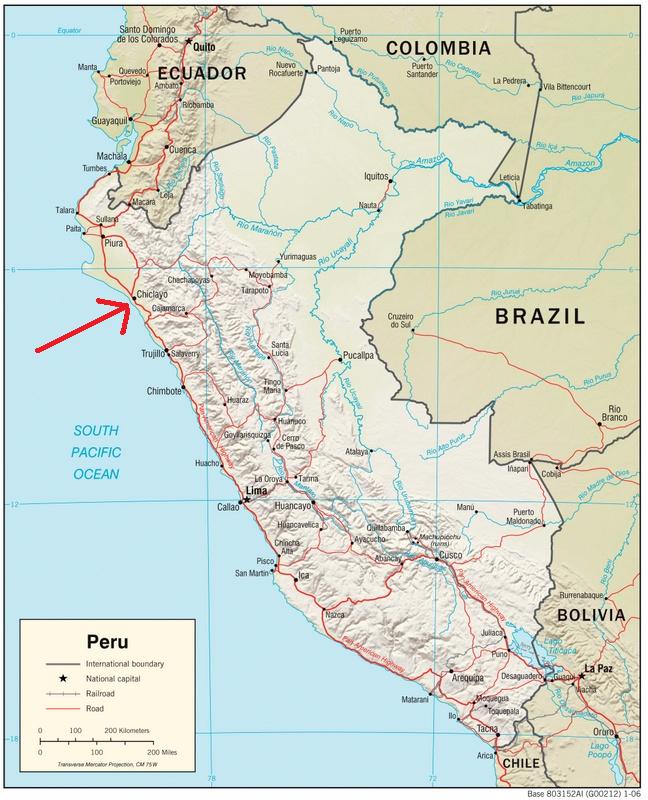
The end of the red arrow indicates Chiclayo, a city of nearly a million people, some 800km north of Lima.
On this map, Pomac is pretty much on the outskirts.
A key reason for its reservation was the presence of mighty mud brick pyramids - now softened at the edges to resemble vast piles of earth from a distance - which are tombs of the 'señors' of the pre-Inca Sicán culture, dating from 900-1200 years ago. When a 'señor' died he was buried under a pyramid - with wives and chief attendants, including chief priest and commander of his guard - then the entire pyramid was razed and another larger one built on top, starting with an extra perimeter base level.
Sicán pyramid (one of several), Pomac Forest, above and below.

However I was there mostly for the natural values - though I certainly visited the remarkable Museum of the Royal Tombs of Sipán (a similar site nearby) on the edge of Chiclayo.
Museo de las Tumbes Reales de Sipán, Chiclayo.
There are excellent walking tracks through the dense Algorrobo forest.
Algorrobo scrub, above and below.

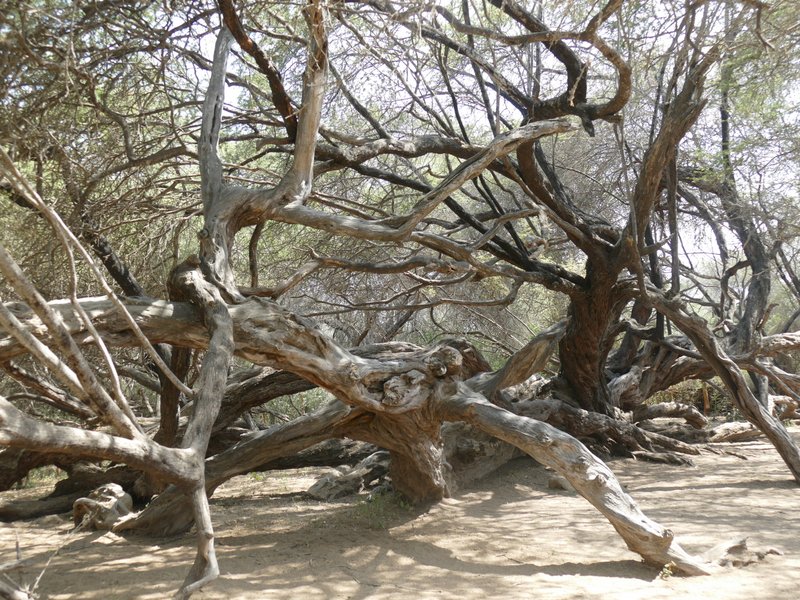
The Millenium Tree is an ancient Algorrobo tree;
some estimates put it at over 1000 years old, though others are a little more modest.
On the edge of the forest is even more arid open land, sand and rocky hillsides.
Sandy semi-desert with Prosopis spp.

Cactus on rocky slopes.
Back in the forest there are other plants in addition to the Algorrobo. 
Mistletoe on Algorrobo.
Amazilia Hummingbirds were feeding on the flowers, but I wasn't quick enough.
Grabowskia buxifolia Family Solanaceae.
This unlikely-looking tough foliage, along with the fruit, is an important food source
for the endangered Tumbesian endemic Peruvian Plantcutter.

Peruvian Plantcutter Phytotoma raimondii.After a long period of uncertainty the plantcutters are now regarded as cotingas.
The Peruvian Plantcutter is known from just eight locations in northern Peru.
Other endangered endemics present in Pomac include the Rufous Flycatcher Myiarchus semirufus and Tumbes Tyrant Tumbezia salvini. Not all residents are so rare however.
Long-tailed Mockingbirds Mimus longicaudatus are ubiquitous.
Exquisite Vermilion Flycatchers Pyrocephalus rubinus are also common in the forest.
Scarlet-backed Woodpecker Veniliornis callonotus - just about to touch down!
Burrowing Owls Athene cunicularia are among the most widespread birds in the Americas.
Around Pomac they can be seen perched out during the day, or at the mouth of their burrow.
Savannah Hawks Buteogallus meridionalis live in the open country all around Pomac.
Black Vultures Coragyps atratus hang around the pyramids, and perch on them (see large pyramid photo above).
Northern Peru isn't on every visitor's itinerary, though I reckon it should be. And when you go there, definitely don't miss Pomac!

BACK ON TUESDAY