About Me

My photo
Canberra-based naturalist, conservationist, educator since 1980. I’m passionate about the natural world (especially the southern hemisphere), and trying to understand it and to share such understandings. To that aim I’ve written several books (most recently 'Birds in Their Habitats' and 'Australian Bird Names; origins and meanings'), and run tours all over Australia, and for 17 years to South and Central America. I've done a lot of ABC radio work, chaired a government environmental advisory committee and taught many adult education classes – and of course presented this blog, since 2012. I am a recipient of the Australian Natural History Medallion, the Australian Plants Award and most recently a Medal of the Order of Australia for ‘services to conservation and the environment’. I live happily in suburban Duffy with my partner Louise surrounded by a dense native garden and lots of birds.

Friday, 4 December 2015

Banksias - grand and beautiful old Australians

(My apologies for this late posting; I was only just getting into it yesterday afternoon when I received a phone call to tell me that one of the first White-winged Black Terns ever reported in the ACT had appeared on Lake Burley Griffin in the city. The only other time I know of it happening I was in South America! That was the end of my afternoon's writing - but what could I do?!)

When Captain James Cook in the Endeavour stopped at the site where the south Sydney suburb of Kurnell now stands in late April 1770 his initial reaction was to call the bay Sting Ray Harbour, but after the remarkable collecting spree of Joseph Banks and Daniel Solander he amended it to Botanists Bay, then almost immediately to Botany Bay.

Among the collections made on that rich visit was a sample of the first banksia to be described by science; 12 years later it was named in Banks' honour by Linnaeus the Younger, son of the famous Carl. This first banksia to be named, the type species, was the grand Saw Banksia B. serrata (both names refer to the toothed leaves), which can grow to a 15 metre high gnarled tree in coastal forests from southern Queensland to Victoria.
Banksia serrata, south coast New South Wales, above and below.
 

Banksias are members of the old Gondwanan family Proteaceae, which I talked about here recently. As I also mentioned in that posting, a 2007 publication, which has been widely accepted, subsumed the large genus Dryandra into Banksia, but that acceptance is not universal. Given that one who vehemently and cogently opposes it is the acknowledged bankia expert, Western Australian Alex George, I am inclined to take a cautious approach. For the purposes of this posting I am limiting to myself to the traditional understanding of banksia - that still leaves us with 78 species to admire however.

Banksias arose in Australia and, with one minor exception, have never left it. Banksia-like trees are known from the fossil record up to 70 million years ago and fossils of 'modern' banksias date back nearly 50 million years.

As is often the case, the south-western corner of the continent has by far the largest number of species, with less than 20 in the south-east and only six in the tropics, of which only three are solely tropical. One of these, the Tropical Banksia B. dentata, is the only species to have left Australia - as well as growing across northern Australia it extends into New Guinea.
Tropical Banksia, Litchfield NP, south-west of Darwin.
The banksia flower spike ('inflorescence' if you're feeling pedantic) is one of its most distinctive features and banksia flowers are among the most widely recognised Australian wildflowers. The woody stem of the inflorescence is covered with densely packed flowers - each single one, unsurprisingly, resembles a grevillea flower - of which there may be hundreds or even thousands. The opening of the flowers from the bottom up (or vice versa in a few cases) produces an impressive slow-motion wave of colour over a period of days. In bud the long style is trapped in the short corolla of petals.
Hooker's Banksia B. hookeriana, Lake Logue NR, north of Perth.
This species is restricted to a small area near Enneaba.

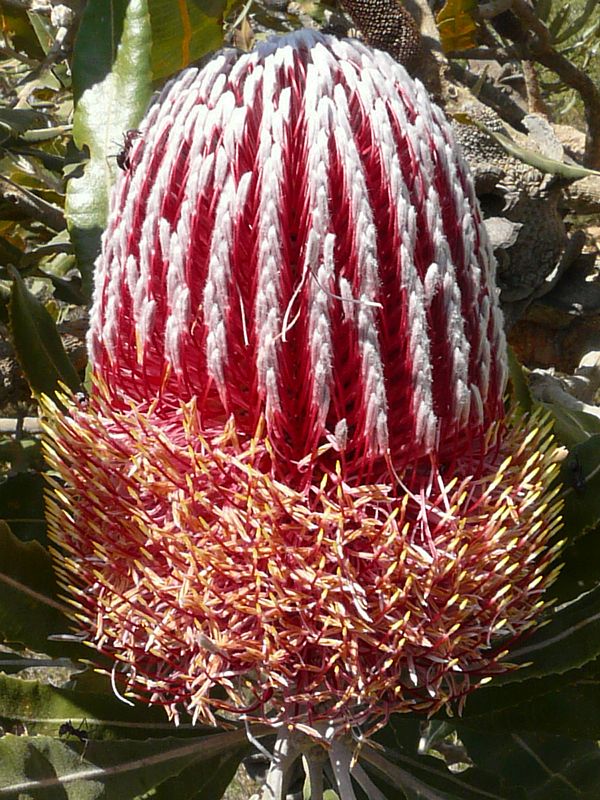
Firewood Banksia B. menziesii Badgingarra NP, north of Perth.
Another inhabitant of the northern sandplains but more widely distributed, from east of Perth to the Murchison River.

Showy Banksia B. speciosa, Cape Le Grande NP, south-east Western Australia.
This one is limited to the south-east sandplains.
After the flowers dry, they may either adhere to the woody stem or drop off entirely.
Persistent dead flowers, Silver Banksia B. marginata, Canberra.
 Only a few of the numerous flowers are likely to be fertilised.
Showy Banksia 'cones', Esperance, south-east Western Australia.
Each fruit contains only one or two small seeds. Many heathland species require a fire's heat
to open the fruit and release the seeds. The cone on the right appears to have no fertilised flowers.


Banksia cone (species uncertain), having dropped seeds post-fire, Fitzgerald River NP,
central southern Western Australia.
Silver Banksia cone with a relatively high rate of fertilisation - the seeds have dropped.
This species lives in forest situations and doesn't require a fires heat to trigger seed drop.
Many species have yellow flowers but there is a range of unexpected colours as well.
Scarlet Banksia B. coccinea Esperance.
The styles still caught in the floral tube, and those released, are very visible here.
Cut-leaf Banksia B. praemorsa, Torndirrup NP near Albany, southern Western Australia.
This truly beautiful species grows only in a tiny area near Albany, very close to the sea,
often among granite boulders.
Heath-leaved Banksia B. ericifolia Nowra.
Here the contrast between styles and floral tubes is spectacular.
Many species favour heathy situations, especially on sand.
Massed Firewood and Hooker's Banksias, Lake Logue NR, north of Perth.
Such scenes are fairly typical of the sandplains, although the extent of this banksia mass is still exceptional.
Others are more specialised - Granite Banksia B. verticillata for instance grows only on or alongside granite outcrops, and only around Walpole and Albany on the Western Australian south coast.
Granite Banksia, Torndirrup NP.
While most banksia inflorescences are large - a Cutleaf Banksia flower spike for instance, while not the largest, can be 27cm long and 6cm wide - some are relatively minute.
The pretty little Teasel Banksia B. pulchella flower, from the central south coast of WA,
is only 5cm in diameter. (North of Esperance.)
Flower appearance is of course driven by pollinators and most banksias seem to be bird-attractors - the numerous flowers of a single spike offer a big reward. 
Little Wattlebird Anthochaera chrysoptera on Saw Banksia, south coast New South Wales.

Western Wattlebird Anthochaera lunulata on Showy Banksia, Esperance.
However recent work has demonstrated the unsuspected significance of mammals in banksia pollination. On the south coast of New South Wales experiments involving putting bags over Hairpin Banksia flowers either by day or night showed that flowers pollinated only by mammals (ie at night) had three times the seed set of those accessible only to birds and insects (by day). The most important pollinators were Brown Antechinus Antechinus stuartii (supposedly carnivorous),  Sugar Gliders Petaurus breviceps, Eastern Pygmy Possums Cercartetus nanus and Bush Rats Rattus fuscipes, another surprise.
Sugar Glides (above) and Bush Rat (below),
important Banksia pollinators.


Hairpin Banksia B. spinulosa Kanangra Boyd NP.
The styles are very stiff, and apparently act as combs to remove pollen from fur.
And once we start to look there are quite a few banksias which are fairly clearly evolved to mammal pollinators, which also means hiding from birds. The flowers tend to be brown and hidden within foliage  - moreover some of them are reported to have a musky 'mouse-like' scent.
Desert Banksia B. ornata, Cox's Scrub Conservation Park, south of Adelaide, South Australia.
The 'desert' here is actually a botanically rich area of heathland and mallee shrubland on sand in
South Australia and western Victoria - the term is a local one referring to low soil nutrients,
hence its unsuitability for farming.

Fox Banksia B. sphaerocarpa, Badgingarra NR, north of Perth.
Some Western Australian species have flowers sitting right on the ground, from stems on or just below the surface, to be even more convenient for furry visitors.
Creeping Banksia B. repens, Stirling Ranges NP, southern Western Australia.
Not all banksia-animal interactions are beneficial to the plant of course; the seemingly rock-hard 'cones' are impervious to most jaws, but the magnificent big black-cockatoos specialise in crushing them open to extract the seeds.
Yellow-tailed Black-Cockatoo Calyptorhynchus funereus extracting seed from
Coastal Banksia B. integrifolia cone.

Carnaby's (Short-billed) Black-Cockatoos Calyptorhynchus latirostris seeking
seeds from Slender Banksia B. attenuata, just north of Perth.
For me, banksias are almost up there with orchids as my favourite wildflowers (or that is to say, they would be if I had favourites...). The fact that they are genuine Old Australians only increases my affection for them.
Acorn Banksia B. prionotes,  Moore River NP, north of Perth.

BACK ON THURSDAY

Thursday, 26 November 2015

Tinderry Temptations

I guess we all know of a place - an alluring road we pass the end of, or a walking track we mean to explore, or a sign to a lookout - with which we're familiar to the extent of promising ourselves we'll go there some time. One such to the south of Canberra is a mountain range passed weekly by probably hundreds of people heading along the Monaro Highway to or from the snow, or the far south coast of New South Wales, or eastern Victoria. The Tinderries are a rugged range east of the highway, accessed from Michelago, some 50km south of Canberra.
The Tinderries from the west. The exposed granitic faces are obvious, and are even more so since
an intense bushfire swept through them in December 2009.
In direct sun or after rain they gleam, catching the attention of cars from the highway some 10km away.
Yes, just 10km, but very few people take the trouble to follow the good-quality all-weather gravel Tinderry Road east from Michelago through the paddocks bearing remnant woodland trees, to climb into the forests of the ranges. You should some time, you know.
Looking back to the west from the Tinderries to the Clear and Booth Ranges in the
southern Australian Capital Territory.
The highway traverses the plain in the middle distance - really not very far!
The granites (and as a non-geologist I'm using the term very loosely, I know) date from vast intrusions of molten material from deep down some 400 million years ago. They dominate the range.
Huge granite slabs like this emerge from the forest.

Mostly however they appear on the hilltops, as huge sheets and tors.

Exposed granitic caps like this have interesting plants and are well worth exploring.
Many are remote and require serious walking; others, including this one, are readily accessible
from the roadside.
The Tinderry Nature Reserve, declared in 1981, has since expanded to 14,000 hectares, all of which is to the north of the Tinderry Road. This road, the only vehicle access to the higher parts of the range, passes through a small extent of Timber Reserve, then private (though currently unfenced) land. To date this land has been managed pretty sympathetically - ie minimally - but on a very recent visit I noticed a couple of For Sale signs by the road (including by the magnificent outcrop in the previous picture), one of my favourite spots in the range. I await developments (hopefully not literally!) with some trepidation. 

The higher parts of the range support the easternmost outliers of sub-alpine forest and woodland vegetation, dominated by Mountain Gums Eucalyptus dalrympleana with Snow Gums E. pauciflora even higher up. (The highest point, Mount Tinderry, is over 1600 metres above sea level - the highest point of the Tinderry Road is 1280 metres.)
Mountain Gums forming a sub-alpine woodland.

Tough! A Mountain Gum seemingly growing out of sheer granite.
Note the wind in the leaves - this is typical of the higher open spaces.
Further down the mountains, the rain shadow to the west produced dry sclerophyll forest of a type widespread in the lower ranges of the region. There is good access to one part of the nature reserve in this section - returning along the Tinderry Road towards Michelago, turn right (north) onto the Burra Road. Some 10km along, in the far north-west of the reserve, there is a parks sign and gate on the right. You'll have to climb through the fence, but at least it's not barbed wire!
Open grassy dry eucalypt forest of Scribbly Gum E. rossii and Red Stringybark E. macrorhynchalow (800 metres asl) in the dry western slopes of Tinderry Nature Reserve.
One of the most significant plants in the range is the wattle Acacia costiniana (named for eminent alpine botanist, ecologist and conservationist Alec Costin, who at 90 is still, as at 2015, going strong). It is limited to the Tinderries (I'm almost certain, though one source has it further afield) where almost none of the population is in the reserve - most is just to the south, especially on granite outcrops including the one featured above.
Acacia costiniana; the phyllodes are very distinctive. It can form dense colonies among the granite.
The range is worth visiting at any time, but spring (which extends well into November at the higher levels) produces an excellent wildflower display. Here is some evidence for this claim! (And this really is just a selection of what I could have offered you.)

Austral Bugle Ajuga australis Family Lamiaceae.
Mountain Boronia B. algida Family Rutaceae.
Several species of boronia are common in the sandstone to the east, but there are very few this far inland.
Common Star-hair Astrotricha ledifolia Family Araliaceae; a large shrub
with many small flowers.
Common Fringe Myrtle Calytrix tetragona Family Myrtaceae.
Another shrub that thrives among the rocks.
Long-leaf Wax Flower Philotheca (Eriostemon) myoporoides Family Rutaceae.
This beautiful shrub is common in gardens, but not so easy to find in the wild.
Another that loves growing among the boulders.
Peas are abundant, here as seemingly everywhere.
Silky Parrot Pea Dillwynia sericea.
Common Shaggy Pea Oxylobium ellipticum.

Heathy Bush Pea Pultenea procumbens.
I'm getting a bit carried away here, so maybe just some herbs to end the floral menu.
Mountain Violet Viola betonicifolia.

Prickly Starwort Stellaria pungens Family Caryophyllaceae - which includes carnations.

Milkwort Comesperma ericinum Family Polygalaceae.
But of course I can't really end without an orchid.
Mountain Golden Moths Diuris lanceolata.
As for animals - well of course, though I don't seem to have many, which may be as well given how long this posting is becoming. Four very different animals to end on.
Spotted Grass Frog Limnodynastes tasmaniensis.This, and some friends, were using a nice cool moist something (I can't now recall what it was!) sunk into the
ground at the edge of the dry forest.


Green Scarab Beetles Diphucephala sp. on Silver Wattle Acacia dealbata.A very common beetle in the mountains regionally.
Magpie Moth Nyctemera amicus; my thanks to Susan for pointing me to an identification for this one (below).
Love the antennae.
Dusky Woodswallow Artamus cyanopterus with chicks.
This nest is in a hollow spout, a typical site for this species.
(And I'm sure she's more interested in her chicks than she appears!)
OK, the Tinderries - if you don't live in Canberra, or visit regularly, this may be of limited interest to you. But if you are one of those who drives regularly by them and wonders what's there - wonder no more! And next time, maybe you can detour...

BACK ON THURSDAY

Tuesday, 17 November 2015

Those South American 'Geese'

For me at least, one of the highlights of a visit to the far south of South America - loosely known as Patagonia, incorporating the southern extremities of Chile and Argentina - is the presence across the landscape of flocks of big geese. I well recall my first visit to Patagonia, getting a hire car early on Sunday morning and heading out of Punta Arenas to drive along the Strait of Magellan - an amazing experience in itself. I was concentrating on driving on the 'wrong' side of the road for the first time when I suddenly saw a flock of Upland Geese in a wet paddock near the road and risked a rapid U-turn. In the event I needn't have - the next flock was only just down the road, and the next soon after that, and so on. But I was rapt.
Upland Geese Chloephaga picta near Punta Arenas.
This species is dramatically sexually dimorphic; males are black and white with black legs,
while females are rusty brown with orange legs.
This dimorphism doesn't end there either - the males come in two forms, which can be seen in the same flock.
The barred morph has densely black-barred breast and belly. It is commonest around
the Strait of Magellan, including on Tierra del Fuego.
This one was on Isla Magdalena, which is a Chilean island in the famous strait.

The white-breasted form becomes commoner further north - this is in
Torres del Paine National Park.
OK, back to the indicator in the title that these aren't really geese - and they're not, despite the protestations of my good friend Jorge from Chiloé! They are in the same sub-group as the shelducks - whether this is the tribe Tadornini or the slightly more prestigious sub-family Tadorninae is a debate I'll leave for those with more information and more time than I.

There are four members of the genus Chloephaga, all from the cold wind-swept south. All are essentially vegetarian, concentrating - with one interesting exception - on stems and seed heads of grasses and sedges; it is suspected that they are important vectors of these seeds. 

The exception is the surprising Kelp Goose C. hybrida, which lives right in the sea spray, on the often stormy rocky shores and shingle beaches of Patagonia. It does so because it lives almost exclusively on sea weeds (though grazes on grass when breeding on freshwater lakes). 
Kelp Goose pair, Puñuhuil, Isla de Chiloé, Chile.
Another strongly dimorphic species - again the male is much paler.
These are very handsome birds - like all their group - and deserve to be admired from closer up too.
Kelp Geese on Isla Magdalena, Strait of Magellan.
Female above, male below.


The other two members of the genus have identical sexes (except for a minor size difference). Ashy-headed Geese C. poliocephala are relatively common, but nowhere near as readily seen as the abundant Upland Geese. In addition to being less numerous, they are birds of forest clearings in the cold Nothofagus rainforests, so less likely to be seen from vehicles crossing the landscape.
Ashy-headed Geese, Ushaia National Park, Argentinian Tierra del Fuego.
The last Chloephaga species is very scarce indeed on the mainland, where it seems that less than a thousand Ruddy-headed Geese survive; they are still abundant in the Falklands however, despite heavy persecution from farmers. I've only seen them once, on the shores of the Strait of Magellan east of Punta Arenas, and have no really acceptable pictures; this one will have to do I'm afraid!
Ruddy-headed Goose C. poliocephala in the foreground.
(Behind it is a male Kelp Goose and two Crested Ducks Lophonetta specularioides.)
Finally there are two other South American geese (I don't think I need to continue with the apostrophes, which will only make them feel judged - they didn't claim to be anything at all!), both found much further north. They form a separate genus in the shelduck group, though the Andean Goose has only recently (and not unanimously) been moved from Chloephaga .

Andean Geese Neochen melanoptera live in the high Andes - never normally below 3300 metres above sea level (except when exceptional snows force them lower) - from central Chile to central Peru and adjacent Argentina. They are a big bird, weighing up to 3.5 kilograms. A haemoglobin mutation has enabled exceptional oxygen carrying ability, to help them at the high altitudes.
Andean Geese in a bofedale - a high mountain wetland - in the Aguada Blanca National Reserve, southern Peru.
Andean Goslings at the same site.
They lay up to ten eggs in a nest on the ground.
Just one member of this group prefers the heat of the tropical lowlands. The Orinoco Goose is found along streams throughout much of the northern Amazon basin, though it is loath to actually take to the water. It is rarely common; indeed in Peru it is listed as Critically Endangered. Both Neochen geese, like their southern relatives, are vegetarian grazers.
Orinoco Goose, Manu National Park, Amazonian Peru.
They don't have the cachet of Jaguars, Condors, macaws or toucans, but I reckon the South American geese (or 'geese') are a special little part of that wonderful continent.

BACK ON THURSDAY (26 November)

Thursday, 12 November 2015

Housekeeping; updating some earlier postings

This may be of little interest to anybody, but I find constantly that people are visiting older postings, so I skim through them a couple of times a year and update as required. Mostly this means replacing pictures with better ones, or adding to postings as more pics become available.

Here, in the perennially popular posting on Wildlife of Machu Picchu, I've added four more photos of different organisms. Links to images (without captions) here, here and here.
Here, in a posting on millipedes, I've added three photos from Borneo. Links to images (without captions) here, here and here.
Here, in a posting on flightless birds, I've added a photo of the Titicaca Grebe. Link to image (without caption) here.
Here, in a posting on colubrid snakes, I've added two photos, from Borneo and Queensland. Link to image (without caption) here.
Here, in a posting on the Lichenostomus honeyeaters, I've added a photo of Varied Honeyeaters. Link to image (without caption) here.
Here, in a posting on South American flamingoes, I've added a photo of Andean Flamingo. Link to image (without caption) here.
Here, in a posting on camouflage in vertebrates, I've added a photo of a very camouflaged Peruvian frog. Link to image (without caption) here.
Here, in a posting on camouflage in invertebrates, I've added a photo of a near-invisible Bornean ghost crab. Link to image (without caption) here.
Here, in a posting on botanist Charles Moore, I've added a photo of Citronella moorei. Link to image (without caption) here.
Here, in a posting on dragon lizards, I've added a photo of a Frill-necked Lizard. Link to image (without caption) here.
Here, in a posting on kingfishers, I've added a photo of Oriental Dwarf Kingfisher. Link to image (without caption) here.
Here, in a posting on bottle trees and kurrajongs, I've added photos of vine scrub and deciduous bottle trees. Link to images (without captions) here and here.
Here, in a posting on kangaroos, I've added a photo of a Whiptail Wallaby. Link to image (without caption) here.
Here, in a posting on Australian robins, I've added a photo of a male Rose Robin. Link to image (without caption) here.