About Me

My photo
Canberra-based naturalist, conservationist, educator since 1980. I’m passionate about the natural world (especially the southern hemisphere), and trying to understand it and to share such understandings. To that aim I’ve written several books (most recently 'Birds in Their Habitats' and 'Australian Bird Names; origins and meanings'), and run tours all over Australia, and for 17 years to South and Central America. I've done a lot of ABC radio work, chaired a government environmental advisory committee and taught many adult education classes – and of course presented this blog, since 2012. I am a recipient of the Australian Natural History Medallion, the Australian Plants Award and most recently a Medal of the Order of Australia for ‘services to conservation and the environment’. I live happily in suburban Duffy with my partner Louise surrounded by a dense native garden and lots of birds.

Thursday, 10 December 2015

Lauca National Park - extraordinarily high and highly extraordinary

Until this year my experiences of Chile had been in the far south, plus stop-overs in Santiago. In September however I had the opportunity to explore some of the far 'other end' of Chile, 4,000 kilometres to the north. Here the forbidding but compelling Atacama Desert dominates, where there are places where rain has never fallen in the 450 years of written records. This near incomprehensible aridity is, in turn, driven by the impacts of the cold Humboldt Current just offshore, and the towering Andes to the east, whose eastern slopes catch most of the moisture moving west from the distant Atlantic. 

There are a few sites and regions I'd like to share with you in due course, but today I'd like to introduce the remarkable Lauca National Park, covering a spectacular 138,000 hectares of high Andean puna steppe-land. 'Puna' can be a confusing concept because it refers to two different things - the Puna Plateau is a high tableland between mountain ranges in Argentina and Chile, while puna is also used for the vegetation type, a largely treeless grassland which also contains some hardy shrubs and cushion plants. (In Ecuador 'páramo' is used instead.) Lauca is inland from Arica in the farthest north of Chile, between the small town of Putre and the Bolivian border. 

Lauca National Park is high in the Andes, on the Bolivian border, at the approximate end of the red arrow.
The lowest part of the national park is 3,000 metres above sea level (masl) - 700 metres higher than the loftiest point in Australia! From here it soars to 6,300masl, providing a challenge to those of us from lower elevations. It is characterised by scenery that would take the breath away if one had any left to spare; snow-dusted volcanoes, impossibly blue glacial lakes (glaciers formed much of the landscape), and highly significant alpine wetlands known as bofedales where wildlife concentrates.
Bofedal, above and below.
Just two of hundreds which sprinkle the landscape of Lauca.
 
Glacial moraine (material deposited by retreating glaciers) around Lake Cotacotani, Lauca NP.
A panorama of volcanoes, some of them in Bolivia, above Lake Chungará which,
at 4,500 masl, is one of the highest lakes in the world.
(The queue of trucks in the right background is part of a 13km long back-up waiting to get through
the border post; opinion seemed to be divided as to how 'normal' this was.)
Part of the queue - they had a very scenic place to wait in at least!
Chungará is truly entrancing - I think it's fair to say that most of us forgot how hard we were working to breathe (it was the highest place I'd ever been while still standing on the ground), as we revelled in the amazing scenery. The lake formed some 8,000 years ago when a massive volcanic cone collapse formed a dam. It is dominated by Volcano Parinocota, one of those ridiculously perfect volcanic cones.
Volcanos Parinocota (left) and Pomerape in Bolivia (right), above Lake Chungará.

A closer view of Parinocota.
Parinocota last erupted 1700 years ago, but it should not be assumed that these volcanoes have all retired from an active life.
Volcanic smoke gently puffing from an unidentified cone, Lauca NP.
I mentioned earlier that the puna is 'largely treeless', but there is one significant exception. Polylepis is a genus of about 20 tree species but the copses they form at high Andean altitudes are very significant habitats indeed, supporting many other plant and animal species, many of them unique to the Polylepis forests. Restricted to the tropical Andes, they are the highest altitude flowering trees known, growing to over 5,000 metres above sea level. They are in the rose family but, unlike most roses, are wind pollinated because pollinators are not common at such altitudes. 
Polylepis trees growing in a harsh glacial landscape well above 4,000masl in Lauca NP.
And the landscape is harsh; we were there long after daybreak on a spring sunny day, but much of the water in the bofedales was still frozen.

Frozen pools in a Lauca bofedal.
Even this stream was substantially frozen.
Another characteristic plant form in the high puna - and indeed in alpine areas throughout the world - is the 'cushion plant' form. These are usually woody plants forming dense ground-covering mats with substantial tap roots. This form, which recurs in a wide range of families, seems to be a powerful adaptation to growing in sparse low-nutrient soils, in low temperatures and with limited water and frequent harsh winds. In Lauca, a common cushion is formed by Azorella species, family Apiaceae.
Azorella sp. mounds, above and below, in a harsh landscape.
 
And by looking at the cushion plants, we're very likely to find another inhabitant too...
Mountain Viscacha Lagidium viscacia;
despite its rabbity appearance, it is one of the old South American rodents and very much
at home in apparently unhomely habitats like Lauca.

In fact, wherever you go in high Lauca there's likely to be a viscacha watching!
Like the South American monkeys, the old rodents have their roots in Africa and, like them,
it's not at all clear how they got here some 45 million years ago, though it must have been by sea.
But it's in the bofedales that much of the animal life can be found.
Here a viscacha has been joined by another enigmatic South American,
a Grey-breasted Seedsnipe Thinocorus orbignyianus.There are just four species of seedsnipe, all South American, and apparently aberrant waders.
In the puna the ground-tyrants - members of one of the two ancient South American passerine sub-oscine groups which dominate here - are prevalent.
Cinereous Ground-Tyrant Muscisaxicola cinereus.The tyrant flycatchers apparently arose as aerial insectivores in the neotropical rainforests, where many remain. Others have extended into the Andes, including the ground-tyrants
which have adopted a primarily terrestrial lifestyle.
Puna Ground-Tyrant Muscisaxicola juninensis.

Rufous-naped Ground-Tyrant Muscisaxicola rufivertex. (It's really the crown which is rufous.)
White-fronted Ground-Tyrant Muscisaxicola albifrons.
The other great sub-oscine group, the funariids or oven-birds, is also represented.
White-winged Cinclodes Cinclodes atacamensis. Cinclodes represent some 14 species of ground-foraging mostly cold-loving birds found throughout the Andes and Patagonia.
Crested Ducks Lophonetta specularioides.
A single-species genus which also favours the high mountains and deep south.
Black-hooded Sierra-finch Phrygilus atriceps, another high-altitude specialist. (Thanks Juan!)
(And perhaps because this is South America, sierra-finches are actually tanagers...)
The bofedales have also been sought by human settlers for at least three thousand years, as places to graze stock and grow crops such as quinoa. Traditional use is still permitted in Lauca.
Alpacas Vicugna pacos grazing in Lauca NP.
And finally, along the shores of Lake Chungará, another special South American.
Giant Coot Fulica gigantea.
This superb bird, a specialist of the high Andean lakes, is the second-largest of all living rails;
it can be over 60cm long and weigh over 2.5kg.
(The more familiar Eurasian Coot F. atra is up to 40cm long and weighs perhaps a kilogram.)
Lauca's not on everyone's South American 'must see' list, but I really think it should be. Bear it in mind anyway...

BACK ON THURSDAY

Friday, 4 December 2015

Banksias - grand and beautiful old Australians

(My apologies for this late posting; I was only just getting into it yesterday afternoon when I received a phone call to tell me that one of the first White-winged Black Terns ever reported in the ACT had appeared on Lake Burley Griffin in the city. The only other time I know of it happening I was in South America! That was the end of my afternoon's writing - but what could I do?!)

When Captain James Cook in the Endeavour stopped at the site where the south Sydney suburb of Kurnell now stands in late April 1770 his initial reaction was to call the bay Sting Ray Harbour, but after the remarkable collecting spree of Joseph Banks and Daniel Solander he amended it to Botanists Bay, then almost immediately to Botany Bay.

Among the collections made on that rich visit was a sample of the first banksia to be described by science; 12 years later it was named in Banks' honour by Linnaeus the Younger, son of the famous Carl. This first banksia to be named, the type species, was the grand Saw Banksia B. serrata (both names refer to the toothed leaves), which can grow to a 15 metre high gnarled tree in coastal forests from southern Queensland to Victoria.
Banksia serrata, south coast New South Wales, above and below.
 

Banksias are members of the old Gondwanan family Proteaceae, which I talked about here recently. As I also mentioned in that posting, a 2007 publication, which has been widely accepted, subsumed the large genus Dryandra into Banksia, but that acceptance is not universal. Given that one who vehemently and cogently opposes it is the acknowledged bankia expert, Western Australian Alex George, I am inclined to take a cautious approach. For the purposes of this posting I am limiting to myself to the traditional understanding of banksia - that still leaves us with 78 species to admire however.

Banksias arose in Australia and, with one minor exception, have never left it. Banksia-like trees are known from the fossil record up to 70 million years ago and fossils of 'modern' banksias date back nearly 50 million years.

As is often the case, the south-western corner of the continent has by far the largest number of species, with less than 20 in the south-east and only six in the tropics, of which only three are solely tropical. One of these, the Tropical Banksia B. dentata, is the only species to have left Australia - as well as growing across northern Australia it extends into New Guinea.
Tropical Banksia, Litchfield NP, south-west of Darwin.
The banksia flower spike ('inflorescence' if you're feeling pedantic) is one of its most distinctive features and banksia flowers are among the most widely recognised Australian wildflowers. The woody stem of the inflorescence is covered with densely packed flowers - each single one, unsurprisingly, resembles a grevillea flower - of which there may be hundreds or even thousands. The opening of the flowers from the bottom up (or vice versa in a few cases) produces an impressive slow-motion wave of colour over a period of days. In bud the long style is trapped in the short corolla of petals.
Hooker's Banksia B. hookeriana, Lake Logue NR, north of Perth.
This species is restricted to a small area near Enneaba.

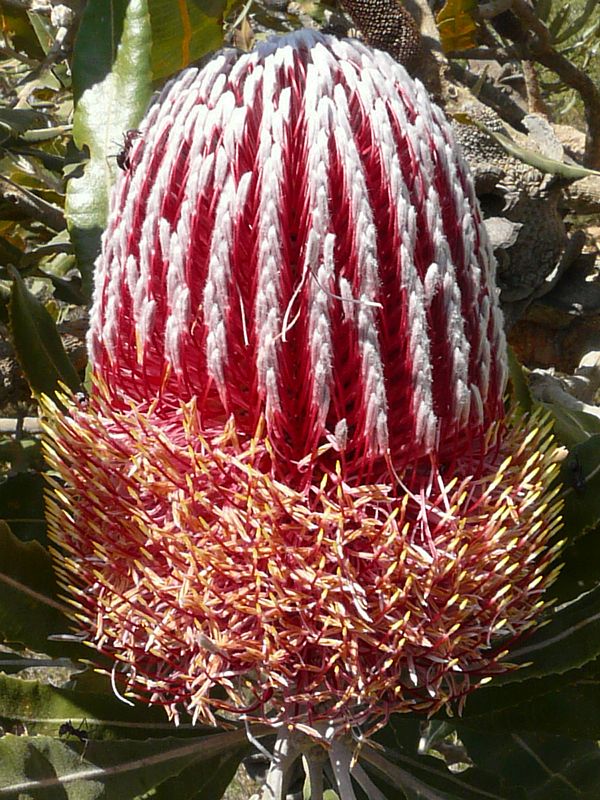
Firewood Banksia B. menziesii Badgingarra NP, north of Perth.
Another inhabitant of the northern sandplains but more widely distributed, from east of Perth to the Murchison River.

Showy Banksia B. speciosa, Cape Le Grande NP, south-east Western Australia.
This one is limited to the south-east sandplains.
After the flowers dry, they may either adhere to the woody stem or drop off entirely.
Persistent dead flowers, Silver Banksia B. marginata, Canberra.
 Only a few of the numerous flowers are likely to be fertilised.
Showy Banksia 'cones', Esperance, south-east Western Australia.
Each fruit contains only one or two small seeds. Many heathland species require a fire's heat
to open the fruit and release the seeds. The cone on the right appears to have no fertilised flowers.


Banksia cone (species uncertain), having dropped seeds post-fire, Fitzgerald River NP,
central southern Western Australia.
Silver Banksia cone with a relatively high rate of fertilisation - the seeds have dropped.
This species lives in forest situations and doesn't require a fires heat to trigger seed drop.
Many species have yellow flowers but there is a range of unexpected colours as well.
Scarlet Banksia B. coccinea Esperance.
The styles still caught in the floral tube, and those released, are very visible here.
Cut-leaf Banksia B. praemorsa, Torndirrup NP near Albany, southern Western Australia.
This truly beautiful species grows only in a tiny area near Albany, very close to the sea,
often among granite boulders.
Heath-leaved Banksia B. ericifolia Nowra.
Here the contrast between styles and floral tubes is spectacular.
Many species favour heathy situations, especially on sand.
Massed Firewood and Hooker's Banksias, Lake Logue NR, north of Perth.
Such scenes are fairly typical of the sandplains, although the extent of this banksia mass is still exceptional.
Others are more specialised - Granite Banksia B. verticillata for instance grows only on or alongside granite outcrops, and only around Walpole and Albany on the Western Australian south coast.
Granite Banksia, Torndirrup NP.
While most banksia inflorescences are large - a Cutleaf Banksia flower spike for instance, while not the largest, can be 27cm long and 6cm wide - some are relatively minute.
The pretty little Teasel Banksia B. pulchella flower, from the central south coast of WA,
is only 5cm in diameter. (North of Esperance.)
Flower appearance is of course driven by pollinators and most banksias seem to be bird-attractors - the numerous flowers of a single spike offer a big reward. 
Little Wattlebird Anthochaera chrysoptera on Saw Banksia, south coast New South Wales.

Western Wattlebird Anthochaera lunulata on Showy Banksia, Esperance.
However recent work has demonstrated the unsuspected significance of mammals in banksia pollination. On the south coast of New South Wales experiments involving putting bags over Hairpin Banksia flowers either by day or night showed that flowers pollinated only by mammals (ie at night) had three times the seed set of those accessible only to birds and insects (by day). The most important pollinators were Brown Antechinus Antechinus stuartii (supposedly carnivorous),  Sugar Gliders Petaurus breviceps, Eastern Pygmy Possums Cercartetus nanus and Bush Rats Rattus fuscipes, another surprise.
Sugar Glides (above) and Bush Rat (below),
important Banksia pollinators.


Hairpin Banksia B. spinulosa Kanangra Boyd NP.
The styles are very stiff, and apparently act as combs to remove pollen from fur.
And once we start to look there are quite a few banksias which are fairly clearly evolved to mammal pollinators, which also means hiding from birds. The flowers tend to be brown and hidden within foliage  - moreover some of them are reported to have a musky 'mouse-like' scent.
Desert Banksia B. ornata, Cox's Scrub Conservation Park, south of Adelaide, South Australia.
The 'desert' here is actually a botanically rich area of heathland and mallee shrubland on sand in
South Australia and western Victoria - the term is a local one referring to low soil nutrients,
hence its unsuitability for farming.

Fox Banksia B. sphaerocarpa, Badgingarra NR, north of Perth.
Some Western Australian species have flowers sitting right on the ground, from stems on or just below the surface, to be even more convenient for furry visitors.
Creeping Banksia B. repens, Stirling Ranges NP, southern Western Australia.
Not all banksia-animal interactions are beneficial to the plant of course; the seemingly rock-hard 'cones' are impervious to most jaws, but the magnificent big black-cockatoos specialise in crushing them open to extract the seeds.
Yellow-tailed Black-Cockatoo Calyptorhynchus funereus extracting seed from
Coastal Banksia B. integrifolia cone.

Carnaby's (Short-billed) Black-Cockatoos Calyptorhynchus latirostris seeking
seeds from Slender Banksia B. attenuata, just north of Perth.
For me, banksias are almost up there with orchids as my favourite wildflowers (or that is to say, they would be if I had favourites...). The fact that they are genuine Old Australians only increases my affection for them.
Acorn Banksia B. prionotes,  Moore River NP, north of Perth.

BACK ON THURSDAY