About Me

My photo
Canberra-based naturalist, conservationist, educator since 1980. I’m passionate about the natural world (especially the southern hemisphere), and trying to understand it and to share such understandings. To that aim I’ve written several books (most recently 'Birds in Their Habitats' and 'Australian Bird Names; origins and meanings'), and run tours all over Australia, and for 17 years to South and Central America. I've done a lot of ABC radio work, chaired a government environmental advisory committee and taught many adult education classes – and of course presented this blog, since 2012. I am a recipient of the Australian Natural History Medallion, the Australian Plants Award and most recently a Medal of the Order of Australia for ‘services to conservation and the environment’. I live happily in suburban Duffy with my partner Louise surrounded by a dense native garden and lots of birds.

Wednesday, 23 December 2015

Kosciuszko in December

I've just realised, with something of a shock, that it is now nearly three years since we last went to Kosciuszko National Park, subsequent to which I wrote a series of three postings on this wonderful mountain park south of Canberra. Rather than repeat myself now, if you're interested in the history, nature and significance of the park, and a map, see here. That visit was in February, towards the end of summer and the flowering season; this time we opted to go earlier in the summer - just last weekend in fact - to catch the earlier flowering. It should no longer be a surprise to see that the flowering in the Snowy Mountains, as in the Brindabellas above Canberra, is noticeably getting earlier. Accordingly the flowers were especially magnificent. This has been a very busy time of year, and our weekend provided a welcome respite. As I foreshadowed in my most recent post I'm starting to run down a bit too, so this will be a low-key posting, comprising basically a photo-record of the flowers and some animals that we enjoyed. I hope you can find time to enjoy them with me.

We did the Main Range walk again, a 13km return walk on a metal walkway - to protect the plants, and keep above the boggy ground - from the top of the Thredbo chairlift to Mt Kosciuszko.
Going down - 600 metres from top to bottom. I'm not a great fan of heights, but this one's worth it.
It's always good to be up there, where the Snowy River rises, and this day was warm (apart from the wind!) and sunny, but it was still early summer up there, and snow drifts persisted.

Headwaters of the Snowy River.
 As I said, the flowers were stunning, as you can see in the background of that photo.
Massed Silver Snow Daisies Celmisia sp., above and below.


Flowers in front of the Ramshead Range.
Daisies provided much - but by no means all - of the spectacle; the Silver Snow Daisies were the stars in terms of dominance, but here are some others. 
Alpine Sunrays Leucochrysum alpinum.This has recently been raised from a subspecies of L. albicans.
Silver Ewartia Ewartia nubigena.Named for Alfred Ewart, Australia's first Professor of Botany as a stand-alone position,
appointed to Melbourne University in 1905.
Cascade Everlasting Ozothamnus secundiflorus.
Dusty Daisy-bush Olearia phlogopappa.
Heaths - formerly Family Epacridaceae in Australia, now mysteriously subsumed in the northern hemisphere Ericaceae - are another important part of the alpine flora; here are just a couple.
Candle Heath Richea continentis, above and below, form massed prickly colonies in swampy ground.

Snow Beard-Heath Leucopogon montanus grows as an erect shrub lower down the mountain,
but above the tree-line it lies flat to the ground or sprawls over rocks.
This mat form is typical of many species in these harsh wind-swept environment.

Alpine Stackhousia Stackhousia alpina.
Sky Lily Herporlirion novae-zelandiae.Of course one shouldn't have favourites, but I can't help it in the case of this delightful ground-hugging
blue-tinged lily, found, as the name suggests, in New Zealand as well as Australian mountains.
Mountain Celery Aciphylla glacialis.Surely one of the most spectacular members of Apiaceae, the celery and carrot family.

Purple Eyebrights Euphrasia collina.
Euphrasia
means 'delighting', and it always works for me!
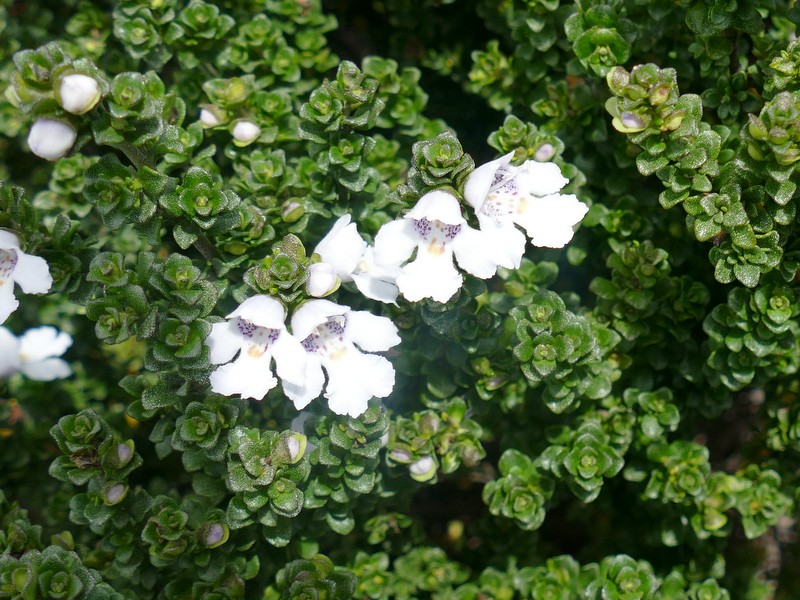
Alpine Mintbush Prostanthera cuneata.A beautiful aromatic shrub which grows close to the rocks, allowing it stand upright.
Alpine Rice-flower Pimelea alpina, a tiny herb.
Bitter-cress Cardamine sp.
Alpine Water-Fern Blechnum penna-marina.I'm always surprised to see ferns growing in a situation where they spend weeks of every year
buried in snow, but these are hardy, and grow among the rocks which provide a heat sink.
Yellow Kunzea Kunzea muelleri.This low-growing shrub can dominate vast areas of hillside - see below.


Another impressively-flowering shrub at the moment - though not nearly as widespread as the kunzea - is Alpine Orites, Orites lancifolia.
Alpine Orites is in the Family Proteaceae, not well-represented at these elevations.
And, far from least, the mighty Snow Gums were flowering too.
Its always seemed a mystery to me that Snow Gums (above and below) are called
Eucalyptus pauciflora - 'sparse-flowering'!
Clearly not named by someone who knew the tree.
 
This time there were some animals to be seen too, though mostly one has to look. The Alpine Mintbush is a good place to start.
The Alpine Spotted Grasshopper Monistria concinna is regularly found feeding on the mintbush,
despite its aromatic supposedly insect-repelling foliage.
Spotted Alpine Xenica Oreixenica orichora;
thanks for the i.d. Suzi!
Unidentified moth.
And it wasn't until I looked at the moth photo more closely that I noticed
this tiny flower spider lurking with intent.
Vertebrates are much thinner on the ground. Only two birds are regularly seen high on the mountains.
Australasian Pipits Anthus novaeseelandiae work across the ground taking insects from foliage.
Little Raven Corvus mellori enjoying the last light of day in a Snow Gum.
As well as gleaning the mountain insects, they have adapted well to human habitation.
Much rarer is the little Mountain Galaxias Galaxias olidus, now found in the high streams pretty much only where the voracious introduced trout have not ventured.
This little fish is also found at lower altitudes, in waters too warm for the trout.
I hope this has been of some interest or enjoyment, and even more I hope that, if it is possible for you, it encourages you to get up there sometime this summer.

Meantime, I hope that Christmas, if it has significance for you, is a time of happiness and peace - and that you can get out and enjoy nature wherever you are.

Old Snow Gum, Charlottes Pass, with Main Range behind.

BACK ON THURSDAY FOR MY TRADITIONAL REVIEW OF THE YEAR VIA A PHOTO PER MONTH.

Thursday, 17 December 2015

Beasts of Many Hues

As the year is winding down, I seem to be too, so forgive me if I don't go into any great depth in this, my antepenultimate posting for the year. I've had some fun in the past looking at colours in nature. (You can, if you like, find the most recent one here and go back, or just go to Colours in Nature in Labels alongside this.)

Some time ago someone suggested I might look at 'rainbow colours' in nature - outside of an actual rainbow that's a bit tricky if taken literally, but in the spirit of that I've decided to look at some multi-coloured animals today, which I've defined as having at least three evident colours without counting black, grey, white or brown. It's quite arbitrary of course, but I had to have some guidelines. I'm not going, on this occasion, to look deeply into the mechanics or even purpose of the colours involved, as that's been covered in my posts on the individual colours and this is a time for simple enjoyment, on both our parts. 

In the event this is overwhelmingly about birds - I was surprised to fail to find any butterflies in my photo collection which meet my criteria, and very few invertebrates at all, or indeed other vertebrates, though that's not to suggest I don't think they exist. I can't really start better than by looking at the three Australian birds which actually have 'rainbow' in their name. 
Rainbow Bee-eaters Merops ornatus, Karumba, tropical Queensland.
The bee-eaters overall are one of the most colourful bird groups - this is the only one found in Australia.
Rainbow Pitta Pitta iris, East Point, Darwin.
The name species name also means rainbow. This angle doesn't give you the best view of its assets,
but you get the idea.
Rainbow Lorikeet Trichoglossus moluccanus, Emerald Botanic Gardens, Queensland.
This widespread and familiar parrot is still expanding its range - it really is spectacular.
Which brings us to the parrots, by far the best-represented group that I found. Curiously, some of the best-known parrots however, such as the macaws, didn't qualify (though of course I don't have pictures of them all). I have had to select, and have limited myself to just four of the many I could have used; I'll find an excuse to introduce the rest in the not-too-distant future however. 
Superb Parrot Polytelis swainsonii, Mulligans Flat NR, Canberra.
A threatened species which has taken to coming into Canberra in recent years,
probably spurred by drought years. An unhelpful name, but hard to argue with.

Mulga Parrot Psephotus varius, outback Western Australia.
Widespread in the inland - not just in mulga (Acacia aneura) - it boasts four obvious colours.
Red-capped Parrot Purpureicephalus spurius, Albany, south-west Australia, where it is endemic.
Double-eyed Fig Parrot Cyclopsitta diophthalma, Cairns, tropical Queensland.
Australia's smallest parrot - only 14cm long - and packed with colour!
One of the few Australian birds which can match the parrots for diversity of colour is a rainforest pigeon, and sadly my pics don't really do it justice.
Wompoo Pigeon (or Fruit Dove) Ptilinopus magnificus, Cairns.
This is a glorious big pigeon, whose name comes from its call. Try saying it slowly and sonorously -
lots of gravitas!
Overseas there are of course many contenders too, though curiously not many hummingbirds seem to be among them - they are intensely coloured, often iridescent, but not really multi-hued. Fortunately I know of at least one to whom that does not apply!
Golden-tailed Sapphire Chrysuronia oenone, Waqanki Lodge, northern Peru.
Masked Trogon Chrysuronia oenone, Tandayapa Lodge, Ecuador.
All trogons are spectacular, but are not always easily photographed in the canopy;
here however they come down to the compost heap!
Many-banded Aracari Pteroglossus pluricinctus, Wild Sumaco Lodge, Ecuador.
Aracaris are small toucans, a notably colourful group.
Saffron-crowned Tanager Tangara xanthocephala, Inka Terra Hotel, Machu Picchu, Peru.
This bird was in shadow - in the sun the crown is more obviously saffron!
Collectively, tanagers are among the most brilliantly-coloured birds in the world.
Not all multi-coloured birds are from Australia and South America of course. Here are a couple from Asia.
Red-crowned Barbet Megalaima rafflesii, Bako NP, Sarawak.
The Asian barbets are now regarded as being in a separate family from both the African and South American ones -
all are spectacular.
Rubycheek (or Ruby-cheeked Sunbird) Chalcoparia singalensis, Batang Ai NP, Sarawak.
The sunbirds, of Africa and Asia, are another group in contention for
Colourful Birds of the World Award.
And among other vertebrates, I could only find a couple of frogs who qualified.
This superb beastie appeared in large numbers from the ground when it started raining at Cunnamulla
in south-central Queensland. It is a Crucifix Frog (or, wrongly, Toad) Notaden bennettii, which survives
dry spells in a cocoon down in the underground mud. Most frogs don't draw attention to themselves -
everybody, it seems, wants to eat them - but this one can afford to. "Don't eat me, I will make you very sorry."
The poison arrow frogs of South America have, if anything, even more firepower to back up their colourful warnings. 
Poison Arrow Frog Ameerega bilinguis, Sacha Lodge, Ecuador.
It exudes toxic alkaloids through its skin - do not try this at home (even assuming you have the frog).
This hand belongs to an indigenous Quichua man who has been handling them all his life and has
evidently developed some immunity.
As for invertebrates, surprisingly I have only been able to come up with four - three grasshoppers (again not what I'd have bet on in advance) and, also unexpectedly perhaps, a crab! None are Australian.
Unidentified grasshopper, Blanquillo Clay Lick, Peru.

And another, also unidentified, from the rainforests of Mt Kupé, Cameroon.

And at last, one I can put a name to - the Galápagos Painted Locust Schistocerca melanocera,on Sierra Negra, Isla Isabela.
Finally, also from the Galápagos, the wonderful Sally Lightfoot Crab Grapsus grapsus.
Sally Lightfoots are found all along the Pacific coast of the Americas,
and they are one of the real features of the Galápagos.
 I hope this lightweight post has brightened your day - I feel more cheerful for having put it together.

BACK ON WEDNESDAY FOR DOUBTLESS ANOTHER FAIRLY FLIMSY OFFERING - LIFE IS BUSY AT THE MOMENT!