About Me

My photo
Canberra-based naturalist, conservationist, educator since 1980. I’m passionate about the natural world (especially the southern hemisphere), and trying to understand it and to share such understandings. To that aim I’ve written several books (most recently 'Birds in Their Habitats' and 'Australian Bird Names; origins and meanings'), and run tours all over Australia, and for 17 years to South and Central America. I've done a lot of ABC radio work, chaired a government environmental advisory committee and taught many adult education classes – and of course presented this blog, since 2012. I am a recipient of the Australian Natural History Medallion, the Australian Plants Award and most recently a Medal of the Order of Australia for ‘services to conservation and the environment’. I live happily in suburban Duffy with my partner Louise surrounded by a dense native garden and lots of birds.

Thursday, 29 September 2016

When He and She Look Different; Birds #2

Continuing from last week, which seems to have generated some interest I'm happy to say. I won't reiterate last week's introduction, but will move on to introduce some very dimorphic couples indeed, birds which in at least some cases you'd have to know belonged to the same species. These are not just a question of more and less intense versions of the same colour patterns, but quite different ones. However, having said that, I readily acknowledge that such observations are of necessity subjective, and where one type of dimorphism blends into the other is a very fuzzy line indeed.

Where they are truly distinctive however, and the name is descriptive, as so many names are, it means the bird is named only for the male - keep your eye open for this blatant discrimination as you browse!

Mostly in dimorphic species the male is brightly coloured while his mate is not, but this isn't always the case even in species where the male is the dominant partner in terms of courtship and display (we saw a couple of examples last week where the female was dominant, brighter or bigger). I recently had the pleasure of the company of a pair of birds which demonstrated this impressively, at a beautiful campsite at Gunlom Falls in Kakadu National Park in the Northern Territory.
Shining Flycatcher Myiagra alecto pair, male above, female below, Kakadu NP.
He is the same glorious blue-black below as above.
This monarch flycatcher is generally found near tropical waters, including mangroves and monsoon forests.
 

Another Australian example is that of the widespread, but in most places not especially common, big duck, the Australian Shelduck Tadorna tadornoides; it is not readily possible to state which of the sexes is more brightly coloured - they're just very different!
Australian Shelduck pair, Bethungra Reservoir, New South Wales, male right, female left.
A very poor old pic, my apologies; a slightly better photo of the male below, at Esperance, Western Australia.
 

A related group of birds, the South American 'geese', also have very different male and female plumage, but both are also equally striking.

Above Kelp Geese Chloephaga hybrida, ChiloƩ Island, Chile and
below Upland Geese C. picta, far southern Chile.
In both cases the males are white and the females are coloured.
 
Other such South American examples can be found among the marvellous hummingbirds.
Green Thorntail pair Discosura conversii, Mindo Valley, north-west of Quito, Eucador; male on the left.
In most of the cases which follow however it's pretty straight-forward - the males have relatively striking colouration and the females are essentially brown, which is an excellent colour to be if you don't want to be noticed while sitting vulnerably on a nest.
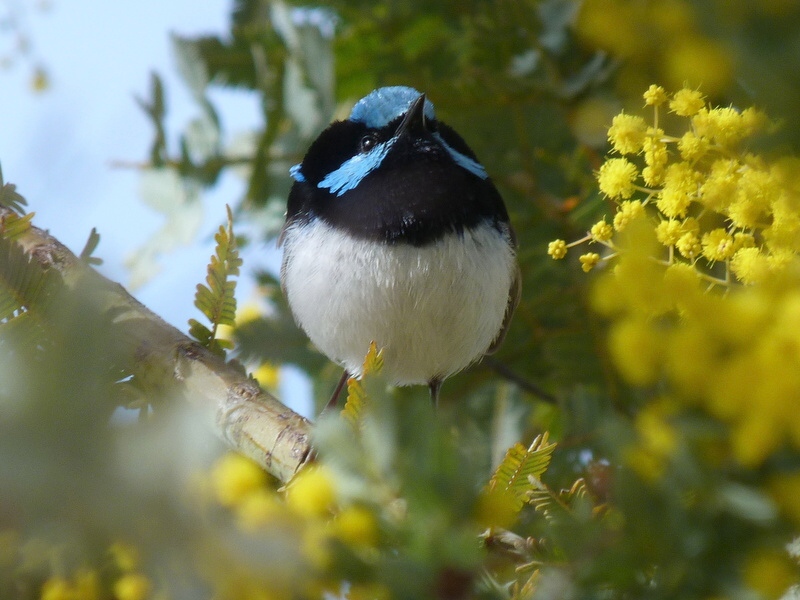
Superb Fairy-wrens Malurus cyaneus, male (Canberra) above,
female (Eurobodalla Botanic Gardens, Batemans Bay) below.
One of south-east Australia's best-known and best-loved birds.
Males moult in winter and follow the females into brown obscurity.
 
Many of the Australian 'robins' (which are no more robins than our wrens are wrens!) follow a similar approach. 
Flame Robin Petroica phoenicea pair, taking a break from attacking the invaders in the mirror,
Namadgi NP near Canberra.
Hooded Robins Melanodryas cucullata, central Australia, above and below.
I seem to be incapable of taking a decent picture of this species, but I'll keep trying!
 
The whistlers form another familiar Australian group which shows strong dimorphism.

Rufous Whistler male (Tinbinbilla Nature Reserve near Canberra)
and female (Mt Scoria Conservation Park, Queensland)

Other monarch flycatchers in addition to the Shining Flycatcher featured above show dimorphism, even though the females aren't as strikingly coloured.
Leaden Flycatcher Myiagra rubecula male (Mareeba Wetlands, Queensland) and
female, Namadgi National Park near Canberra, below.
 

Trillers are a group of small cuckoo-shrikes (family Campephagidae) which show strong dimorphism, unlike the larger members of the family.
White-winged Triller Lalage tricolor pair, Longreach Waterhole near Elliott, Northern Territory.
This was part of a large flock moving south to breed - he is still moulting into his full breeding plumage.

Satin Bowerbirds Ptilonorhynchus violaceus, male, National Botanic Gardens Canberra, and
females, Jerrabomberra Wetlands, Canberra.
The day when bowerbirds get their own posting here is surely approaching!
 
Mistletoebird Dicaeum hirundinaceum, male (Milang, South Australia) and
female (Fraser Island, Queensland).
The only Australian Flowerpecker (Family Dicaeidae), whose ancestors arrived relatively recently
here from Asia, but which is now the major vector (spreader) of Australian mistletoes.
 
 
Orange Chats Epthianura aurifrons, Bourke, New South Wales.
Now recognised as being well within the honeyeater family, some of the Australian chats nonetheless exhibit a strong
dimorphism that other honeyeaters lack.
Another group which varies considerably between species with regard to the differences between males and females are the parrots, most of which show no such traits. Some do however.
Superb Parrots Polytelis swainsonii, Canberra, above and below.
A threatened species which flies south from northern New South Wales to breed in woodlands
north of Canberra, but in recent years has taken to feeding in Canberra suburbs, probably prompted by drought.


Red-rumped Parrot Psephotus haematonotus pair, Canberra.
An exquisite little ground-feeding parrot, common in suburban parks.

Red-winged Parrot pair Aprosmictus erythropterus; a glorious parrot found across much of the
tropics and eastern inland Australia, as well as southern New Guinea.
As noted above and last week, ducks are well-represented in lists of dimorphic birds. Here are a couple more strong contenders.
Above Chestnut Teals Anas castanea, south coast New South Wales, and
below, Cinnamon Teals Anas cyanoptera, Arica, northern Chile.
And now that we've returned to South America, let's stay there to finish off today's exploration, beginning with one of the continent's truly iconic birds.
Andean Cocks-of-the-Rock Rupicola peruvianus, males above at a display lek,
female, below, eastern slopes of the southern Peruvian Andes.


Austral Negritoes Lessonia rufa, southern Chile, above and below.
These active little ground-feeders are members of the old South American family of tyrant-flycatchers.
   
Thick-billed Euphonias Euphonia laniirostris, Aguas Calientes, below Machu Picchu, Peru, above and below.
Euphonias are members of the huge and colourful tanager family; this species is
found across much of north-western South America.


Great-tailed Grackles Quiscalus mexicanus, Puerto Jeli, Ecuador.
These bold urban scavengers are North American blackbirds, whose ancestors arrived in
South America relatively recently, as South America crashed into North America.
 

Finally, trogons are one of the more spectacular bird families, comprising some 40 species across the world's tropical and sub-tropical zones - except for Australia. Many are notably dimorphic.

Masked Trogons Trogon personatus, Andean cloud forests north-west of Quito, Peru.


Well, if nothing else I hope you've enjoyed meeting some pretty impressive birds, with a special characteristic. 

Next time I'll look at a place, probably featuring somewhere from my recent travels in Australia.

BACK ON THURSDAY 

 (And remember that you can get a reminder when the next post appears by putting your
email address in the Follow by Email box in the top right of this screen.)

Thursday, 22 September 2016

When He and She Look Different; Birds #1

After quite a hiatus, I am back live in my office, and will be for some time, so my usual weekly postings (not pre-prepared as has been the case recently) recommence now. 

It is an interesting phenomenon in the natural world that in some animal species the sexes are externally identical, in others they differ relatively subtly, though consistently, and in still others they look so different that they could be (and in some cases have been) described as separate species. Our own species of course is a case in point - on average (which of course means there are always exceptions) males are larger than females, and there are obvious physical differences. 

Today though I'm going to limit myself to birds, because this is a very large topic - in fact I'm not going to even attempt to complete it today. In species which do differ physically between sexes - ie are dimorphic - it is usually the males which are larger and more colourful. Not always however.
Australian Painted Snipe Rostratula australia, Jerrabomberra Wetlands, Canberra.
The female, on the right, is larger and more brightly coloured.
(Though I'm not entirely certain that the other bird isn't an immature - it is a feature of such species that the less
colourful sex often has very similar plumage to young birds of both sexes.)
This is a rare and seldom-seen species whose appearance here in 2011 generated considerable interest.
Brown Falcon pair Falco berigora, Sturt NP, New South Wales.
The obviously larger bird on the right is the female; this is consistently true for most diurnal birds
of prey - falcons and hawks/eagles, even though the two groups are not at all closely related,
as well as many owls.
In this case the purpose seems to be to divide up the territory so that the two birds are hunting
different-sized prey from each other, utilising the resource more efficiently.
The colour differences here are simply part of a wide variation in this species, and are not sex-linked.
It is a useful rule of thumb that monogamous species tend to be monomorphic - both are contributing significantly to the ultimate breeding success so neither is more expendable. On the other hand a large proportion of polygamous species tend to be dimorphic, with the dominant sex being larger and more brightly coloured; as noted above this is usually the male. It is glib but nonetheless at least partly true that the more brightly coloured a male is relative to the female, the more socially useless he is likely to be!

Perhaps more helpfully, his conspicuous plumage's role is likely to be primarily for attracting a mate (or several mates) - "I can afford to be so easily seen because I'm strong and smart enough to survive, and isn't that what you want in the father of your chicks?". However, in the broader scheme, the same message helps in intimidating rival males and maintaining the territory. It may even be that by being colourful and loud he is attracting the attention of predators who are thus less likely to notice his more subtly-coloured mate sitting quietly on the nest.

We can say that strong colour dimorphism is commonest among species that nest in the open. As ever in nature, it's all a trade-off - be inconspicuous to predators and you're unlikely to appeal to a desirable female. Be too obvious and you'll end up as lunch before you're a father. An extreme example of this is the peacock's ridiculous tail - the longer and heavier it is, the more females are impressed. Simultaneously the more likely he is to be unable to escape the attentions of tiger, leopard or dhole.

However, I'm going to start by introducing some milder, but nonetheless obvious, examples of dimorphism, where the female is similarly coloured to the male, but generally paler and less intense. Where this becomes a different colour as opposed to a variation on the same shade is of course subjective, and some of these examples could as readily have appeared in next week's offering of more dramatic examples of dimorphism. 
Spotted Pardalote Pardalotus punctatus, female above, male below.
(She belongs to the yellow-rumped mallee race, xanthopygus;
I was a bird bander in a past life.)
She is only subtly more different, with buffy spots rather than his strikingly white ones,
and without his yellow throat.
 
Tasmanian Scrubwren Sericornis humilis, Freycinet NP, female above, male below.
Like most other scrubwrens, she's a washed-out version of him.
 

Zebra Finches Taeniopygia guttata, Kata Tjuta NP, Northern Territory.
She, in the centre, lacks his chestnut cheeks and flanks.
Australian Darters Anhinga novaehollandiae, Canberra, female above, male below.
His plumage is richer in colour, especially the chestnut throat and dark breast.
 

Cockatiels Nymphicus hollandicus, Sturt NP, far north-west New South Wales.
This exquisite arid  land cockatoo is the world's smallest.
Again, males are a more intense version of the grey, white and yellow theme.
Cactus Finches Geospiza scandens, Santa Cruz, GalƔpagos, female above, male below.
He has much more melanin in his feathers, but it's essentially the same pigment.
 
White-browed Woodswallows Artamus superciliosus, Canberra, female above, male below.
Again the difference is evident, but is in intensity of shades.


Ducks are particularly notable in dimorphism (though by no means all of them of course), and several will feature in next week's post of extreme dimorphism. Here are a few more subtle ones.
Australian Wood Ducks Chenonetta jubata, Canberra, male right, female left.

Green Pygmy-geese Nettapus pulchellus, Fogg Dam, near Darwin, female left.
These are not really geese at all, but in the mainstream line of duck.

ChiloƩ Wigeons Anas sibilatrix, Puerto Natales, southern Chile, male right.
Despite the name, this pretty duck is widespread across southern South America.
Some species are subtly dimorphic in a more specific way - they have very similar plumage except for just one feature. This may even be as discreet as eye colour!
Black-necked Storks Ephippiorhynchus asiaticus, Croydon, North Queensland.
He has black eyes, she yellow.
Galahs Eolophus roseicapilla, Nambung NP, Western Australia.
In this case she has red eyes, while his are black.

Magpie-larks Grallina cyanoleuca, Canberra, female above, male below.
In this case the only difference is in the face colour - black for him, white for her.
(Immatures have a black forehead and white throat and sort it out later!)
 

Magnificent Frigatebirds Fregata magnificens, GalƔpagos, male left.
She has a white throat, where he of course has the red throat pouch.
(In this case he is flying higher than her, he is not smaller.)
Olive-backed Sunbird pair Cinnyris jugularis, Cairns, Queensland.
It may initially seem that they are very different, but nearly all the difference is in his iridescent throat.
Nankeen Kestrel Falco cenchroides;female, Fraser Island, above, male, near Canberra, below.
Here the distinction is in crown and tail, chestnut for her, grey for him.
 

And that will do us for today. Next week, as I've flagged, I'll conclude this series (for now at least) with examples of more extreme dimorphism, where the sexes are entirely different. 

(By then I hope to have been able to process my photos from my last two Australian trips, to the western deserts and the tropics, so I can share some of those lands with you.)

BACK ON THURSDAY 

 (And remember that you can get a reminder when the next post appears by putting your
email address in the Follow by Email box in the top right of this screen.)


Sunday, 4 September 2016

Ferdinand von Mueller's Collectors

In my last post I paid tribute, albeit an utterly inadequate one, to 19th century Australia's towering figure of botany, Ferdinand von Mueller. As discussed there he described some 2,000 species of Australian plants (browse any plant list that includes the authors and you'll see that his work was rigorous enough to stand the test of time). About half of those were from specimens  he collected himself, so what of the origins of the others? Von Mueller was a very astute man, as you'll have gathered by now, and he kept a very close eye on who was collecting what, in part through his huge web of contacts both in Australia and Europe. When he came across someone providing material to his 'opposition', he made sure to induce them to supply him as well. Moreover, he ensured wherever possible that exploring expeditions took a botanist who would report to him, and made contacts with anyone else who was going to be in remote areas to enlist their aid. Today I have only room to tell the stories of a few of the numerous people who provided his specimens, but I hope it gives an idea of the breadth of their backgrounds, though in a couple of cases we know very little in fact. I have stuck too to collectors for whom he named plants (he was generous in this) and, for the sake of breaking up the text, ones that I can illustrate! 
Leichhardt's Breadfruit Tree Gardenia wilhelmii, near Georgetown, north Queensland.
Named for Carl Wilhelm, an important von Mueller collector - see below.
Unfortunately, every person we meet today was a man; however von Mueller made a point of enlisting over 200 women in his vast network of collectors. He placed letter-advertisements in papers around the country, with tips for collecting and preserving specimens. Notable among these was Louisa Atkinson. Von Mueller did name plants for some of his female collectors, but sadly I can't offer an example which meets our criteria today. For an excellent account of his female collectors, see here.

Firstly the professional collectors; there was evidently a lucrative enough living for those skilled and hardy enough to ply the trade in remote corners of the world. Botanic gardens, herbaria and museums (and even some wealthy private individuals) paid good money for specimens and seeds; some even sponsored the best collectors. Von Mueller did pay some collectors to be in the field for limited periods of time, and paid expenses; to independent professional collectors he certainly paid for material provided. Some amateur collectors were rewarded with gifts, such as books and seeds. Given his background and contacts, it is unsurprising that many of his professional suppliers were Germans working in Australia.

One such was Carl Wilhem, a man of whom we know intriguingly little. He arrived in Australia in 1850, and worked for three years as Protector of Aborigines in the Port Lincoln area, in South Australia. He sent many specimens from this period to von Mueller; he was apparently a good botanist and keen collector, and came to work at the Melbourne Botanic Gardens just a year before he became acting-Director while von Mueller was off on the Gregory expedition (I'm going to assume you have read, or will read, the last posting - sorry!). After von Mueller returned Wilhelm did a lot of valuable collecting, especially in the Grampians, then returned to Dresden in 1864, where he apparently opened a seed shop.

Acacia wilhelmiana, near Temora, New South Wales.
William Bauerlen was another such, who was engaged by von Mueller to collect for him in the 1880s. He was later official botanical collector to a scientific expedition to New Guinea.
Chef's Cap Correa Correa bauerlenii, south coast New South Wales.
Another German who collected for von Mueller was Hermann Behr, a medical doctor who seems to have been much more interested in anthropology, botany and entomology. He arrived in South Australia in 1844 and lived among in Aboriginal communities, learning languages and publishing anthropological observations. He described many new insect species (mostly published in Germany), and collected large numbers of plants. He returned to Germany but later went on to California, where von Mueller sent him plants, thus introducing many Australian species to North America.
Pink Velvet Bush Lasiopetalum behrii, Caralue Bluff Conservation Reserve,
Eyre Peninsula, South Australia. Family Malvaceae (formerly Sterculiaceae).
Carl (Charles) Walter came to Australia from Germany in the 1850s and wandered the outback with a swag and his camera. He collected seeds to send back to Germany – presumably for funds – and this activity brought him to von Mueller's attention. Von Mueller was always on the alert for competent collectors, and Walter was able to add many plants to the Victorian list. He later worked for the Technological Museum at the Public Library of Victoria, compiling an annotated collection of vegetable products; he later performed the same task for von Mueller. He was an early member of the Victorian Field Naturalists' Club and later opened a wine shop in Swanston Street.
Monkey Mint-bush Prostanthera walteri, Mt Morris, East Gippsland, Victoria.
This unusual mint-bush is limited to granite hills in forests of north-east Victoria and
south-east New South Wales.
It was collected for von Mueller by Walter.
Augustus Oldfield on the other hand was an English plant and animal collector who worked from Tasmania to Sydney (he apparently walked from Melbourne to Sydney) to Western Australia and was highly valued by von Mueller, as well as by Joseph Hooker of Kew Gardens. Like Behr he had an active interest in indigenous Australian anthropology. Oldfield collected the type specimen of Eremophila oldfieldii (along with other specimens) on the Murchison River, at a place he called Yattoo, but its location remains a mystery.

Charles Moore, originally Scottish-Irish, trained at Kew and in 1848, aged just 28, was appointed New South Wales government botanist. He ran the botanic gardens efficiently, and collected widely in New South Wales and Queensland, as well as into Melanesia. I'll leave it there, as I've talked about him in more detail previously.
Pinkwood Eucryphia moorei, Monga NP, New South Wales. A member of an ancient Gondwanan
family, with very close relations in South America. This species is limited to southern New South Wales
cool temperate rainforest. Moore collected it on either the Clyde or Shoalhaven River.
Walter Hill was appointed first director of the Brisbane Botanic Gardens in 1855 and, when Queensland became a colony in its own right in 1859, separate from New South Wales, he also took on the role of Colonial Botanist. He had previously worked at the Royal Botanic Gardens in Edinburgh and Kew, then came to Australia where he went plant collecting in tropical Queensland and was the only survivor of an attack by Aboriginals in the Whitsundays, shortly before taking up the botanic gardens position. He set up a herbarium but the combination of the humid sub-tropical climate and poor quality buildings meant that specimens deteriorated rapidly (and many were eaten by termites!) so he sent most of his material off to von Mueller and to Kew. He travelled and collected widely in Queensland. He also apparently introduced mangoes, pawpaws, ginger and jacaranda to Australia, and was the first to grow Queensland macadamias commercially (in the botanic gardens).
Myrtle Bells Orchid Sarcochilus hillii, Nowra, above and below.
This exquisite little epiphytic orchid grows north from the far south of
coastal New South Wales to the Tropic of Capricorn in Queensland.
Hill collected it at Moreton Bay.
 
Others who supplied plants to von Mueller were not professional collectors, but collected in the course of their day job. Explorers were an obvious target, though arguably the greatest of them all, John McDouall Stuart, was too focussed on the task to be much diverted by plants. He did nonetheless send some material back to von Mueller, who received this attractive and unusual desert plant thus, and thanked Stuart by naming it for him.
Desert Peppercress Diplopeltis stuartii Family Sapindaceae, Great Sandy Desert, Western Australia,
above and below.
It is unusual in its family in having such conspicuous flowers, as most members (including the familiar
Australian hop-bushes Dodonea) are wind-pollinated with small greenish flowers.


One who did contribute more heavily was another eminent desert survivor, Ernest Giles. 

In 1875 he travelled west from the Flinders Ranges to Perth, then back again just south of the Tropic of Capricorn; 8000km in summer in some of the most arid country in Australia. Zoologist Hedley Finlayson in his 1952 classic The Red Centre wrote: “All who have worked in that country since Giles’ time have felt both admiration and astonishment at the splendid horsecraft, the endurance and the unwavering determination with which those explorations were carried out… The discovery, with the very scanty resources at his command, of the great system of ranges, including the Everard, Musgrave, Petermann, George Gill and Rawlinson, and much of the county between, is one the finest feats of exploration in the history of the Empire.” When his companion Gibson lost his horse, Giles gave up his own, and walked, while suffering extreme thirst and starvation. He survived, while Gibson did not; Gibson had the desert named for him. Despite all this he collected plants for von Mueller and got them back to him.
Eremophila gilesii, central Australia.
Another extraordinarily hardy desert explorer who found time and energy to collect plants in the course of his travails was Charles Sturt. I have previously told his story here, so won't reiterate, but it's worth a read.
Solanum sturtianum, Broken Hill.
Sturt collected the type specimen somewhere in central Australia, but it's not clear exactly where.
Yet another in this category was Augustus Gregory, with whom von Mueller had a special relationship, having travelled with him extensively on the North Australian Expedition of 1855. His story too I have previously told - he's not a household name, but he deserves to be.
Desert Kurrajong Brachychiton gregorii, Mereenie Loop, central Australia.
The only dryland kurrajong, this is found across the western half of inland Australia.
It is unclear whether Gregory collected it for von Mueller, or whether the botanist
himself did so on Gregory's expedition.
Senecio gregorii, Lasseter Highway, central Australia.
This one was collected by Gregory, in the course of his ultimately fruitless search for the
vanished explorer Ludwig Leichhardt, later the subject of the Patrick White novel Voss.
Ralph Tate was appointed as the inaugural chair of natural sciences at Adelaide University in 1874; primarily a geologist he also had an interest in zoology (especially molluscs) and botany. To be honest I'm unclear where he stands with regard to his place in this article - it's not obvious that he did supply von Mueller, but it's certainly more than possible. Von Mueller certainly named species for him.
Androcalva (formerly Commersonia) tatei, Heggaton Conservation Park, South Australia.
The formal authorship is "F. Muell. ex Tate"; I don't know what to make of that.
One reason I've included it here is in the hope of clarifying the situation - thank you in anticipation!
Another geologist who definitely collected for von Mueller in the course of his field work was James Stirling, who worked for the Victorian Mines Department in the second half of the 19th century, and was an active member of the Royal Society of Victoria.
Oven Everlasting (referring to the Ovens River in Victoria) Ozothamnus stirlingii, Namadgi National Park,
Australian Capital Territory.
A very different man, working in a very different place, was Pastor Friedrich Kempe, originally from Dresden, who ended up working as a missionary among the Arrernte people of central Australia, where he produced the first Arrernte grammar and vocabulary guide. The mission he founded, formerly Hermannsburg, is now the Antaria community. He corresponded with von Mueller and sent him upwards of 500 plant specimens, many of them doubtless provided by Arrernte collectors. Among them was one of the most familiar small trees of the area.
Witchetty Bush Acacia kempeana, near Alice Springs. The common name stems from the fact that
the large edible wood-boring larvae of several moth species, known collectively as Witchetty Grubs,
are collected from the roots.
And some collectors remain a complete mystery, at least to me. One such is Alex Walker, who collected the spectacular dry country pea named for him by von Mueller from the Peel Range (now known as Cocaparra Range, near the town of Griffith in southern inland New South Wales). Von Mueller himself recorded that, but I can find nothing more about him, and indeed no other reference to him (other than regularly reiterated statements that he "found" it). Again, any assistance gratefully received!
Cactus Pea Bossiaea walkeri, Nullarbor Plain.
The leafless shrub is found across southern arid Australia.
And with that I shall end this lengthy odyssey - which nonetheless deals with only a tiny fraction of the myriad people who supplied von Mueller with plants. I hope it has been of at least passing interest.

BACK ON THURSDAY 22 SEPTEMBER, WHEN I SHALL BE BACK FROM EXTENSIVE PEREGRINATIONS IN CENTRAL AND NORTHERN AUSTRALIA, AND THUS ABLE TO RESUME NORMAL WEEKLY SERVICE!
 (And remember that you can get a reminder when the next post appears by putting your
email address in the Follow by Email box in the top right of this screen.)