About Me

My photo
Canberra-based naturalist, conservationist, educator since 1980. I’m passionate about the natural world (especially the southern hemisphere), and trying to understand it and to share such understandings. To that aim I’ve written several books (most recently 'Birds in Their Habitats' and 'Australian Bird Names; origins and meanings'), and run tours all over Australia, and for 17 years to South and Central America. I've done a lot of ABC radio work, chaired a government environmental advisory committee and taught many adult education classes – and of course presented this blog, since 2012. I am a recipient of the Australian Natural History Medallion, the Australian Plants Award and most recently a Medal of the Order of Australia for ‘services to conservation and the environment’. I live happily in suburban Duffy with my partner Louise surrounded by a dense native garden and lots of birds.

Thursday, 14 March 2019

North Queensland's Crater Lakes NP; a special rainforest remnant

We recently spent ten memorable days in tropical north Queensland in the summer Wet Season. Some friends made little pretence of their belief that we were mad, but it was rich and wonderful - and as it turned out, a lot cooler on several days than was our home in 'temperate' Canberra over 2,000km to the south. 

Three of those nights were spent on the Atherton Tableland, whose rich volcanic soils, rainforest timbers, high rainfall and relatively mild climate (compared with the nearby steamy coast 800 metres below) have long attracted European settlers and farmers. (And of course people have lived there for tens of thousands of years before that.) This farming and logging has come at a great cost to the rich upland rainforests of the tableland.
The Atherton Tableland, roughly 50km south-west of Cairns on the coast. The Crater Lakes NP consists of
Lake Barrine and Lake Eacham (unconnected units) at the ends of the red lines above.
Elsewhere on the tableland the tiny Curtain Fig Forest Reserve (yellow) and Mount Hypipamee NP (green)
are the only other areas of conserved forest - all the other forest areas on the map are State Forest
(and thus open to logging). All the cleared land in the rest of the photo was once rainforest.
Crater Lakes National Park - Lake Barrine (north) and Lake Eacham.
Only the forest immediately around the lakes (or some of it anyway) is national park.
For instance the red arrow indicates Chambers Rainforest Lodge where we stayed,
within the forest on the park's edge; as I've mentioned before, I only name specific commercial accommodation
when I believe the owners have a genuine conservation ethos and the experience is exceptional.

Let's start with the view from our little verandah, looking straight into the forest. The following photos were taken from it (and yes, I confess we shared a little of our fruit to encourage the neighbours to drop by). 
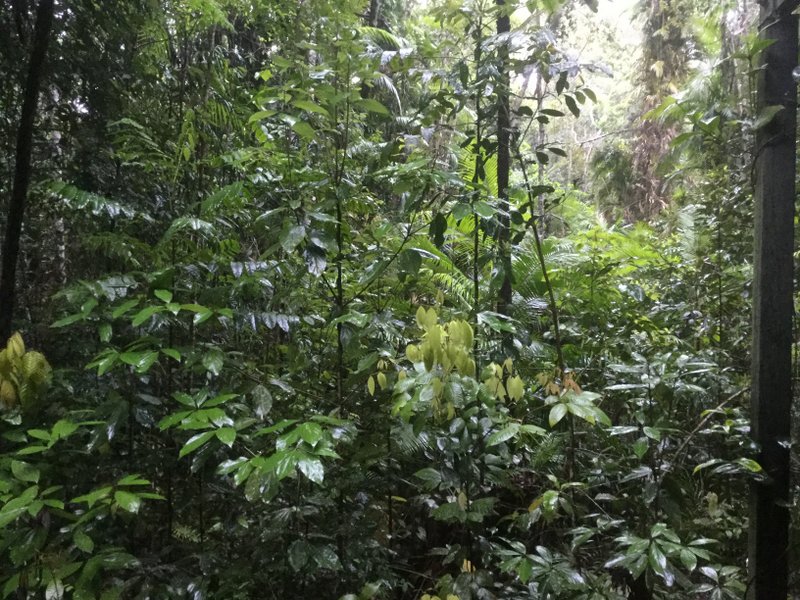
As I mentioned, the verandah looks straight into the forest; not all of the cabins do so,
so you might want to make enquiries as to that if you're booking.
Black Butcherbird Melloria quoyi. This butcherbird, recently put into a different genus from all other butcherbirds,
lives and hunts in a range of forest types across northern Australia and New Guinea.

By contrast, the often confiding Grey-headed Robin Heteromyias cinereifrons, is confined to
the rainforests of Queensland's Wet Tropics region.
The Pale-yellow Robin regellasia capito is another rainforest specialist, with one population
in the Wet Tropics and another far to the south in south-east Queensland and north-east New South Wales.

Lewin's Honeyeater Meliphaga lewinii on the other hand is found along most of the east coast of
Australia in denser vegetation, where its 'machine gun' rattling call is familiar.


The Spotted Catbird Ailuroedus maculosus belongs to a genus of possibly primitive rainforest bowerbirds
which do not build display bowers. There are ten species, seven confined to New Guinea, plus the
Black-eared Catbird A. melanotis found in both New Guinea and Cape York Peninsula, and the
Green Catbird A. crassirostris from southern Queensland to the NSW south coast.
The yowling 'cat call' can be hair-raising if you're not expecting it!

Male Victoria's Riflebird Ptiloris paradiseus, one of three Australian riflebirds (which are
birds of paradise) with similar distributions to the three Australian catbirds (above),
reflecting the fragmentation of once-widespread rainforests as the continent dried out.
This one is restricted to the Wet Tropics.
He has wonderful iridescent plumage and his display, on a raised perch, is truly spectacular.
(And it's a bird of which I still don't have a decent photo!)

Musky Rat Kangaroo Hypsiprymnodon moschatus, a very primitive little daytime kangaroo, possibly
resembling the ancestral kangaroo. It is also a Wet Tropics endemic.
For more on this truly fascinating little ancient Australian, see my most recent posting.
After years of seeing them bound out sight with no chance of laying lens on one,
it was both a thrill and a bit surreal to have one pottering about right under our noses.

A walk along the access road (ie away from the crater) led us through mixed forest, with both rainforest elements and some tall wet eucalypt forest.
Flooded Gums Eucalyptus grandis. These magnificent trees are among the tallest of all eucalypts;
one near Bulahdelah (near Newcastle) was measured at 86 metres high.
One of the highlights for us was the feeding station set up near the cabins, with a shelter and benches where people can sit and wait for wildlife to come (or not) to minimal food offerings. In particular a small amount of honey is poured on to a couple of tree trunks to attract some special possums. The trees are floodlit but the animals don't seem perturbed, which is quite counter-intuitive. I first saw this on floodlit waterholes at Etosha NP in Namibia, and it puzzled me then too. I am very dubious about feeding wild animals, but in the three nights we were there the few individuals which came stayed no more than 15 minutes or so, and then went about their main business. None of them came on all three nights.


Sugar Gliders Petaurus breviceps occur right around the north, east and south-east coast
and hinterlands of Australia, and in New Guinea and the Moluccas. They eat nectar, pollen,
invertebrates and the sap of some acacias and eucalypts. To access the sap they will
chew notches in the bark with their sharp front teeth.
The animal on the right, with extended left hind leg, is demonstrating part of its gliding membrane
which stretches from wrist to ankle. With this it can glide up to 50 metres between trees, changing
direction by adjusting one or other membrane, and braking to land upright on the tree trunk.
Another visitor to the tree was even more exciting for us though, as it is restricted to the forests of far north Queensland and New Guinea. The Striped Possum Dactylopsila trivirgata is in the same family as the Sugar Glider, but does not glide.
Striped Possum Dactylopsila trivirgata. This is not a well-understood animal, but it is said to emit an
unpleasant odour, which might indicate a bad taste too and thus explain the warning colouring.
Striped Possums are largely insectivores, and in particular relish wood-boring larvae. They locate them by tapping
on the wood, then chew a hole and use the elongated fourth toe, quite obvious in this photo, to extract
the unlucky grub. It is a remarkable example of parallel evolution with the utterly unrelated big
nocturnal Madagascan lemur, the Aye-aye.
And this lovely huntsman (or huntswoman) was waiting for us on the verandah when we got home.


We of course visited both lakes, including an early morning circumnavigation of Lake Eacham, a pleasant rainforest stroll of three kilometres.

Lake Eacham is truly a lovely little crater lake; both it and Lake Barrine are about 65 metres deep.

Another view. The explosions took place only about 10,000 years ago, and local people tell the stories.
(My mind reels at the idea of a 10,000 year old accurate oral tradition.)
At that stage - late in the last glaciation - the surrounding forest was dry, as told by pollen studies from the lake.


A typical section of the track, most of which is a boardwalk.
At one stage the track passes through the root curtain of this magnificent old strangler fig Ficus virens(though there are several other species which are also stranglers).
A bird has deposited a fig seed on a branch of an unwitting host tree; the germinating seedling sends down aerial
roots which eventually reach the ground and boosts the seedling's growth. The fig takes nothing from the host
but support. It does however eventually kill it - not by strangulation
(hard to imagine what that might mean to a tree!) but by shading out its canopy.
Eventually the host trunk and branches rot, leaving only the free-standing fig.
A couple more trackside glimpses.
Bracket fungi - sorry do better than that! Busy turning wood back to soil.

Bank of Common Maidenhair Fern Adiantum aethiopicum. Despite the scientific name it is not
found in Ethiopia, though it does grow in southern Africa, a testament to the antiquity of ferns.
We visited Lake Barrine late in the afternoon, without time to do a full circuit, but it was nonetheless a rewarding time.
Again a lovely lake rimmed with rainforest, though the rim is sadly thin.

Lake Barrine through the trees.
Lianas, a key component of tropical rainforests. These are plants which use the huge investment of trees in
building vast wooden trunks, to get their own foliage into the sunlight.
Climbing Palms Calamus sp. There are some 400 species of these rattan palms in African, Asian and
Australian rainforests. Their thin stems can be over 100 metres long, and climb with the help of
wicked spines. Their spiny dangling tendrils can make walking in the forest very hazardous.
New growth, before it's gained its chlorophyll; presented here just for aesthetics!
A famous pair of huge Bull Kauris Agaathis microstachya, near the start of the walk; they are nearly 50 metres tall
and estimated to be around a thousand years old. They belong to the old Gondwanan conifer family Araucariaceae.
This beautiful lizard was clinging to a tree trunk near the kauris; we'd been here in winter a couple of times, but never seen one. Another reason to come in summer!
Boyd's Forest Dragaon Lophosaurus boydii, a lightly built lizard but up to half a metre long.
It has a relative in the rainforests of the Queensland - NSW border region.
Spectacled Monarch Symposiachrus trivirgatus; a common rainforest monarch in rainforests north from near
Sydney to southern New Guinea and Indonesian islands to the west.

The Atherton Scrubwren Sericornis keri is not nearly so widespread -
in fact it is endemic to the Wet Tropics rainforests. Unlike the very similar Large-billed Scrubwren
it has a straight (not uptilted) bill and forages on or near the ground.
I've left one of our trip highlights to last, but it's the appropriate place for it, as we saw it on foliage
just above us as we were about to leave Lake Barrine.

Male Cairns Birdwing Ornithoptera euphorion; this is Australia's largest butterfly, with a wingspan of up to 15cm,
and is truly magnificent. It is found from Mackay to Cooktown.
Next time you're up that way - and it doesn't have to be in summer, though you might see more then! - put aside some time for the Crater Lakes. There's more to them than their tiny size might suggest. And if you can spend some nights there, so much the better!

Next time I'm back - on a different day from my usual! - it will be to celebrate National Eucalypt Day! Who knew?

NEXT POSTING SATURDAY 23 MARCH
(And remember that you can get a reminder when the next post appears by putting your email address in the Follow by Email box in the top right of this screen.
And I'd love to receive your comments - it's easy and you don't need to sign in!

Thursday, 21 February 2019

Reconsidering Kangaroos #2

This post follows my most recent one, which introduced the kangaroo family and explored the 'main line' of kangaroos and wallabies, the ones with which we're most familiar.

But the family is much more diverse than that, and becomes more so if we also consider the two other closely related families. So where did they all come from? The oldest Australian marsupials we know about were small carnivores, some of which climbed into the trees and apparently began utilising the abundant fruit and even more abundant but hard to digest foliage. Our fossil record of this time is still fairly sketchy, but it is evident that at some stage (more than 35 million years ago, but we can't yet be more precise) one of these arboreal groups came down again and resumed a ground level existence. These little pioneers were the ancestors of modern kangaroos and wallabies - those that stayed aloft were the grand-parents of the various modern possum groups.

Around 35 million years ago the ancestral macropods ('big foot', the convenient name for kangaroos, wallabies and kin - see last week's post) diverged into two lines. The descendants of both are still with us, though one whole line now comprises just one little survivor - all of its relatives (11 that we so far know about) are familiar to us only as fossils. The Musky Rat Kangaroo Hypsiprymnodon moschatus lives only in the rainforests of the Queensland Wet Tropics, and gives us an idea of what the oldest macropods might have looked like. With the widespread loss of coastal rainforest, they are mostly now found in the highlands, such as the Atherton Tableland.
 Musky Rat Kangaroo, Lake Eacham, north Queensland. The sole living member of the ancient family Hypsiprymnodontidae, this little animal is still regarded as a macropod (along with the next family we'll
mention) because of its close shared ancestry with the actual family Macropodidae.
They are only about 23cm long, plus a bare 14cm tail.
It differs from other macropods in important ways though - and after all it has had 35 million years to become different! It is only active in the daytime, it primarily eats fruit, it has five hind toes, and bounds along on all fours, rather than hopping. They can readily be seen crossing tracks or roads in the rainforest, or foraging on the forest floor, but are rarely as obliging as this one was, seen from the verandah of our rainforest cabin on a recent trip. As well as fruit - which they bury, with seeds, across the forest floor, greatly assisting tree seed distribution - they snack on invertebrates and fungi.

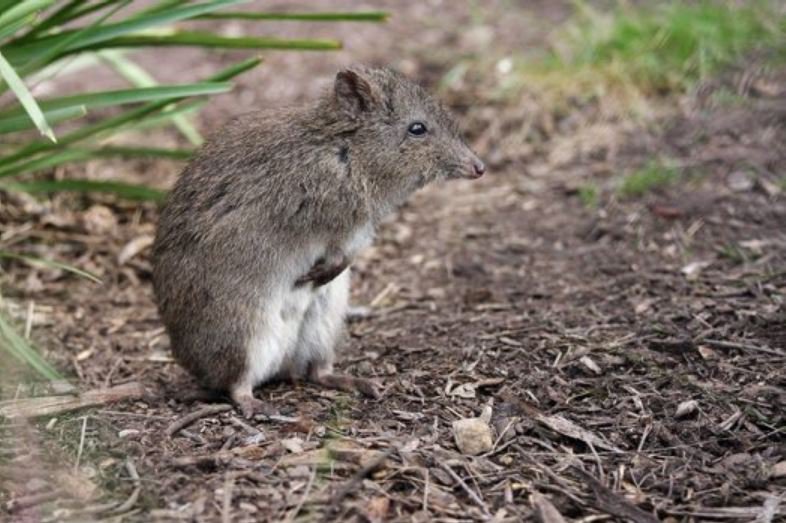
The remaining macropod line split again about 23 million years ago, giving rise to the modern potoroos and bettongs, in addition to the 'main line' macropods. These are also small mammals, dwelling mostly in dense understorey, from rainforests to coastal heaths. They are well known as 'environmental engineers', moving huge quantities of forest soil in their search for underground 'truffles', fungal bodies associated with the roots of trees and crucial to forest health. There are four living bettongs and three potoroos, several of them in serious danger of extinction. I can't offer you my own photos of these (because I don't have any!), but here's what they look like - just an example of each.
Long-nosed Potoroo Potorous tridactylus, courtesy Australian Museum.
This species, from wetter near-coastal forests of south-eastern Australia, is the only one of
the three potoroo species which is not listed as Threatened. Potoroos superficially resemble bandicoots,
but are unrelated, and soon reveal their macropod connections when they hop!
Eastern Bettong Bettongia gaimardi, courtesy Mulligans Flat Woodland Sanctuary.
Once common in woodlands of south-eastern mainland Australia from Queensland to
South Australia, we had exterminated them by the 1920s. Fortunately they have survived
well in Tasmania, where Red Foxes have never established, and recently a population has been
established in a large fenced sanctuary at Mulligans Flat, a woodland nature reserve
on the northern edge of Canberra.
Of the other three bettong species, two are listed as Endangered, and the Boodie, whose range once covered more than 60% of the continent, is limited to a few islands off the west coast. Stories don't come much sadder.

Well, those are the two macropod families that are not the 'main stream' Macropodidae family that we introduced last time. Within that though are also several other groups of kangaroos and wallabies that we really should meet too.

We divide the family into two sub-families - on one side is just one species, the enigmatic Banded Hare-Wallaby, and on the other are all the other 60 or so species. 
Banded Hare-wallabies Lagostrophus fasciatus, from John Gould's superb
A monograph of the Macropodidæ, or family of kangaroos
(courtesy of the inestimable Biodiversity Heritage Library).
This fascinating animal - a link to the early origins of the kangaroo family - was once scattered across southern Australia from the west coast to Victoria and south-west New South Wales. It too now only survives on a couple of western islands.

For the rest there are tree kangaroos, pademelons, rock wallabies, nail-tail wallabies, hare wallabies, the New Guinea dorscopsis wallabies and a couple of 'outlying' species (Swamp Wallaby and Quokka). I will briefly introduce them all; hope you can bear with me!

The ancestral tree kangaroo seemingly had second thoughts about its forebears' decision to come down out of the trees, and has again adopted an arboreal lifestyle. They are most closely related to the rock-wallabies, and it is not too hard to imagine such accomplished climbers adapting their rock-climbing skills to scaling trees to harvest the vast crop of rainforest leaves; most tree kangaroos are from New Guinea, and it is proposed that they arose there. This may have been a relatively recent move as they are not especially adept, but they can move on two legs or four along branches, and leap between trees or down to the ground from high in the canopy. Their forelegs are relatively much longer and more muscular than those of other kangaroos, and their feet are broader and with a grainy sole, like those of rock-wallabies. 
Lumholtz's Tree Kangaroo Dendrolagus lumholtzi, Malanda, Atherton Tablelands.
This plateau inland from Cairns in north Queensland is the centre of the remaining range of this,
the smaller of Australia's two tree kangaroo species. The name commemorates Norwegian explorer
and anthropologist Carl Lumholtz who introduced a specimen to science in the 1880s.
Bennett's Tree Kangaroo D. bennettianus lives further north on Cape York Peninsula, and there are about a dozen species in New Guinea, though more are being described and this number will rise - sadly, many of them are in serious trouble from over-hunting and forest clearing.

I discussed the wonderful rock-wallabies a while ago here, so won't reiterate the whole story, but in summary they seem to be closest to the rainforest and dense near-coastal shrubland pademelons (and the tree kangaroos) and have spread across the continent, specialising in cliffs and ranges, where their proficiency on sheer slopes is remarkable. Isolated now by predators (especially foxes and dingoes) and habitat loss, several species are in trouble. Key adaptations are short broad feet with rough soles like sandshoes and no protruding toe and claw, and a heavy non-tapered flexible tail to provide balance at speed. The following two photos show these characters, plus the colourful coats of some rock wallaby species, compared with those of most other macropods.
Black-footed (or Black-flanked) Rock-wallaby Petrogale lateralis, Alice Springs.

Yellow-footed Rock-wallaby, Flinders Ranges, South Australia. This is one of the oldest rock wallaby species,
though the group seems to have only diverged in the last few million years.

Black-footed Rock-wallabies on alert, Alice Springs Telegraph Station.
Pademelons comprise seven species of the genus Thylogale, small solid kangaroos of dense understories of rainforests and wet eucalypt forests (and sometimes coastal heaths). The name is an adaptation of the Indigenous name for them in the Sydney area. Colonial Botanist Richard Cunningham in 1827 used the form paddymalla (and went on to claim that it typically weighed 60 pounds!), and the obviously Anglicised paddymelon has also often been used (though we tend to use that more for various native and exotic species of 'cucumber').

I can show you all three Australian species, though it's not very hard to do as while they have suffered from habitat loss, they can still be quite common and even numerous where they persist, though they tend to be nocturnal and wary and rarely stray far from shelter.
Red-necked Pademelon Thylogale thetis, Mt Clunie, near Kyogle in inland far northern New South Wales.
These emerged to feed at the same time every day, as is typical of the species, which lives along the
sub-tropical east coast.

Tasmanian Pademelons T. billardierii, Narawntapu NP (formerly Asbestos Range), northern Tasmania.
Despite the name, this one used to live in mainland south-eastern Australia too; it has gone from there since
European settlement, but is common throughout Tasmania.
Like other pademelons the tail just drags behind, and is not used for support.

Red-legged Pademelon T. stigmatica, Kingfisher Park, Julatten, north Queensland.
This youngster probably shouldn't have been out on its own. This tropical species is found along
the east coast from north of Sydney to Cape York and into New Guinea, where there are
also another four species.
There are - or were - three species of nailtail wallaby, genus Onychogalea, small wallabies characterised by a  hard spur at the tail-tip, for no apparent purpose. Another characteristic is their gait - at speed a nailtail holds its arms out forward and down for balance, seemingly rotating, hence the old name of Organ Grinder. The Northern Nailtail Wallaby O. unguifera is still doing OK across northern Australia, but another one is Endangered and the other was very rare by the early years of the 20th century and extinct within a few decades - both had huge ranges across drier Australia.
Poignant portrait of Crescent Nailtail Wallabies O, lunata From John Gould's mighty Mammals of Australia, 1863.
At time they were common and widespread and remained so until the 20th century. Thereafter records rapidly
declined; the last substantiated records were in the 1930s.
The story of the Hare-wallabies, genus Lagorchestes, is sadly similar - four species, covering most of the continent in the 19th century, now only two and one of those has seen its range shrink from most of the central and western deserts to two small islands off Western Australia. This one, the Rufous Hare-wallaby L. hirsutus, remains a key story animal to many desert people and there have been determined attempts to reintroduce it to the central deserts; so far these attempts have been thwarted by cats and foxes, but there are good captive populations and hopes remain. (The hare-wallabies incidentally don't include the Banded Hare-wallaby that we discussed earlier! That was a case of mistaken identity, but the name stuck.)
Spectacled Hare-wallaby L. conspicillatus, also from Gould's Mammals of Australia.Only this species of the three is still widespread across the tropical grasslands, though even here there
are worrying signs of decline in some areas.
The Dorcopsis wallabies (genera Dorcopsis and Dorcopsulus) are rainforest dwellers of New Guinea and nearby Indonesia; I recall some in Adelaide Zoo around the 1970s but I don't think that there are any in Australia now.
White-striped Dorcopsis D. hageni, courtesy A to Z Animals. It is found across northern New Guinea,
though I'm sure this a captive animal. I recall this strange 'tripod' stance using the stiffly bent tail from
the Adelaide Zoo animals, though they were Grey Dorcopsis D. luctuosa.
Which brings us to the two 'loners', each quite familiar to most Australians with an interest in wildlife, the only members of their respective genera and with no close relations.

The Swamp Wallaby Wallabia bicolor is common and widespread along the entire east and south-east coast and hinterland; indeed it was apparently to this species that the Sydney language name of  'wallaby' (or something similar) was applied and adopted by Europeans for all the familiar smaller kangaroos. The names Black and Black-tailed Wallaby have also been used - and arguably more helpfully, though I have also read that the Swamp name refers to the rank smell and taste of the meat. The black tail, relatively small head and odd gait - hump-backed with head held low and tail stiffly out behind - immediately mark the Swampy as 'different' from other wallabies.
Swamp Wallaby, Mulligans Flat Nature Reserve, north Canberra. This is an attractive, colourful species.
It is more of a browser than grazer; this one is munching on a benign mistletoe leaf from a low-hanging clump,
but they are also seemingly immune to toxic fare such as Bracken Fern (poisonous to stock) and introduced Hemlock -
if only poor Socrates could have learnt that trick.
Lastly, and far from least, the Quokka, Setonix brachyurus, the favourite of many Australians, though they are only found in Western Australia, and only likely to be seen on Rottnest Island, off the coast of Fremantle, Perth's port. This was the second Australian marsupial to come to the attention of European explorers when Dutch navigator Samuel Volckerzoon reported 'wild cats' on an unidentified island near Perth in 1658. The poor Quokkas had to get used to being misrepresented, as later Willem de Vlamingh characterised them as 'a kind of rat big as a common cat'. Indeed he named their island Rottnest - ie Rat's Nest. They were common along the coastal plain but while still there they are scarce and not often seen; on Rottnest however they are completely accustomed to people.
Quokka, Rottnest Island. The round face, shaggy body and short tail make this engaging little
animal quite unmistakable.
So, a fairly extensive survey-cum-tribute to one of the most fascinating groups of mammals in the world, though most of us don't know much about most of them, and we've overall treated them very badly. We should never ignore them though, and I'd love to think I might have encouraged you to look more closely - and seek out more of them. Marvellous macropods. Thanks for coming with me.

NEXT POSTING THURSDAY 14 MARCH
(And remember that you can get a reminder when the next post appears by putting your email address in the Follow by Email box in the top right of this screen.
And I'd love to receive your comments - it's easy and you don't need to sign in!


Thursday, 14 February 2019

Reconsidering Kangaroos #1

It's been some four years since I posted on kangaroos and in the meantime our understanding of the relationships of different kangaroo groups to each other has changed considerably, so it's probably time to revise and update that post. Moreover that post was only on the 'main line' of kangaroos and I've been meaning for some time to add a post on the 'other', equally interesting, members of the family. That will finally occur next week!

The story of people and kangaroos in Australia is at least 60,000 years old (and almost that old in New Guinea) but that story isn't mine to tell. The first kangaroo (and I'll be defining my terms soon) to have the misfortune to be killed by a European seems to have been a Dusky Pademelon Thylogale brunii on the South Coast of New Guinea in 1606, by Captain Don Diego de Prado y Tovar. Prado, apparently a Spanish nobleman, was in command of the San Pedrico which accompanied Luis Váez de Torres on the expedition which sailed between New Guinea and Australia, through the strait that now bears Torres' name. Soon afterwards, in 1629, the Dutchman Francisco Pelsaert described the first Australian kangaroo, probably a Tammar Wallaby Notamacropus eugenii, while rescuing survivors of the Batavia disaster off the west coast of Western Australia. The first English account was by naturalist-pirate William Dampier in 1699 also from northern Western Australia, seemingly this time the fascinating Banded Hare-wallaby (see next week).

All this means that when Captain James Cook's crew encountered (and cooked) Eastern Grey Kangaroos in northern Queensland in 1770, they were not quite as surprised by the creatures as they are sometimes portrayed as being.
Eastern Grey Kangaroos Macropus robustus, Namadgi National Park, south of Canberra.
In vernacular, we tend to use 'kangaroo' for the larger members of the family Macropodidae (which has some 60 members), and 'wallaby' for smaller ones, but it's not taxonomically meaningful. Indeed until very recently all the best-known Australian kangaroos and wallabies were included in just one genus Macropus (ie 'big foot'), from which the kangaroo family name Macropodidae derives. I use 'kangaroo' loosely to refer any member of the family, but better still is the word macropod, which I'll use from now on. 

It was only by accident - literally - that we use the word kangaroo, that being the name for Eastern Grey Kangaroo in the Guugu Yimithirr language of north Queensland. It came to our attention when Cook's Endeavour struck a reef in 1770 near where Cooktown now stands, necessitating an extended stay, during which naturalist Joseph Banks learnt the word for the animal his greyhounds caught. I like to muse that had Cook sailed on by, as he'd intended, we'd almost certainly be calling them something like Patagarang or Badagarang, that being the word in the language of the people who lived in the area where the first settlement intruded on them, in 1788 where Sydney now stands. 'Wallaby' also comes from the language of the Sydney people (a language often referred to as Dharug, though there seems to be some doubt about that), apparently being the word for what we call Swamp or Black-tailed Wallaby Wallabia bicolor. 

And to head off another oft-asked question, 'wallaroo' is not a kangaroo-wallaby hybrid, but any of three species of mostly stocky muscular hill kangaroos; unfortunately the hybrid name furphy was recently perpetuated again in a widely read on-line ABC story on kangaroos. Wallaroo is yet another Sydney language word. This term is used for Osphranter robustus along the Great Dividing Range along the east coast, while the word Euro (from the Adnyamadhanha language of the Flinders Ranges in South Australia) is used throughout the inland for the same species.
Wallaroo, Nangar NP, New South Wales.
Wallaroos (mostly from the Great Dividing Range) are blue-grey, while Euros (from the drier inland)
are reddish grey, despite being the same species.
Note the shaggy coat and big ears.
Euros, Broken Hill, far western New South Wales, in typical rocky range habitat.
Those who are familiar with kangaroo species names might now be getting agitated about my use of unfamiliar genus names Notamacropus and Osphranter instead of the familiar Macropus. May I explain my temerity? Macropus as we generally understand it was not always set in stone. Osphranter was actually coined by Gould back in 1842 for the euros and, despite being included in Macropus by some authorities later in the 19th century, Osphranter was still being used by respected macropod taxonomists such as Ellis Troughton and Tom Iredale into the second half of the 20th century. (At this stage, and even later, Megalaia was also widely used for the Red Kangaroo.) In 1985 Terence Dawson (one of the greatest kangaroo field ecologists of all) and Tim Flannery, eminent marsupial zoologist (et alia!), proposed three sub-genera within Macropus. Macropus itself contained just the two grey kangaroos; Osphranter held the three wallaroos plus the Red Kangaroo; Notamacropus comprised the 'main line' wallabies. This was widely accepted by science, but had little effect on the wider world, as no-one else takes much notice of sub-genera.

This changed in 2015 with the monumental tome Taxonomy of Australian Mammals, by Stephen Jackson (widely published on marsupials, working for NSW government) and Colin Groves (of the Australian National University, and a doyen of world mammal taxonomy until his untimely death last year). They raised the three sub-genera to full genus level and I found their reasoning to be interesting, and indeed refreshing. "... we urge an objective standard for the recognition of genera, and ... the only one that seems readily applicable is time depth; and our preferred time depth for a genus is 4-5 million years." These three groups seem to have separated 8-9 million years ago, so readily meet this criterion. Indeed, the proposal seems to have been near-universally accepted by those in the field, so I could hardly do otherwise, even were I so inclined.

I hear so many stories of people coming to Australia and expecting to see kangaroos in the main streets that I suspect that some of them must be true. And here in Canberra it's pretty close to the way things are! In suburbs near the numerous hill reserves which are scattered through the urban area it's common to see roos grazing the lawn or drinking from garden ponds in dry spells. And driving anywhere in Canberra can be potentially hazardous when the roos are on the move. I could meet you at the airport and pretty much guarantee to find you Eastern Grey Kangaroos within about 10 minutes. The abnormally very high numbers of this species in precious Canberra grassy woodland reserves has led to science-based regular culls to keep kangaroo numbers within sustainable levels, which has of course led to community conflict. No sane person enjoys killing animals, but our stewardship of the natural world comes with sometimes difficult responsibilities.
Eastern Grey Kangaroos Macropus giganteus, just a few minutes from my Canberra suburban home.
The animals in this photo are showing the classic kangaroo characteristics of powerful hind legs, short forelimbs with grasping paws and a long heavy counter-balancing tail. Lounging about stretched out on the ground is typical daytime behaviour too.
Eastern Grey Kangaroo lounging, Mulligans Flat Nature Reserve, northern Canberra.
The long hind legs are an adaptation to hopping, a form of locomotion which seems to have arisen in the ancestral kangaroos somewhere between 15 and 20 million years ago, though this is a relatively unusual situation where the fossil record has so-far unfilled and frustrating gaps. While members of a few rodent families, and a member of one other family of small marsupials (the carnivorous Kultarr) have independently evolved hopping, the kangaroos are the only large vertebrates ever to have developed the trick. (Tales of hopping dinosaurs seem to be no more than tales.)
Eastern Grey Kangaroos on the move.
The leaps that these legs can power are sometimes astonishing. These Eastern Greys were moving back from early
morning feeding in the paddocks to the shelter of Mt Ainslie Nature Reserve. Most went under the fence, as is
normal - I was still probably 100 metres away and they were in no panic - but this relatively young
animal went over the fence from a standing jump with little effort.
You can see the height of the fence relative to the size of the hopper.
Hopping is not an efficient mode of locomotion at low speeds; at less than 12km an hour a trotting dog for instance uses less energy. As speed increases however the hopping kangaroo begins to pull ahead energetically, and increases its relative efficiency further as its speed increases. At 22km per hour, the highest speed that I'm aware that energy expenditure has been measured, a hopping kangaroo uses less than 75% of the energy a similarly sized dog would. At speeds of 40kph - which a kangaroo can readily achieve - it would be expected to be twice as efficient. 

The reason for this has been tentatively suggested in terms of the muscles and tendons acting like springs, storing kinetic energy which is used in the next leap. Doubtless this occurs, but we now know that galloping animals also utilise this 'bouncing ball' strategy, so a roo's advantage can't be attributed solely to this. It seems that the explanation lies in the much longer stride a hopping kangaroo can achieve. An animal can increase speed either by taking longer strides, or by taking more steps or hops per minute; it is the latter which uses much more energy. A kangaroo's gait allows it to simply to take longer and longer hops as it accelerates, to more than four metres per bound. At very high speeds it will also start to put in extra hops, which presumably uses more energy.

At very low speeds however, such as when feeding, a kangaroo 'caterpillars' along, using five limbs, the tail being co-opted for this purpose. 
Big male Eastern Grey Kangaroo, Namadgi National Park.
To get to the next patch of desirable grass, the animal swings its back legs forward together,
while balancing on its forelegs and tail.
As we approached he simply rose and began hopping to put a bit of distance between us.
Curiously, when swimming, a kangaroo suddenly learns how to move its hind legs independently of each other, the only time it seems able to do so.

The drive from the ground is conveyed by an elongated fourth toe and strong claw, as demonstrated by this laid-back wallaby.
Extremely relaxed Red-necked Wallaby N. rufogriseus, Mount Clunie, near Kyogle, northern New South Wales;
note the long fourth toes and strong claws, on either side of the tail.

Tail, hind legs and the wicked fourth claw are all used in combat too - in defence against predators (especially dogs and dingoes), and in fights with rival males over mating rights. Usually such fights are largely ritualised demonstrations of strength and experience, but when in earnest real damage can be done by the power of the legs and the tip of the claw.
As can be seen here (in Namadgi National Park, south of Canberra) the male balances briefly on his tail
while launching a kick - with limited intent of malice in this case. The imposing front claws too can be
used to attack the opponent's face, so the head is usually held back by the defender.
As marsupials, embryos develop externally, but in the pouch (ie the marsupium). In the case of the big kangaroos time in the pouch varies with species from 200 to 300 days.

Agile Wallaby Notamacropus agilis with joey, Cape Hillsborough NP, tropical Queensland.
This one is starting to explore the world, but retreats to safety when it feels the need.
Eastern Grey Kangaroo, Canberra. The joey dives in head-first, then reorganises itself while inside.
More seasonal climate species, such as the Eastern and Western Grey Kangaroos M. fuliginosus, breed seasonally, but the extended pouch life means that the female is usually caring for a pouch young and a still dependent joey 'at foot', who follows her around and feeds from her. Arid land species, such as Red Kangaroos and Euros, tend to breed continuously. In either case the female produces quite different types of milk from the two teats (protected in the pouch), with one of them elongated to assist the youngster leaning in from outside to feed. (It was long believed that the joeys developed directly from the teats.) Furthermore Red Kangaroo females will at any one time be not only caring for a pouch young and dependent joey, but will also be carrying a blastocyst (an embryo 'frozen' in development at only a few cells, some 0.25mm in diameter). This is released to grow when either the mother loses the pouch young, or it leaves the pouch as it grows. This is an adaptation to living in the boom and bust of an El Niño climate; populations can crash during droughts, and rebound rapidly in the irregular and non-seasonal good years.

There is of course a lot more to say, and I'll be saying some of it next week, but you've probably read more than your fill for now. Let's finish with a partial gallery of the kangaroos until recently called Macropus, though I'm missing four of the thirteeen living species. (These are Parma Wallaby N. parma, rediscovered in the wild in northern NSW coastal forests in 1967 after a 100 year hiatus; the Black-striped Wallaby N. dorsalis, a shy nocturnal dweller of dense NSW and Queensland shrublands; the Western Brush Wallaby N. irma of south-western Australian heathlands; and the rare and little-known Black Wallaroo O. bernardus of the sandstone escarpments of Kakadu NP and the immediate surrounds. I've seen the Black-striped and Western Brush Wallabies, but have no usable photos; pictures are easy to find on line though if you're interested.)

Big male Eastern Kangaroo, Canberra.
Like most of the big kangaroos (though not many smaller macropods), Eastern Greys have benefited
greatly from agriculture, which supplies pastures and water points. They are expanding well out of their
traditional range into the semi-arid zone, utilising farm dams.

Western Grey Kangaroos:
female, Cape Le Grande NP, Western Australia (above);
big male, Silverton, far western New South Wales, below.
Western Greys are really brown. They evolved in Western Australia when the south-west
was isolated from the east by arid conditions, and later spread east. They were only recognised
as forming a separate species from the Eastern Grey in recent decades.

Red Kangaroos M. rufus; Western Australia (above), south-west Queensland (below).
This beautiful animal is found throughout the arid inland.
Theoretically males are red and females blue-grey, but a substantial proportion of animals (varying
between populations) has the 'other' colour, or a blend.
Wallaroo, Nangar National Park, New South Wales.
Euro, Idalia NP, south-western Queensland
Big male Euro in stand-off with a Dingo, Telegraph Station Reserve, Alice Springs.
Kangaroo cave painting, Burrungkuy, or Burrunggui (formerly erroneously known as Nourlangie Rock),
Kakadu National Park, Northern Territory.
In this sandstone habitat, the painting probably represents a Euro.
Antilopine Wallaroos O. antilopinus, Kakadu NP.
This is the kangaroo of the tropical savannahs.
Agile Wallaby, Kakadu National Park.
Also a tropical macropod, though one that goes into the brushes more than the Antilopine does.

Male Agile Wallaby, Tyto Swamp, Ingam, north Queensland, in pre-dawn light.
The notably narrow face is obvious here.

Red-necked Wallabies N. rufogriseus, Namadgi NP, near Canberra, above and below.

The origin of the species name, rufogriseus, 'red and grey', is obvious.
In Tasmania (here Ben Lomond NP) the same species is known as Bennett's Wallaby.
Tammar (or Dama) Wallaby M. eugenii, Kangaroo Island, South Australia.
This engaging little animal is still common there, but scarce on the adjacent mainland
and in south-western Western Australia.
Whiptail (or Prettyface) Wallaby M. parryi, Undara NP, north Queensland.
This elegant wallaby is found throughout coastal and hinterland
tropical  and subtropical eastern Australia.
I hope you've enjoyed this brief introduction to a group of marsupials that many of us here take for granted, though they are fascinating and intrinsically beautiful and we should never do so. Next time I'll talk about the rest of the macropods in other genera.
 
You can find the next and final instalment here.

NEXT POSTING THURSDAY 21 FEBRUARY
(And remember that you can get a reminder when the next post appears by putting your email address in the Follow by Email box in the top right of this screen.
And I'd love to receive your comments - it's easy and you don't need to sign in!