About Me

My photo
Canberra-based naturalist, conservationist, educator since 1980. I’m passionate about the natural world (especially the southern hemisphere), and trying to understand it and to share such understandings. To that aim I’ve written several books (most recently 'Birds in Their Habitats' and 'Australian Bird Names; origins and meanings'), and run tours all over Australia, and for 17 years to South and Central America. I've done a lot of ABC radio work, chaired a government environmental advisory committee and taught many adult education classes – and of course presented this blog, since 2012. I am a recipient of the Australian Natural History Medallion, the Australian Plants Award and most recently a Medal of the Order of Australia for ‘services to conservation and the environment’. I live happily in suburban Duffy with my partner Louise surrounded by a dense native garden and lots of birds.

Thursday, 16 January 2020

Talking of Storks

As much of the world is very well aware, Australia has been dominated by unprecedented fires, in extent and intensity, and it's hard to think and talk about anything else. That seems a good reason to offer a blog post on something entirely different - I need a break from the stress and grief of what's happening, as I'm sure do many of you. 

So, why storks? Well, why not? They are among the most impressively imposing and grand birds in the world - 'stately' is often used in describing them - big predators, standing tall and even seemingly menacing at times. 
Saddle-billed Stork Ephippiorhynchus senegalensis, Lake Mburo NP, Uganda. One and a half metres
tall, with a bill 35cm long and a wingspan of well over 2.5 metres, this is a big bird by any standards.
Its long legs are an adaptation to hunting in water and its massive bill can catch big prey; all these
comments are relevant to all storks, to varying degrees.
The staring yellow eyes can give the impression of implacable ferocity, but of course that's just us!
There are 20 species of living storks, in six genera, found throughout the world's tropics and subtropics, with a couple also found in temperate Europe and western Asia. As for the word 'stork', allow me to quote myself from the recent second edition of our book Australian Bird Names; meanings and origins (co-authored with my friend and scholar Jeannie Gray; Jeannie 'did' the Latin names, hence my reference to quoting 'myself' in this instance). "‘Stork’ is an Old English word (from Old German) meaning a stick, applied as a nickname to the nesting storks (White Stork in Britain) which commonly roost on one leg. Lockwood (1984) helpfully noted a secondary meaning in Old German (presumably low Old German!) of penis – which, he claimed, is why storks are said to bring babies." (WB Lockwood's Oxford Dictionary of British Bird Names is a treasure, but is sometimes somewhat speculative.)

Until recently they were included in the same Order as herons and ibis, but are now recognised as having no close relatives and occupy their own Order. 
White Stork Ciconia ciconia, Serengeti NP, Tanazania.
This is the familiar stork of Europe, where it traditionally nests on roofs and chimneys in many
places. After breeding it sensibly migrates to sub-Saharan Africa to avoid the northern winter.
I am in the happy position of being able to offer you 14 of the 20 species today (though a couple, of flying birds, are of dubious quality). 

A good way of introducing the different genera is via their bills, which vary to reflect different feeding strategies. Ciconia (such as the White Stork above) are heavy and straight, and are regarded as the least specialised of stork bills. 
Maguari Stork Ciconia maguari, south Pantanal, western Brazil.
This is the only Ciconia in the Americas and in line with its 'generalised' bill has a broad dietary range,
including fish, crabs, rodents, snakes, insects, worms and bird eggs.

The two Ephippiorhynchus storks - the Saddlebill above, and the Asian and Australian Black-necked Stork E. asiaticus - have massive bills with a slight upslant at the tip, for hunting large prey in shallow water. 
Black-necked Stork swallowing a small python, Fogg Dam near Darwin, Northern Territory, Australia.
Saddle-billed Stork with substantial fish (a catfish I think), Amboseli NP, Kenya.
The South American Jabiru Jabiru mycteria has a similar but even more massive bill.
Jabiru, south Panatanal, Brazil. It was hard to believe that it could swallow the huge fish, but
after a lot of battering and careful alignment, it managed it.
Jabiru, north Pantanal, tossing back unfortunate baby caimans, probably recently hatched, as snacks.
For reasons not at all clear, given the very different appearance and colour of the birds, the name jabiru (which is from the Brazilian Tupi-GuaranĂ­ language) has been widely used - and still is in Australia - for the two Ephippiorhynchus storks, Saddlebilled in Africa and Black-necked in Australia. In fact in the central Queensland town of Longreach streets named after birds abound, including Jabiru for the locally-occurring stork. Unfortunately reliance on an internet search engine uncoupled from basic bird knowledge has there led to this impressive but embarrassing sign.
Nice Jabiru pic - but the South American one. Oops...
Mycteria storks have slender down-curved bills which they use, in analogy with ibis, to probe into mud and water, finding fish, crabs, frogs and aquatic insects by touch, using a dense network of nerve cells in the bill known as the 'bill tip organ'. 
Wood Storks, south Pantanal, above and below.
It's worth noting that the three South American storks, (this, the Jabiru and Maguari, both above)
belong to different genera and thus feed quite differently.
 
Wood Storks often open their wings while hunting. This was an overcast day and they were foraging
in dense vegetation in a drying wetland, so presumably they weren't trying to shade the water. They may
have been trying to startle prey into revealing itself.
The three Leptoptilos species, the Marabou of Africa and the two Asian Adjutants, have absolutely massive bills; they are primarily carrion eaters and use the bill both for attacking a carcase and fighting off competing scavengers, both birds and mammals.
Marabou Leptoptilos crumenifer, Entebbe Botanic Gardens, Uganda.
Increasingly Marabous are gathering in large numbers at garbage tips.
Chicks are fed on small live prey, which they mostly hunt in dryland situations.
Lastly are the truly remarkable Openbill Storks, Anastomus, one species each from Africa and Asia.
African Openbill Anastomus lamelligerus, Entebbe Botanic Gardens, Uganda.
You can see readily enough the outward curve towards the end of the lower mandible, but not obvious from this
angle is the twist to the side, so that the tips don't meet. Stalked pads at the tip of the upper mandible hold
a big Pila snail against the ground (or underwater mud) while the lower tip stabs past the protecting operculum
to cut the muscle which holds the flesh in the shell. Even more remarkably a narcotic in its saliva
trickles down the bill to assist the process by relaxing the snail.
Nearly all stork pairs are identical, though males are sometimes slightly larger. The sole exception is in the two Ephippiorhynchus species, where the male has dark eyes and the female the glaring yellow.
Black-necked Stork pair, Norman River, Karumba, Gulf of Carpentaria, tropical Queensland.
Female on the left.
Storks, being big birds, are great soarers, using the energy of rising air currents to conserve energy. (And here's where I slip in a couple of very ordinary photos of birds I can't otherwise illustrate.) Unlike herons, storks fly with neck extended.
Black-necked Stork soaring, near Georgetown, north Queensland.

Lesser Adjutant Leptoptilos javanicus, Labuk Bay, Sabah, Malaysian Borneo.

Storm's Stork Ciconia stormi, Sepilok, Sabah, Malaysian Borneo.
This is the world's rarest stork (probably less than 500 left, from far southern Thailand to
Sumatra and Borneo) and hard to see, as it forages on the floor of lowland swampy rainforest.
(My excuses for offering such a poor photo.)


Some storks generally nest solitarily, others nearly always nest in colonies. 
Jabiru and chicks, south Pantanal, Brazil. Their enormous nests are often alone, though there
may also be others in the vicinity.

Yellow-billed Storks Mycteria ibis (here breeding in a sprawling colony along the roadside near
Lake Manyara NP, Tanzania) usually breed in colonies. Here a huge Marabou is nesting above them;
they too usually nest in company and it's common for different stork species to nest together.
We haven't met Yellow-bills yet, and they're very attractive so here's a better look at one.

Yellow-billed Stork, with typical slender curved Mycteria bill (plus Spur-winged Lapwing and of course hippo),
Mazinga Channel, Queen Elizabeth NP, Uganda.

While we're on the subject of 'new' storks, here's a couple more that we haven't yet made the acquaintance of today; both are Ciconia, with the straight all-purpose bill.
African Woolly-necked Stork Ciconia microscelis Lake Nakuru NP, Kenya.
This stork has a huge range, across Africa - formerly however it was even vaster,
when it was lumped with a closely related Asian species.

Abdim's Stork Ciconia abdimii, Serengeti NP, Tanzania.
This east African species is the world's smallest stork, standing less than 80cm high
(half the height of the biggest storks) and weighing up to 1.5kg (compared with a Marabou's 8-9kg).
It eats mostly insects.
If you've made your way this far through the world of storks, thank you - I'm glad that presumably you found something here of interest. I find them them worthy of much consideration and admiration; like most of the rest of the natural world I suppose. I look forward to your company again through 2020.
Marabou at dawn, Shaba Nature Reserve, Kenya.
NEXT POSTING THURSDAY 30 JANUARY.
And remember that you can get a reminder when the next post appears by putting your email address in the Follow by Email box in the top right of this screen.

I'd love to receive your comments - it's easy and you don't need to sign in!

Tuesday, 31 December 2019

Farewell to 2019!

Continuing my tradition of recent years, to mark the changeover of years I've selected just one photo* from each month of 2019. As ever I don't make any pretences to photographic excellence, but have chosen the pictures because of their associations, and in most cases because they are ones I've not previously used this year in a blog posting. 
It's been a remarkable year for us, marking the next stage of our life. To celebrate we did a bit of extra natural history travelling (of course): tropical Queensland in January;  Africa (Tanzania, Kenya and South Africa) in May-June; Brazil (accompanying a tour) in July-August; Costa Rica (reconnoitering for a tour next year); western Victoria, chasing wildflowers primarily, in September.

(*Actually that turns out to be a lie; for a couple of months there were other pics I just had to share. Sorry, but only a little bit sorry.)
JANUARY

Cairns Birdwing Ornithoptera euphorion, Lake Barrine, North Queensland. The main reason for going
to the tropics in the Wet is for the wealth of wildlife; we saw many things we'd not previously seen,
including this magnificent animal, Australia's biggest butterfly with a 15cm wingspan.
It is limited to coastal tropical Queensland.

Striped Possum Dactylopsila trivirgata, Lake Eacham, North Queensland.
This is an animal I'd long wanted to see, and it came to a feeding station near our accommodation,
attracted by some honey smeared on the tree (not by us). Its main food however comprises wood-boring larvae;
it chews through wood with chisel-like teeth and uses the long fourth toe to extract the morsel.
FEBRUARY

Sparring Eastern Grey Kangaroo males Macropus giganteus, Namadgi National Park,
south of Canberra. These two weren't seemingly intending serious harm but were
definitely testing each other's strength and resolve. Note how the tail acts as a fifth limb.
 MARCH

Robber Fly Ommatius coeraebus, Nowra, southern New South Wales.
When visiting I often prowl Lou's parents' substantial garden, and I'm usually rewarded.
Lucky I'm not smaller! Robber flies are fearsome predators, perching like this to watch for
prey insects flying by, which they pursue and capture with their spiny legs, stab with the short
powerful proboscis, inject with paralysing and digestive enzymes, and devour in the air.
Even wasps and dragonflies are not safe.
 APRIL

Filamentous lichens on a dead branch, Shanahans Mountain, southern Namadgi National Park,
south of Canberra. This is a memento of a nice walk we did on a sunny autumn day.
 MAY

Greater Flamingo Phoenicopterus roseus and Cape Buffalo skull, Serengeti National Park, Tanzania.
I'm surprised I selected this one of all the possible amazing animals we saw in Africa, but this
juxtaposition appealed to me.
 
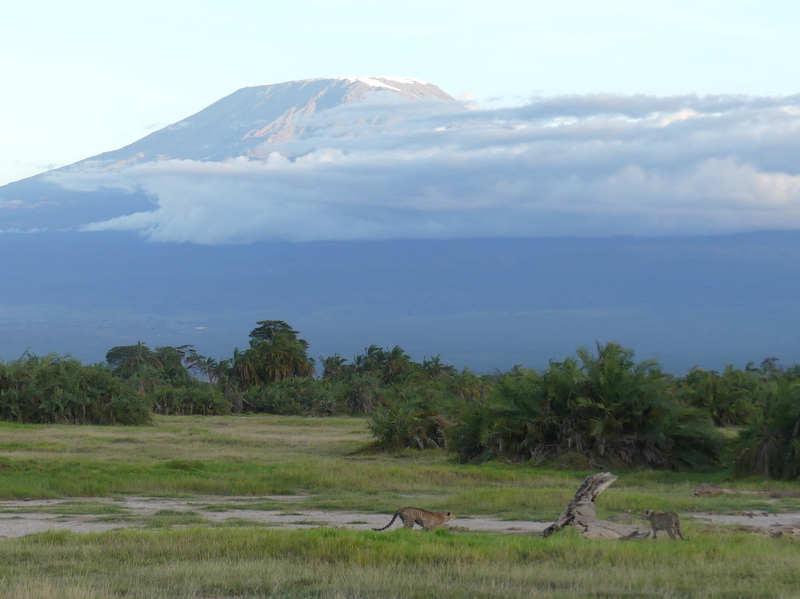
But in the end one wasn't quite enough for East Africa, so I've sneaked in this one of a Cheetah family,
mother and three youngsters, in the evening in Amboseli NP, in front of mighty Mount Kilimanjaro,
making a rare appearance from the clouds.
These two young ones had dropped behind and were playing chasing games.  
 JUNE
Gemsbok Oryx gazella, Augrabies Falls NP, northern South Africa. There are four species of oryx, big arid
land antelopes. Gemsboks are from southern Africa, centred on the Kalahari Desert.
This one was quite at home in the dry rocky wilderness of Augrabies.
JULY 
Southern Tamandua Tamandua tetradactyla, the second-largest South American anteater (up to 150cm long),
which I had longed to see for ages. This one appeared in a cattle paddock at Pousada Aguapé in the southern
Pantanal late in the afternoon. It was clearly aware of us, but seemed to have very poor eyesight.
We eventually left it to its own pottering devices in fading light; I was thrilled.
AUGUST

Crowned Tree Frog Anotheca (or Triprion) spinosa, Tapirus Lodge, Costa Rica.
This is a remarkable-looking frog with a spiny 'crown', living in bromeliads and related plants in the rain forest,
where our equally remarkable local guide located it for us in the rain. Eggs are laid in a flooded
tree hollow, where the female returns to feed the tadpoles by laying unfertilised eggs for them to eat.

Male Resplendent Quetzal Pharomachrus mocinno, Savegre Valley, Costa Rica; through early morning mist.
One of the most sought-after birds in this country of wonderful birds.
SEPTEMBER

 Common Heath Epacris impressa, Mount Zero, northern Gariwerd/Grampians NP, western Victoria.
There are quite a number of plants endemic to the range, but I chose this widespread species
because I love the fact that this healthy plant is virtually growing out of the sandstone.
It is Victoria's floral emblem, and also comes in pink and white.
 OCTOBER

Red-bellied Black Snake Pseudechis porphyriacus breakfasting on an unfortunate - and inattentive - Heatwole's
Water Skink Eulamprus heatwolei at Tidbinbilla Nature Reserve, just south of Canberra.
It was odd to watch such a drama played out at close range, and in total silence.
NOVEMBER

Hoary-headed Grebe Poliocephalus poliocephalus, Molonglo Pond, just down the road from our home.
The adult (sexes are identical, and both play similar roles in chick care, so not sure who this is) was carrying
the baby around the pond, hidden under its wings. At this moment it popped its head out to be fed.
It was a delightful encounter.
 DECEMBER
 
The sun through bushfire smoke over Canberra, late afternoon but still high in the sky, 17 December.
The nearest fires to us are over 40km to the east but at times the smoke is choking and stinging here.
Between here and the coast three ferocious fires have burnt some 200,000 hectares so far (23 December),
mostly in national parks (but it will be more by the time you read this).
To the north over 400,000 hectares have burnt in the Greater Blue Mountains World Heritage Area, and are still burning.
Only rain will put these fires out, and none is expected for at least a month...
This one was taken three days later, 20 December, mid-morning. It was an opportunistic shot, with just my phone.
I wouldn't normally post such a photo, but it really does give you an idea of conditions here
(and throughout much of eastern and southern Australia at the moment).
This is looking through the smoke across Lake Burley Griffin in central Canberra, to the other shore
only a couple of hundred metres away. Much of eastern Australia is burning in unprecedented December temperatures,
but our government doesn't deem this the right time to even discuss climate change, let alone meaningfully address it.
This is not how I wanted to end my year in photos, but anything else would have been dishonest.
However I can add an addendum, as a balance. I won't forget either the horrors of these fires or the shame of our government's contempt for the land, but neither do I want to forget the joy that I took from the world this year, as always, so here's another of my year's highlights.
Big male Leopard in a massive rock outcrop overlooking Serengeti NP, Tanzania.
Like most people I'm awed by big cats, and this year was an astonishing one for us in that regard.
So, that's one version of my year, but there could have been others. Perhaps I've prompted you to muse too on your year's natural history highlights - that can be a very satisfying and even therapeutic thing to do.

Thank you reading this, and if you're a 'regular' reader I greatly appreciate that support. May 2020 bring you lots of natural pleasures and surprises, and I look forward to sharing some with you.  

NEXT POSTING THURSDAY 16 JANUARY.
And remember that you can get a reminder when the next post appears by putting your email address in the Follow by Email box in the top right of this screen.

I'd love to receive your comments - it's easy and you don't need to sign in!

Thursday, 19 December 2019

"I Thought There Was Only One!"; of zebras, ostriches and more

The year is winding down, but there seems so much to do still. Accordingly this will be a fairly low-key post, based on a comment I heard with regard to our African adventure earlier this year, both while there from our companions on the East African tour, and since getting home. "But I thought there was only one zebra (ostrich, giraffe etc)!"

Fair enough too; we usually just refer to such animals in one-word terms, strongly implying that this is exactly the case. 'Zebras' for instance; even if we're aware of the more formal name of Plains or Common Zebra we usually tend to just go for friendly informal 'zebra'.
Plains Zebras Equus quagga, looking Africa-postcardish in the magnificent Ngorongoro Crater in Tanzania
(one of the most satisfying days of my natural history life by the way).  And you might like to entertain yourself
by thinking of how many other names there are with a 'q' in both genus and species name.
This is quite understandable; almost any zebra that you're likely to see either in captivity or in the wild in Africa will probably belong to this species. This post is intended as an introduction to a few often unsuspected animals, not an in-depth study, but a couple of questions probably need to be asked about this one. Why 'zebra', and why the stripes? Unfortunately if you really wanted to know the definitive answer to either of these questions, you've come to the wrong place. My trusty old big Oxford Dictionary reports that it appeared in English for the first time in 1600, in a work translated from Portuguese. It suggests that the word originated in a Congolese language and appeared in similar forms around the same time in Italian, French and Spanish too. However I understand that other sources suggest a possible Latin origin, though the nexus seems pretty vague. I'm inclined to go with the Oxford, based on a long relationship.
Plains Zebra and foal (and bonus Yellow-billed Oxpecker), Tarangire NP, Tanzania.
The foal's stripes will darken age.
And the stripes? There is an array of suggestions, the most popular of which relate to camouflage, either referring to broken shadows or the 'dazzling' effect of swirling patterns of fleeing animals. Social aspects have been mooted, wherein stripes stimulate a zebra to groom other zebras, or the unique patterns of individuals assist in recognition. A couple of more recent suggestions, both evidence-based, are interesting. One shows that biting flies, which rely on homing in on polarised light, are confused by the stripey patterns. Another demonstrates that black stripes can be up to 10 degrees C hotter than adjacent white ones, which sets up small air convection currents which in turn assist in evaporative cooling. Have fun working your way through all those options!

We do know about the quagga part of the name though. This is a Khoekhoe word (once referred to as Hottentot) from South Africa, referring to an abundant sub-species which was hunted to extinction by 1880. Only one photograph exists (from an animal in London Zoo), plus 20-odd skins. Curiously the Quagga lacked stripes over most of the back half of its body. Which brings us to the point of this post; there isn't just one 'zebra' and this isn't just true at the subspecies level. Before we look at the other two zebra species, let's see what differentiates the Plains Zebra from them.
Plains Zebra, Lake Mburo NP, Uganda.
The key factor is the stripes (unsurprisingly!); in the Plains Zebra they run right under the belly,
and body stripes are much wider than those of either of the other two. There are no small transverse stripes
across the rump and top of the tail, and no stripe along the spine.
While the Plains Zebra is found in much of eastern Africa, and across northern Namibia to the Atlantic, the Mountain Zebra Equus zebra is limited to scattered mountain populations in southern South Africa and western Namibia. In the 1930s there were perhaps only 100 left, but numbers have increased with sustained conservation programs.
Mountain Zebra, Goegap NR, South Africa. They seem to like it rocky, hot and dry;
Goegap, near Springbok in the north-east of the country, meets these requirements well!
Notice the white belly and narrow body stripes, which suddenly get dramatically wider on the hips.
The little stripes across the spine above the tail and on it, and the obvious throat dewlap are also distinctive.
The third zebra species lives in the opposite corner of the continent, scattered in a few reserves in northern Kenya and Ethiopia, while it has has been extirpated in Djibouti, South Sudan, Eritrea and Somalia. Grevy's Zebra E. grevyi is the largest living wild horse, and rangier than the other zebras. This was the hippotigris ('tiger horse') which appeared in Roman arenas and parades. It is listed as Endangered, though populations seems to have stabilised.

Grevy's Zebra, Buffalo Springs NR, northern Kenya.
It has narrow body stripes and white belly like the Mountain Zebra, but no broad bands on the hips,
and a dark stripe down the spine bordered by a white strip on either side, plus noticeably bigger ears.
But ostriches? Surely there's only one ostrich?! No, there are actually two. The Common Ostrich Struthio camelus has two quite separate big ranges, across southern Africa, up from northern South Africa, and across a huge swathe of the Sahel from the Red Sea to the Atlantic with a 'tongue' of occupation down through Kenya and Tanzania.
Common Ostriches, Tarangire NP, Tanzania. The two ostriches are the world's largest birds;
a male can be nearly three metres tall and weigh over 150kg. Females and immature birds are
very similar.
The Somali Ostrich S. molybdophanes was described as a separate species back in 1883 but this was rapidly rejected, and until this millennium it was regarded as a sub-species of Common Ostrich. Only in 2014 was it reinstated as a full species, based on various physical and genetic characters, and the fact that the two live side by side in Ethiopia.

Somali Ostriches, Shaba NR, northern Kenya. The most obvious distinction from Common Ostrich
is in the blue-grey (not pinkish) legs and necks. The male is also 'very' black, as opposed to sort of 'off black'.
There are other differences too. 
Male Common Ostrich (Lake Nakuru NP, Kenya) above; male Somali Ostrich (Shaba NR, Kenya) below.
The Common has mostly dark irises, and a smooth crown with bristly hairs;
Somali has pale irises and a bare crown with a little horny protrusion.
Add caption
At Shaba we encountered another Horn of Africa relative of a widespread and well-known species too. The Common Warthog Phacochoerus africanus is a familiar pig across much of sub-Saharan Africa.
Common Warthog, Ngorongoro Crater, Tanzania. It really is a remarkable creature.
In northern Kenya, Ethiopia and Somalia is a closely related warthog, an arid land specialist, the Desert Warthog P. aethiopicus. It's been known for a long time, but it's not a part of the world that most nature-watchers tend to visit.
Desert Warthogs, Shaba NR, Kenya. They are very similar to Common Warthogs, but have very
different dentition, lacking incisors entirely and with muscles that allow considerable side to side movement.
Presumably this assists with mastication of hard tubers and roots.
And finally I mentioned giraffes. No, it's OK, there really is only one Giraffe species Giraffa camelopardalis. Well, so far anyway; a number of reputable recent studies strongly suggest there are more. The eminent - and sadly recently late - Colin Groves in a 2011 publication believed there were eight species! We'll stick with the orthodoxy for today though, which generally recognises eight subspecies. Here are some of them; they are really quite distinctive.
Cape Giraffe G. c. giraffa, Augrabies Falls NP, northern South Africa.
The spots are dark and not as angular as others, and extend to about the knees.
From north and north-eastern South Africa and into Zimbabwe and Mozambique.

Masai Giraffe G. c. tippelskirchi, Serengeti NP, Tanzania.
The spots here are very 'splintered' and go right down to the hoofs. Tanazania and southern Kenya.

Reticulated Giraffe. G. c. reticulata, Shaba NR, northern Kenya. Arguably the most striking giraffe,
with big angular chestnut spots on a white background.
An arid land giraffe, from north-eastern Kenya and adjacent Ethiopia and Somalia.

Rothschild's Giraffe. G. c. rothschildi, Lake Nakuro NP, Kenya.
Its large dark spots often contain paler lines, which can be seen on the male on the left
(though you may have to click on the photo to enlarge it).
From a small area here in south-western Kenya, plus northern Uganda and adjacent South Sudan.
As I said, these very different giraffes are still regarded as the one species, but I have a feeling that that may not be the case for much longer. 

Well, not for the first time that's probably more than I meant to say, but I hope you've found something to interest you here. If nothing else you may have met some special animals whose existence you may not hitherto have known about. Either way they're worth considering.

Enjoy the last days of 2019, and may 2020 bring you lots of natural history adventuring! I'll be back once more before the end of the year, for my annual year's highlights, via one photo per month.

NEXT POSTING TUESDAY 31 DECEMBER
(And remember that you can get a reminder when the next post appears by putting your email address in the Follow by Email box in the top right of this screen.
And I'd love to receive your comments - it's easy and you don't need to sign in!)