About Me

My photo
Canberra-based naturalist, conservationist, educator since 1980. I’m passionate about the natural world (especially the southern hemisphere), and trying to understand it and to share such understandings. To that aim I’ve written several books (most recently 'Birds in Their Habitats' and 'Australian Bird Names; origins and meanings'), and run tours all over Australia, and for 17 years to South and Central America. I've done a lot of ABC radio work, chaired a government environmental advisory committee and taught many adult education classes – and of course presented this blog, since 2012. I am a recipient of the Australian Natural History Medallion, the Australian Plants Award and most recently a Medal of the Order of Australia for ‘services to conservation and the environment’. I live happily in suburban Duffy with my partner Louise surrounded by a dense native garden and lots of birds.

Thursday, 28 October 2021

Tidbinbilla; Canberra's favourite picnic spot. And much more!

When I arrived in Canberra to live over 40 years ago, Tidbinbilla was well established as a place you took your visitors, especially if they were from overseas - as many were, be they diplomats, academics, scientists, government officials or tourists. Canberra is the national capital after all and 'Tid' is just 40 km from the city centre. Back then of course it was much more of a rural drive - the suburbs have marched much further south in the intervening decades, but despite periodic pressures it's hard to imagine any government daring to allow the urban tide to cross the Murrumbidgee River. 

Despite being familiar to so many generations of Canberrans, Tidbinbilla is also a much-misunderstood concept. The ranges that surround the Tidbinbilla Valley on three sides are visible from all over Canberra, but are near-universally misidentified as the Brindabellas, which form the high western spine of the Australian Capital Territory (ACT) and are mostly hidden from view by the Tidbinbillas.

Looking further south-west from the south-western edge of the suburb of Duffy, (just around
the corner from where we live) across the remnant woodlands of the plains.
The Murrumbidgee flows in front of the low forested Bullen Range, behind which is
the Paddy's River Valley. Finally the snow-dusted peaks and ridges of the Tidbinbilla and
Gibraltar Ranges rise on the horizon. (They are only sporadically snowy in winter -
this photo was taken in June.)

Another view, from nearby Cooleman Ridge Nature Reserve. This higher angle shot
shows more clearly the distinction between the Bullen Range in the foreground
and the Tidbinbillas behind.

Parts of the area have been reserved, albeit somewhat informally, since the 1930s, primarily for wildlife enclosures - the 'zoo' theme continued until relatively recent times. Freehold land was acquired as the basis of a formal reserve in the early 1960s and the Tidbinbilla Nature Reserve was gazetted in 1971 under Federal legislation. Since self-government in 1988 the reserve has been managed under ACT legislation. The reserve is fairly modest in size, covering slightly less than 6,500 hectares, but it is contiguous with the far larger Namadgi National Park (106,000ha) and through it with the rest of the Australian Alps National Parks system in NSW and Victoria.

Map of southern ACT, with Tidbinbilla in teal, indicated by the red arrow, and
Namadgi NP in blue and brown. The green curve north-east of the red arrow
marks the approximate southern limit of suburbia. Map per ABC.

The use of Tidbinbilla by visitors varies dramatically from person to person. A large proportion of them probably go no further than the excellent picnic areas and playground not far inside the entrance. Many do the circuit drive indicated on the map above and quite a few of these visit the fenced Sanctuary in wet forest - more below. Some use the truly lovely walking tracks in wet forest at the foot of the range and a few do the longer, more demanding walks on walking tracks and management tracks up to the ridges.
The entrance, off Paddy's River Road.
The excellent Visitors' Information Centre (built to the highest bushfire safety standards).
 
Lovely carving of Brush-tailed Rock-Wallbies outside the information centre;
until the 1950s they were common in the ranges here. Now there is a captive
breeding program for them at Tidbinbilla.
Much of the circuit drive is through the open valley encircled by ridges on both sides and at the end of the valley.
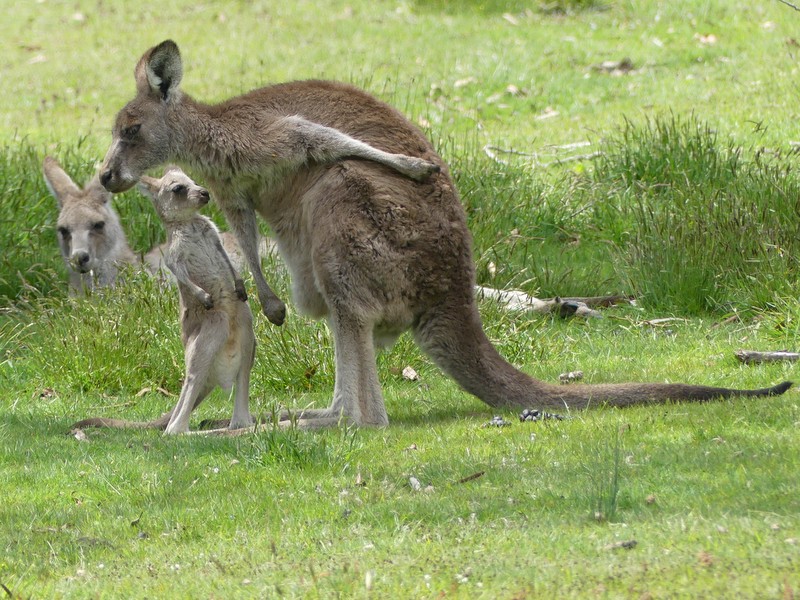
Typical view from the road - and the Eastern Grey Kangaroos are numerous and totally blasé about
visitors. The valley floor was partially naturally treeless, due to the frost hollows along the
stream lines, but small landholders cleared the surrounding trees and shrubs to make
more space for their grazing animals.
Young joey, just out of the pouch.
Looking north up the valley to the Tidbinbilla Range; the circuit road runs right along the foot
of these mountains.
Tidbinbilla in a very different mood - and this was in drought too, in 2015.
Looking back to the north, out to the plains, from an elevated site along the drive.
A feature of the reserve is the massive granite tors which dominate parts of the skyline along the ridges. The older underlying rocks were formed by layers of sediments in deep oceans some 460 million years ago, in the Ordivician. The tors are newer, from when the massive Murrumbidgee Batholith (a vast 'blob' of molten magma) forced its way through the older material during the late Silurian, 417 million years ago. As the softer sediments eroded away the tors became exposed. Some are enormous.
Tors in the Gibraltar Range, east of the valley.

Views of the huge granite pile known as 'Hanging Rock', above and below,
readily reached from a short walking track by the circuit drive.

The shelter formed by a vast overhang; this area was doubtless of great significance to
the people who lived in this area from at least 20,000 years ago, at the time of
the last glaciation.
Granite outcrops in Ribbon (or Manna) Gum, Eucalyptus viminalis forest.
This is the dominant tree in much of the wet eucalypt forest on the lower
slopes of the ranges.

Old Ribbon Gum in regenerating forest. Most of Tidbinbilla (along with
70% of the whole ACT) was burnt in the great fires of 2003, and is still recovering. In January 2020 another fire, totally unnecessary, and caused through remarkable carelessness by an outside agency, burned 80% of Namadgi, and 22% of Tidbinbilla, though in Tidbinbilla this one was mostly in the ranges away from the areas frequented by most visitors.

The drier forests have vegetation which is quite similar to that of the forested hills around Canberra, so the relatively few plant photos I have from Tidbinbilla are either in grasslands or the wet forests.

Yellow Rush Lily Tricoryne elatior in moist grassland behind the Visitors' Centre.

Parson's Bands Orchid Eriochilus cucullatus, also in wet grassland.
And here are a couple from the wet forests of the walking tracks past the big Koala enclosure. That area was ferociously burnt in 2003, and while of course it is recovering I've never really been minded to take many photos of the forests since, preferring to remember them as they were.

Snowy Daisy Bush Olearia lirata. A small tree, one of the biggest daisies,
gleaming white in the wet forest understorey in late spring.

Bristly Helmet Orchid Corybas (or Corysanthes) hispidus. I love the strange little helmets,
lurking in dim wet places, and mostly flowering in autumn or winter.
These conditions are also good for greenhood orchids too.

Montane Leafy Greenhood Pterostylis (or Bunochilus) montanus.
Summer Greenhood Pterostylis (or Diplodium) decurvum.
Maroonhood Pterostylis pedunculata. This one can grow in colonies of hundreds of plants.
The wet forests are also rich in fungi, especially in a wet autumn. Here are a few examples, mostly from one April walk a few years ago.
Velvet Parachutes Marasmias (or Collybia) elegans growing from
a burnt tree trunk.
Rosy Rozites Cortinarius roseolilacinus, a large fungus, beautifully coloured.
My initial assumption was that it had been nibbled by a wallaby, but Susan (see comments
below) tells me that this genus is toxic to mammals, so the nibbler is more likely
to have been a slug. I always appreciate learning things from my readers!
Yellow Navel Lichenomphalia (or Omphalina) chromacea.
Puffball (any of several possible genera) 'puffing' out thousands of minute spores.
Salmon Coral Fungus Ramaria formosa.

Finally, to the Sanctuary. This was a great idea that arose from post-2003 fire recovery planning. Basically it took an existing substantial area of forest, already fenced to contain kangaroo species in particular (not all of which were native to the area) and greatly enhanced it through design. The fence is now predator-proof to allow reintroductions of locally extinct species such as bandicoots and potoroos and an existing weir on the Tidbinbilla River has been used to maintain a series of quite large downstream ponds. A 2.1km wheelchair-accessible walking track (plus side tracks) provides a circuit around the water and through the forest. There is an emphasis on education via signage - and originally strongly complemented by a large number of intensively trained volunteer guides. The excellent Australian Conservation Volunteers organisation provided high quality training and provided ongoing support for those who graduated. 

It worked well but sadly financial exigencies, whether driven by necessity or changed priorities, drove the Department to bring the training and day to day operation in-house, with the result that the whole program collapsed. For some time there were no annual training intakes, no support and few if any of the scores of trained guides persevered. It was for a while a sad loss and a very false economy indeed, but I am assured that things have taken an upturn again (within the constraints of COVID) and there are again dedicated and trained volunteers, though not yet as many as before and they are not all deployed in the Sanctuary. However it is certainly an important step or two back in the right direction.

The eight million dollars spent on the original consultancy to plan and build the infrastructure was certainly not wasted and many visitors (including us) visit regularly.

Looking out from a viewing platform near the entrance to the Sanctuary,
through the forest to the ponds.
From there the track descends to pass alongside the ponds.

Part of the excellent wheelchair-friendly track.
Scattered along the track are some very compatible sculptures, both of recycled metal and wood; here are some examples which we like. I'm not a fan of human artefacts in truly wild places, but these seem appropriately complementary to me.

This eagle is viewed through a gap in the roof of the shelter at the viewing platform
mentioned above.
Pelican, just metres from the water where the real ones live.
Likewise the metal platypus.
This rock-wallaby references the nearby breeding colony, which supplies
wallabies for release in areas (mostly in Victoria) where they used to live.
The hope is that one day this will include the ACT, but that will require effective fox control.
And Red-bellied Black Snakes, slow and placid (unless you're a frog or lizard)
are regularly encountered along the walkway.
There are some animals present which have been released into the Sanctuary, though anomalies such as arid land Red Kangaroos are no longer here.
Actually the Magpie Geese Anseranas semipalmata are pretty anomalous; they used
to be fairly common in southern wetlands (and can still be seen occasionally to the west
of here) but there are no records that I'm aware of from the ACT, and they wouldn't
have come to the mountain forests. However they have been kept at Tidbinbilla for a long time.

Another tradition has been the presence of a lone male Musk Duck Biziura lobata in Tidbinbilla ponds.
The original bird, known part-affectionately as Ripper, was notorious for hunting other waterbirds
(it's something Musk Ducks do) but I doubt that the current 'Ripper' is the same bird.
They engorge the flap beneath the bill with blood and perform dramatic and noisy
courtship rituals on the water; it has been suggested that these helped enforce the Bunyip
legends amond earlier European settlers.

As mentioned earlier, the predator-proof fence has enabled the reintroduction of
locally extinct small mammals such as Southern Brown Bandicoots Isoodon obesulus,
which seem to be thriving and are active during the day.

However of course there are many other naturally occuring species that also thrive in the sanctuary. Some rely on the ponds and associated waterways. The most eagerly sought of these are the resident Platypuses - Tidbinbilla is without doubt the Platypus-sighting hotspot of the region. (Though a respected reader - see the first comment below - suggests the Queanbeyan River from weir to suspension bridge merits an equal claim. I won't argue.)

A little patience will almost certainly reward you with at least a distant view of a Platypus lolling
on the water, but they will often also swim near the paths. Rakali, or native Water Rats, are
also present, but the flat bill and tail of the Platypus, and the curious rolling dive with which
they disappear are characteristic.

Eastern Long-neck Turtles Chelodina longicollis are present all year round, though will
go into torpor in cold spells (such as most of winter!). However they can often be seen
sunning on logs or rocks, as well as in the water.

Australian Pelicans Pelecanus conspicillatus come and go, but some are generally present.
This one was bathing vigorously to maintain good feather condition.

Australian Reed Warblers Acrocephalus australis are annual migrants from the north,
arriving in spring to breed in reed beds throughout the south-east, including Tidbinbilla.

Southern (or Yellow-bellied) Water Skinks Eulampris heatwolei can be seen
everywhere on warm days, flicking over logs and rocks, or just basking.
Mostly they're pretty alert, like this one.

This one however was not paying due care and attention, providing this
Red-bellied Black Snake Pseudechis porphyriacus with brunch.
The paths of the Sanctuary are good places to observe, in complete safety,
these good-natured snakes going about their business. There are no records of
people dying from a bite from this teddy bear of a snake.
I'm going to end very soon with my favourite Tidbinbilla Sanctuary reptiles, but a couple of bush birds first; these you're likely to find on any walk in the Sanctuary, at least in the warmer months.

Male Rufous Whistler Pachycephala rufiventris. Another spring migrant, breeding
on the hills around Canberra and in the ranges. Their song is part of the spring
soundtrack of Tidbinbilla.
White-eared Honeyeaters Nesoptilotis leucotis are present all year round,
though they move up and down between plains and mountains with the seasons.
Like for their ringing melodious 'chock' call, like a low-pitched guitar chord.
Alongside the viewing platform near the entrance to the Sanctuary is a huge boulder stack immediately on your right. Most visitors walk past it to the view, but I always linger a bit here, as it is home to a family of big Cunningham's Skinks Egernia cunninghami. They live in the crevices, where their spiny tail discourages predators from entering after them; they also puff up their bodies to wedge themselves safely in. Even on a cool sunny day there are often a few of them basking on their relatively warm rock surface.
I have a particular fondness for these lizards, having kept some in a big outdoor enclosure
when I was a child; that was before you needed a permit to do so. They have some unusual
social characteristics too. For instance males are apparently entirely monogamous.
They are also highly sociable, unlike most lizards, living in large social groups.
I can't imagine a year when we wouldn't make several trips to Tidbinbilla, to walk the tracks, to look for flowers and birds, to search for Platypus or visit the Cunningham's Skinks in the Sanctuary, or to picnic in one of the many quiet and leafy places available. In summer (during daylight saving hours) the reserve is open until 8pm, and we will sometimes dine there before coming home in the evening. It's a special place and deserves your attention, whether you live in Canberra or are just visiting.

NEXT POSTING THURSDAY 25 November
I love to receive your comments and in future will be notifying you personally by email when a new posting appears, if you'd like me to. All current subscribers have been added to this mailing list and have already been contacted.
This will mean one email every three weeks at the current rate of posting. 
I promise never to use the list for any other purpose and will never share it.
Should you wish to be added to it, just send me an email at
calochilus51@internode.on.net.
You can ask to be removed from the list at any time,
or could simply mark an email as Spam, so you won't see future ones.
Thank you!

Thursday, 7 October 2021

It's Not Easy Being Cool

Last time we talked about the wonderful toucans and hornbills, including the newly-recognised importance of their amazing bills in helping them keep cool. As promised, this time I'm going to talk more about some of the ways in which animals lose heat to avoid overheating, and a bit about the implications for this in a world which is getting warmer all the time. Hopefully it won't be too dry - as usual plenty of pictures of interesting animals! Firstly I must remind us that birds don't have sweat glands - not much point in them under feathers (or indeed fur) - so that's not an option for cooling off.

Before we leave last week's theme of large beaks with networks of surface blood vessels which can be opened to 'dump' surprisingly large amounts of heat quickly, or closed off to conserve heat where necessary, it's worth noting that hornbills and toucans aren't the only ones to practise this strategy. In fact the more that researchers look, the more examples they're finding of it. An unexpected one is among puffins, seabirds of the cold northern oceans. 

Tufted Puffins Fratercula cirrhata were shown to drop the temperature of their bill by
five degrees C within 30 minutes of landing from a foraging flight,
while heat loss from the back was negligible.
Photo per phys.com.

Why would they need to get rid of excess heat in such an environment? The answer seems to lie in observations of a close relation, the Thick-billed Murre Uria lomvia, of the North Pacific and Atlantic. Like puffins they have relatively short stubby wings for diving and chasing after food underwater, so they are not terribly efficient in the air and they must work very hard to fly. In fact the increase in their energy expenditure during flying compared to resting is the highest ever measured in a vertebrate. That, with their efficient insulation, leaves them vulnerable to over-heating, hence the use of the bill to remedy that danger. 

Last time I reported on a South African study which showed that ground hornbills lose a significant amount of heat from the bare skin on the face and neck as well as the bill. It follows that other birds with extensive bare skin on the face, especially in the tropics, are probably doing the same thing.

Blue-and-Yellow Macaw Ara ararauna, Pantanal, south-western Brazil, at nest hollow.
The large white face is bare of feathers except for the artfully arranged lines of black feathers.
It doesn't mean however that these birds are controlling the heat exchange, as the toucans and puffins are. Simply having such expanses of non-insulated skin will allow cooling to take place through blood vessels near the surface. Work on Ospreys showed that heat was lost through the long legs and claws much more than through the beak, but this wasn't managed either.
 
Birds will tuck their beak or a foot under the feathers to stop them from losing heat, but will also do so in hot weather to prevent them taking up any more heat from the air. 
 
Emus and Ostriches do regulate their heat loss, through beaks and bare or lightly feathered necks and legs plus feet and toes. This study, using infrared thermography ('heat pictures'), was done back in 1994, which surprises me.     
Emus near Esperance, Western Australia. The expanses of bare skin on
neck, legs and feet all act as controlled temperature regulators.
 
Somali Ostrich, Shaba Reserve, northern Kenya.
The same comments apply to it as to the Emu, though its barer
neck is presumably a better heat disperser. Both live in hot
arid situations (though Emus also live, or lived, in milder moister regions).
That study also looked at a Southern Wattled Cassowary, a rainforest bird, and concluded that they behaved similarly, but that the legs were less important. (The overall sample size was very small, two ostriches, two emus and the cassowary, all in Brookfield Zoo in Illinois.)  However, they reported that the casque - the big impressive spongy helmet - performed the function instead. Hitherto many suggestions had been made for its purpose (from crashing through dense vegetation to display) none of which were very convincing. Much more recently a 2019 study of 20 captive cassowaries at temperatures from 5 to 36 degrees across eastern Australia confirmed the earlier findings. The bill tip, legs and especially the casque were important in temperature control. At high temperatures they increased the blood flow to the casque, so allowing heat to escape, and when it was cold (they live in mountain rainforests as well as down near the sea) they closed it down. When it was particularly hot they would dip their head in water to increase the heat dump.
Southern Cassowary Casuarius casuarius, in rainforest, Atherton Tableland, north Queensland.
And it seems that many other birds are shedding heat through bills, skin, legs and feet, as this infrared image of an Australian King Parrot Alisterus scapularis shows. Even smaller bills are of value here.
The hottest parts (ie shedding the most heat) show as yellow - the bill,
skin round the eyes and feet. Photo per The Conversation.
The bigger you are, the smaller your surface area is relative to your mass. This is fine if you're in a cool climate, because it means you don't lose heat as easily as a smaller animal. However if it's hot you might be in trouble trying to lose enough heat to stay safe. Accordingly, an elephant's ears represent the biggest 'thermal window' of any animal (along with the bill of the largest toucans).
African Bush Elephant, Queen Elizabeth NP, Uganda.
These magnificent ears are thin and full of fine blood vessels. Even when they are
still they dump heat readily but, if that's not enough, flapping them makes them
even more efficient. (They're pretty good at hearing too!)
Near the other end of the mammal scale the bare tail of many rodents does the job too.
Fawn-footed Melomys Melomys cervinipes, Kingfisher Park, north Queensland.
(No I know you can't see much of the tail - sorry, but you know what it looks like.)
Which brings us to some behavioural tricks for getting rid of some heat (though to at least some extent most of the structures we've looked at need to be operated too).

After my last post I had an interesting but ultimately fruitless discussion with a friend about the behaviour of sea lions and fur seals in the generally cold seas of southern Australia waving their flippers and tails in the air while lolling about in the water. I couldn't see the point in such conditions, although I found it asserted widely on line that it was indeed to cool down, albeit with no evidence that I could find. If anything the reverse seemed more plausible, that it was a strategy to warm up (as long as the air is warmer than the flipper). However the discussion above about puffins suggested something else to me. The 'seals' (no real seals in Australian waters, but that's what we call them for lazy convenience) have superb insulation in the form of a thick layer of blubber and perhaps are in danger of overheating after a busy session chasing fish. Just a thought and if you have another one (or even some actual information!) I'd be very glad to hear from you.

Australian Fur Seal Arctocephalus pusillus, Narooma, south coast NSW in typical loafing pose.

And New Zealand Fur Seals A. forsteri, relaxing and waving en masse at Goolwa, near the
mouth of the Murray River in South Australia.
Many birds in warmer climes have featherless sections of skin along the underwings, so they can lose heat by exposing blood vessels just under the surface by extending their wings.
Cocoi Heron Ardea cocoi, Pantanal, south-west Brazil, exposing bare underwing
patches to lose heat from the blood vessels near the surface.
This big heron is found throughout all of South America except for the Andes.
However this Cocoi is doing something else - its beak is open and it is panting, breathing in and out while fluttering its throat to lose heat by evaporation. This is widespread behaviour among birds in hot situations.  Here are some more examples of panting, though passerines (such as the swallows and bee-eater below) for some reason never learnt the throat-fluttering trick.
Ethiopian Swallows Hirundo aethiopica (above) and
White-throated Bee-eater Merops albicollis (below), Waza, north Cameroon.
Their wings are partly open too to increase air flow over skin.
The temperature was well over 40 degrees, and we felt like panting too!
This lovely bee-eater nests up here near the Sahara (see the long tail streamers which proclaim
its breeding status) and spends winter in the rainforests of west and central Africa.
Wood Storks Mycteria americana, Pantanal.
Galápagos Cormorants Nannopterum harrisi, Isla Fernandina.
This flightless bird is the world's largest cormorant; it nests in the full sun on lava rocks.
Female Australian Darter Anhinga novaehollandiae, Winton, central Queensland.
But what are implications of a relentlessly warming world for all this? Some at least are certainly not good for birds in arid lands in particular. You can only dump heat from a bill (or other exposed body part) if the air temperature is lower than your own temperature. As air temperatures rise that window of opportunity gets smaller, but worse, once they rise above body temperature the once-beneficial bill suddenly becomes a dangerous heat absorber. On the other hand panting is still a viable option - but as droughts become more frequent and more intense a panting desert bird is put under ever-increasing stress from water loss. If you're interested my book Birds in Their Habitats; travels with a naturalist, has more on this (and many other things of course!) - I've just noticed that it's on sale too!
 
Those problems aside for now, we might expect that appendages such as birds' bills and mammalian ears would have increased in size over the last century or so. Can we test that though? Of course we can - in museums around the world are vast treasure troves of specimens waiting to be measured and to contribute to knowledge. An Australian study published in 2015 found that the bills of three common Australian parrots, and a rarer cockatoo, have increased in surface area by up to 10% since 1871.
     
Red-rumped Parrots Psephotus haematonotus....
...Mulga Parrots Psephotellus varius...
...Gang-gang Cockatoos  Callocephalon fimbriatum...
... and Crimson Rosellas Platycercus elegans all have significantly larger bills
than their recent ancestors did.
But there's yet another aspect which I've touched on too. We noted that the elephants need extra big ears to keep cool, as their large bodies have a smaller surface area than smaller bodies. The corollary of course is that smaller bodies have a relatively greater surface area, so can shed heat more readily. Bergmann's Rule accordingly predicts that individuals of a species living in warmer climates will be smaller than members of the same species in cooler places.  But what happens when a place warms over time, as of course is happening all over the world? We might predict that at least some of the animals living there might be smaller than their ancestors - and a team led by Dr Janet Gardner of the Australian National University showed just that. They measured 517 museum skins of eight Australian insect-eating birds, collected over 130 years from 1869 to 2001. Six of the species showed a decrease in size since 1950, four of them being statistically significant. 
 
White-browed Scrubwrens Sericornis frontalis...
...White-browed Babblers Pomatostomus superciliosus...
... Jacky Winters Microeca fascinans...
... and Hooded Robins Melanodryas cucullata living at the latitude of Canberra are
now the size that their relatives at the latitude of Brisbane (nearly 1000km to the north)
were before 1950, just 70 years ago.
We've covered a lot of ground, and if you're still with me - thank you! I think the topic of how animals manage their temperature (especially when it's hot) is an interesting one in itself, but the question of  the impact of a warming world on that is an even bigger and more significant one. We've learned a lot about that in recent years, and I don't for a moment imagine we're close to understanding it all.

Next time, something a bit more scenic perhaps? I'll put my mind to it.

NEXT POSTING THURSDAY 28 October
I love to receive your comments and in future will be notifying you personally by email when a new posting appears, if you'd like me to. All current subscribers have been added to this mailing list and have already been contacted.
This will mean one email every three weeks at the current rate of posting. 
I promise never to use the list for any other purpose and will never share it.
Should you wish to be added to it, just send me an email at
calochilus51@internode.on.net.
You can ask to be removed from the list at any time,
or could simply mark an email as Spam, so you won't see future ones.
Thank you!