About Me

My photo
Canberra-based naturalist, conservationist, educator since 1980. I’m passionate about the natural world (especially the southern hemisphere), and trying to understand it and to share such understandings. To that aim I’ve written several books (most recently 'Birds in Their Habitats' and 'Australian Bird Names; origins and meanings'), and run tours all over Australia, and for 17 years to South and Central America. I've done a lot of ABC radio work, chaired a government environmental advisory committee and taught many adult education classes – and of course presented this blog, since 2012. I am a recipient of the Australian Natural History Medallion, the Australian Plants Award and most recently a Medal of the Order of Australia for ‘services to conservation and the environment’. I live happily in suburban Duffy with my partner Louise surrounded by a dense native garden and lots of birds.

Thursday, 23 March 2023

Lake Cargelligo; La Niña winding down

We have a friend who lives in a small town on the edge of the western plains some 400km north-west of Canberra. We've been visiting her on and off for years in Lake Cargelligo - which for the record I am assured is properly pronounced k'JELL-igo - but our recent trip there was perhaps the most memorable in terms of the countryside. This was in the aftermath of the vast floods caused by the three-year La Niña event which is now seemingly running out of steam, with the waters receding and the country starting to dry out.

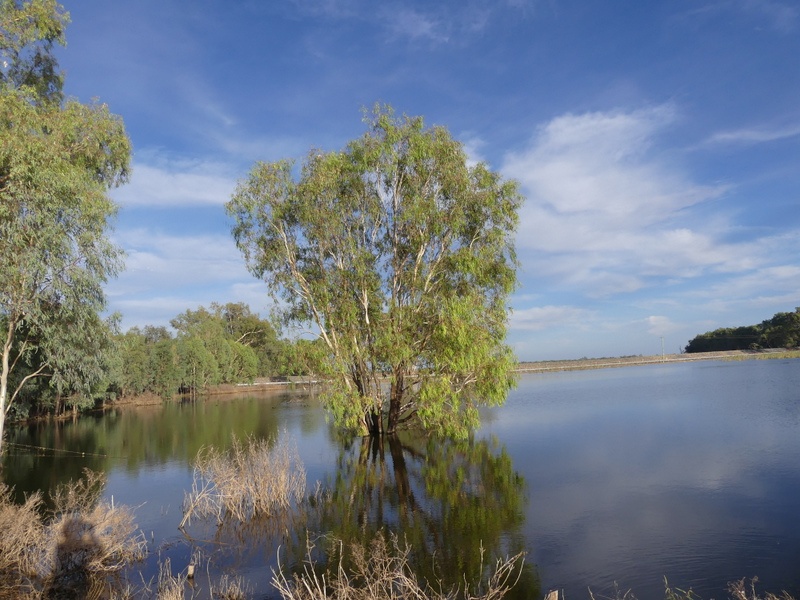
Ephemeral wetland on the outskirts of Lake Cargelligo.
It's seemed somewhat counter-intuitive that during the very wet last three years, waterbirds haven't been so easy to find, but this is because they have the choice of millions of flooded hectares to choose from and so are scattered over much of the continent. As the rains ease and the surface waters shrink however the birds are having to start to retreat to refuges, though these are still pretty easy for them to find. I'm seeing it in Canberra where the suburban and peri-urban wetlands have been a bit light-on for birding opportunities for quite some time, but are now starting to get busy again.

And millions of birds are certainly seeing Lake Cargelligo as a refuge; I can't recall seeing so many waterbirds concentrated into roadside pools and flooded paddocks for some time. It was astonishingly rich and even put me in mind of the great Kakadu wetlands in the Top End of the Northern Territory. But let me locate it for you.

The arrow marks the approximate position of Lake Cargelligo on the Lachlan River.
West Wyalong is to the south-east, Condobolin to the east and Hillston to the west.
Both the last two towns are also on the Lachlan.
The country is flat, though there are outcrops, ridges and low ranges rising surprisingly regularly from the plains. Much of the original vegetation has been cleared for agriculture and grazing, which is why I don't have many 'scenery' shots, except for the lake and wetlands. The woodlands were remarkably rich in tree and shrub species, and some remain along the roadsides.
Weeping Myall Acacia pendula always delights me, in stands of grey drooping foliage.
Poplar Box Eucalyptus populneus is another that I look forward to renewing acquaintance with
when I head west, though I could wish it wasn't defined by an exotic tree which, to my aesthetic
senses, can't begin to compare with it.

There are also areas of mallee, including very substantial reserves (Round Hill and Nombinnie) to the west and some roadside remnants near to Lake Cargelligo.

But it is The Lake which defines the town, which is right on its shores. It was a natural ephemeral lake, filled by the Lachlan in wet years, but drying in drought times. The ever gloomy and very British Surveyor-General John Oxley called it Regent's Lake in 1817 (yes, I'm wincing too) but in 1836 his successor in the position, the now notorious Thomas Mitchell, had the good sense to reestablish the local name for it (or a version of it) calling it Cudgallagong. He did have a reputation for using existing names where available and it has gone through a few variations since then. (Later in this journey, Mitchell was responsible, by his own reporting, for a bloody massacre of Indigenous people on what is now the Murray near Swan Hill.)

Last light on the lake, from the town shore.
Pastoralists arrived in 1840 and the village was founded in 1850, though mostly only on paper at that stage. In 1879 gold was discovered, which hastened the growth of European population, and a government village was surveyed, which the current town largely reflects. In the first years of the 20th century the ephemeral lake was made largely permanent, by deepening it and adding levee banks in order to regulate flows for downstream irrigation. Today there are some 1500 inhabitants of 'Lake' as it is usually referred to by locals, including a significant Indigenous community.
 
And I should say that there is a very pleasant, well-run, treed and birdy little caravan park right by the lake, where we stayed this time.
Sunset view from our cabin.
But back to the lake; here it is at first light in a couple of different moods.
A foggy sunrise with a Black Kite drifting through; this from a previous visit.
Another, more recent, sunrise over a shallow section, with a family of Black Swans.
The lake is overflowing, and channels and backwaters associated with it and with the Lachlan are full. One indicator is the number of trees, especially River Red Gums, which are inundated.
River Red Gums Eucalyptus camaldulensis are trees of the inland waterways throughout
most of the continent. They not only tolerate flooding, but need it from time to time to
refresh the water tables and to disperse seeds. However they can't tolerate being inundated
for more than a couple of years, so they are a good indicator of abnormal water levels.
This is an area where the lake has overflowed.
These River Red Gum saplings were carried as seeds to the limit of a previous flood where they
germinated. The current level of the Lachlan River is way above that but when the
waters recede again and the river is confined within its banks, these young trees will
get a strong growth spurt from the water and the rich sediment that it will deposit.
Moreover there will be another line of seedlings to mark the limits of the new floodwaters.
And everywhere paddocks normally supporting crops and livestock were slowly emerging from weeks of being submerged.
 
This paddock out towards Hillston was typical...
... as was this rapidly receding pool in grazing land near to Lake. Its nutrients are still
attractive to these Grey Teals Anas gracilis and Pied Stilts Himantopus leucocephalus, which
are eating water plants and small animals respectively. And the thing was, that every
pool, from lake to puddle, was worth a look for what it was attracting.
It's the birds I want to focus on for most of the rest of this post, but I also want to end with them, so first a few other animals we've encountered in the area.
Lace Monitor Varanus varius on a eucalypt trunk west of Lake Cargelligo. This big lizard -
up to two metres long - is found across most of the state, though is most familiar
from coastal forests.
Black-headed Skimmer Crocothemis nigrifrons, a familiar dragonfly across most
of Australia and beyond.
Golden Orb Spider Nephila sp., with handy food parcels.
Australian Water Rat or Rakali Hydromys chrysogaster. This is an old Australian rodent,
highly specialised to aquatic life. Some time ago there was a push by the federal
environment department to improve the image of Australian rodents by not
calling them 'rats', so Indigenous names were applied. I of course agree in principle,
but perhaps we could also try to educate people that there are rats and rats, so to speak.
Also, the name apparently comes from a Murray-Darling language, and there are many
other names in other languages throughout the country. However I don't have
an ideal solution either!
So, the birds. As I've flagged, the waterbirds were the real stars this time, so I'll leave them until last, and start with some land birds, from this and previous trips. Most of these are quite common, but they help build a picture of the area.
Grey-crowned Babbler Pomatostomus temporalis. This noisy gregarious bird is declining with
the woodlands, but on this occasion I saw and heard them in the town.
 
Black-shouldered Kite Elanus axillaris watching for unwary early morning mice.
Bluebonnets Northiella haematogaster are parrots of the semi-arid inland.
They're quite common but are often hard to approach, so I was grateful to this one.
Fairy Martins Petrochelidon ariel. It's quite a while since I took this photo and I can't remember what
they were doing on the ground - they normally catch their food on the wing and only come to ground
to collect mud for their nests, but this doesn't seem to be the case here. Presumably a gathering of
insects had attracted them.
It was hot while we were there last time and the campground attracted many birds to
its shade and the irrigated grassy area. These Blue-faced Honeyeaters Entomyzon cyanotis -
dependent fledglings on the table, and an adult on the bench - were appreciating the cool
of the concrete structures in a shelter.
Still in the campground these little Red-rumped Parrots Psephotus haematonotus were
enjoying the seeds produced by the lawn grasses, very close to our verandah. They are
common but nonetheless lovely little birds of the south-east inland open country.
At the edge of the lake this pair (only the male is brightly coloured) took a vigorous bath
It was another species of parrot/cockatoo however which were the stars away from the water. Pink Cockatoos Lophochroa leadbeateri must surely be among the most glorious of all Australian birds, with soft salmony pink body and glowing yellow and vermilion crest. It has widely been known as Major Mitchell's Cockatoo, as his rhapsodising over it brought it to public attention, but with his discrediting for the massacre alluded to earlier here, that name is being increasingly avoided.

They are not rare, but neither are they abundant, and a sighting in their semi-arid environment is always a cause of excitement. However during our stay in Lake Cargelligo they flew over the campground every day, and on our first evening there I watched them feeding on exotic pine cones at the end of the road. However my most memorable encounter with them was when a small flock of them flew into a roadside stand of callitris pines by the roadside as I drove speculatively one early morning. As I watched more and more sreamed in, perhaps drawn by the calls of those already there. Certainly there were dozens eventually, straggled along the road. The photos that follow are all from that delightful roadside rendezvous.
A truly gorgeous bird and an inland treat. Like other cockies that powerful bill can
also be used with great delicacy to extract small seeds from very hard cones.
The cone is nipped off and held, usually in the left claw, which rotates the
cone to allow access to all the seeds.
Gorgeous as they are, they are still cockies so also inclined to be quarrelsome.
The upper bird took exception to the proximity of the lower one, and shrieked
and threatened until the other was hanging upside down, flapping and shrieking in return.
The others took no notice at all.
It can be hard not to be anthropomorphic about cockies, but I got
the impression that in the end the upside down bird was quite enjoying
the novel view of the world and was in no hurry to right itself.
And it's good to see the town appreciating these glorious neightbours, via this lovely artwork on a grain silo near the edge of town. 
Silo art is a rapidly expanding phenomenon in Australia, and
many of the huge results are simply amazing.
So, finally, to the waterbirds. They are of course always present around the lake, even in dry times.
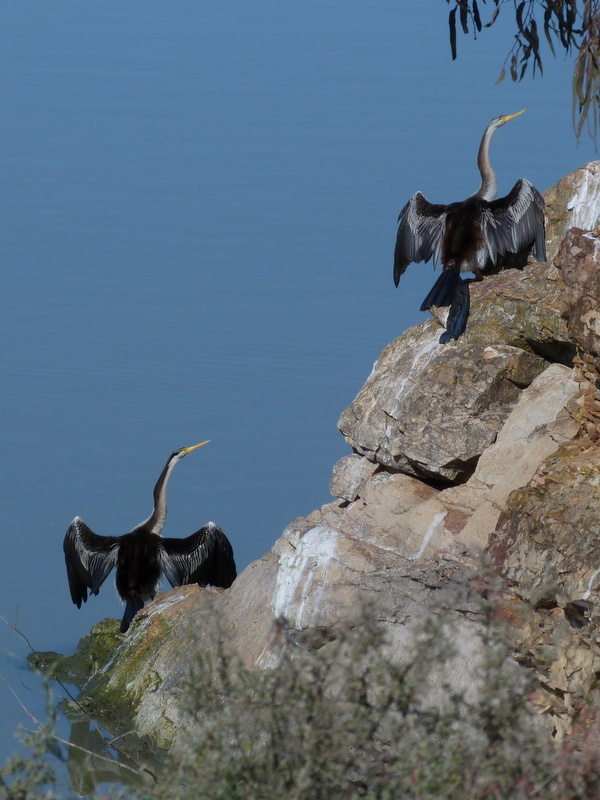
Female Australasian Darters Anhinga novaehollandiae on a rockface by the lake.
Like cormorants, which also dive for food, their feathers are not waterproofed with oils
(this would make it too hard to stay under the water) so they must hang their wings out to dry.
A collection of waterbirds (White-necked Herons, darters, Little Black Cormorants
and White Ibis) enjoying the late morning sun after a morning's fishing.
 
Pied Cormorant Phalacrocorax varius. This large cormorant is found in New Zealand and Australia, both coastally and inland, though not always common. Around Canberra for instance it is quite
scarce. However it can often be seen, though usually in small numbers, on inland waters.
 
Part of a remarkable flock of at least 30 Great Crested Grebes Podiceps cristatus from our recent trip.
The flock included many immature birds; the breeding opportunity offered by the floods was
certainly not wasted! Bad light I'm afraid, they were between me and the rising sun.
But on our most recent visit the body of lake itself wasn't the main focus of activity, which was out in the flooded paddocks and along the ephemeral waterways.
Little Black Cormorants Phalacrocorax sulcirostris, part of a large loose flock of hundreds,
fishing vigorously in a series of flooded billabongs on an anabranch of the Lachlan.
Nankeen Night Herons Nycticorax caledonicus were disturbed by us at various locations along
the waterways, roosting in the River Red Gums.

I spent quite some time slowly driving along the roads (not all of which are yet open to traffic) and examining the temporary wetlands - very satisfying indeed.

From the bare surrounds I suspect that this paddock was under water for some time,
though now drying. Here Grey Teal and Pied Stilts are making the most of what is left.
One bird that I didn't expect to see was the Magpie Goose Anseranas semipalmata, the only member of its family of primitive duck-relations. They are abundant in the tropics but were almost exterminated in the south, though my impression is that they are making a come-back. I've recently seen them both at Forbes and Leeton, so I shouldn't have been too surprised to see flocks alighting just outside of Lake Cargelligo.
A dawn scene that could have been from Kakadu!
How can you not love a bird that seems to have inspired Daffy Duck?
One of my favourite destinations in our recent visit was the wetland, just outside of town and by the roadside, that features in the first photo of this post. There was always something to see there; here are some representatives of them.
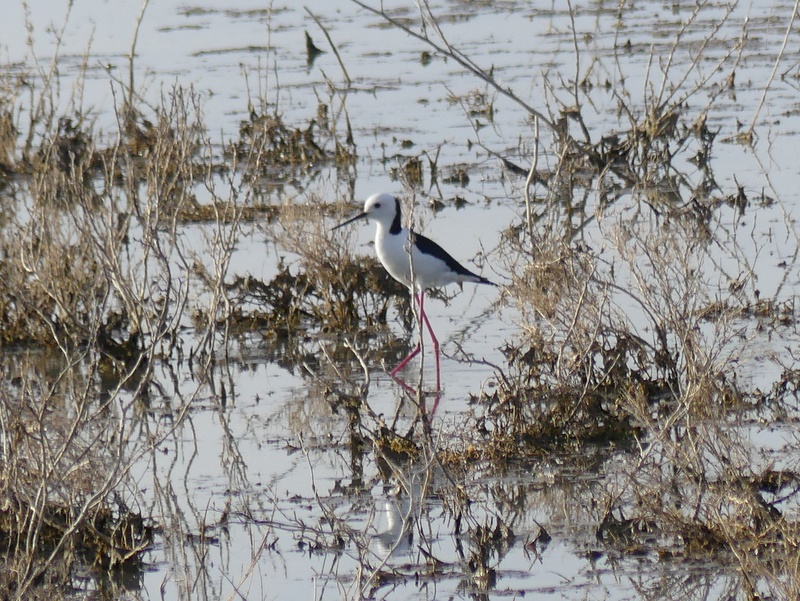
Pied Stilts were breeding there, but the chicks were staying low and away from the road.
I have a special affection for these birds, as one of my first birdwatching memories as a child
was a family holiday to Milang, a little town with lots of holiday shacks by Lake Alexandrina
near the mouth of the Murray River in South Australia. I was delighted by the stilt colony
nearby, loud with their yapping like little dogs, and swirling as they took to the air trailing
impossibly long red legs - indeed the longest proportionally of any water bird.
Crakes are always a challenge and might or might not appear, but on our last
morning we found a spot where there always a few pottering about on the mud.
There were three species present but the Spotless Crake only appeared briefly.
There were several Australian Spotted Crakes Porzana fluminea however,
mostly tolerating but also sometimes harassing...
... the even smaller Baillon's Crakes Zapornia pusilla. This one was actually across
the road, atypically running along a fallen eucalypt sapling in the water, presmably
because there was no exposed mud here.

The most impressive collection of large waders however was in a flooded paddock on the road to Hillston. The attraction was a major kill of young carp, probably due to a 'hypoxic blackwater' incident, in which the organic matter on the surface of the land covered by floodwater oxidises and breaks down removing crucial oxygen from the water.

Dead and dying carp rimmed the shoreline for hundreds of metres; doubtless there were still
numerous live ones remaining too, for a while at least.
And herons, especially White-necked Herons Ardea pacifica and Great Egrets Ardea alba, were there in their hundreds, creating a truly splendid spectacle.

This was only a small part of the vast mixed flock of big herons, with birds constantly coming and
going, and some near the road taking to the wing when trucks roared by.

Both these species, though far from uncommon, are generally fairly solitary birds
and I found this agglomeration mesmerising. I wish I could better convey to you
the sheer grandeur of the numbers!
More, I hope I've been able to excite you with what is going on out on the plains. The birds will start to scatter soon as the water recedes further and I hope some of them come your way. Meantime, if you can still get out to where the floodwaters still lie, I'm sure it will enthral you as much it did us. And if you're in the area, you could do a lot worse than visit Lake Cargelligo.

Sunrise at Lake Cargelligo.
 
NEXT POSTING THURSDAY 13 APRIL
 
I love to receive your comments and in future will be notifying you personally by email when a new posting appears, if you'd like me to. All current subscribers have been added to this mailing list and have already been contacted. This will mean one email every three weeks at the current rate of posting. I promise never to use the list for any other purpose and will never share it.
Should you wish to be added to it, just send me an email at calochilus51@internode.on.net. You can ask to be removed from the list at any time,or could simply mark an email as Spam, so you won't see future ones.

Thursday, 23 February 2023

Beowa National Park#2: some animals

In my last post, I introduced fascinating Beowa National Park on the far south coast of New South Wales, and explained why it is no longer known as Ben Boyd. Today, as promised, I'll conclude the short series with some of the animals of the park that we have encountered there, though of course there were many others that I didn't manage to photograph. Birds are usually the most obvious animals in any area, so I'll start with them. Curiously I've found the campground itself, though within forest and encompassing many original trees, to be generally pretty bereft of birds for no obvious reason. There is one rather entertaining exception however.

This is definitely a Pigeon With a Purpose! Wonga Pigeons Leucosarcia melanoleuca are big
ground-feeding pigeons, usually of wetter forests, along the east coast and ranges of
Australia. They feed on the ground, on fallen fruit and seeds, following a regular route to
and through feeding areas.They're often shy, but not this one! It behaves like a 'normal' Wonga
in following a path at regular intervals, alongside and through the campground, including
camp sites though without seemingly looking for food scraps.
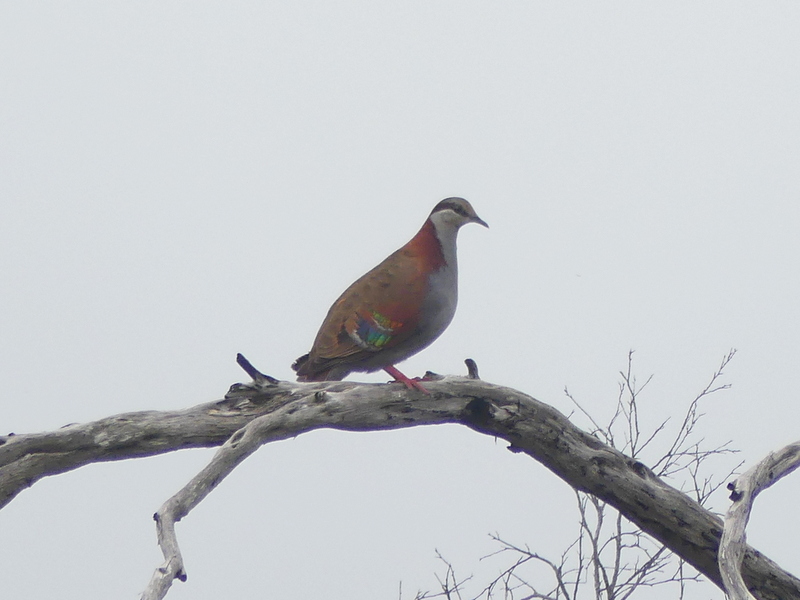
In the heath is another often elusive pigeon - at least there were quite a few in 2022, but I couldn't find a single one on this occasion, an anomaly which I'm unable to explain. Brush Bronzewings Phaps elegans are a little smaller than the more familar Common Bronzewing C. chalcoptera, and more brightly coloured. They occupy a range of habitats in coastal and hinterlands in the south-east and and south-west of the country, but I associate them particularly with coastal heaths.
Brush Bronzewing perched unusually in the open, on a dull early morning.
They really are a lovely bird, even in this dull light.
The Bittangabee Bay area (where the campground is) is noted for its population of human-tolerant Superb Lyrebirds, though we'd managed to miss them last year. This time however we were well aware of them, and in particular one afternoon we were treated to a wonderful lyrebird 'private time'. The male was perched in the shade at about eye level, preening as all birds must do daily, but also seemingly absent-mindedly quietly running through his repertoire of bird-song mimicry. It was a bit like peeping at him through a window, except that he knew full well we were there. I guess he was just rehearsing the words in preparation for his season of display performances in autumn-winter. Obviously it wasn't for our benefit, but we were entranced.
Male Superb Lyrebird Menura novaehollandiae, rehearsing his repertoire of
other birds' songs, while preening.
And a front view, especially of the wonderful tail. It does sort of look like
an upside-down lyre, but he never carries it upright like one - the bird was named
from stuffed specimens.
Eventually, with a showy flounce of wings and tail (which I didn't quite catch)
he hopped down and resumed his business of foraging for small animals in the litter.
More familiar birds were in the forest around the camp; both of these I could see from time to time at home, but it's different when they're in another setting.
Grey Butcherbird Cracticus torquatus taking a brief break from proclaiming his
territory on the edge of the campground. (This, the day we left, was the only
really sunny one we had.)
Yellow-tailed Black-Cockatoo Zanda funerea, on a much more typically dull morning.
They were foraging on banksia cones in the burnt area just down the entrance road.
At the Green Cape Lighthouse lookout were some seabirds, but not many species at the time. In fact here (where I went early each morning) I saw only three species utilising the sea. One is widespread in Australia, the other two not so much.
Great Cormorants Phalacrocorax carbo on a little rocky island off the cape; they can be found on
any water throughout Australia, as well as around the coast.
White-bellied Sea-eagle Haliaeetus leucogaster; it's not often I get to see these
magnificent birds from above.
The other ocean birds present were by far the most abundant, but too far off shore to photograph.There were probably two species of shearwaters present (Wedge-tailed Shearwaters Ardenna pacifica and Short-tailed Ardenna tenuirostris) but most were beyond the range of my binoculars (or skills!). Some on-site information makes mention of watching them migrating daily, but I think that's a bit of a furphy - they can hardly be migrating past for the six months they are here, many of them breeding. Rather they forage daily flying back and forth offshore, and far out to sea. (Short-taileds spend the southern winter in the Arctic North Pacific, but Wedge-taileds go only to the tropics north of Australia.)

The artificially grassy areas where heathland has been cleared around the lighthouse has attracted some common open country species including Australian Pipits Anthus australis.

Australian Pipit on the raised boardwalk to the lighthouse lookout.
But it's heathland where I spent most of my time. Here are three more heath specialists (along with the Brush Bronzewing) which caught my attention.
Tawny-crowned Honeyeaters Gliciphila melanops have always been a favourite of mine,
very distinctive (in fact the only member of their genus), and with a  lovely and unusual fluting call. They are found in coastal heaths from northern NSW to south-west WA, with a break across the Nullarbor. (Curiously the estimable CSIRO's Australian Bird Guide excludes the WA population from its distribution map, at least in the first edition.)
But my main focus this time was on finding and even (for the first time) photographing Southern Emu-wrens, which are common enough in these heaths, but very skulky and, to my ageing ears, inaudible! I failed last time here, but this time went out early each morning walking on likely tracks. (I would also have liked to stumble on a Ground Parrot, but no point in over-optimism!) On the third morning of this I'd pretty much given up but decided before knocking off to drive slowly along a track I'd already walked, just in case. A Striated Fieldwren (another I'd have loved a photo of) flew across and perched briefly on a dead banksia, then dropped into the undergrowth. I thought I might as well have a try, and got out and 'swished' to attract its attention. It dutifully popped back up and perched again - and as I watched through the binoculars it was joined briefly by an emuwren! I was delighted; my shot of the two of them was blurry (probably hands shaking!) but I got just one of the wren on its own, in poor light, but a lot better than nothing.
Male Southern Emuwren Stipiturus malachurus (she doesn't have a blue throat) showing
off the wispy tail which gives him the 'emu' part of the name.
And as a bonus, the Striated Fieldwren Calamanthus fuliginosus proceeded to behave
very amenably for me. Found in coastal heaths of south-eastern Australia from Sydney
to South Australia, and throughout Tasmania, it is regarded as threatened due to habitat loss.
Invertebrates are of course always evident, though not always photographable or, in my case, identifiable. Here are some which did stay still for long enough and, in all but one case, were recognisable even by me (or by someone I know!).
Male Common Flatwing Austroargiolestes icteromelas; thanks Harvey!
This is a common eastern Australian damselfly.
A scarab beetle, but that's as far as I'm prepared to go! Too attractive to ignore though.
And of course in summer there will be butterflies; here are just three.
Brown Ringlet Hypocista metirius, a common little butterfly of the east coast; Family Nymphalidae.
Fortunately for me they tend to keep near the ground and rest regularly!
Splendid Ochre Trapezites symmomus, a very handsome butterfly indeed; Family Hesperiidae.
The larvae feed on matrushes, Lomandra spp.
Varied Swordgrass Brown Tisiphone abeona, another nymph.
This one specialises in saw-sedges, Gahnia spp., like the one it's resting on.
Mammals are always present, though not necessarily obvious in the daytime. Here are three exceptions to the last comment, but first some observations on one nocturnal visitor to our camp which I didn't photograph but can't ignore! I've lived alongside Brushtailed Possums Trichosurus vulpeculus for much of my life, but never met one as contemptuously disrespectful of humans as this one. One night it scrambled onto the little shelf on the side of the camper van and knocked various condiment bottles to the ground, miraculously failing to break any. On another it knocked down a large bottle of cooking oil, this time dislodging the lid. When I approached it, it continued lapping up the oil and refused to even acknowledge me until I took its booty away. After that everything was locked away at night but on the last night it somehow forced its way under the zip of the van door and, without us hearing, found and devoured a banana near our feet, peel and all, and left half a sweet potato for me to find in the morning before forcing its way out again. And I refuse to feel guilty for 'feeding the wildlife' on this occasion!

A more demure neighbour was this Black-tailed (or Swamp) Wallaby Wallabia bicolor, which brought its pouch joey while it browsed on Pittosporum foliage by the camp but didn't even ask for, let alone steal, our food.

Black-tailed Wallabies are interesting in having no close relatives among the kangaroos.
They tend to be browsers (ie on leaves of bushes and trees) rather than grazers (on grass leaves).
One morning early I was walking to the lighthouse when I nearly collided with another stroller who suddenly emerged from a tunnel in the heath, which doubtless led to a burrow, without paying due attention to oncoming traffic.

Common Wombats Vombatus ursinus are indeed common around here where the sandy soils
are ideal for burrow construction, but aren't often encountered during the day.
Off the shore to the left of the headland lookout beyond the lighthouse a regular feature is a gathering of Australian Fur Seals Arctocephalus pusillus, said to be young males, just lolling in the swell.
The extended flippers are apparently acting as heat dispersers. This may seem odd in
these cold waters, but it seems that after vigorous pursuits of fish underwater the body
can overheat due to the thick layer of insulating fat.
After the last post, one anonymous reader predicted that I would discuss both shearwater and Humpback Whale migrations here. See above re the shearwaters, but I'll leave the whales for now. All along the east coast they move north to the tropics in winter to breed, then return towards the Antarctic in spring. The lighthouse area is a good place to watch them go by, though I've not been there at the right time to see them here. 
 
This time the honour of closing out the post goes to the reptiles! Inevitably in summer they were prominent, but a couple really stood out for me. 
Jacky Dragons Amphibolurus muricatus were seemingly everywhere, especially in the heath.
They are common along the south-east coast and in the highlands, and were one of the
first Australian reptiles to be formally named in English, from the Sydney colony in 1790.
Of more interest though - in that I'd not seen it before - was this large legless lizard (about half a metre long), the Common Scalyfoot Pygopus lepidopodus, which I initially mistook for a snake.
They're normally active early or late in the day, not mid-afternoon.
The grey-rusty-grey colour scheme (ie for  head-body-tail) is typical.
Even in close-up I'm having trouble seeing the ear opening which immediately distinguishes
it from a snake.
Goannas, in the form of Lace Monitors Varanus varius are common in the coastal forests and were often seen sauntering around the camp ground, though they didn't seem to be too obviously cadging for food. We watched one wandering right across the beach on a cool afternoon at the bay, then return to flop on the sand in the sun, presumably to get any warmth which was still available.

However one of the highlights of our stay, which involved two big male goannas, actually took place when we did a drive down the highway into Victoria, through the coastal town of Mallacoota and into the adjacent Croajingalong NP. We were investigating the Shipwreck Creek campground for a future stay, and were enthralled by the sight of these magnificent animals straining and wrestling for dominance. It is a struggle for territory, and ultimately mating rights within the territory. It is known in many goanna/monitor species from around the world, and is probably practised by most if not all species. However it's the first time I've witnessed it, and we watched for quite some time, though eventually left them to it.
The erect 'sumo' stance seemed to be the preferred approach, though they regularly
toppled and continued to push from a lower stance.
Like male snakes which have the same ritual, there is no intent to injure - among other
things claws and teeth are valuable and potentially breakable. It continues until one
of the contestants acknowledges defeat and retreats.
It was an extraordinary glimpse at a special and dramatic aspect of the lives of these
impressive animals, and we felt privileged to have been in the right place at the right time.
(And yes, it may be cheating to include this in a post about a different park, but I really couldn't
keep this secret from you and I'm sure it was also taking place somewhere in Beowa!)
After the first post of this series, a couple of people contacted me to say they were planning to visit Beowa - I hope that this one entices a few more to do so. You, perhaps?

NEXT POSTING THURSDAY 23 MARCH
 
I love to receive your comments and in future will be notifying you personally by email when a new posting appears, if you'd like me to. All current subscribers have been added to this mailing list and have already been contacted. This will mean one email every three weeks at the current rate of posting. I promise never to use the list for any other purpose and will never share it.
Should you wish to be added to it, just send me an email at calochilus51@internode.on.net. You can ask to be removed from the list at any time,or could simply mark an email as Spam, so you won't see future ones.