About Me

My photo
Canberra-based naturalist, conservationist, educator since 1980. I’m passionate about the natural world (especially the southern hemisphere), and trying to understand it and to share such understandings. To that aim I’ve written several books (most recently 'Birds in Their Habitats' and 'Australian Bird Names; origins and meanings'), and run tours all over Australia, and for 17 years to South and Central America. I've done a lot of ABC radio work, chaired a government environmental advisory committee and taught many adult education classes – and of course presented this blog, since 2012. I am a recipient of the Australian Natural History Medallion, the Australian Plants Award and most recently a Medal of the Order of Australia for ‘services to conservation and the environment’. I live happily in suburban Duffy with my partner Louise surrounded by a dense native garden and lots of birds.

Thursday, 8 August 2024

Welford National Park; big skies and wide plains

As my regular readers may recall, we are recently home from a memorable four weeks in the semi-arid lands of south-western Queensland. This is the first post - but not the last, be warned! - to stem from that trip. I'll be introducing a few state reserves and a couple of other sites over the next few months, albeit mixed in with other topics.

Australian Bustards Ardeotis australis, in Mitchell Grassland with the Barcoo
River corridor in the background. The fencing remains from the former status
of the park as a grazing property, one of three that were combined to form
the park in 1994. The park was named for Richard Welford, one of the
earliest European landholders there.


Welford is a big park - 124,000 hectares - with a variety of habitats, including Mulga lands, spinifex sand plains, clay pans, sand dunes, river frontages and waterholes. It's not heavily visited, though most of those who go there do so in June and July - including us on this occasion.

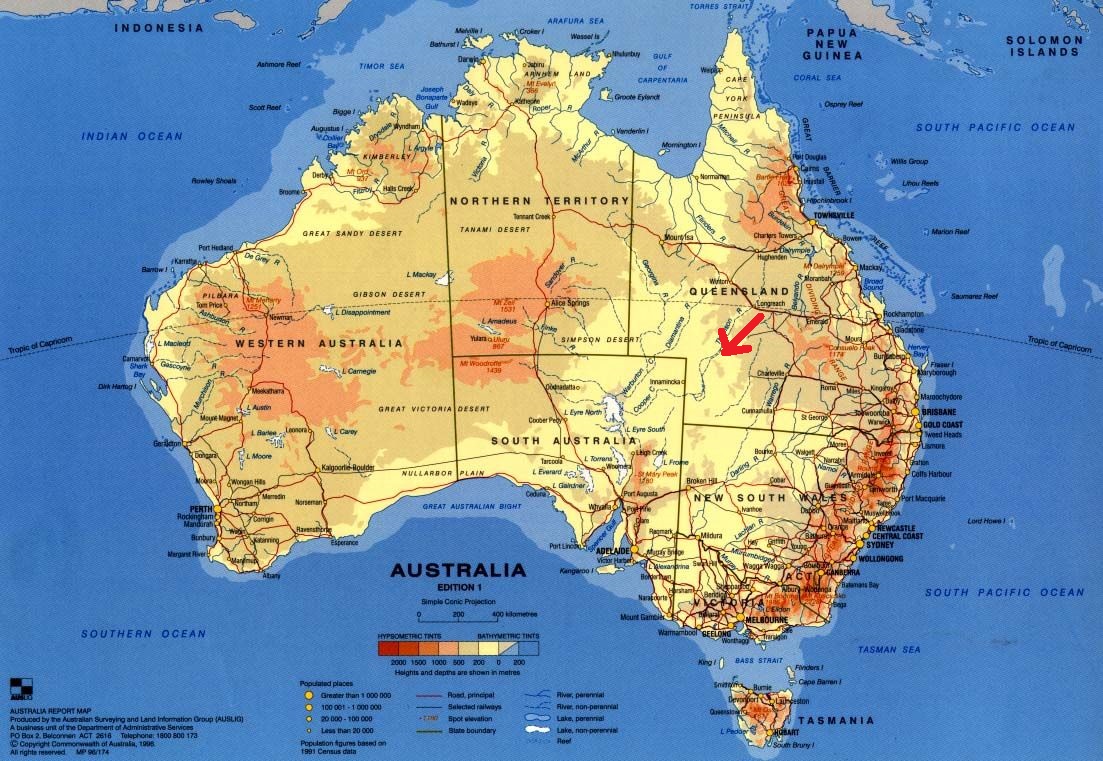
The end of the red arrow indicates the approximate position of Welford,
though I'd not recommend you to use this map to navigate there!

We came from Jundah to the north, though you can also come via the south, from
Windorah or Quilpie. The campground is on the Barcoo River in the smaller (but
still substantial) western section; it is marked by a fairly modest sign by the road, so
keep your eyes open. Do not make my mistake and rely on a well-known phone navigation
application; it took us south out of the park, then west and wanted us to head north
on property tracks which would have taken us to a spot opposite the campground on
the wrong side of the river!
The River Drive and Desert Drive are shorter drives
from the campground; the excellent Mulga Drive is a 70km circuit in the huge
eastern section. (From the excellent South-west Queensland National Parks booklet,
which is available at the information sign in the parks camping areas.)

Little Boomerang Waterhole Campground (the only one in the park) is relatively small and when full is probably a little squishy for our liking, but this was apparently exacerbated by people arriving late and leaving early, some of whom hadn't booked based on the number in the campground on a couple of nights. However for most of the year this wouldn't be an issue and it's a lovely ground, with the sites scattered among Coolabahs Eucalyptus coolabah.

Our camp among the Coolabahs in the morning at Little Boomerang Waterhole camp;
the river is just to the right of this photo.

Here are three views of the Barcoo from the campground; it really is a beautiful place, with River Red Gums Eucalyptus camaldulensis lining the river. The Barcoo is an unusual river (though perfectly normal in this part of the world!) which flows not to the sea, but inland to the Lake Eyre Basin.

At dawn...

... a little after sunup...

... and in the evening.

The River Drive is the shortest and probably least rewarding of the three; ironically the closest it gets to the river is a carpark 200 metres from it, where a rock 'jetty' extends into the water. However of course it's worth doing anyway, because you just never know what might be around the corner!

Rock 'jetty' in the Barcoo on the River Drive.

There are no qualms at all about recommending the other two drives however. The Desert Drive is a 22k drive north from the campground, ending at the Jundah-Quilpie Road near the northern border of the park.

It crosses a clay pan...

... passes a waterhole which isn't on the Barcoo..

... and traverses sandy plains supporting Spinifex Triodia spp. hummock grasslands.
It would seem implausible, to the many Australians who rarely venture
far from the coastal areas, that this habitat covers nearly a quarter of
the total land area of the continent.

Ghost Gum Corymbia dallachiana growing on the spinifex plain.

Probably the highlight of this drive however was the area of red sand dunes, apparently the eastern-most occurrence of them in this part of the world. One such dune has excellent interpretation (unfortunately not a common offering in most of the parks we visited on this trip) and was a delightful short walk.

A view from this dune, looking out over the sand plains.
Much of the flowering from the previous rains in the south-west had ended, but on this dune there was apparently still residual moisture and there was a selection of flowering shrubs.
Desert Rattlepod Crotolaria eremaea.

Sandhill Grevillea Grevillea stenobotrya, one of my favourite grevilleas,
which grows and blooms on dunes right across central Australia, from
western Queensland to the Indian Ocean.

Lolly Bush Clerodendrum floribundum, growing on the lower edge of the dune.
The green fruit will turn black as it ripens, making a dramatic contrast with the fleshy
red sepals, hence the 'lolly' though it's only in appearance! It has a remarkable
distribution right across northern Australia, from coastal rainforests to the desert lands.
Beyond the dune country was dense Mulga Acacia aneura - which remarkably covers another 25% of Australia!
The upright foliage funnels rainwater to the trunk and down to the roots, so
that the tree effectively harvests nearly all the rain that falls on it.
The longer Mulga Drive obviously enough does feature more Mulga woodlands, but also a lot of Mitchell Grass plains Astrebla spp.
Mitchell Grass plains along the Mulga Drive.

Australian Bustards in tall Mitchell Grass (well yes, I know I did, but you can't really have
too many bustards, can you?).
Desert Bloodwood Corymbia terminalis growing in the Mitchell Grass.

At the eastern end of the loop drive there are low stony ridges, with a well-graded easy walk up to Sawyer's Creek Lookout, where there are views out over the mulga-covered plains.

Across the Mulga to other low ranges at the furthest point of the Mulga Drive.
And at the foot of this range is the creek for which the lookout is (somewhat confusingly) named.
Sawyer's Creek waterhole. The 2021 park management plan foreshadows a
'small bush camp' here that would 'provide a different camping
experience to that of the Little Boomerang camp ground', but it is
not clear if this is going to happen.
A couple of flowering eremophila, or emubush, species caught our eye along this route, as they always will. They're right up there as one of a small cluster of my 'favourite plant groups' (along with orchids and banksias in particular); the name means 'desert lover' which should be a clue too!
Harlequin Emubush Eremophila duttonii. This one grows on sandy soils
right across the eastern and central arid zones.

Bignonia Emubush Eremophila bignoniiflora, which also has a wide
inland distribution but grows by water courses or on floodplains.

The birds throughout the trip weren't as prolific as I'd expected after the rains, but the country was drying again and despite the previous few photos most of the flowering had passed. Certainly there were few waterbirds despite the presence of good water, and I suspect that many of the nomads had moved further west but I'm only speculating. There's always something though and many of the flocks included young birds.

Budgerigars Melopsittacus undulatus were breeding, as they always will while
conditions are right, but interestingly we'd not seen any on the trip until we got as
far west as Welford, and then we saw them daily thereafter. Always a joy!
Diamond Doves Geopelia cuneata are common, and very attractive, dry country doves,
but again this was the first time that we'd seen them on the trip.
The Red-backed Kingfisher is the arid land kingfisher Todiramphus pyrrhopygius
of Australia, usually seen on any inland trip, but it never seems abundant.
Whistling Kites Haliastur sphenurus on the other hand can be found anywhere in Australia
where there is water, from the coast to the deserts, especially along rivers.
Zebra Finches Taeniopygia castanotis (above and below) are, like the Budgies,
arid land El Niño specialists, breeding up to huge numbers in the good years,
crashing to survival levels in the others.

Part of a constant parade of little flocks of Zebbies coming to drink at the river
in the early morning by the camp. Their feathers are fluffed up against the cold,
and three of the five whose heads are visible (two on the right, and the middle
one on the left) have recently fledged.

And of course we can't ignore the wonderful Red Kangaroos Osphranter rufus that are emblematic of dry Australia, and for which I'll always pause no matter how often I've seen them. Even just typing this makes me smile to think of them.

Mother and semi-independent young Red Kangaroos in lush Mitchell Grass along
the Desert Drive in Welford National Park, with the Barcoo River behind them.
(The red youngster is probably a male but it doesn't always follow.)
However the animal I'll probably most remember is one I didn't even see, but I certainly have sharp memories of it!
Mulga Ants Polyrhachis spp., often pile dry mulga foliage around the raised mound,
supposedly to help protect against ground surface flood waters, though I don't
know that the theory has ever been tested. However I'd never seen one like this
before, and don't even know even it's the same genus. I assumed that the covering
comprised grey sand grains, and picked some up between thumb and forefinger
for a closer look.
Bad mistake! If you look closely you can see that the grains are in fact
thousands of wickedly sharp spiny burrs, probably from a chenopod
(saltbush family) and presumably to discourage intruders.
It certainly worked on me!! However it was worth the sharp shock
to discover something as fascinatingly new to me as this.
If you have any information on it I'd be glad to hear from you.

If you've read this far you'll enjoy the reality of Welford even more, so put it - and south-west Queensland in general - on your shopping list. I'll be offering more of its parks to tempt you in the coming months, so hope to see you then and thanks for reading.

The start of a day on the plains of Welford, with
the moon still bright before sunrise...
... and its ending with the afterglow of sunset through the Coolabahs of the campground.
NEXT POSTING THURSDAY 29 AUGUST
I love to receive your comments and in future will be notifying you personally by email when a new posting appears, if you'd like me to. All current subscribers have been added to this mailing list and have already been contacted. This will mean one email every three weeks at the current rate of posting. I promise never to use the list for any other purpose and will never share it.
Should you wish to be added to it, just send me an email at calochilus51@internode.on.net. You can ask to be removed from the list at any time,or could simply mark an email as Spam, so you won't see future ones.
If you do leave a comment - and I love it when you do - please remember to click the
box below your comment that says 'Email follow-up comments to...[your address]'
so you'll know when I reply - and I always do!

Thursday, 18 July 2024

Corymbia; ghosts, blood and spots!

This is my first post for a while as we've been exploring the wonders of south-western Queensland, as I mentioned in my last post. We brought back plenty of material for future posts, but for now I'm going to offer something different while I sort out my photos. I also thought this one might be a relatively easy one with which to ease myself back in (my mind is still back with big blue skies, huge horizons, narrow roads stretching out of sight ahead, and surprises round each corner). However, as usually happens in such a situation, it's been a lot more work than I'd realised, as I discovered how much I didn't know and, with new knowledge, came across a couple of misidentifications in my photos. All for the good, I know.

Today I'm talking about an important group of eucalypts, including a few pretty familiar ones, which are no longer called Eucalyptus. That might sound contradictory, but in fact 'eucalypt' is a general name to describe any of the trees that have at some time been called Eucalyptus; they remain as closely related to each other and as instantly recognisable as they ever were.

Flowers of Red Bloodwood Corymbia gummifera, here at Tianjara Falls in Morton
National Park inland from Nowra, south coast NSW. There are a couple of issues here
that are relevant to today's post, the first being the way the flowers are clustered. You may not be
able to see it well here, but the relatively flattened shape of each flower cluster is caused
by the different lengths of the flower stems within the cluster. The lower stems are longer
than the higher ones, so the overall shape is flat, or only slightly domed. This, in botanical
terms, is a corymb, which is different from the way in which other eucalypt flowers grow,
hence the genus name - more on that in a couple of paragraphs time!

The other thing to note in the above caption is the name of the tree. 'gummifera', naturally enough, means 'bearing gum' and while we may not think this remarkable, many early Europeans who encountered eucalypts certainly did. In 1688 the English pirate-naturalist William Dampier reported from the far north-west of Australia that "the Gum distils out of the knots or cracks that are in the bodies of  the trees". Governor Arthur Phillip, who commanded the first British colony on what is now Sydney Harbour, used the term 'gum-tree' in 1778; he collected this gum, and send samples back home, doubtless to have its commercial potential tested. The German botanist Joseph Gaertner first used the name gummifera in a description, but it was Daniel Solander, who sailed with Cook and Banks in 1770 and became the first university-trained botanist to land in Australia, who formally described it in 1788. 

However more than 200 years later the respected botanist Lawrie Johnson of the Royal Botanic Gardens in Sydney, along with colleague Ken Hill, grasped a very large and forbidding nettle indeed when he tackled the problem of what to do about Eucalyptus. The problem, in a gum-nut shell, is that the differences between Eucalyptus and Angophora are no greater than between the various sub-groups of Eucalyptus. Logic demanded either incorporating Angophora into Eucalyptus, or splitting Eucalyptus; Lawrie boldly chose the latter. Before his sad death from cancer in 1997 he had got as far as separating out the bloodwoods, spotted gums and ghost gums as Corymbia; they remain in most books now as the only other non-Eucalyptus eucalypt. There are four sub-groups within Corymbia; in simple terms they are the red bloodwoods (59 species), the yellow bloodwoods (11 species), the ghost gums (24 species) and the spotted gums (3 species). (There are also three outliers, but we won't worry about them today). 

That's about as technical as I'm going to get here - for the rest I'll introduce members of the four main groups and we can just admire them! Many of the bloodwoods, including those most familiar in the south-east, readily 'bleed' sap on the trunk, often encouraged by the gnawing of glider possums.

Desert Bloodwood Corymbia opaca near Windorah, south-west Queensland,
'bleeding' copiously, though not to any detriment! This species was separated
from the much more widespread C. terminalis (see below) in 1985, though
not everyone accepts the distinction.
Many of this group have plated bark, like this one, though not all.
Red Bloodwood again, near Narooma on the NSW south coast.

Pink Bloodwood C. intermedia (like most tree 'colour' names, the pink refers
to the timber, not that I've ever seen it). This one was in the Coffs Harbour Botanic
Gardens on the north coast of NSW, though it is an original tree.
These last two species are trees of the temperate south-east, though a couple of other well-known red bloodwoods are from the south-west (though are not called 'bloodwood').

Red-flowering Gum Corymbia ficifolia, in Wagga Wagga Botanic Gardens.
This small tree has a very small natural distribution in the south-west of Western Australia,
mostly along roadsides, but is very widely planted in gardens and road verges across
southern Australia. This photo shows the corymbs fairly clearly.

Marri C. calophylla, Darling Ranges near Perth. This is a very impressive
tree which dominates some dry forests in the south-west, often along with
Jarrah Eucalyptus marginata. Its big hard fruits (very like those of the Red-flowering Gum
above) are key food for the Red-capped Parrot and the Endangered Baudin's
(or, more helpfully, Long-billed) Black Cockatoo, both of
which extract the tiny seeds with a thin elongated upper mandible.
Others, like the Desert Bloodwood above, are restricted to the arid inland and the seasonally dry north.

Inland, or Desert Bloodwood C. terminalis, above and below. The one above
is in Currawinya NP, in south-west Queensland, and the one below in
Boodjamulla/Lawn Hill NP in monsoonal north-west Queensland,
with torrential summer rains and arid winters.

I'm especially fond of this species, and I see it on any inland trip to the northern half
of Australia, in four of the five mainland states and the Northern Territory.
 Another closely related desert bloodwood was only recognised in 1995.

Sand Dune Bloodwood C. chippendalei, Great Sandy Desert, central eastern WA.
This one only grows on dunes in the central and western deserts.
It was named for George Chippendale, an expert on plants of the Northern
Territory and later the author of the mighty eucalypts volume of the Flora of Australia.
He was also a lovely person who delighted in sharing his knowledge with others.
Corymbia deserticola (another 'Desert Bloodwood' though without a formal English name)
also growing in the Great Sandy Desert. It has a similar distribution to the Sand Dune
Bloodwood, but a wider range of habitats though is usually found on the plains.
Other red bloodwoods grow only in the seasonal tropics.
Small-fruited Bloodwood C. dichromophloia, Boodjamulla/Lawn Hill NP.
This common bloodwood is found from north-west Queensland to the Kimberley.
It is smooth-barked except for the base of the trunk, to which flakes of old bark adhere.

(Another) Red Bloodwood C. erythrophloia, Undara Lava Tubes, north Queensland.
This very striking tree grows in eastern tropical Queensland.
The yellow bloodwoods are much fewer in number. This one is common, and especially conspicuous.

Yellow Jacket C. leichhardtii, Salvator Rosa NP, south-central Queensland
(part of the Carnarvon Range), above and below. This is its southern-most extent,
but it extends north on the western slopes to Mareeba and is readily seen on a
drive through the Queensland tropical woodlands, where sandy soil overlays sandstone.
And one familiar to readers from the Sydney region, is Yellow Bloodwood C. eximia, also found only on sandstone, from Nowra to the Hunter Valley.
Yellow Bloodwood, here at Glenbrook in the Blue Mountains
(and I really must get a better photo of this species!).
There are just three species in the spotted gum group, including the well-known Queensland endemic Lemon-scented Gum C. citriodora - well known because it is widely planted in southern Australia. I used to walk to university in Adelaide through a large stand of them in Botanic Park. However further south by far the best known spotted gum is, wait for it... Spotted Gum C. maculata, which grows all along the NSW coast south from Taree. It is a lovely and readily recognisable tree for its blotchy bark, caused by grey flakes of old bark sticking to the trunk. Here are three Spotted Gum portraits from the south coast of NSW - I'm very partial to them!
Spotted Gum forest along a walk to the beach, Murramarang NP.
Tall old Spotted Gum near Nowra - I couldn't get far enough away to fit
it all into a conventional photo.
Spotted Gum forest with typical understorey of Burrawang cycads,
Macrozamia communis, near Nelligen.
Finally, the last group of Corymbia comprises the wonderful ghost gums, which I blogged about in more detail seven years ago here. By far the best known is the Ghost Gum of central Australia, from eastern WA to western Queensland.
A Ghost Gum C. aparrerinja, estimated to be at least 300 years old, at Trephina Gorge,
eastern Tjoritja (MacDonnell Ranges). For more photos of this very beautiful species,
and some interesting information I was given about the origin of the unusual
species name, see the link immediately above.
Ghost Gum by the road west of Windorah, south-west Queensland.
This must be close to its south-eastern limits.
(It occurs slightly further east to the north of here, at Barcaldine.)
Other ghost gums occur in the tropics.
Rough-leaved Ghost Gum C. aspera, Boodjamulla/Lawn Hill NP. The species is
found across the northern tropics from here in north-west Queensland to the Kimberley.

Ancient C. blakei in Bladensburg NP in central Queensland, growing on
a substrate too hard to penetrate with its roots! It is restricted to this part of Queensland.

Two others in the ghost gum group are very striking trees from eastern Queensland, though to my frustration my photos don't do them justice. Oh well, I'll just have to go back!

Dallachy's Ghost Gum C. dallachiana, Barcaldine. This is a young tree (and drought-affected)
and doesn't give much indication of how handsome it will grow up to be!
And we end with another favourite of mine, the stately Carbeen, or Moreton Bay Ash
C. tessellaris. Heading north we encounter this tall white tree with a rough grey or black
bark stocking in northern NSW, and it continues right up to Cape York.
Well, if this topic didn't interest you much, you won't be still reading! For those who are, thank you for persevering and I hope you learnt something of interest (I certainly have) and at the least enjoyed some of the trees themselves. Next time I'll be back with a more general posting, almost certainly based on one of the lovely parks we've recently spent time in, in south-western Queensland.

NEXT POSTING THURSDAY 8 AUGUST
I love to receive your comments and in future will be notifying you personally by email when a new posting appears, if you'd like me to. All current subscribers have been added to this mailing list and have already been contacted. This will mean one email every three weeks at the current rate of posting. I promise never to use the list for any other purpose and will never share it.
Should you wish to be added to it, just send me an email at calochilus51@internode.on.net. You can ask to be removed from the list at any time,or could simply mark an email as Spam, so you won't see future ones.
If you do leave a comment - and I love it when you do - please remember to click the
box below your comment that says 'Email follow-up comments to...[your address]'
so you'll know when I reply - and I always do!