About Me

My photo
Canberra-based naturalist, conservationist, educator since 1980. I’m passionate about the natural world (especially the southern hemisphere), and trying to understand it and to share such understandings. To that aim I’ve written several books (most recently 'Birds in Their Habitats' and 'Australian Bird Names; origins and meanings'), and run tours all over Australia, and for 17 years to South and Central America. I've done a lot of ABC radio work, chaired a government environmental advisory committee and taught many adult education classes – and of course presented this blog, since 2012. I am a recipient of the Australian Natural History Medallion, the Australian Plants Award and most recently a Medal of the Order of Australia for ‘services to conservation and the environment’. I live happily in suburban Duffy with my partner Louise surrounded by a dense native garden and lots of birds.

Thursday, 10 February 2022

Seasons of Cocoparra National Park; a Riverina treasure

We're very recently back from a short stay in one of our favourite parks, Cocoparra, some 400km to the west, in a low range near the irrigation town of Griffith in the Riverina region. At this time of the year the coast is far too busy for our comfort, though we're heading there in a couple of weeks when the school holidays end. It's been a cool wet summer for the second year in a row, so we felt confident in heading inland to areas that are generally uncomfortably hot for camping at this time of year. It involves a half-day drive through the woodland remnants of the deep soils of the South-west Slopes region to the edge of the great Western Plains, which effectively roll flatly on until they reach the Indian Ocean, almost 3000km away. 

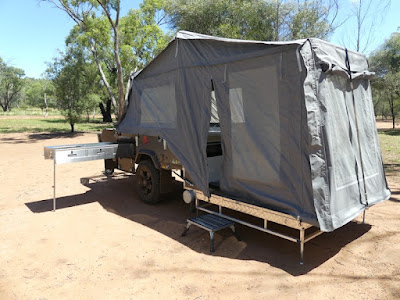
This trip also marked our first in our new camper van, which we've been planning for years after many, many years of tenting, in acknowledgement of the passing years.

    
Above our camping set-up until now, and below the future!
Both photos are in the same campsite at Woolshed Flat Camp Ground at Cocoparra.
 
The green on the ground under the trees in the background is testament
to the wet period - we are in the second year of a combined La NiƱa (which affects the Pacific)
and Negative Indian Ocean Dipole Events. The previous photo was taken during an extensive
drought which only ended in mid-2020.
Griffith (and Cocoparra) are at the end of the red arrow.
This post is actually an updated and supplemented version of a post I wrote some years ago, during the drought, to offer contrasting faces of the park between wet and dry periods, both of which are quite natural here. And of course I have more photos to offer now. The average annual rainfall for the area is only 400mm anyway, and last time we stayed there, four years ago, there had only been 25mm in the previous three (hot) months. This time nearly 300mm had fallen in the last three months, and there were flowers and flowing streams.
 
When the sourly disposed Surveyor-General John Oxley entered the land of the Wiradjuri people in June 1817 he was, predictably, not impressed. Of the plains, which supported rich though dry woodlands and mallee shrublands, he commented: “There is a uniformity of barren desolation of this country which wearies one more than I am able to express.” Of the view from the ridge of Cocoparra (which he called Peel's Range) he opined: “I am the first white man to see it, and I think I will be undoubtedly the last.” He continued that theme when, to mark the king's birthday, they planted oak, apricot, peach and quince seeds in the range (well, he was an surveyor, not a horticulturalist) and he sniffed that the act was "to serve to commemorate the day and situation, should these desolate plains be ever again visited by civilised man of which, however, I think there is little probability". Perhaps not someone you'd invite twice to dinner.

Civilised or not, Europeans certainly did come and settle, albeit some 50 years later, taking up the land surrounding the range as huge grazing properties, which were later subdivided into wheat farms in the early 1900s. Meantime, not far to the west, a massive irrigation scheme, planned in the late 19th century and activated in the early years of the 20th, was transforming the plains, bringing water from new distant reservoirs on the Murrumbidgee River. The rich soils lacked only water, and with that they now produce huge quantities of grapes, citrus, stone fruits, olives and vegetables. In fact on this trip we were somewhat taken aback to see that new vineyards have encroached right to the edge of the range at one point.

Fortunately for us, none of this affected the Cocoparra Range much; there was some opportunistic grazing, but in general the slopes and gorges were too rough for stock. In acknowledgement of this (plus, we hope, because of the undoubted biodiversity values of the range) it was declared a national park in 1969. It covers only 8300 hectares, though is supplemented by the 4600 hectare Cocoparra Nature Reserve adjoining to the north (a nature reserve is dedicated wholly to conservation and research, not passive recreation, which is a function of national parks).
 
Welcome to Cocoparra National Park!
 
Looking west over the plains from Cocparra to the McPherson Range, at the foot of which lies Griffith.
Black Cypress Pine Callitris endlicheri dominates the foreground.
The two ranges comprise 350 million year old sandstones and other sedimentaries,
laid down on an inland floodplain. Folding and uplifting have raised the ranges
above the much newer soils which filled the basin between them.
  
Looking in the other direction, to the north-east from the highest point in the park,
Mount Bingar, a not-very-lofty 450 metres above sea level. This photo, from
our recent trip, certainly looks greener than the previous one, though this is
partly due to the Spearwood Wattles Acacia doratoxylon in the foreground.

The plants and resident animals of the park are quite capable of dealing with arid conditions, but wet conditions bring flowers, ephemeral herbs and frogs calling in the gorges. 

Firstly a quick general introduction to the park via the main vegetation types. As we would expect, the vegetation on the hills is very different from that on the lowest slopes and valleys. As seen in the first of the two vista photos above, Black Cypress Pine is an important component on the hillsides and ridges.

Black Cypress Pine along Jack's Track. This is one of our favourite walks in the park,
which starts on the exposed slopes and ends by descending
into the gorge sometimes known as Ladysmith Glen; several of the photos here were
taken on that walk. However on our most recent visit the upper section of the track was
closed for maintenance (perhaps unsurprising after 300 recent millimetres of rain!),
which was a double pity as there would have been good flowering up there.
Currawang Acacia doratoxylon. This tall spindly wattle forms dense stands on ridges in particular.
It is also known as Spearwood Wattle, which is the meaning of the species name too.
Dwyer's Gum Eucalyptus dwyeri. One of the red gum group, which grows almost
exclusively in rocky situations. In particularly harsh positions it will grow as a mallee form -
ie a multi-stemmed shrub sprouting from a subterranean lignotuber.
 On the deeper soils different trees predominate.
Mugga Ironbark Eucalyptus sideroxylon, with White Cypress Pine Callitris columellaris on the left.
The deeply fissured bark is impregnated with kino, and as it dries out becomes immensely hard.
There are a few dozen species with this characteristic scattered across eastern Australia.
Bimble Box Eucalyptus populneus. This lovely tree is characteristic of the NSW western plains, and
north into Queensland. The shiny rounded leaves give rise to the species name, meaning 'poplar-like'.
And in the few creekbeds - which are dry most of the time - are found the ubiquitous River Red Gums Eucalyptus camaldulensis, which dominate every stream line in inland Australia.

River Red Gums along Jack's Creek Gorge (or Ladysmith Glen).

Contrast this with the same gorge (albeit not quite the same spot) four years ago.


And more of the gorge from January 2022, in a state I'd not it for years - a delight!
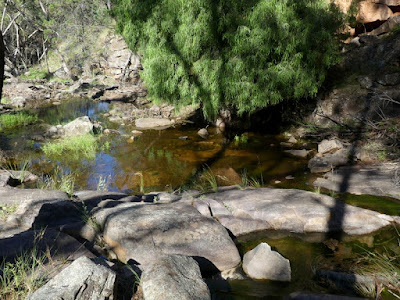
 
I'm sorry you can't hear the frogs calling.
 
This is a lovely little gorge; we always pause at the lookouts above the gorge before descending - not this time of course, unfortunately, so not much 'lush' in these shots. However as a geologist might say, the less plant growth there is, the more you can appreciate the rocks! And I must say that sandstone is always a pleasure.

Looking down into Jacks Creek Gorge (Ladysmith Glen).

Looking across the gorge in another dry year, 2011.

Cliffs in Jack's Creek Gorge again, 2011. The creepers tumbling down the faces are
Wonga Vine Pandorea pandorana, Family Bignoniaceae. I'll come back to them soon.

And more sandstone, on another very pleasant creek walk, this time Store Creek,
a short drive south of Jack's Creek.

But back now to a few more plants before moving onto some of the animals of Cocparra, starting with the Wonga Vine.

The lovely tube-shaped flowers of Wonga Vine. Remarkably, this species is found in most habitats
in all mainland Australian states, and beyond to New Guinea, Vanuatu and Indonesia.

Deane's Wattle Acacia deaneii flowering in Jack's Creek Gorge.
This is locally common in more sheltered areas of the park.

And unlike our most recent previous visits, herbs were abundant.
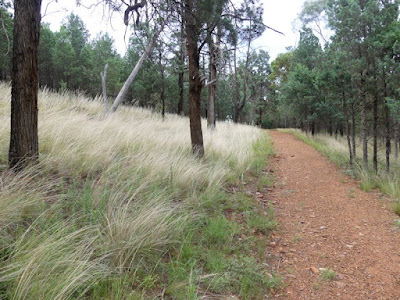
Native grasses flowering under the Callitris along Store Creek walk, a delight to see.
The gentle slopes around the camp ground were covered in swathes
of flowering daisies.
Purple Burr-Daisies Calotis cuneifolia and Yellow Burr-Daisies C. lappulacea.

Close-up of the Purple Burr-Daisies. Both species had been flowering for a while,
so there were lots of burrs (immensely prickly and clingy seed heads), a
great encouragement to stay on the tracks.

Which brings us to a few of the birds of Cocoparra; most of the following were taken around the camp ground.
Bar-shouldered Dove Geopelia humeralis. The distinctive "let's go to schoooool" call
echoes around the camp, and the pretty doves are all around. I only saw them here
for the first time in 2018 (though I'm not there every year). This is a bird which seems
to be extending its range south along the coast, and increasingly inland.
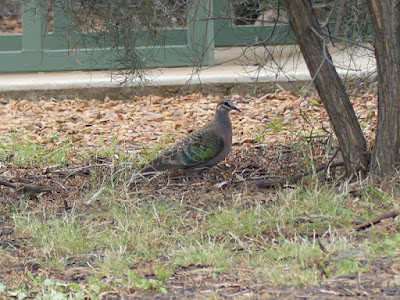
There were actually five pigeon/dove species around camp, though I failed to get photos of Diamond Doves and probably didn't try for the Crested Pigeons, which are common at home too. Here are the other two, both common and familiar, but always welcome.
Common Bronzewing Pigeon Phaps chalcoptera.
Peaceful Dove Geopelia placida; their melodious 'toodle-oo' calls
were the sound track of the camp ground. This is not a very natural setting, but its current attraction
to birds is determined by the wet summer. There is a covered barbeque area,
with a tank filled by pipes from either side of the roof.
In the roof of the tank is a recess into which the pipes empty, covered
with a grill to stop leaves getting in. After so much rain the tank is completely full
and the birds were queuing up to drink from the 'well' at the top of it.
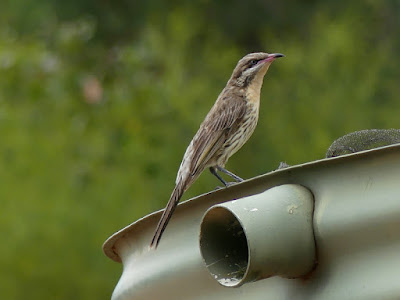
Apart from the doves, the main drinkers were honeyeaters, especially the ubiquitous Spiny-cheeked Honeyeaters Acanthagenys rufogularis.
Spiny-cheeked Honeyeaters are very attractive dryland honeyeaters, quite large, with
pale salmon breast and throat, black-tipped pink bill and blue eyes.
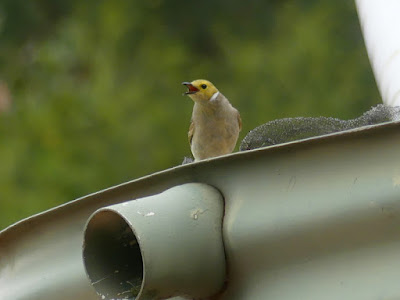
White-plumed Honeyeaters Ptilotula penicillata are common wherever there is water, especially along
River Red Gum streamlines, which they can dominate.
Other honeyeaters were about, including a White-eared Honeyeater Nesoptilotis leucotis which also came to drink, though I didn't catch it there.
White-eared Honeyeater gleaning insects above our camp.
Blue-faced Honeyeater Entomyzon cyanotis on the way out of camp; this is the only one I've
ever seen in the park. The greenish eyepatch (not bright blue) tells us that it's a young
bird so perhaps it was dispersing after fledging. They're commoner in the wetter
areas around Griffith.
Parrots, mainly the Ringnecks, which tend to replace rosellas in the dry country, are common around camp.
Ringneck Parrots Barnardius zonarius, above and below, are constantly and noisily
present in the camp ground and along roadsides.
 
Blue-bonnets Northiella haematogaster are common along the perimeter roads, but I find them nervous and generally hard to photograph. Mulga Parrots Psephotellus varius are less common and seemingly not always present - we didn't see them this time, though have in the past.
Male Mulga Parrot Psephotellus varius, one of our loveliest parrots (in my opinion at least!)
and found throughout much of Australia's drylands.
One of the highlights of this trip, which I didn't catch with the camera, was a pair of Threatened Glossy Black-Cockatoos Calyptorhynchus lathami which flew low overhead one morning as I was making the tea.
 
 Here are some other campground birds from various trips.
Jacky Winter Microeca fascinans, one of the fly-catching Australian robins,
though without the distinctive colours of most of their family.
White-browed Babbler Pomatostomus superciliosus, the smallest of the four Australian babblers
(there is also one in New Guinea). (More on them here.) I love these bold raucous highly sociable larrikins bouncing across the ground and making it clear just whose campground it is!
Speckled Warbler Pyrrholaemus sagittatus, in Deane's Wattle Acacia deanei.
Wedge-tailed Eagle Aquila audax; this beauty was perched by the road as we drove
out of camp one morning.
And some other animals. There were four species of kangaroos around the camp - Eastern and Western Greys, Red-necked Wallabies and Euros. Only the Eastern Greys were actually in the campground.
 
Euros Macropus robustus are stocky hill kangaroos found right acrosss
the country.

Eastern Bearded Dragon Pogona barbata catching the late afternoon sun on a track, and
confident that we hadn't seen it. This is a familiar big lizard, found in a broad band of country
inland from the coast across south-eastern Australia.
Male Wandering Ringtail damselfly Austrolestes leda (thanks Harvey)
attracted to the ephemeral pools in Jack's Creek Gorge.
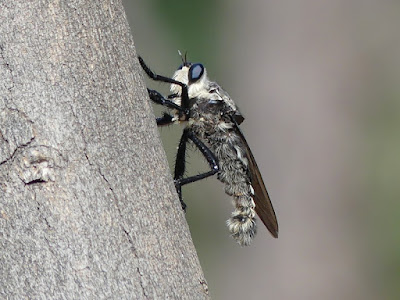
An impressive robber fly, Blepharotes sp. (thanks Kimberi) and maybe B. coriarius (thanks Harvey),
Family Asilidae that hung around our camp.
In flight it had a striking bright orange back, but not visible here.
Striped Carrion Fly Oxysarcodexia varia (again I'm almost certain); possibly an unfortunate name
for PR purposes, but it's a pretty snappy little creature.
Orange Spider Wasp Cryptocheilus bicolor hunting for spiders to paralyse,
in order to feed her larvae from eggs laid on it in a burrow.
(This wasp normally has a black abdomen with two orange stripes, but it seems that
it can sometimes be all orange. As ever, I claim no expertise here.)
At night Owlet-nighjars and Tawny Frogmouths call, and the rising moon and stars shine through the Bimble Box and the Southern Cross rides above. Who'd want to be anywhere else? As with all NSW parks now, you must book a campsite in advance on line, though it's free. Only six campers at a time are permitted so you'll not ever be crowded. You won't be sorry you went.


NEXT POSTING THURSDAY 3 MARCH
I love to receive your comments and in future will be notifying you personally by email when a new posting appears, if you'd like me to. All current subscribers have been added to this mailing list and have already been contacted.
This will mean one email every three weeks at the current rate of posting. 
I promise never to use the list for any other purpose and will never share it.
Should you wish to be added to it, just send me an email at
calochilus51@internode.on.net.
You can ask to be removed from the list at any time,
or could simply mark an email as Spam, so you won't see future ones.
Thank you!

Thursday, 20 January 2022

Black Cockatoos; wailing spirits of the land

No, I haven't really gone all mystical since last year, but there is something truly thrilling about a flight of massive black-cockatoos rowing easily across the sky, their creaking wailing calls drifting down as they pass over. This is a uniquely Australian experience, as the five species all evolved here and are found nowhere else.

Yellow-tailed Black-Cockatoos Zanda funerea, part of a large flock flying over Lower Glenelg NP,
far western Victoria, under a leaden sky.
Overall there are 21 species of cockatoo that together comprise the family Cacatuidae. The only ones found outside of Australia are seven of the 11 species of the genus Cacatua, which live in New Guinea and nearby islands scattered as far as Sulawesi and the Philippines. Although the massive Palm Cockatoo Probosciger aterrimus is also black, it is much more closely related to the white and pink cockatoos.
Red-tailed Black-Cockatoo Calyptorhynchus banksii, Nitimiluk NP, Northern Territory.
Coming in to land, it shows the typical black-cockatoo characters of long rounded
wings and long tail, massive bill and overall dark plumage with coloured tail panels.
This one is moulting, currently regrowing the outside left tail feather.
Red-tailed Black-Cockatoo landing, Bourke, New South Wales, and giving
a slightly better view of the lovely tail panels.
Yellow-tailed Black-Cockatoo, Murramarang NP, south coast New South Wales,
cracking banksia cones to get at the nutritious seeds - an accomplishment that would be
fatal to our teeth! This shows better the huge powerful bill and also the typically
zygodactylous feet, though this is not a structure unique to the cockies.
The four toes are opposed with the outside two pointing backwards and the middle two
facing forwards. This is an excellent arrangement for both grasping food and for
clambering in trees. (This bird is a male, with dark bill and reddish eye-ring.)

We have now met the two genera, Zanda (with yellow or white highlights) and Calyptorhynchus (with red or orange panels). For most of their taxonomic history they have all been included in Calyptorhynchus, a name applied by the French zoologist Anselme Desmarest in 1826. It means 'covered bill' (ie the base of it, by feathers), and while true it is certainly not unique. In 1913 the somewhat erratic but highly productive Gregory Mathews, a wealthy Australian working from England, separated out the 'yellow and white' black-cockatoos and called them Zanda. Characteristically he didn't see a need to explain the name, and it might have been inspired by an Indigenous name (though probably not, as he also used it as a subspecies name for several unrelated birds) or he might simply have made it up - he had form. Also typically it didn't take on, until within the past decade when based on plumage characters (coloured bars and speckles on the 'red' females, but not the 'whites and yellows') and significant differences in begging calls of young birds, it was resurrected.

Red-tailed Black-Cockatoo pair roosting (and canoodling) in a tree by a waterhole near
Barcaldine, central Queensland, female on the right. (And try as I might I couldn't get
a vantage point where the sun wasn't behind them, though they were quite
unperturbed by us.)

Black-cockies are found throughout much of the continent except for the deep deserts, though Red-tails are found well inland where there is water. They alone are found scattered in separate populations in every Australian mainland state and the Northern Territory. Yellow-tails are found in a broad hinterland band from Eyre Peninsula in South Australia to Tasmania and the southern tropics in Queensland. They are the most familiar ones to most people, living in the heavily populated south-east. They're not typically suburban birds, though they're quite common in Canberra and are regular in and over the suburbs. Luckily for us they love the big bankia which overhangs our balcony and they drop by from time to time to sample the seeds ripening in the tough cones.

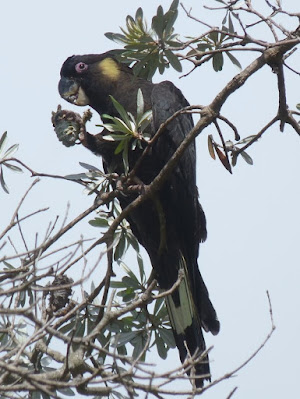
Female Yellow-tailed Black-Cockatoo in Silver Banksia, suburban Duffy, Canberra.
(She has a white bill and brown eye rings.)
This leaves three species with much more limited distributions; all are regarded as Threatened due to habitat loss (especially large hollow-bearing breeding eucalypts) and fragmentation.

The Glossy Black-Cockatoo Calyptorhynchus lathami is scattered across a large area of coastal south-eastern Australia, extending well inland in places. It is a casuarina specialist, living almost exclusively on the dust-like seeds that they extract from the cones, having selected a tree with a good proportion of ripe cones. It nips off a cone, holds it up (nearly always in its left foot) and rotates it, stripping off the woody layers and eating the tiny seeds. They must feed nearly all day to get enough. While doing so they can often be readily approached, giving themselves away by soft metallic grating creaks. 
 
They are listed as Vulnerable (ie to extinction) in each state and territory in which they occur, though the Kangaroo Island population in South Australia is Endangered.
Male Glossy Black-Cockatoo eating casuarina cones, Bawley Point, south coast
New South Wales. He has a dark bill and plain head.
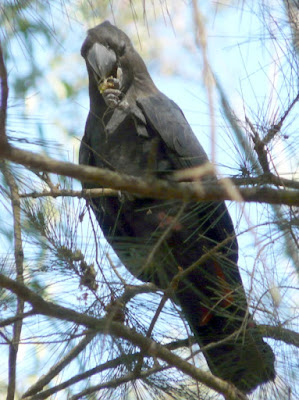
Female Glossy Black, Nowra, further south down the coast. She has a white bill
and yellow-blotched head. Both sexes have red tail panels, which are the source of reports
of Red-tailed Black-Cockatoos in the south east. These are invariably incorrect
but are persistent.

While on the topics of myths around black-cockatoos, a favourite is that they are bringers of rain. Undoubtedly the two coincide on occasions, but they also turn up here regularly during drought and many a rainstorm is unheralded by cockies (or any other birds known as 'rain birds'). It's a curious one and its adherents cheerfully brush such objections aside. I admire their faith.

In the south-west of the continent are two species of white-tailed black-cockatoos, which apparently arose in wetter times when yellow-tails were able to cross from the east before the arid Nullarbor Plains closed the access. This has happened more than once and presumably the two white-tailed species arose from separate crossings, the second after the first had been there long enough to evolve into a separate species and unable to breed with their now distant relations. They are quite similar and the differences weren't recognised for a long time, until 1948 in fact. The key difference is in the beaks, which relate, naturally, to their diets. For a while they were known, logically to most of us, as Short-billed and Long-billed White-Cockatoos but (unfortunately for those of us who aren't keen on lumbering unsupecting animals with human names) they are now known as Baudin's Black-Cockatoo Zanda baudinii and Carnaby's Black-Cockatoo Z. latirostris. Both species are listed as Endangered

Carnaby's (Short-billed) Black-Cockatoos at Yanchep, north of Perth. Here they are in
their major habitat of banksia coastal heathland, where their short heavy bills are
employed in cracking open the cones, like the Yellow-tails from which they derived.

A female (white bill, large cheek patch), part of the same flock.

As well as the coastal heaths (kwongan) Carnaby's are found inland in Wandoo woodlands where there is an understorey of Banksias and related woody-seeded shrubs. They are named as a tribute to West Australian entomologist and jewel beetle expert Keith Carnaby, who recognised that two white cockatoos are present and published it in 1948. 

The 'other' species, Baudin's Black-Cockatoo, is taken from the species name, which in turn is for the French naval officer Nicholas Baudin who commanded the great scientific expedition to Australia from 1800 to 1803. By all accounts he was appallingly rude and unsympathetic to the needs of the scientists who were the point of the whole exercise, but I also note that he died on the way home and history tends to be written by the survivors.

Baudin's (Long-billed) Black-Cockatoos, Stirling Ranges NP. Unfortunately their bills are
largely obscured by the feathers (hence Calyptorhynchus!) but you get some idea of its
longer and more slender nature from the bird on the left. (I recall this morning as offering some
of the worst light I recall - at least to someone with my limited photographic skills!)

It's a pity I can't show you the bill in more detail, because it's very specialised. Like other black-cockies the top bill is very mobile, hinged to allow greater movement than that of most birds, to allow delicate grasping and great pressure to be applied. However it is also very long and slender to enable the extraction of seeds from the large woody fruit of Marri Corymbia (or Eucalyptus) calophylla, a common tree of the south-western forests and moister woodland.

The incredibly tough Marri fruits (here in John Forrest NP, near Perth) are up to 50mm long
and 35mm wide, and can form all year round, producing large numbers of seeds
over an extended period, including during the sometimes hungry days of winter.
This is a very valuable resource, worth the effort of extraction. The bill is strong
enough to crush the capsule, then the top mandible extracts the tiny seeds.
Faced with an apple, the cocky will similarly extract the seeds and ignore the flesh! This has led to many fatal interactions with orchardists, some under licence, others illegal.
 
As well as seeds, other black-cockies also eat fruit; Red-taileds are very fond of the fruit of White Cedar Melia azedarach. This tree is native to NSW, Queensland and the Northern Territory as well as across south-eastern Asia to China and Japan, and across the Pacific. It mostly lives on rainforest margins, but has been widely planted. The fruits, seeds and leaves are toxic to most mammals, but not birds. In Bourke, in far northern inland NSW (and doubtless other inland towns too), the Red-taileds can always be found in town when the White Cedar street trees are in fruit.
Red-tailed Black-Cockatoo dining in town on White Cedar fruits, Bourke.
It might be a surprise to know that they can be quite carnivorous too. Yellow-taileds are very assiduous in extracting large beetle and moth larvae from the interior of very hard eucalypts, doubtless to the surprise of the larvae who doubtless consider themselves safe there. The birds will clamber down the trunk of the tree, searching for the holes through which the grubs void their waste (frass, in case you were looking for a more technical term). It will then rip out a strip of timber with its formidable bill, until it is at about 45 degrees to the trunk, and use it as a perch from which to work, tearing the hardwood out until it reaches the luckless and luscious grub. 
Blackbutt Eucalyptus pilularis excavated by a Yellow-tailed Black-Cockatoo,
Ulladulla, south coast NSW.
They also spend a lot of time on much softer wattles too, an easier proposition from which to extract the meal, though the smaller the stem the smaller the reward too.
Yellow-tailed Black-Cockatoo working on an Acacia stem, Murramarang NP.
The holes by his left foot may be exploratory, or there may have been more
than one grub present.
So, the wonderful black-cockatoos, old Australians who still thrill us with their wailing presence in the skies, in the forests, and even, on a good day, in our yards.
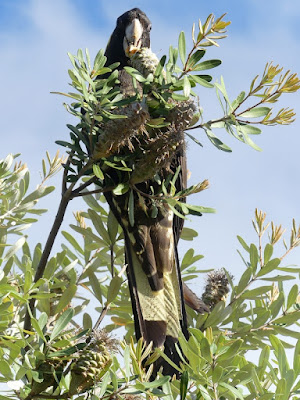
Yellow-tailed Black-Cockatoo female (but you knew that!) just outside my study window,
snacking on banksia seeds and discarding the rest. I don't mind cleaning up after her..
After all, any black-cocky day is a good day.
(And because I don't want to leave the other cockies feeling miffed, I promise to write about them someday soon.)
NEXT POSTING THURSDAY 10 FEBRUARY

I love to receive your comments and in future will be notifying you personally by email when a new posting appears, if you'd like me to. All current subscribers have been added to this mailing list and have already been contacted.
This will mean one email every three weeks at the current rate of posting. 
I promise never to use the list for any other purpose and will never share it.
Should you wish to be added to it, just send me an email at
calochilus51@internode.on.net.
You can ask to be removed from the list at any time,
or could simply mark an email as Spam, so you won't see future ones.
Thank you!