About Me

My photo
Canberra-based naturalist, conservationist, educator since 1980. I’m passionate about the natural world (especially the southern hemisphere), and trying to understand it and to share such understandings. To that aim I’ve written several books (most recently 'Birds in Their Habitats' and 'Australian Bird Names; origins and meanings'), and run tours all over Australia, and for 17 years to South and Central America. I've done a lot of ABC radio work, chaired a government environmental advisory committee and taught many adult education classes – and of course presented this blog, since 2012. I am a recipient of the Australian Natural History Medallion, the Australian Plants Award and most recently a Medal of the Order of Australia for ‘services to conservation and the environment’. I live happily in suburban Duffy with my partner Louise surrounded by a dense native garden and lots of birds.
Showing posts with label butterflies. Show all posts

Thursday, 12 March 2026

Atherton #2: Crater Lakes NP

In my most recent post, I introduced the fascinating Atherton Tableland in northern tropical Queensland. It, or at least the rainforest remnants it supports, is part of the Wet Tropics of Queensland World Heritage Area. These rainforests are a snapshot of ancient Australia, when old Gondwana was wet and rainforests covered most of the continent before the great drying which produced Australia as we now know it. The tableland is volcanic in origin, which led to very fertile soils, hence both the presence of the rainforest and its subsequent widespread clearing for agriculture. I feel that it is frustratingly obvious that a coordinated reafforestation program, offering appropriate incentives to landholders, would make an enormous difference. I've seen how such projects have transformed places with similar climates, such as Singapore and Costa Rica, undoing decades of clearing (though in Singapore most of the subject land is state-owned). However this would of course require a government with both vision and commitment.

Perhaps the richest of the remaining rainforest is the too-thin fringe that surrounds the two Crater Lakes, Barrine, originally Barany, and Eacham, also known as Yidyam, in the north-east of the tableland. 

Looking across Lake Eacham/Yidyam to the narrow belt of rainforest which surrounds both it and 
nearby Lake Barrine/Barany.

Just to save you from having to go back to the previous post; the crater lakes are in
the north-east of the map.
 
Lake Barrine/Barany above, and Lake Eacham/Yidyam; the red arrow points to Chambers Wildlife Lodge,
where we've stayed on a couple of occasions. As I've said before, I will only name
commercial businesses where I believe they have a genuine conservation ethos and
that what they offer is worth sharing with you. The national park covers just less than
1000ha, about half of which comprises the lakes themselves. Even then, not all of the forest
is reserved (eg the lodge I've mentioned is on the edge of the park, though I'm sure 
the forest is safe in their hands) and the two forests are only marginally connected. 

Despite this, the remnants are remarkably rich, a richness which is obvious to even a casual observer. We like to think of ourselves as a little more than that, and we are entranced by it.

The craters formed between 10,000 and 17,000 years ago (depending on what you read) when massive explosions resulted from the conjunction of molten magma with underground water. Pollen analyses tell us that at that time the surrounding forests were drier (this was during the last glaciation, when aridity was the norm). Both lakes are 65 metres deep at the lowest point and both lakes have easy circuit walks around them, 3km for Lake Eacham/Yidyam and 5k for Lake Barrine/Barany. We've done both of these walks more than once, and have enjoyed it every time, and recently did the boat cruise for the first time, so let's start with the lakes. 

A glimpse of Lake Eacham/Yidyam from the walking track.

Lake Eacham/Yidyam has large and usually busy picnic areas and extensive carparks. Often these are really too busy to provide much wildlife, but on our most recent visit we had a real surprise!

This splendid Southern Cassowary Casuarius casuarius was ambling along,
seemingly oblivious to the gawking humans (which of course included us).
They are massive up close. Cassowaries have not done well from the human
invasion, with traffic, dogs and of course rainforest clearing reducing numbers 
alarmingly. However there are apparently some encouraging signs of at least a 
slowing in the rate of reduction, and we were told that it has been quite some
years since a cassowary was last seen at Lake Eacham. (The next morning it 
turned up at our nearby accommodation!)

Nearby Lake Barrine/Barany has the historic teahouse and boat cruises. The teahouse was built in 1928 and has been a recreation hall, a guesthouse and, during World War II, an army convalescent home. 

Lake Barrine/Barany. (I'm afraid it rarely occurs to me to photograph buildings, but you can find
photos of the teahouse readily on line; it is a handsome old wooden building.)

As far back as 1888 both lakes, with a narrow strip of shoreline, were declared scenic reserves, and in 1934 both lakes were elevated to National Park status. In 1913 George Curry, with his wife Margaret, settled by the lake and after the war they developed the now teahouse and he was appointed a ranger by the Lakes Trust. (The details differ slightly between the accounts of the Curry family told to us on the boat cruise and the parks service website; I'm not in a position to adjudicate and it doesn't matter in this context anyway.) The teahouse and the boat cruises are still in the family; George and Margaret's grandson runs the boat cruises (at least on the day we were there) and their great-granddaughter and her partner run the teahouse.

Lake Barrine/Barany rainforest from the boat.

It was with a modicum of trepidation that we booked the boat cruise on the spur of the moment (we'd had a disappointing experience on another boat trip earlier in the year, albeit far from here) but our trepidation was entirely misplaced. We were accompanied on the cruise by a small busload of young local Indigenous people and a bigger busload of girls from a Sydney private school - both groups seemed fascinated by what they saw and heard. Our skipper Steve Curry was accompanied by a local Indigenous elder, Laurie, who told the local creation story of the lakes. Steve quietly told the history of the place, pointed out trees and other landmarks (and shared perhaps quite enough polished dad jokes), and the two of them made it an excellent experience. A highlight for seemingly most of us was seeing a couple of impressive Amethystine Pythons in branches just above the water; it was a cool day and the water is a heat sink, so keeps the air above it warm too and they gather here because of it. 

Australian Scrub (or Amethystine) Python Simalia kinghorni; it kept moving and I
unfortunately was unable to catch the head! (There is some disagreement re the names,
but it seems that Amethystine Python, while closely related, occurs only in 
Indonesia and PNG, not Australia.) Magnificent anyway, it is the longest and most massive
Australian snake, and one of the world's Big Snakes..

Flowering Umbrella Trees were another delight.

Flowering Umbrella Trees Heptapleurum (formerly Scheffleraactinophyllum 
Family Araliaceae growing by the lake, above and below.

A downside was the presence of African Tilapias in the water, among several species not native to the lake, which were all released illegally. As a result the number of fish species native to the lake has now dropped from three to one.

Tilapia in Lake Barrine/Barany.
Needless to say the perspective of the forest from the walking track around Barrine/Barany is rather different; here are some highlights we've enjoyed along the path.

A famous pair of Bull Kauris Agathis microstachya, growing by the track near the start
of the Lake Barrine/Barany walking track (going clockwise from the teahouse). These
are in the ancient Gondwanan conifer family Araucariaceae, and the species is endemic
to the Atherton Tablelands and the immediate vicinity. These two are estimated to 
be 1000 years old.

Boyd's Forest Dragon Lophosaurus boydii on the side of a tree, a common
resting/hunting place for them. A few years ago we went up to the tropics
in January - definitely not tourist season! - and were rewarded with sights
we'd not seen in the drier times of the year. This was one of them.
This spectacular dragon is another Queensland Wet Tropics endemic.

Another treat on the same walk was this male Cairns Birdwing Butterfly 
Ornithoptera euphorion, a real stunner and another Wet Tropics 
special (apart from an outlying population near Mackay to the south).

Atherton Scrubwren Sericornis keri, yet another Wet Tropics endemic,
mostly in the highlands.
 
Spectacled Monarch Symposiachrus trivirgatus, a more widespread species,
extending along the east coast south to the NSW mid north coast.
But many aspects of both tracks are, understandably, very similar, so the following set of photos is a combination of both walks; any of these images could have been taken on either walk.

Typical rainforest along the walking track, much of which is a boardwalk (at Lake Eacham at least).

Lianas; the climbing form allows these plants' leaves to access the sunlight by 
ascending into the canopy without investing in a massive wooden trunk. 
They are a feature of tropical rainforests.

A conspicuous group of climbers is the rattan palms, Calamus spp. (I think this
one is C. australis.) They require care on the part of walkers on these tracks. Young 
stems are protected by a thicket of thin sharp spines, and from the crown of palm leaves
descends a very unpleasant flexible 'whip', covered in wicked hooks. We are just
collateral damage however, the real purpose is to hook onto host trees to enable
them to extend upwards to the light.
 
Some rattan palm thorns, small but very effective! Their common name refers
to their use in basket and wicker furniture making, but they are more commonly
referred to in Australia as lawyer, or wait-a-while vines, for their savage entanglements.
Epiphytes are plants which grow on other plants, not taking nutrients from them (as mistletoes do) but using them for support to again get up nearer to the light. Many of these in the tropical rainforests are fern and orchids, which have minute dust-like spores and seeds respectively, to be carried on air currents to a resting place. 
Basket Ferns Drynaria sp., high in the canopy.

However there is one group of epiphytes which eventually literally overwhelm other rainforest trees; these are the strangler figs. 

A bird or bat deposits a fig seed on a branch or trunk in their sticky droppings. The seed
germinates and sends down roots, fine tendrils at first, which get bigger later. When the roots 
reach the ground they penetrate it and start sending nutrients up to the fig seedling, which in 
turns starts to grow upwards. Eventually its massive canopy kills the host tree, not by 
'strangling' but by shading it and preventing it from photosynthesising. The host trunks 
slowly rots, leaving the fig as a free-standing tree, with numerous aerial roots which 
provide shelter to many animals.

A well-known strangler fig on the Lake Eacham track. There are many species of them, 
this one and the one above being Ficus virens (often known as White Fig or Albayi).
Despite the previous comment however, not all ferns are epiphytes of course, and the rainforest understorey supports many fern species. 

Bank of Maidenhair Fern Adiantum hispidulum.
 And fungi are of course profuse; here are a couple that I can't name - sorry!

These bracket fungi are busy returning the log to the forest soil.


To end this celebration of the Crater Lakes NP I'm going to offer some of the highlights we've seen from (and even on) the balcony of our accommodation there, facing into the rainforest. Technically the lodge is obviously not in the park, but the boundary is very close and is unmarked. 
 
This is along the short entrance road to the property, some of which is dominated
by huge Flooded Gums Eucalyptus grandis, forming wet sclerophyll forest;
this track  is always work a walk. The lodge however, a bit lower down, is 
totally within the rainforest.
 
This is the view from a cabin verandah, looking directly into the rainforest.
It is not surprising then that the following photos, taken from one or other such verandah on different trips, are a pretty good sample of some of the vertebrate fauna of the park. They include three more Wet Tropics bird endemics though I'm starting with a couple of much more widespread species.
 
Rufous (or Little) Shrikethrush Colluricincla rufogaster, like all shrikethrushes a glorious songster.
It's smaller than other species, and is found across northern Australia and down
the east coast to northern NSW, mostly in rainforests
Lewin's Honeyeater Meliphaga lewinii is found right down the east coast
of Australia in wetter forests. It readily learns to come to the lodge verandahs
if fruit is on offer.
Grey-headed Robins Heteromyias cinereifrons are endemic to the Wet Tropics rainforests.
I find them beguiling, quiet but not especially shy, intent on going about their business.
This one was just below our balcony.
Black Butcherbirds Melloria quoyi live across the wetter parts of northern Australia
and down the east coast to Mackay, as well as in New Guinea and some associated
islands. An authoritative study determined that it is something of a link
between the other butcherbirds and Australian Magpies. Like other
butcherbirds (and magpies) they have a lovely rich complex call,
sometimes almost bell-like.
Male Victoria's Riflebird Ptiloris victoriae on the balcony. (We may have
inadvertently left some fruit on the railing...) Unfortunately the light was
entirely wrong, but you get just a hint of his glorious iridescence. This
species is pretty well limited to the Atherton Tableland.
There are three species of riflebirds, which are birds of paradise, in three 
small discrete populations in the eastern tropical and subtropical rainforests. 

Spotted Catbird Ailuroedus maculosus, calling from just off our balcony. It has a
rather weird cat-like wailing-yowling call, very atmospheric. Catbirds are 
apparently primitive bowerbirds, which do not build display bowers.
This one is another Wet Tropics endemic; there are two closely related and
similar species in far north Queensland and in New Guinea, with which
 it has until recently been confused.
One of the highlights of Chambers Wildlife Lodge is the night wildlife viewing area, near to the cabins, facing into the rainforest.

The area is lit, which initially surprised me, but it doesn't seem to bother at least
some of the animals; I've seen the same setup at a waterhole in Etosha NP in 
Namibia, and in a similar forest situation to this in Brazil.
In principle I don't like the idea of feeding wildlife, but this seems fairly controlled. Some honey is spread on a couple of tree trunks in the early evening, especially to attract two species of possum. In our experiences there the animals don't stay long and don't come every night, so it seems to be providing a minor treat rather than a primary food source. Anyway, here are the stars. 

Sugar Gliders are widespread in eastern and northern Australia and New Guinea.
However we now know that there are three Australian species and the most widespread
one, west of the Great Dividing Range, is Krefft's Glider Petaurus notatus, including this one.
(The true Sugar Glider P. breviceps live along the coastal strip in NSW and Victoria,
and has been introduced to Tasmania.) The New Guinea situation is still being studied. 
The gliding membrane stretches from wrist to ankle - we can see some of it by the
arm and leg of this one - and can carry the glider for well over 100 metres
between trees, changing direction as necessary.
Even more exciting to us however, because it is limited to the tropics and we'd never seen one properly, was the wonderful Striped Possum Dactylopsila trivirgata, found across New Guinea in a couple of narrow strips of rainforest on Cape York and the Wet Tropics. 
This striking colouration is usually a warning sign in animals. It has been reported
that Striped Possums have a strongly unpleasant odour, which suggests that they
might also taste bad for protection and would explain the warning.
Here we can see the extended fourth toe, which they use to extract nutritious wood-boring
larvae from the tree trunk. They locate a hollow by tapping on the trunk, then chew a hole
to access it, and use the long toe to extract the unfortunate grub. In a remarkable 
example of parallel evolution this is exactly the strategy used by the entirely
unrelated Madagascan lemur, the Aye-aye Daubentonia madagascariensis; see below.

This female is part of a population on an island in the Pangeles Lakes of eastern
Madagascar, partially habituated to come down for coconuts left out for them.
(The teeth which evolved primarily to rip into wood work well here too.) The photo
is not good (flashes are quite rightly banned here) but if you expand the photo
you can see the very slender fingers on her right hand and the extended
middle finger.

Another mammal came to the offerings too, but was only able to take whatever fell to the ground.

Long-nosed Bandicoot Perameles nasuta. This little marsupial is found along almost
the entire east coast of Australia, in a variety of habitats. The complete generalist, 
it is also omninvorous and while most of its diet is invertebrates it also eats fungi
and tubers (as well as some spilled honey where available!).
Perhaps the most interesting regular visitor to the lodge however is a tiny kangaroo - the smallest in fact, and the most ancient, perhaps resembling the ancestral kangaroo. Moreover the Musky Rat-Kangaroo Hypsiprymnodon moschatus is the only kangaroo that doesn't hop on its hind legs. It is diurnal and omnivorous and in my opinion one of the most fascinating of Australian mammals. It is not uncommon in the Wet Tropics (and only found there) but until this lodge my only experience of them was repeated glimpses as one dashed across a road or track. Not here though!  

I could scarcely believe my eyes the first time a 'Hypsie' pottered out of the forest
just below our balcony and proceeded to so potter unconcerned by us.
By now you may have some idea how exciting this was for us!

If you've read this far, my thanks. I hope you've been encouraged to visit this tiny park and adjacent forests, whether for the first time or as a return. This remnant of ancient Australia deserves our attention and awe.

NEXT POSTING THURSDAY 2 APRIL

I love to receive your comments and I will notify you personally by email when a new posting appears, if you'd like me to. This will mean one email every three weeks at the current rate of posting. I promise never to use the list for any other purpose and will never share it. Should you wish to be added to it, just send me an email at calochilus51@internode.on.net. You can ask to be removed from the list at any time,or you could simply mark an email as Spam, so you won't see future ones.
If you do leave a comment - and I love it when you do - please remember to click the
box below your comment that says 'Email follow-up comments to...[your address]'
so you'll know when I reply - and I always do!


Thursday, 17 July 2025

Wild Ireland#2: some animals

In my last post I offered some impressions and understandings of the Irish landscape and some of the flowering plants we enjoyed. Here I am concluding this two part series by introducing some of the animals we encountered. There's nothing unexpected here and if you're familiar with Ireland (or indeed other parts of Europe) then you may well find this a bit pedestrian. But if, like us, you're not sure what to expect there then you may find it of interest. There are quite a few birds in particular so it's a relatively long post, but I'll try to keep it manageable by mostly making it a photo essay without too much other commentary.

I'll start with a few other animals. We didn't do well with mammals; I expected to see Red Deer in the moorlands, and really hoped to see a Stoat (which are apparently commoner there than in Britain) but we missed on both. Others told us about Basking Sharks close to the shore, but again no luck. Here are a couple of nice ones that we did see however.

Irish Hare Lepus timidus, Iveragh Peninsula, County Kerry.
This is the Irish subspecies of Mountain Hare, which is found right across far northern
Europe and Asia, plus the European Alps and the Scottish highlands. This rusty coat
is typical of it; we didn't see it often and this is the only photo I managed.

Distant Red Squirrel Sciurus vulgaris, The Raven NR, County Wexford.
This squirrel is found across Eurasia from Portugal to the Bering Strait but in Britain
in particular it has declined severely from competition by the introduced North American
Grey Squirrel Sciurus carolinensis. In Ireland however Red Squirrels are doing fairly well
following their almost total extinction due to the completion of deforestation
in the 17th century and reintroductions in the 19th century. So far Grey Squirrels have
not appeared in the west of Ireland - perhaps they are still unaccustomed to being 
hunted by Pine Martens, while the Reds have developed protective strategies? 
- but elsewhere they carry diseases which do affect Red Squirrel populations.

Grey Seal Halichoerus grypus, Great Saltee Island, Co Wexford.
We surprisingly didn't see many seals (and no Harbour Seals); a boat trip we 
did in Donegal Harbour to visit a colony was nowhere near as interested
in them as we were, despite their advertising. 
I recall my astonishment when our good friend Sarah, from England, told us long ago that there is only one frog native to Britain - The Frog! We were delighted to have Sarah and Richard with us for a couple of days in Wexford and she found a frog for us at Tacumshin Wetland (more on that, and other reserves mentioned here, in the previous post - see link in first line above).  

Common Frog (to give it its full name!) Rana temporaria, Tacumshin Wetland.

This extremely impressive big Black Slug (or Black Arion) Arion ater
appeared on our cabin verandah after a wet night near Doolin, Co Clare.
It's normally nocturnal but this was a dull morning. It's native to northern Europe
but has been introduced elsewhere, apparently including Australia though
I've not seen one here. They grow to 15cm long so are hard to miss!
It was early spring while we were there and the flowers were appearing, though many hadn't started by the time we left in early May. There were quite a few small quick grey butterflies, but one stood out, though we didn't get very close to it.

This Peacock Butterfly Aglais io, The Raven NR, Co Wexford, is truly lovely.
They hibernate over winter to give their larvae a head-start in spring, hence
this one being active so early.

The insects we saw most on flowers however were bumblebees, which I was intrigued by as there are none native to Australia and they really are very appealing. To my surprise when I got back and did some homework I realised that I had photos of four different species, though as ever I welcome corrections.

White-Tailed Bumblebee Bombus lucorum, Glenveagh NP, Co Donegal.
Garden Bumblebee Bombus hortorum, Glenveagh NP, Co Donegal.
Common Carder Bee Bombus pascuorum on Dandelion, Wild Nephin NP, Co Mayo.
Buff-Tailed Bumblebee Bombus terrestris, on Thrift flowers, Fanad Lighthouse, Co Donegal.
This one I'm not entirely confident about as I can't see its tail, but the orange band
(rather than yellow) encourages me.
Which brings us to the birds. Again if you're familiar with European birds there won't be much to excite you here but hopefully it's of some interest to other readers. Our first real excursion after we left Dublin was a very good one, via a ferry to Great Saltee Island off Wexford, accompanied by our very bird-wise friends, Richard and Sarah Thomas. It gave us by far the best seabird experience of our month in Ireland (which was probably a mixed blessing, having it over with right at the start!), and also coincided with a wonderful 'fall' of migrant songbirds coming north from Africa en route either to Ireland itself or points much further north for summer. Let's start with the seabirds though, where several species were already breeding - and we might as well start with the stars (as voted by us), the Atlantic Puffins Fratercula arctica which must be one of the most-recognised birds in the western world! We had the bizarre and delightful experience of sitting down on a grassy slope to eat our picnic lunch while less than 20 metres away puffins loafed and paraded by their burrows. They get two photos! 
Atlantic Puffins (there are also two species from the North Pacific)
by their breeding burrows, Great Saltee Island, Co Wexford. Males and females
are indistinguishable (to us anyway). They are auks (not to be confused with orcs),
a family of northern hemisphere seabirds.
The extraordinary bill only looks like this during breeding; afterward the bright
orange plates are shed and the bill is much plainer, though as they spend winter
entirely at sea we rarely it like that. The structure of the bill enables them to carry up to a
dozen sand eels at a time, which they've caught underwater, to the nest.
(The first ones are held in place by the tongue, while they catch more.)
OK, so puffins also get more words here than most other birds are going to; favouritism? Yeah, guilty as charged. Another two auk species were also present, probably more abundant here than the puffins. I couldn't get close enough to the Common Guillemots (or Murres) Uria aalge for a photograph, but the abundant Razorbills Alca torda were more obliging. Unlike the puffins on Great Saltee, both these species nest on the cliff faces.  
Razorbills, Great Saltee. The white line on the bill is only present during breeding.
The somewhat similar guillemots have a sharp, thin bill, rather than the Razorbill's
side-to-side flattened deep bill.
Australia is quite depauperate in gull species relative to other places, with only three regular species. The Saltee cliffs alone had more species than that. Here are three of them. 
Lesser Black-backed Gull Larus fuscus, Great Saltee. There were also 
Great Black-backed Gulls present, which are the world's largest, but I somehow
failed to get a photo of them.
Kittiwakes Rissa tridactyla, Great Saltee. This is an elegant little gull, and the only
one which nests solely on cliffs. 
Herring Gulls Larus argentatus were also at Great Saltee (indeed they seem to be 
absolutely everywhere) but these were in Dublin. In fact they were the first Irish 
birds we saw, flying overhead as we rode in a taxi from the airport to our hotel.
This is an enormous gull, at least four times the weight of our familiar Silver Gull.
Another very common gull across Ireland is the Black-headed Gull Chroicocephalus ridibundus, another small gull. This one was hunting crabs (successfully) alongside the ruined Doe Castle in Donegal.
And here are another two common seabirds which were nesting on the Great Saltee cliffs.

A nesting colony of Northern Gannets Morus bassanus, on a rock stack just 
off Great Saltee. This is the largest gannet species in the world. Although 
numbers are currently healthy there is concern about their vulnerability to bird flu.

Gannets hunt by diving from considerable heights into the ocean and chasing
fish underwater. This one off County Galway was just starting its dive.
 
Shag Gulosus aristotelis on Great Saltee where there was a small breeding group.
This is a common marine cormorant, but the cormorant which can be seen anywhere 
throughout Ireland is the same as our Great Cormorant Phalacrocorax carbo.
Common Shelduck Tadorna tadorna, on tidal flats of the Moy River, Co Mayo.
This is a very handsome big duck which I found hard to get near. It is nearly
always found on estuaries and salt marshes.

Greylag Geese Anser anser, in a bay near Carrowkeel, Co Donegal.
These are the ancestors of domestic geese, and are more usually seen on inland waters 
and fields. They're mostly winter vistors to Ireland but some stay all year round.
 

There are of course other waterbirds which can be found on both inland and coastal waters too, including the ubiquitous Grey Heron Ardea cinerea. 

Grey Heron in a freshwater pond, St Stephens Park, Dublin...

... and in a bay, Co Donegal.
And for the record, a couple of the commonest waterbirds in Ireland, found on any inland waters, including town parks. Both these photos were taken in Saint Stephens Park, Dublin.

Mallard Anas platyrhynchos, the basis of all domestic ducks except Muscovies
(which are from South America). In the same way as we had to get used to seeing
Gorse and Hawthorn as native species rather than weeds, it took a bit to get thinking
of Mallards as other than exotics. 
Mute Swans were abundant on rivers, loughs, and town parks, 
and are always superb birds.
And so to some land birds, perhaps the most obvious of which were the various species of crows which were virtually never out of sight. Here are four common ones, plus another couple which we only encountered once. 

Rook Corvus frugilegus inspecting the picnic tables at The Hook lighthouse, Co Wexford.
This is a large sociable crow which feeds in flocks and is found across Eurasia; the broad
expanses of cleared Irish countryside suit it well. It is readily distinguished by the large bare 
white patch of skin around the base of the beak.

Rooks also breed colonially; here is an active spring rookery in Co Tipperary.
This is a common sight across Ireland. 

Eurasian Magpie Pica pica, Dublin. The origin of the (unrelated) Australian Magpie's name.
Highly intelligent and found throughout Ireland - and east to Kamchatka.

Jackdaw Coloeus monedula, Cashel Castle, Co Tipperary. An engaging little gregarious crow
which is abundant in Ireland, and often nests in the rnassive stone ruins which dot the countryside.

Hooded Crow Corvus cornix, Doolin, Co Clare. A striking crow (especially to those of us
who expect all crows to be black!) which I found to be particularly wary, probably with 
good reason. An inveterate scavenger, it is found in all habitats from the sea shore to the mountains.

Red-billed Chough Pyrrhocorax pyrrhocorax, Great Saltee Island. An uncommon crow
of the Atlantic cliffs and islands of Ireland, we were very fortunate to see this bird (and its mate)
at the beginning of our trip at Great Saltee, as we didn't see it again. No relation to
(and really very little resemblance to) its Australian namesake the White-winged Chough.
 
(Eurasian) Jay Garrulus glandarius, Belleek Woods, Co Mayo. A very poor photo of 
this attractive forest crow, but surprisingly it was the only one we saw. My ignorance of the
calls of the Irish birds probably contributed to this, but they are also reported to be
'significantly shyer and more elusive' in Ireland than they are elsewhere in Europe.
Finches are always welcome, not least because we don't have any native 'real' finches in Australia; the birds we refer to as finches all belong to another family entirely, the grassfinches or waxbills. Nonetheless we continue to call ours finches and that's fine, but here are the 'other finches' if you'd prefer. 
Male Chaffinch Fringilla coelebs, Glenveagh NP, Co Donegal.
One of the commonest birds in Ireland, and always a delight.

Female Chaffinch, Co Cork. They are essentially seed-eaters like all finches
(and indeed all grassfinches).
Bullfinch Pyrrhula pyrrhula, Co Clare. A very poor photo of a most attractive
bird, but sadly it was the only one I got.
Goldfinch Carduelis carduelis, just outside our cabin window near Lough Gill, Co Sligo.
This one has been familiar to Australians since its introduction here in the 19th century,
but it's never been in sufficient numbers here to cause concern.
Siskin Spinus spinus, seen through the same window. This one is common enough,
though we didn't see it as often as the Goldfinch, or perhaps it just doesn't stand out
as much when seen from a car window.
Thrushes are prevalent, but mostly the three following common species; we saw others, but no photos.
Common Blackbird Turdus merula, Dublin. This is a familiar exotic species in 
south-eastern Australian urban areas and, as with other such species, it was
good to be able to enjoy it as a native species on its home turf. 
Song Thrush Turdus philomelos, County Kerry. One of the commonest Irish birds,
usually seen hunting worms and insects on grassy areas. Though they were released in
Australia in the 19th century by the pernicious acclimatisation societies, the introductions
were not ultimately successful and now they survive only as a small and declining 
population in Melbourne and on Lord Howe and Norfolk Islands.

Mistle Thrush Turdus viscivorus, Belleek Woods, Co Mayo. Another fairly common
thrush, often feeding in the open like the Song Thrush. This one was very curious,
inspecting us from various angles as soon as we stepped out into the carpark.

Here are a couple of Old World flycatchers (ie members of the big family Muscicapidae), one of which is probably the bird most featured on Christmas cards, albeit usually in distortion and in countries, such as Australia, very far from where it actually lives. 

European Robin Erithacus rubecula, Co Donegal. It actually could have been
taken anywhere, as they are ubiquitous, in town and forest, and are curious and engaging,
often accompanying gardeners to see what's turned up that might be wriggling and edible.

Male Northern Wheatear Oenanthe oenanthe, Great Saltee Island, Co Wexford.
This bird had just flown in, with many others of various species, from somewhere 
in Africa where it had spent winter, to breed in Irish heathlands in mountains 
or along rocky coasts.
Wagtails and pipits (same family) are abundant, though this is only true of one or two species of each.

Pied Wagtails Motacilla alba are seemingly everywhere in open spaces, on grass or
even carparks and other sealed urban space, or along the coast. They hunt insects on the ground.
Both these birds were in County Cork, the male above in the grounds of one of the 
numerous castles, ruined and otherwise; most castles have a resident pair. 
He is in his dapper summer plumage.
 
This one, on the busy foreshore in Cobh is, I'm pretty sure, a female, though
I have some trouble with recognising males coming out of their paler winter coat.

Distant Grey Wagtail Motacilla cinerea on the mud flats of the River Ilen in Skibereen,
also in Co Cork. It is apparently 'common and widespread' but I mostly missed them! 
We probably didn't spend enough times along rushing streams. 
The two resident species of pipits are both common, though one is found only along the coast.
Meadow Pipit Anthus pratensis, Co Clare. It is found throughout the island in open country,
(of which there is a lot), but I found them hard to approach closely.
Rock Pipits A. petrosus, here on shoreline rocks in Co Kerry, are birds of the shorelines
and offshore islands. It seemed to me to be a lot more tolerant of humans than Meadow Pipits.

The 'Old World Warblers' used to form a huge family of small songbirds, but better understanding has now recognised that this was always just a grouping of convenience and several families are actually involved. Many of these warblers pass through Ireland from their wintering grounds in Africa, but here are a couple that breed in Ireland and are quite common.

Blackcap Sylvia atricapilla, Family Sylviidae, Co Wexford. A very distinctive bird.

Less distinctive for newcomers like me to the European birds, is the 
Willow Warbler Phylloscopus trochilus, here singing in Killarney NP, Co Kerry.
It is very similar to the closely related Chiffchaff P. collybita, but the songs are different
and the yellow legs on this bird are very different from the black ones of Chiffchaffs. 
There are three very common species of tit, Family Paridae, which are also widely familiar as they readily come to garden feeders. Here are two of them.
Blue Tit Parus caeruleus Co Cork; this is likely to be one of the first Irish birds you see,
and they are colourful, abundant and not especially shy. I find them most endearing. 

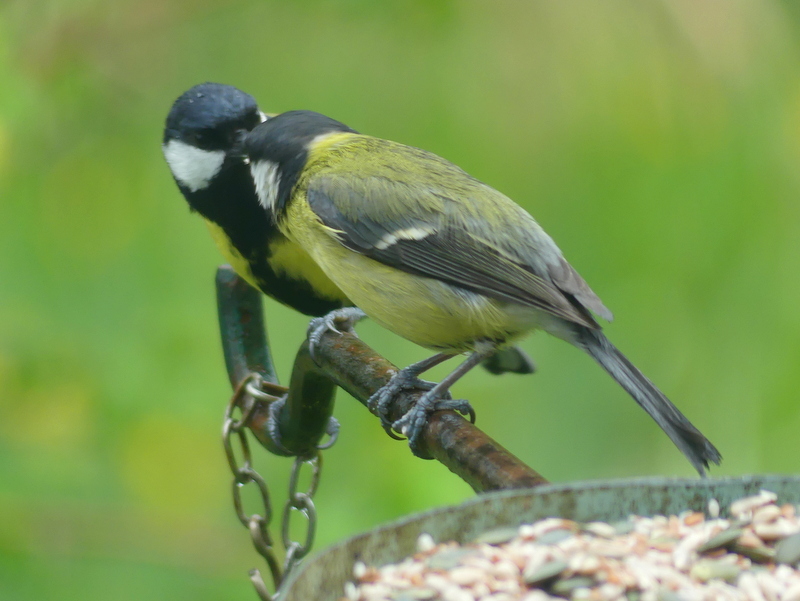
Great Tits Parus major Co Sligo. This very much seems to be ritual courtship
feeding, as the adult recipient certainly doesn't need to be fed in this situation!
And finally four birds from four families, all fairly common, one abundant.

Wood Pigeon Columba palumbus, Dublin. Another of the very commonest Irish
birds, in towns and countryside. There is open hunting season on them over the three winter
months (November to January) when they are not breeding, but there are also huge loopholes
which allow shooting pretty much all year round, and it seems to be quite an industry, eg here
Needless to say, Wood Pigeons in rural areas are pretty toey!
Reed Bunting Emberiza schoeniclus, Co Wexford. This attractive bunting is certainly a bird of 
the reed beds, but is also found beyond them. It has a huge range over most of Europe
and much of Asia.

Dunnock Prunella modularis, Glendalough, Co Wickford. An easily overlooked 
little bird of the forest understorey, hedgerows and even in town parks, though I 
certainly overlooked them there! They are accentors, in the Family Prunellidae,
of which there are only a dozen closely related species, nearly all the others
being birds found very high in the mountains, above the tree level.

And lastly one of my favourites (yes I know but I can't help it), the tiny
Goldcrest Regulus regulus, here preening in early dawn light outside our
cabin in rural Co Kerry. You can just see the yellow and orange crest here,
but better below in an even more light-deprived photo, which makes this a male.
(She has just yellow.) Its family, the kinglets, has just six members
across Eurasia and North America.

Well I hate to leave you with such a poor photo, which hopefully you can forgive me for the sake of the subject. 

It's been a long post, as I warned, and if you've got this far I thank you for your diligence!

THERE WILL BE QUITE A HIATUS NOW BEFORE MY NEXT POST,
AS WE'LL BE TRAVELING TO AND IN TROPICAL QUEENSLAND. 
HOWEVER I SHOULD COME BACK WITH MORE MATERIAL FOR YOU!
 
NEXT POSTING THURSDAY 25 SEPTEMBER

I love to receive your comments and in future will be notifying you personally by email when a new posting appears, if you'd like me to. All current subscribers have been added to this mailing list and have already been contacted. This will mean one email every three weeks at the current rate of posting. I promise never to use the list for any other purpose and will never share it.
Should you wish to be added to it, just send me an email at calochilus51@internode.on.net. You can ask to be removed from the list at any time,or could simply mark an email as Spam, so you won't see future ones.
If you do leave a comment - and I love it when you do - please remember to click the
box below your comment that says 'Email follow-up comments to...[your address]'
so you'll know when I reply - and I always do!