About Me

My photo
Canberra-based naturalist, conservationist, educator since 1980. I’m passionate about the natural world (especially the southern hemisphere), and trying to understand it and to share such understandings. To that aim I’ve written several books (most recently 'Birds in Their Habitats' and 'Australian Bird Names; origins and meanings'), and run tours all over Australia, and for 17 years to South and Central America. I've done a lot of ABC radio work, chaired a government environmental advisory committee and taught many adult education classes – and of course presented this blog, since 2012. I am a recipient of the Australian Natural History Medallion, the Australian Plants Award and most recently a Medal of the Order of Australia for ‘services to conservation and the environment’. I live happily in suburban Duffy with my partner Louise surrounded by a dense native garden and lots of birds.
Showing posts with label scenery - South America. Show all posts

Thursday, 23 July 2026

High Living #2: plants above the treeline

In my last post we went soaring well above where most of us spend much time, way up in the mountains where the conditions are too harsh for trees to survive - ie above the treeline. Today I want to introduce a selection of the plants that survive up there; some exclusively, others have broader habitat ranges. If you missed part one you may want to catch up before reading this, to get some background on the ecology and the places where these plants and animals live. On the other hand if you just want to browse the pictures here and enjoy some plant life you may not have met, that of course is fine too! It's mostly just a photo essay.

Silver Snow Daisies Celmisia sp. and Mountain Celery Aciphylla glacialis brighten the alpine
meadows in summer in Kosciuszko NP, in the NSW Australian Alps.

All these photos were taken in Australia and South America (and, just, in North America). I've only once been above the treeline in Africa and while I have strong memories of that day high in Lesotho (including a magnificent Lammergeier sailing overhead), that was well before my digital photography days. And the closest I've got in Asia was the lower slopes of mighty Kinabalu. 

Let's start with some plants. 

Mataguanaco ('guanaco bush') Anarthrophyllum desideratum, Torres del Paine NP,
Chilean Patagonia. This spectacular spiny cushion bush pea thrives in the often frozen,
always windy treeless expanses of Patagonia. 

The next half dozen photos were also taken on the exposed Patagonian Steppes slopes of Torres del Paine NP; I've been there five times, not because I love the experience of cold, often wet, winds (I don't) but because it's an extraordinary landscape, and supports some appropriately extraordinary life.

A more 'conventional' pea, Paramela Adesmia boronioides, a tough aromatic low shrub
which grows on the edge of the open plains at the foot of the mountains.

Mariposa del Campo ('butterfly of the field') Alstroemeria patagonica, in the mostly 
South American lily family Alstroemeriaceae. This is a tiny plant, with flowers on 
5cm stems to keep their head down out of the wind.

Darwin's Slipper (but in Spanish Zapatito de la Virgen, 'our lady's slipper')
Calceolaria uniflora, family Calceolariaceae. This is another very low-growing
herb of the harshly exposed Patagonian meadows and mountainsides.
Astonishingly it is pollinated by the Least Seedsnipe, one of a small family 
of four shore waders which have become vegetarians in Patagonia
and the high Andes. Apparently the white 'lip' of the flower contains sugars which 
the seedsnipe appreciate; in pecking the flower they transfer pollen from on flower 
to another. Rather than make you wait for the animals section (by when you may have 
forgotten about it) I'll introduce this surprising mountain bird now.
 
Least Seedsnipe Thinocorus rumicivorus near Coyaique, northern Patagonia

Estrallita ('little star') Perezia recurvata, a daisy. It grows on rocky ground
in the Patagonian Steppe.
And finally, to my surprise at the time, there are orchids in this harsh wind-blasted steppe land; here are a couple which delighted me.
Porcelain Orchid Chlorea magellanica. There is nothing small and 'keeping head down' 
about this beauty, which is found as far south as icy Tierra del Fuego. It can spend 
8 months of the year under snow but when the snow melts its flowering spike
can grow to 50cm tall. 
Yellow Gavilea Gavilea lutea can also grow tall, to 60cm. While probably
most often found in Nothofagus forests, it also grows in wet areas
in the absence of trees.
Far to the north of Patagonia in the Andes of southern Peru near Chivay at 3600masl, conditions are much drier and many alpine plants must grow on the rock faces.

Air plants Tillandsia sp. growing on a road cutting. They are bromeliads which take
most of their nutrients from the air; bromeliads are probably better known as
abundant epiphytes in tropical cloud forests (though the most famous bromeliad
is doubtless the pineapple!).

Puya Puya sp., another genus of bromeliads, growing on the top of
the same high altitude road cutting.

Cactuses growing, perhaps unexpectedly, at the top of Colca Canyon, also
near Chivay at about 3600masl, above the trees.
Again in the southern Peruvian Andes a very different and moister habitat, perched on the brink of the Amazon basin above the cloud forest at 3800masl at Acjanaco Pass on the Manu road, has of course very different plants. 

Gentians Halenia sp. and hardy grasses in the mist at Acjanaco Pass.

And to balance the unexpectedness (to me at least) of yellow gentians, here's
a more familiarly coloured one - I'm thinking Gentiana sedifolia? - in El Cajas NP
in the southern Andes of Ecuador, at some 4000masl.
And finally, from further north again, in North America in fact, some ancient, non-flowering plants from the páramo of central Costa Rica at about 3400masl.
Lycopods, or club mosses, a Class of now small plants which appeared more than 400 million years ago,
long before the rise of the flowering plants, and which dominated forests for a long time.

But we'll finish this part with some Australian alpine plants, mostly from Kosciuszko NP. After an introductory 'wildflower meadow' photo, there are 11 photos of plants from 11 different families. All were growing above the treeline in Kosciuszko NP except where I've specified otherwise.

  December on the Main Range of Kosciuszko NP, with the flowering just 
getting underway; the flower spikes are mostly of Candle Heath Richea continentis.

A close-up of the Candle Heath, a striking plant which lives in boggy situations in 
the alps of NSW and Victoria.

The snow country is perhaps not where we expect to find ferns, but nature can
 enable life in almost any environment. Alpine Water Fern Blechnum (now 
usually known as Austroblechnumpenna-marina is extremely hardy and even 
lives on the sub-Antarctic islands, as well as New Zealand and South America. 
It likes a sheltered position, often among rocks, and spends part of the year under snow.

Bidgee Widgee Aceana novae-zelandiae is far from an alpine specialist - it can be found
at sea level - but it is also very much at home above the trees. It's in the rose family, and
the head of tiny white flowers later forms a bundle of sticky burrs. They evolved to
transfer seed on fur and feathers, but many high country walkers have discovered
that socks suit them equally well. 

Mountain Celery Aciphylla glacialis is indeed in the celery family (Apiaceae). It is found
almost entirely above the treeline and is recovering well from the ravages of
historical alpine cattle grazing.
 
Ribbony Grass Chionochloa frigida grows only in the Kosciuszko alpine zone;
it too has recovered well since the removal of stock grazing. (Actually I'm having slight
doubts about my identification here, from a long time ago. Any comments welcome.)

Tasmanian Mountain Gentian Chionogentias diemensis, Ben Lomond NP,
north-eastern Tasmania. The gentian family is associated with mountains
on every continent (except Antarctica of course). This species is 
limited to alpine and subalpine areas in Tasmania.
Silver Ewartia Ewartia nubigena, Main Range Kosciuszko NP. A small-flowered but
extensive mat-like daisy bush that only grows in exposed alpine herbfields, where
it can colonise bare areas of soil and rock..

Royal Bluebell Wahlenbergia gloriosa in the Snow Gums in Namadgi National Park
in the Australian Capital Territory. It does however extend above the treeline, and
as the ACT's official wildflower emblem (despite my reservations as to its 
appropriateness!) I thought I should give it a guernsey. 
Alpine Mint Bush Prostanthera cuneata, Kosciuszko NP. This lovely member of the true
mint family grows above the treeline (and just below it), often among granite boulders,
in the NSW and Victorian alps.
Alpine Rice-flower Pimelea alpina is another prostrate shrub when growing above
the treeline. It has a similar distribution to the Alpine Mint Bush. The hundred or so
species in Australia and New Zealand are otherwise all found at lower altitudes
and most are erect shrubs.
Alpine Orites Orites lancifolia belongs to a generally unfamiliar genus in a generally very
familiar family, Proteaceae (ie banksias, grevilleas, waratahs etc). This one is found high
in mountains from the ACT to the Victorian alps and grows erectly even above the treeline. 
The only other Australian species is a rainforest tree! 
(There are also four species in Tasmania and two in South America.) 
And that I think is probably enough for one posting! I wonder sometimes if my longer postings aren't a bit off-putting, but I'm unlikely to get feedback from people who don't want to read that much, so I'm only speculating. 

It's not the time to be going to admire the flowers in the high country in the Southern Hemisphere, but perhaps you can bear this in mind for the coming summer. It's made me think we should plan another expedition to Kosciuszko, probably before or after the school holidays. Meantime, thanks for accompanying me on this particular wildflower walk; I've enjoyed it, hope you have too.

NEXT POSTING THURSDAY 13 AUGUST

I love to receive your comments and I will notify you personally by email when a new posting appears, if you'd like me to. This will mean one email every three weeks at the current rate of posting. I promise never to use the list for any other purpose and will never share it. Should you wish to be added to it, just send me an email at calochilus51@internode.on.net. You can ask to be removed from the list at any time,or you could simply mark an email as Spam, so you won't see future ones.
If you do leave a comment - and I love it when you do - please remember to click the
box below your comment that says 'Email follow-up comments to...[your address]'
so you'll know when I reply - and I always do!

Thursday, 29 June 2023

Chapada dos Guimarães National Park; a small Brazilian surprise

By the time this post is published, I'll be just about on my way out of Australia for the first time in four years, both nervous and excited. Unsurprisingly to many of my readers we'll be heading back to the Neotropics, and specifically to Costa Rica to run a tour that we had to cancel - and didn't we all have to cancel?! - three years ago. Accordingly my mind is on the Neotropics now, so this post will take us back there, which I know won't please everyone, but who can? ☺ Needless to say I'm pretty distracted at present, so this might be shortish, or at least somewhat spare on detail. Hopefully you can enjoy the scenery and birds anyway.

Sandstone outcrops, which are typical of the Chapada dos Guimarães landscape.
Most natural history people who visit Brazil (and it's a fabulous destination, especially now that some of the worst of the ugliness of the past few years has been swept away) are likely to head for the Amazon, Pantanal and Iguazú Falls, and quite rightly. However if you're going to the Pantanal - and you really should! - please build in a couple of days to take in Chapada dos Guimarães National Park, just to the north. You're likely to fly into Cuiabá, a surprising high-rise city of over a million people in the plains, and Chapada dos Guimarães is not too far away - in fact they are visible from each other, though about 60km apart.
Cuiabá, capital of Mato Grosso state, bigger than NSW,
in the hazy distance from Chapada dos Guimarães NP.
The nearby pleasant small town of Chapada dos Guimarães is a good base from which to explore both the park and as a jump-off point for the vast wetlands of the Pantanal. The park itself is valuable as one of the very few in the Cerrado, a vast area of moist savanna woodland and grassland in central Brazil, covering more than 20% of the country. It has been vastly undervalued by governments and most of it has been cleared for agriculture, despite its enormous biodiversity values as one of the richest tropical savannas in the world. Doubtless the rugged rocky nature of Chapada dos Guimarães is the major reason for it being spared.
The extent of the Cerrado, as defined by the World Wildlife Fund. The green
cross marks the Pantanal, and Chapada dos Guimarães is just to the north of it,
in the purple. Bolivia is immediately to the west, and Paraguay to the south.
The Cerrado just extends into both.
My first impression of the rocky wildness of Chapada dos Guimarães reminded me of the Blue Mountains, but on reflection the red sandstone and the tropical climate is more redolent of the Top  End and Kakadu sandstones in the Northern Territory. Here are some more sandstone vistas and features.
Though there are other explanations for the name to be found on the internet (most of them
simply copying each other) chapada in Portuguese means a high plain, or plateau,
according to my dictionary. Guimarães is a historic city in Portugal, perhaps the
home town of the person who named the landscape here; I can find no
reference to this.
And with plateaux like this there are bound to be waterfalls. Here is the most famous and most visited of them.
Véu de Noiva (ie Bridal Veil) Falls, above and below. I'd love to know how many of these
there are in various languages around the world. In Australia I can think of five Bridal Falls
(two in NSW, and one each in Queensland, Victoria and Tasmania) and I'm sure there'll be more.
The Cerrado vegetation is by and large tough and scrubby, though in some sheltered situations there are pockets of moister forest. Here are some roadside examples in the park.
The structural resemblances to Australian tropical savannahs are obvious, though the plants are
very different.

Here are few specific plants in flower, some of which I'm reasonably sure I know and a couple that I don't, but which I float here in the hope that someone like you might be able and willing to help me!

Feathery Acacia Senegalia lowei (formerly Acacia plumosa), one of several South American acacias.
Byrsonima crassifolia, Family Malpighiaceae. The small fruits which will form from these
flowers are valued by humans, and doubtless other animals.
Jacaranda decurrens. We were very surprised to see a jacaranda growing as a small shrub.
In Australia we are familiar with the widely-planted tree J. mimosifolia and it didn't occur
to us that there might be other species with other forms. There are in fact 49 species,
all belonging to the tropics and subtropics of America.
This species and the next I'd love your help with, if you're able.
The families look frustratingly familiar, but I can't be sure of that.
The rest of the post consists of a series of birds (and one reptile), with brief comments on each for those who want them. The first two were taken along the road from the Cuiabá airport to our very nice little lodge in Chapada dos Guimarães.
Black-throated Saltator Saltatricula atricollis. This is actually a tanager but until recently
they were included with the cardinal family. There's a lot of that sort of thing in the Neotropics,
as taxonomies are sorted out. This one is virtually a Cerrado endemic.
Narrow-billed Woodcreeper Lepidocolaptes angustirostris. Widespread in drier habitats
of eastern South America, probing bark crevices for insects.
The next few were in the town of Chapada dos Guimarães, mostly either in the grounds of our lodge or on the wires in the street outside.
Barred Antshrike Thamnophilus doliatus on the garden wall. Anything beginning with 'ant' in
South America is likely to be extremely skulking and frustating - but not this one!
Double-collared Seedeaters Sporophila caerulescens (yet another tanager-called-something-else)
and Ruddy Ground Dove Columbina talpacoti on the lodge feeder.
Rufous-bellied Thrush Turdus rufiventris. This is a common and much-loved bird
(mostly for its song) which has been declared the national bird of Brazil.
Pale-vented Pigeon Patagioenas cayennensis, another familiar and widespread species,
including in suburbia as long as there are trees remaining.
Masked Tityra Tityra semifasciata, a member of a small family (45 species) of South
and Central America species, including quite a few formerly regarded as - and still known as -
flycatchers. This one is very widespread.
And the rest of these birds were all in the national park; we didn't spend a lot of time there (much of it is inaccessible, especially to vehicles such as our little bus) but it was time very well spent. These are roughly in taxonomic order.
White-tailed Hawk Geranoaetus albicaudatus. This large and very handsome hawk is found
throughout much of eastern South America and scattered in central America.
Burrowing Owls Athene cunicularia, found in open land in every South American country
and a fair bit of North America, always delight me. I still can't get used to seeing owls
standing sternly at the mouth of a burrow, and in the daytime!
Ferruginous Pygmy Owl Glaucidium brasilianum, a mini-owl only 15cm high, found from the
far south of the US south to most of South America east of the Andes. A fierce little hunter,
it operates by day (taking insects, scorpions, lizards and birds as large as thrushes and doves)
as well in the dusk and dawn.
I love it that it apparently has eyes in the back of its head, presumably to deter
its own predators, and perhaps the many other birds that regularly mob it.
 
Peach-fronted Parakeets Eupsittula aurea roosting and quietly preening in the heat of the day.
A lovely little parrot found in open country throughout north-eastern South America.
White-eared Puffbird Nystalus chacuru, one of 37 species found throughout South and
Central America. They are perch-and-pounce predators with big heads and bills, mostly
patterned in browns or greys or blacks, some with fluffy plumage (hence the group name).
This one is found in the dry forests of the Cerrado, and a little beyond.

As mentioned earlier the antbirds and their kin - ancient South Americans, found
nowhere else (save for some that have spread into Central America) - tend to be
shy and often notoriously hard to see. Fortunately some can be tempted into
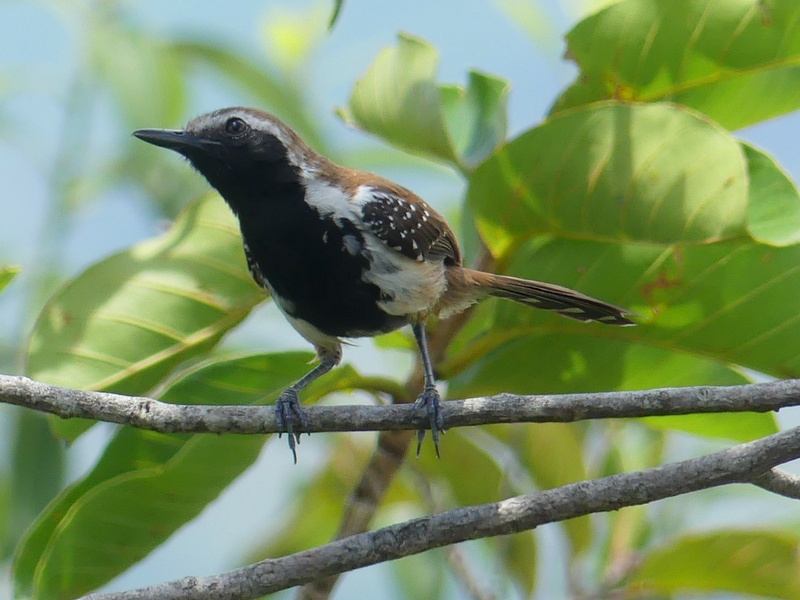
the open, such as this female Large-billed Antwren Herpsilochmus longirostris.
A Brazilian endemic, it is largely restricted to the Cerrado.
Male Rusty-backed Antwren Formicivora rufa, a very handsome little bird when seen
up close. Similarly found across the Cerrado, it also crosses the borders of some
neighbouring countries.

Suiriri Flycatcher Suiriri suiriri (though some recognise this subspecies as a separate species,
Chapada Flycatcher). This is a member of the 'other' great group of old South American
passerines, the tyrant flycatchers.
Helmeted Manakin Antilophia galeata. I love manakins, mostly brilliantly coloured
(the males anyway) little Neotropical birds which display in dark forests. This one deserved
a better portrait than this, but this was the best I could do in the conditions. Another Cerrado
endemic, and almost restricted to Brazil.
And the remaining five species I have for you are all tanagers - or in one case, a 'tanager'. And a couple of the real tanagers are actually called 'finches' (based on past misunderstandings). This is my favourite Neotropical bird family, after the hummingbirds, a whirlwind of colour and activity, which readily come to fruit feeders at many lodges. All these however were very much 'in the wild'.
White-rumped Tanagers Cypsnagra hirundinacea prefer grassy areas with few trees,
unlike most of their relatives. Limited to the Cerrado.
Swallow Tanagers Tersina viridis on the other hand are found throughout much of
northern South America - and what stunners they are (shining even through this
dull day)! Tanagers never fail to surprise, and this one, as well as eating fruit like most tanagers,
also catches insects on the wing, hence the name.
The attractive Red Pileated Finch Coryphospingus cucullatus is really a tanager (ie a member
of the Family Thraupidae). It's another bird of the dry forests and shrublands, but ranges
well south of the Cerrado, deep into Argentina. There are also some far-flung outlying
populations, including around Cusco in the Andes of southern Peru!
Coal-crested Finch Charitospiza eucosma, another 'finch' that's really a tanager!
This handsome bird is limited to the Cerrado and I was very happy to see it.
And finally, the 'tanager' which is actually a cardinal. The misunderstandings surrounding tanagers and related families is finally being resolved with the use of more and more sophisticated biochemical tools, but the past confusion leaves a legacy of a web of muddled common names which could hurt your head if you let them. They're all lovely birds though which ultimately is what matters.
Pair of Red Tanagers Piranga flava (male on the right). Flava means yellow, but a glance at
female explains this one at least. (Yet further confusion results from the inclusion of the
species by some people in the very widespread Hepatic Tanager
- another hangover from the past.)
And to wrap up this not-so-brief-after-all introduction to the wild places of Chapada dos Guimarães, a token reptile - not its fault, or even mine, but it was the only one I recall seeing there.
Chaco Spiny Lizard Tropidurus lagunablanca; I'm almost sure this is right, and if
you could either correct me or reassure me, I'd be grateful. Very handsome in any case!
If you get to Brazil - and it's worth it - try and fit in a couple of days at least in Chapada dos Guimarães, you won't regret it. Meantime, thanks for helping me indulge in some nice memories.

I'll be back here in August, with material for another exotic posting or two!

NEXT POSTING THURSDAY 10 AUGUST
 
I love to receive your comments and in future will be notifying you personally by email when a new posting appears, if you'd like me to. All current subscribers have been added to this mailing list and have already been contacted. This will mean one email every three weeks at the current rate of posting. I promise never to use the list for any other purpose and will never share it.
Should you wish to be added to it, just send me an email at calochilus51@internode.on.net. You can ask to be removed from the list at any time,or could simply mark an email as Spam, so you won't see future ones.