This somewhat unsettling post is prompted by a truly uplifting event which seems
to be still ongoing in Canberra. We are revelling in an influx of Swift Parrots,
one of Australia's most threatened bird species.Years go by here without more than a handful of sightings; some years we see none. This is in itself not necessarily a cause for concern as on the mainland they are woodland nomads, following the flowering of the boxes and ironbarks in particular across the countryside. However we know that numbers are perilously low, and falling.
 |
Swift Parrot Lathamus discolor, Mount Majura, Canberra;
an exquisite little bird which we see all too rarely.
|
The temperate grassy woodlands of south-eastern Australia are one of our most threatened habitats, and were once one of the richest - this is why they were selectively settled early, grazed (and overgrazed), cleared and, worst of all, ploughed. More recently, in places like Canberra, suburban sprawl has chewed up more of the shrinking habitat. (To be fair, recent governments here have made an effort to conserve remaining woodlands and habitats, though the current one seems sadly uninterested. Across the border in much larger New South Wales, the situation is dire.)
 |
Yellow Box Eucalyptus melliodora and Blakely's Red Gum E. blakelyi woodland in the
northern ACT. A woodland is characterised by trees more scattered than in a forest,
so that grasses form a significant part of the understorey.
|
These two tree species dominate the local woodlands, along with a couple of other species found more to the west of here - the ACT is on the south-eastern edge of the great swathe of woodland that once covered thousands of square kilometres on the western slopes of the Great Dividing Range, from Queensland to South Australia. It has been authoritatively estimated that less than 5% of the original Yellow Box - Red Gum woodland remains, and much of that is unprotected. Remarkably the Mulligans Flat - Goorooyaroo Nature Reserve in the north of the ACT, at just 1600 hectares, is the largest reserve of this habitat in Australia (and thus the world of course).
 |
Blakely's Red Gum, just north of the ACT.
|
 |
Yellow Box, Campbell Park, Canberra.
One of my favourite tree species!
|
Of the very significant area of this woodland which includes White Box E. albens (not in the ACT) only 0.1% is reliably estimated to be largely intact.
Comparatively, the ACT has done fairly well with woodland reserves over the past couple of decades, but there is little of the necessary connectivity. Fencelines and road verges are cleared or just 'tidied', paddock trees are felled or just eventually just die, firewood collection, overgrazing, overburning and weeds all take their toll and the woodlanders which don't wander are trapped in their little patches. Such small populations will invariably die out in time.
Given this, it is almost inevitable that any species which relies on the habitat to a significant extent will be in trouble and this is what this post is about; a brief introduction to those woodland bird species in this part of the world which are listed as threatened with extinction under either ACT, national or NSW legislation. Recognising a problem, and meeting the victims, is a first step to addressing it. Most of these species, while decreasing, are probably not facing immediate disappearance, though complacency would be very dangerous and sudden population crashes are not uncommon, as we'll see. A few though are in serious trouble, especially two nomads, including the Swift Parrot.
It has other problems in addition to the loss of the woodlands. Uniquely among the woodland specialists, it breeds in tall wet Blue Gum E. globulus forest in south-eastern Tasmania and in autumn crosses the hazardous Bass Strait to winter in the mainland woodland remnants. And those Blue Gum forests are being logged at an alarming rate, mostly on private land. Moreover, and bizarrely, the little Sugar Gliders Petaurus breviceps, which were introduced to Tasmania in about the 1830s, have taken to preying on nests, chicks, and even brooding females in the nest. This was only recently recognised and is a serious problem; for instance it is calculated that 65% of breeding females are killed by Sugar Gliders each year! (It occurs to me that this means that every year most breeding females are likely to be young and inexperienced, but I don't know how much of a problem this is.) Trapping of gliders by means of nest boxes is being trialled. Protection of forests on islands, especially Bruny Island, where gliders are absent, is critical.
 |
Sugar Glider; a seemingly unlikely and hitherto unsuspected assassin.
This one was a long way from Tasmania, in north Queensland.
|
Twenty years ago it was estimated that around 2000 Swift Parrots survived, but numbers were falling then. More recently genetic analysis suggests that the number of breeding birds could be as low as 300 and it is listed, nationally and by the relevant states, as Critically Endangered.
The Canberra influx in the past few weeks has thus been refreshing. Just before the rains came and the flock scattered, there was a count of around 50 birds at Callum Brae Nature Reserve in southern Canberra - in the context of the overall population estimate this is remarkable. Moreover good numbers have been reported elsewhere in Canberra, especially near Mount Majura woodlands. A friend has just told me of half a dozen in suburban Turner, near the Canberra city centre (next to where I lived for 27 years without seeing one!), so there are doubtless more around. We can only cautiously hope that it's a sign that the work being done in Tasmania is paying off.
 |
Part of a flock of Swift Parrots at Callum Brae a couple of weeks ago, preening in the early
morning sun. I never expected to see this many again, and the number of young birds
among them is heartening.
|
|
|
|
The other Critically Endangered woodland nomad is the Regent Honeyeater Anthochaera phrygia. In some ways its plight seems even greater than that of the Swift Parrot, because we don't really know why its numbers have crashed so dramatically compared with other woodland species. Into the 20th century this dramatic bird (which we now know to be a small wattlebird) was present in flocks of hundreds and even thousands from South Australia to southern Queensland. Now there are perhaps 400 left, scattered and wandering from Victoria to northern New South Wales.
[Since I wrote the above I received a comment from regular reader Roman in Canberra, drawing my attention to the book Australian Honeyeaters by the curiously named Brigadier Hugh Officer in 1964, a work I don't own. In it he states “It has stood up successfully to the encroachment of settlement and can
still be found in Melbourne’s inner suburbs, while, in Bendigo, it is a
bird of city gardens.” So the population crash has been even more sudden - well within my lifetime for instance - than I had appreciated. Roman's full message can be seen in Comments below.]
 |
Regent Honeyeater, Watson, suburban north Canberra, January 2020.
I first saw the species in 1992; in the 29 years from then to now I've seen exactly seven
birds, over five observations. This was the most recent, sadly just a single bird which
stayed for a couple of weeks.
|
It seems that they require high quality woodland with continuous nectar flow - sadly this scarcely exists any more. Ominously it seems that as the numbers fall the situation spirals; individual birds are easily hounded away by miners and Red Wattlebirds, though Gould commented on their pugnacity when in company. I've also read it suggested that breeding might require a colony, but we really don't know. Targeted tree plantings are numerous and many good people are working to save them. If I may quote myself (from my book Birds in their Habitats, CSIRO 2018): "it’s like watching a medical team fighting a steadily losing battle in the emergency department". Desperately sad in other words, and what can you do for a few hundred birds that wander over thousands of kilometres and disappear for years from a place they seemed to like? I really fear that we may see the Regent become the first Australian mainland extinction since the Paradise Parrot.
 |
How I hope that this was not the last Regent I'll see and, more importantly,
that people will stil be enjoying them long after I've gone.
|
There are no local woodland birds listed as Endangered (a category between Critically Endangered and Vulnerable) mercifully, but there are seven listed as Vulnerable (ie to extinction, unless the situation changes). One of these is also a nomad, the beautiful and scarce Painted Honeyeater Grantiella picta. Unlike the previous two species however, this one roams across much of inland eastern Australia, following the mistletoe fruiting. However there is also a poorly-understood migration of at least some birds in winter to the north-eastern inland tropics. That is, it is not limited to the box-gum woodlands, and again we don't understand just what's caused its decline though it certainly seems to prefer more intact, less fragmented woodland. I've not seen many, and don't have any good photos; here are a couple of examples! Both were taken in 2013 when a few appeared in flowering mistletoes along the Murrumbidgee Corridor NR near Canberra, and even bred.
 |
Painted Honeyeater in River Oak Casuarina cunninghamiana.
The characteristic yellow wing bar is barely visible here.
The mistletoe Amyema cambadgei, whose foliage mimics that of the Casuarina,
was fruiting heavily here at the time.
|
 |
Painted Honeyeater on a nest; you're looking at its bill, eye and throat.
I include it here solely because it's so rare to see it.
|
Two other birds on the list are migrants, so it could be that factors in their winter non-breeding northern range are part of their problem. Superb Parrots Polytelis swainsonii are deserving of their hyperbolic name, simply stunning. They may also be bucking the trend and staging a recovery - or perhaps it's just that having been driven into Canberra suburbia during the 'millenium drought' of the early 2000s they learned that living is easier here and have returned to the city every year since, giving us an inflated idea of their numbers.
 |
Male Superb Parrot feeding on Acacia baileyana seed pods,
Mulligans Flat NR, northern ACT.
|
Superb Parrots breed in woodlands in old hollow-bearing trees to the north of the ACT, and many now come into the suburbs for the rest of summer. Then they return to their wintering grounds in the Gwydir and Namoi River catchements of the north-western slopes of NSW. This is cotton country and there is some concern that agricultural chemicals are part of their decline. (There is a separate population, seemingly not migratory, in the Red Gum forests along the rivers of the Riverina in south-western NSW. These birds have been badly affected by logging of the Red Gums, though there is better protection now, especially across the border in Victoria.)
White-winged Trillers Lalage tricolor are more conventional migrants, breeding in the south-eastern woodlands and wintering in the tropical north. It was a bit of a surprise when they were listed as Vulnerable, but those determinations are made by an independent scientific committee and based on substantial data. We should trust the numbers rather than our subjective impressions, and the Canberra Ornithologists Group has built up a very impressive data base of records over the decades.
 |
White-winged Trillers, female above, Barkly Tablelands, Northern Territory,
and male below, Campbell Park woodlands, Canberra.
In the tropics males moult their snappy uniforms and resemble the females.
|
The other four listed local Vulnerable species are largely sedentary, staying here all year round, though at least one of them moves up and down from the ranges. In their cases loss and isolation of woodland remnants is the only likely cause for their decline.
 |
Scarlet Robin female Petroica boodang, Narrabundah Hill, Canberra.
This species mostly moves into the lower ranges in summer to breed,
and comes down to woodlands and dry forests around Canberra for the cooler months.
|
 |
Scarlet Robin male, Black Mountain NR, Canberra.
They really are a stunning little bird, but the local numbers show
a sharp decline in recent years. They don't like suburbia either,
so retreat as the houses advance.
|
Another local robin is in even more precipitous decline, though it is still doing OK to the west and north-west of here. (That is no reason for complacency though - extinction is the cumulative effect of many populations, like little lights, going out one by one. It is rarely a single cataclysmic event.) Australian Robins were named for the (very superficial) resemblance of the Scarlet Robin to the entirely unrelated European Robin; unfortunately yellow, and even black and white, robins then appeared, but it was too late to change the name then!
 |
Male Hooded Robin Melanodryas cucullata, south of Canberra.
A striking little bird, common across much of inland Australia,
but seemingly disappearing from the ACT. It has gone from most
of its former local strongholds over the past decade or so.
|
|
The Brown Treecreeper Climacteris picumnus is in even more trouble here; its future in the ACT seems very limited. I used to be able to find them with some confidence in several ACT woodland sites but not any more. Worryingly it seems to have gone from Mulligans Flat NR, despite a lot of work to enhance habitat (they love a lot of branches and logs on the ground) and even reintroductions from elsewhere. The last good population was in the Glendale Crossing and Old Boboyan Road section of Namadgi National Park in the south of the ACT, but that area was severely burnt in early 2020, and there is no evidence yet that I know of that the species has survived there. It too is still doing well further inland though.
 |
Brown Treecreeper, Newline Quarry site, 2006. This was a good site (though isolated) for them, but
they've been gone from there for some years now.
|
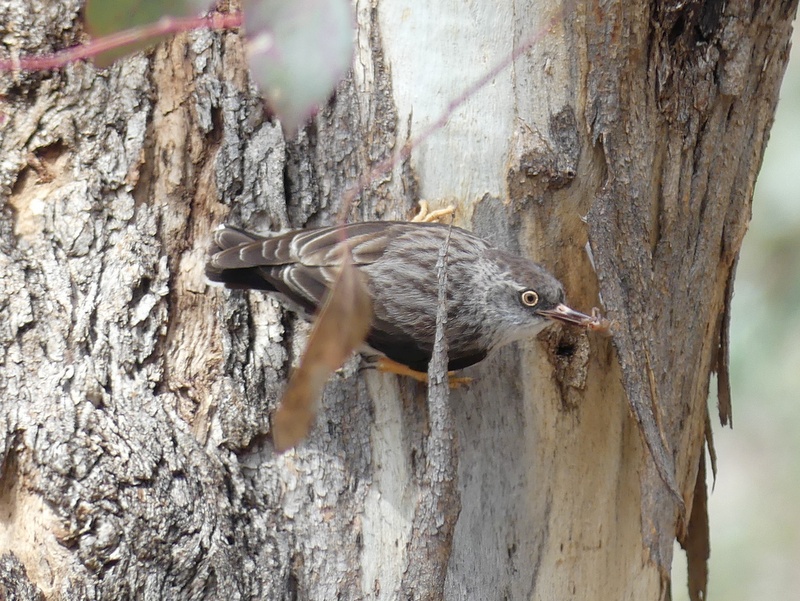
Varied Sittellas Daphoenositta chrysoptera are found across much of Australia, but in a series of distinctively coloured subspecies. They are the only member of their family in Australia, with another in New Guinea. They are engaging little industrious gleaners of small prey on tree trunks and branches, which they probe with their upturned bills. They are highly sociable. Numbers reported have been dropping steadily as the non-reserved woodlands decline further.
 |
Varied Sittella, Campbell Park, above and below.
This one briefly displayed its glorious distinctive chestnut wing bars.
|
 |
Showing its strong uptilted bill, clutching lunch.
|
I am also going to include three species which are resident in the ACT
and, while not listed here, are regarded as threatened across the border
in NSW. Maybe they really are doing better here, or perhaps the data was
insufficient to list them at this stage or maybe there are subtle differences
in the criteria between the two jurisdictions. The fact is they are clearly in some sort of trouble,
and woodland deterioration is the key factor. My subjective view would
be that at least two of them have declined in the ACT in recent times.
 |
Diamond Firetail Stagonopleura guttata, a truly lovely little grass finch which I don't see
nearly as often these days.
|
 |
Speckled Warbler Pyrrholaemus sagittatus, an attractive little ground dweller
which is not seemingly in too much trouble here, but because of its decline in NSW it
needs to be watched carefully here too. This one was nesting in
the woodland patch behind the Namadgi National Park visitor centre.
|
 |
Male Flame Robin Petroica phoenicea, high in Namadgi NP. It breeds in banks among
the Snow Gums and spends winter in woodlands around Canberra. Perhaps we're not
seeing much decline here yet, but caution is needed too.
|
I hope this hasn't been too depressing - I really don't believe that all is lost for most of these birds, but we need to be aware of the situation and to understand it as best we may. And when the Swift Parrots come we must welcome them - for our sakes rather than theirs, as they don't care much about us - and take fresh hope and inspiration from them.
 |
Swift Parrot, Callum Brae NR.
The
great ornithologist John Gould in the 1840s described
small flocks of them flying over Hobart
‘chasing each other with the quickness of thought’
(hence the name by which we know it). Maybe it could
happen again. |
NEXT POSTING THURSDAY 3 JUNE
And
remember that you can get a reminder when the next post appears by
putting your email address in the Follow by Email box in the top right
of this screen.
I'd love to receive your comments - it's easy and you don't need to sign in!
However, this reminder service, which is becoming increasingly unreliable, is going to be withdrawn and I'm not sure what I can do about it. I already keep hearing of people who are no longer getting notifications of new postings and I'm losing readership presumably as a result. You might like to set a calendar alert as a back-up to avoid missing out.
Alternatively, if you'd like to send me an email (to calochilus51@internode.on.net)
I can put together a mailing list to send out whenever a post goes up;
I guarantee never to use your address for any other purpose.
Thank you!