About Me

My photo
Canberra-based naturalist, conservationist, educator since 1980. I’m passionate about the natural world (especially the southern hemisphere), and trying to understand it and to share such understandings. To that aim I’ve written several books (most recently 'Birds in Their Habitats' and 'Australian Bird Names; origins and meanings'), and run tours all over Australia, and for 17 years to South and Central America. I've done a lot of ABC radio work, chaired a government environmental advisory committee and taught many adult education classes – and of course presented this blog, since 2012. I am a recipient of the Australian Natural History Medallion, the Australian Plants Award and most recently a Medal of the Order of Australia for ‘services to conservation and the environment’. I live happily in suburban Duffy with my partner Louise surrounded by a dense native garden and lots of birds.

Thursday, 5 August 2021

Turtles and Tortoises; the real old-timers

These wonderful animals have been around in pretty much their current form for at least 200 million years. Two hundred and twenty million years ago the first turtles separated off from the other reptiles and have been doing their own thing ever since. It was another hundred million years (would you like a moment to think about that?) before a recognisable crocodile, the other notable vertebrate group which has been around for a very long time in its modern form, made an appearance and doubtless began preying on turtles.

Yellow-spotted River Turtle Podocnemis unifilis, Manu River, Peruvian Amazonia.
For a turtle, the shell's the thing. It comprises a plastron below and a carapace protecting the back. It took them the first twenty million years to get it right, but they had plenty of time and got there in the end. The plastron developed first, to protect swimming proto-turtles from attacks from below. The carapace evolved after turtles came ashore. Segments of ribs and spine were 'borrowed' to form the bony carapace - which is still fused to the ribs and spine - while the plastron developed from the shoulder girdle and breast bones, plus special floating 'dermal bones' found in the belly skin of ancient reptiles including crocodiles. Extensions from the plastron connect the plates at the sides. The bony shield was then eventually covered with tough keratin scales called scutes, based on reptile skin. Modern freshwater and marine turtles have land-dwelling ancestors.
Yellow-spotted River Turtle again - they are seemingly everywhere in the Amazon.
Carapace, plastron plus side extensions, and scutes are all obvious here.
Note too the broadly webbed and strongly clawed feet, plus the nostrils on the very
tip of the nose, for breathing while staying otherwise submerged.
Let's get the 'tortoise or turtle' thing out of the way now, before we get in deeper. It's pretty much a furphy really but there's confusion in Australia in particular because we use the terms differently from elsewhere. Traditionally we've pretty much reserved 'turtle' for the big ocean-going turtles, and 'tortoise' for everything else including the numerous freshwater species. I'm guessing that usage derived in the 19th century from English ancestors, but it may have been home-grown. It is likely that the absence of land-dwelling tortoises here influenced this too. In either case in modern-day Britain as well as elsewhere in the English-speaking world 'tortoise' is reserved for club-footed purely land-dwelling animals and everything else is a 'turtle'. That preference is starting to gain traction here too and it's how I'll be using it today.
 
The turtle world, comprising the Order Testudines for the record, is indeed divided into two, but not like that. As in many other groups of animals and plants, it looks as though this dichotomy had its origins in the times when the world was divided north and south, though it is probably not that simple. For our purposes it is only significant that one Suborder (the Pleuridines, or side-necked turtles) is solely southern today, in Australia, South America and Africa. As the name suggests, they tuck their neck away sideways into the shell where it fits neatly in front of one front leg.
Eastern Long-necked Turtle Chelodina longicollis. Its front is to the left,
and the folded back neck can be seen above my thumb. I've moved very many
turtles (mostly this species) off roads out of harm's way but be wary - they ungratefully
defend themselves with a foul-smelling secretion which you do not want on you or
your clothes!
The other Suborder (the Cryptodines, or hidden-necked turtles) pull their heads straight back in, between their front legs, folding their neck neatly into an S-shape. This, as you may imagine, requires a very different skeletal and muscular design, and the separation between the groups seems to go back to the Jurassic, 150-200 millon years ago.
The Malay, or Southeast Asian, Box Turtle Cuora amboinensis, here at Sepilok,
Sabah, Malaysian Borneo, is an example of the hidden-neckeds. Its short neck
is pulled straight back into the shell when threatened. It is found throughout
southeast Asia. Many species of box turtles are threatened in the wild both
by the demand for wild food in China, and the depredations of the
US pet industry.
However this group also contains all the tortoises and sea turtles, and is found on every non-frozen continent (and ocean) except Australia. Well, not quite. There is one species in Australia, the ancient and unique Pig-nosed Turtle Carettochelys insculpta found in a few Top End rivers, and in New Guinea. It is the only surviving member of its entire family, though fossil relations are widely known. It closest relations seem to be the soft-shelled turtles of Africa, Asia and North America.
Pig-nosed Turtle, Melbourne Aquarium. Unlike any other fresh-water turtle it has
flippers like a sea turtle. Its nostrils are at the end of a long snout, hence the common name.
It is still not well known to science, though of course Indigenous Top Enders have long known it well.

The six species of great sea turtles also belong in this Suborder. They have lost the ability to retract their head, though other factors place them in the group of hidden-neckeds. Their plastron is smaller than that of other turtles, and joined to the carapace only by ligaments. Perhaps their substantial size - carapace length across the species ranges from 70cm to over two metres - enables them to dispense with some protection. And of course they have flippers to enable them to cross vast ocean distances.
Green Turtle Chelonia mydas basking ashore, Galápagos.
By 90 million years ago huge turtles seemingly related to modern leatherbacks were feeding on squid in northern seas. The ancestors of other modern sea turtles arose about ten million years later.
Green Turtle, Galápagos. Adults feed on sea grass beds in shallow water.
However Green Turtles cover huge distances - up to 2500km - to breed,
and can be found across huge areas of the world's oceans where
temperatures are above ten degrees centigrade.
Females determine mating, which takes place in the water.
Green Turtles mating, Galápagos.
After that she comes ashore to dig a hole in the sand and lay up to 300 round white leathery eggs, 40-50mm across, which she buries. The youngsters hatch at night after 8-10 weeks and all head for the water, though few successfully run the gauntlet of predatory birds and crabs. Perhaps only 1% of hatchlings survives to maturity, but if they do they may live for 80 years.

Green Turtle tracks, Lady Elliott Island, Great Barrier Reef.
Within their huge range, Green Turtles are at their most abundant in the
Great Barrier Reef and the Caribbean.

Tortoises, totally land-dwelling animals without any foot adaptations to swimming, all belong to the Family Testudinidae, which is found everywhere except Australia (and of course Antarctica), especially in warmer drier environments.
Angulate Tortoise Chersina angulata, above (Bontebok NP, southwest South Africa)
and below (Augrabies Falls NP, northwest South Africa).
This very attractive tortoise is a South African endemic.

Angulate Tortoises from the drier inland, like this one, tend to be
darker and plainer, but I also wonder if age is a factor in this one.
This, being the only member of its genus, has no close relations.

The lovely Leopard Tortoise Stigmochelys pardalis, despite its apparent similarity
to the Angulate, is not closely related and is much more widely distributed, from
the Horn of Africa to eastern South Africa. Like all tortoises and turtles,
to my knowledge, it buries its eggs in soft soil.

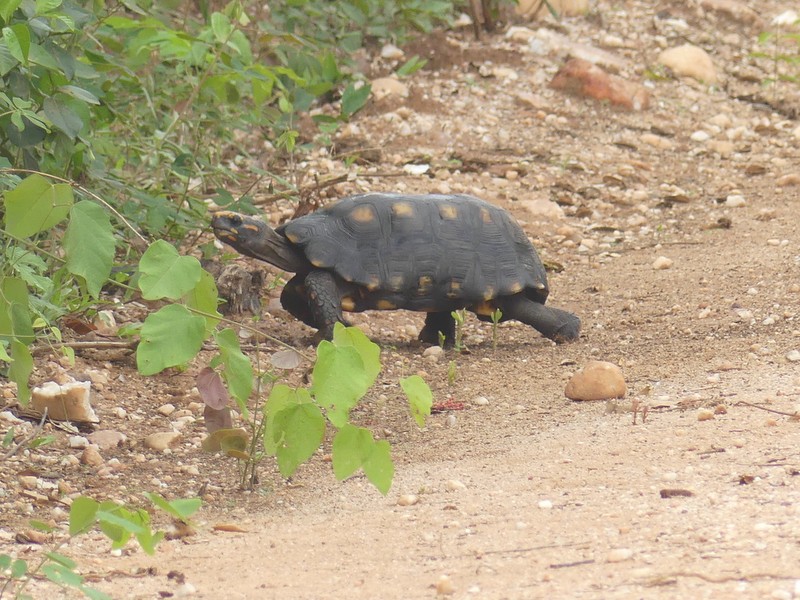
Red-footed Tortoise Chelonoidis carbonarius, crossing the Transpantaneira Highway
in the Pantanal, south-western Brazil. Most tortoises are grazers but forest-dwelling
species like this one also eat fruit, invertebrates and carrion.

Interestingly, the famed Giant Tortoises of the Galápagos belong to the same genus as this, and their ancestors floated - either alone in the open ocean or on floating vegetation rafts - across the Pacific where they came ashore and their descendants gradually grew into giants. This is possible because tortoises can go months without eating or drinking. The same happened to produce the only other living giant tortoises, of the Seychelles in the Indian Ocean (and formerly the Mascarenes), though their ancestors sailed from Madagascar. Indeed until recently there were many giant tortoise species on islands including Malta, Cuba, the Bahamas, the Canaries and Madagascar, but humans destroyed them all. 

Western Santa Cruz Giant Tortoise Chelonoidis porteri, Santa Cruz, Galápagos, munching on grass.
In (the few) moister parts of the archipelago they can rely on this luxury, but elsewhere cactus
flesh and fruit are important food sources.
Until recently it was assumed that there was just one Galápagos tortoise species, but 12 living ones are now recognised, with another two or three recently becoming extinct. The islands rose sequentially from the ocean as they passed over a volcanic 'hot spot'. The oldest islands were colonised first, and later provided new colonists to younger islands as they arose.

One interesting aspect of these giants is the consistent existence within species of 'saddlebacked' and 'dome-backed' shell forms.
Saddlebacked form, Charles Darwin Research Station, Santa Cruz.
At that time different species weren't recognised. The shell rises to the front,
allowing the head to be raised.


Dome-shaped shell on a Sierra Negra Giant Tortoise C. guentheri
crossing the road on Isabela Island.
Saddlebacks tend to be smaller and live on lower drier islands. The dome-backs inhabit higher wetter habitats. It is suggested that the saddlebacks, in a more demanding situation, can reach higher to access tall cactuses, while the dome-backs can easily get enough grass low down. It has also been proposed that the adaptation may allow competing males to stretch higher to intimidate rivals and attract females. In this case it would be an advantage for the smaller animals to be able to reach high. It seems to me that the two explanations are not mutually exclusive.

The tortoises and sea turtles tend to get star billing in this group, but in terms of numbers the more modest freshwater turtles are predominant. Family Geoemydidae, which includes the box turtles we met earlier, has some 70 species across Europe, Asia and North America, with a smaller and presumably relatively recent incursion into South America.
Black River Turtles Rhinoclemmys funerea, here below the bridge at
La Selva Research Station in Costa Rica, are restricted to central America.
Which brings us back to the side-necked turtles, which (apart from the Pig-nosed Turtle) are the only ones we have in Australia; here they all belong to the Family Chelidae. This is an ancient Gondwanan family which first appeared some 100 million years ago and is restricted to Australia, New Guinea and associated islands, and South America. They are carnivores, using long necks and fast reactions to catch fish and small crustaceans. For courtesy I'll start with a couple of South Americans; we've already met the Yellow-spotted River Turtle in the genus Podocnemis but we didn't see its spots before - here they are!
Yellow-spotted River Turtle, Yasuní NP, Ecuador.

South American Snake-necked Turtle Hydromedusa tectifera Iguazu Falls, Argentina.

Our common local turtle is the Eastern Long-necked Turtle Chelodina longicollis, abundant in local waterways and dams. It's often encountered crossing roads, especially on a sunny day after rain, looking for new territory or a somewhere to lay eggs.

Eastern Long-necked Turtle, Tidbinbilla Nature Reserve near Canberra.
The long neck is evident here. They hunt by ambush, combined with a potent
'gape and suck' strategy. As the mouth gets close to the prey, it suddenly
and powerfully opens, creating a powerful suction action.
Elseya is a genus of six Australian species, plus three in New Guinea, known as the Australian snapping turtles (though they are mostly vegetarian, including floating fruits).
Northern Snapping Turtle Elseya dentata Howard Springs, south of Darwin.
It is found across northern Western Australia and the Northern Territory.

Saw-shelled Turtle Elseya (now usually described as Myuchelys) latisternum
Cumberland Dam, inland North Queensland.
Finally, Emydura, the short-necked turtles, of which six are currently recognised in Australia.
Krefft's Turtle Emydura kreftii, Centenary Lakes, Cairns.
It lives in the waterways of east coastal Queensland. The short neck
which characterises the genus is evident in this photo and the next.

Murray River Turtle Emydura macquarii, Melbourne Aquarium.
This is a widespread species in the Murray River basin, including most of NSW,
where it extends to the north coast.

I hope you has as much affection and admiration for these most ancient of vertebrates; but if you don't you've probably not read this far anyway. I find them truly wonderful.


NEXT POSTING THURSDAY 26 AUGUST

I love to receive your comments and in future will be notifying you personally by email when a new posting appears, if you'd like me to. All current subscribers have been added to this mailing list and have already been contacted.
This will mean one email every three weeks at the current rate of posting. 
I promise never to use the list for any other purpose and will never share it.
Should you wish to be added to it, just send me an email at
calochilus51@internode.on.net.
You can ask to be removed from the list at any time,
or could simply mark an email as Spam, so you won't see future ones.
Thank you!

Thursday, 15 July 2021

Shaba National Reserve; superb 'outback Kenya'

For the natural history aficionados among us (and surely that's anyone reading this blog), Kenya calls  loudly and clearly, even if we can't answer the call at the moment. Amboseli, Mount Kenya, the Maasai Mara and Tsavo are all eagerly sought destinations, but Shaba? Or Buffalo Springs? Perhaps not quite so much, but I'm hoping that in a small way I can do something about that. 

The green-fringed Ewaso Nyiro River flowing through a semi-arid volcanic landscape at Shaba.

Shaba is one of three adjacent reserves safely right in the centre of Kenya, though tours that do go there usually describe it as in the north; that's only relative to the bigger attractions though. 

The red arrow points to Shaba; note that Maasai Mara, Amboseli and Tsavo
are all down on the southern border with Tanzania (though you'll probably have
to click on the map to see that detail).

Shaba, along with adjacent Buffalo Springs and Samburu, was declared a reserve in 1974; Shaba is the largest of the three, at 23,900ha. Despite the designation of national reserve, it is actually managed by the local county council rather than the very experienced national parks service. I'm sure there's some political history there but I'm not aware of the details. 

The vertical red line is a major highway leading north from Nairobi to Ethiopia.
The Ewaso Nyiro River forms the northern boundary of Shaba and more or less
separates Samburu and Buffalo Springs.
I was going to write a single post about the whole unit, but there are obvious differences between the landscapes of Shaba and the western parks, and too much for a single post, so I'll leave Buffalo Springs for later (we didn't get into Samburu). I love the dry country of Australia, and so was very excited to be going into this different semi-arid landscape, which was the furthest north we went in East Africa, and with strong elements of the Horn of Africa among the animals, which caught my imagination when I first read about the trip. (I'd been a bit further north in Uganda, but I think of that as Central Africa, and it was very different again). 
 
Our lodge on the river was really more of a resort, and seemed a bit incongruous in the setting, with swimming pool and lush lawns; I think it was just outside the reserve. Our impression was that many of our fellow guests didn't venture far from the (excellent) buffet and the pool. It was a lovely setting on the river though.
Walking to breakfast pre-dawn (us that is, though the baboon was probably crossing
the river to try his chance around the restaurant). The Marabou was happy in the water.
At the lodge, big Nile Crocodiles come up on the bank at night, under lights, where doubtless they are fed. They are impressive animals.
 
They lie just below the path, with guards keeping an eye on them (and us, I imagine).

We did a couple of excellent drives, in late afternoon and early morning, and again as we left in early afternoon to cross the road to Buffalo Springs. The sandy plains are dominated by steep-sided volcanic plugs and ridges; the sand is comprised of eroded material from these outcrops.


These Umbrella Thorntrees are either Vachellia (formerly Acacia) elatior or V. tortilis;
both are present and look pretty similar from a distance.


The Doum Palms Hyphaene compressa (though some describe these as H. thebaica) are
characteristic of the park, and of many hot East African landscapes. Both species
are widespread and it could be that both are present.

The Doum Palms mostly grow along the river or near soaks. The branched form is
typical of the genus; most other palms are single-stemmed.

Succulents such as these big euphorbias are another feature of the plains and slopes.

Also characteristic are the huge and knobbly termite nest 'castles';
presumably, as in the Australian tropical savannas, the termites are reliant on the grasses.

As is often the case in Africa it's hard to say whether the birds or mammals are more exciting. I don't feel a need to take sides, but let's start with some birds, and in particular with one I was really looking forward to seeing. Until recently it was accepted that there is only one species of ostrich, but we now know there are two, with the Somali Ostrich Struthio molybdophanes replacing the widespread Common Ostrich S. camelus in the far north-east of Africa.

Male Somali Ostriches have distinctive blue-grey necks and legs, in contrast to the white neck
and pink legs of the Common Ostrich. They also lack the white ring around the lower neck and
like scrubbier country than the generally grassland southern species.

Here are some other north-eastern Africa specials which I was especially happy to see.

Female Buff-crested Bustard Lophotis gindiana; a bird of the arid bushlands,
about which not a lot seems to be known. It is beautifully patterned.

Black-faced Sandgrouse Pterocles decoratus. I'm a big fan of sandgrouse, though
I've not had many opportunities to get to know them. We regularly saw these attractive
birds on and by the roads. Again it seems that not a lot of work has been done in
this part of the world, which is perhaps not surprising.

Vulturine Guineafowl Acryllium vulturinum, a truly spectacular big bird -
the largest of the guineafowl - also restricted to the Horn of Africa and
adjacent countries. Like other guineafowl it congregates in big flocks,
but strangely we only saw two birds, and both were among the much more
familiar Helmeted Guineafowl Numida meleagris.

Male Eastern Violet-backed Sunbird Anthreptes orientalis, a truly
lovely little north-eastern special. Click on the photo to see the delightful
violet highlight on his back.

Eastern Yellow-billed Hornbill Tockus flavirostris. Previously there was just
one widespread species of Yellow-billed Hornbill recognised, but now the
north-eastern birds are separated. One obvious difference is the skin around
the eye - black here, red in the southern species. And I do like hornbills!

Red-bellied Parrots Poicephalus rufiventris (which should by rights be called
Orange-breasted, but you can't see it in this photo anyway) are yet another
bird of the arid and semi-arid north-east. Acacia seeds, which these may have
been snacking on before we distracted them, are an important food item.
Other Shaba birds that we enjoyed are more widespread in Africa, but I never tire of them so I hope you don't either. 

Black-bellied Bustards Lissotis melanogaster are found in grasslands across much
of sub-Saharan Africa. This is the male (she lacks the snappy black waistcoat).
I love that slightly manic stare.

Cinnamon-breasted Buntings Emberiza tahapisi have a similarly widespread
distribution but, like this one, are generally found on rocky hillsides.
However it had hitherto eluded me, and I recall it fondly as being my hundredth new
bird for this glorious trip.

Purple Roller Coracias naevius, yet another widespread African bird which I'm always
glad to see again, though it's not as colourful as many other rollers. It typically sits high
in thorn bushes (or on wires) in order to pounce on insects, spiders and small reptiles on the ground.

Rosy-throated Longclaw Macronyx ameliae. To an Australian, from a continent
with just one pipit, very sombrely clad, pipits such as longclaws are an exciting
revelation. They also sit up in bushes and hold singing contests.

Tawny Eagle Aquila rapax. This magnificent predator is found across Africa and India,
and scattered in the Middle East. They hunt hares and small antelopes, large birds such as
hornbills, bustards and guineafowl, and lizards.

White-throated Bee-eater Merops albicollis. Bee-eaters are another favourite group
of mine, and this one is well up there. It has an interesting life history, breeding
(when it rains) right across the southern edge of the Sahara, then flying hundreds of
kilometres south to spend the rest of the year in the tropical forests of central Africa.
The mammals, as I've noted, are equally impressive, in numbers and diversity, and for the presence of species not found much further south. As we with the birds, let's start with the biggest.

African Bush Elephants Loxodonta africana are well known as the largest living land
mammals; a big male can weigh ten tonnes. Tragically they are now listed internationally
as Endangered, but the Shaba park system supports an apparently healthy population.
Elephants - eg in Namibia - can live in desert situations, but in this dry land they have the
invaluable resource of the Ewaso Nyiro River. More on that when I post on the
other part of the reserve system, where we watched a herd drinking and bathing.


Reticulated Giraffes; these strongly-patterned giraffes are a sub-species
of the Northern Giraffe Giraffa camelopardalis. Giraffe taxonomy is still vexed,
but the knots are unravelling with the help of ever more powerful tools.
The existence of three species is now widely (but not universally) accepted;
my go-to reference for mammal taxonomy is the mighty Illustrated Checklist
of the Mammals of the World
, published in 2020 by Lynx Editions..
However a very recent study (2021) using whole-genome analysis
suggests a fourth species - this Reticulated Giraffe, which would be Giraffa reticulata.
These things might seem of little practical interest, but in terms of conservation they are
critical. There has been a tendency to say 'well, it's just a subspecies, we can afford to
lose it if necessary'. I think that's fallacious anyway (a subspecies is evolution in action)
but it becomes catastrophic if the population is really a full species..

And on that general theme (though less controversially), while we often think of  'the Zebra' there are actually three zebras, two of which have limited ranges. One of them, Grevy's Zebra Equus grevyi, is found only in Kenya and Ethiopia. Fortunately for me its range includes Shaba, and this was another exciting moment for me.


Grevy's Zebra is an Endangered Species, but we later saw herds of them over the
Highway in Buffalo Springs. This was the first one for us though. Note the white
belly and narrow stripes on the rump, which distinguish it from the other two zebra species.
See here for more on this (but note that the discussion on giraffes there was written
before the recent publications).
Yet another Horn of Africa special that I'd looked forward to was the Desert Warthog Phacochoerus aethiopicus. The familiar Common Warthog P. africanus lives across most of the rest of the continent, but the story's not quite that simple. Until the 1860s another population of 'Desert' Warthog lived thousands of kilometres away in South Africa.

The key differences from Common Warthogs are in somewhat obscure features like
teeth, but one clue in this picture (at least if it is enlarged) is in the curled-back ear tips.
As you might expect, antelopes dominated the larger mammals in terms of species (and numbers). Many of these too are restricted to north-eastern Africa.

Galla Oryx Oryx gallarum. The oryxes comprise a group of big powerful antelopes, lovers
of arid lands. This one lives only in northern Kenya and adjacent Uganda.
Gerenuks were also high on my wish list for this trip. They are ridiculously slender and graceful antelopes, extended to browse shrubs out of the reach of other species (except giraffes). There are two species. The Northern Gerenuk Litocranius sclateri lives in a tiny area in Djibouti on the Gulf of Aden. The Southern Gerenuk L. walleri has a larger range, but still only from north-eastern Tanzania to Somalia. 

Southern Gerenuk females in the Shaba landscape.

Male Southern Gerenuk, a wonderful animal that made my heart sing.
Guenther's Dik-dik Madoqua guentheri, yet another Horn special!
There are 14 species of dik-dik, diminutive antelopes (this one weighs less than 5kg)
each occupying a small range, scattered across Africa, mostly in the east.
And finally of the north-east African antelope endemics, the Northern Kudu Strepsiceros chora is every bit as handsome and imposing as the other three kudus now recognised.
We intercepted a small group of Northern Kudus walking along the river bed while going
to drink in the heat of the day as we left.
Male above with the superb spiral horns, female below.
Compared with all these, the Ellipsen Waterbuck Kobus ellipsiprymnus is very widespread, extending through east Africa to South Africa. I'm always pleased to see them though.
Male Ellipsen Waterbuck taking a break in the limited shade available.
And with all these grazers there are bound to be predators. Lions and Leopards are both present (Joy Adamson's book Born Free was set here), though we didn't encounter any. Our one cat though was much rarer than these!
Cheetah Acinonyx jubatus, also seeking thorntree shade near the road.
We saw these lovely animals, a prize of any African trip, in no less than four parks
in the course of our three weeks. We were very fortunate indeed!
And we felt very fortunate to have had the opportunity to visit this wonderful off-the-track park with its wealth of restricted range species that would be hard to see safely elsewhere I imagine.

The Marabou in the predawn river isn't at all hard to find, but it's one of the images of Shaba that I'll treasure for the rest of my life. If you're able to get to Kenya in the future (and if you can you certainly should) be sure to incorporate Shaba-Buffalo Springs into your itinerary. It's special.


NEXT POSTING THURSDAY 5 AUGUST

I love to receive your comments and in future will be notifying you personally by email when a new posting appears, if you'd like me to. All current subscribers have been added to this mailing list and have already been contacted.
This will mean one email every three weeks at the current rate of posting. 
I promise never to use the list for any other purpose and will never share it.
Should you wish to be added to it, just send me an email at
calochilus51@internode.on.net.
You can ask to be removed from the list at any time,
or could simply mark an email as Spam, so you won't see future ones.
Thank you!