About Me

My photo
Canberra-based naturalist, conservationist, educator since 1980. I’m passionate about the natural world (especially the southern hemisphere), and trying to understand it and to share such understandings. To that aim I’ve written several books (most recently 'Birds in Their Habitats' and 'Australian Bird Names; origins and meanings'), and run tours all over Australia, and for 17 years to South and Central America. I've done a lot of ABC radio work, chaired a government environmental advisory committee and taught many adult education classes – and of course presented this blog, since 2012. I am a recipient of the Australian Natural History Medallion, the Australian Plants Award and most recently a Medal of the Order of Australia for ‘services to conservation and the environment’. I live happily in suburban Duffy with my partner Louise surrounded by a dense native garden and lots of birds.

Thursday, 6 October 2022

Greenhoods are Great!


It's spring, and an old (in my case) man's fancy turns to thoughts of orchids. That's a vast topic; there are some 1700 orchid species in Australia alone, and orchids comprise some 8% (one in twelve) of the world's flowering plant species. Accordingly I'm going to limit myself today to just one group, less colourful than some orchids but nonetheless attractive, and indeed fascinating, to many of us. Within the wider orchid family they seem to be an old group with no close relations; indeed they are so specialised that they are not always immediately recognised as orchids. There are some 400 species of greenhoods, most of them Australian and the rest nearby, in New Guinea, New Zealand and New Caledonia. 

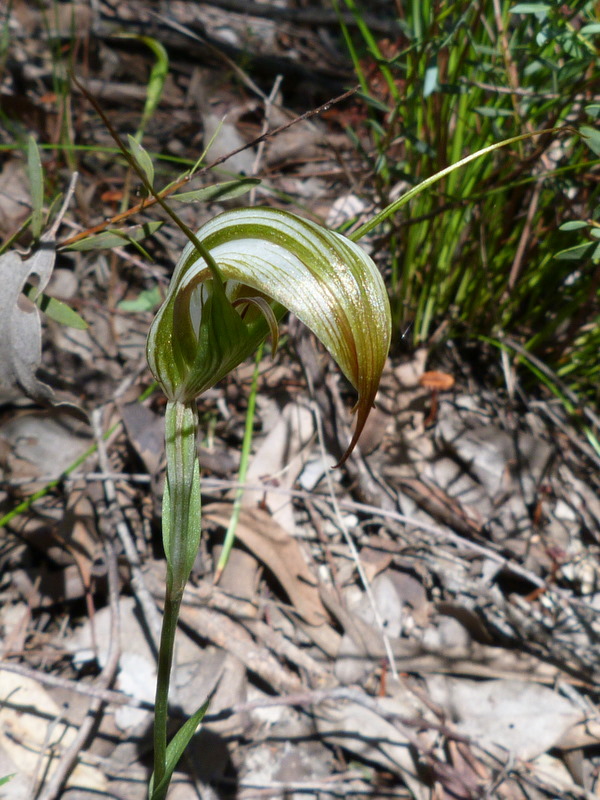
Summer Greenhood Diplodium decurvum, Brindabella Ranges, above Canberra.
To understand this curious flower structure, let me remind you of the basic orchid form (on which there are a myriad variations) using a rather more typical orchid flower. (You can skip this if you like, though that might make it harder to understand some of what follows - don't miss the pictures though!)
Purple Donkey Orchid Diuris punctata, Tallong, New South Wales.
Unlike most flowers, orchids (and lilies) have sepals - the outer ring of flower parts - which are as large and colourful as the petals. There is one dorsal sepal at the top of the flower, and two lateral sepals lower down. There are two dorsal petals, with the third petal forming an insect landing platform called the labellum (lip). (In this photo the dorsal sepal looks to be in front of the petals, but if you look at the top flower - you might have to magnify it by clicking on it - you'll see that it really does rise from behind them.) And that'll do for now!
The greenhood in the previous photo looks entirely different, but the basic structure of the flower is exactly the same. However in greenhoods the two dorsal petals and the dorsal sepal strongly overlap to form the hood, or galea; it may look as though it's a single fused structure, but it's not. The inconspicuous labellum of the Summer Greenhood can just be seen protruding under the hood. The two lateral sepals, which droop down in the donkey orchid, stand stiffly up in this greenhood, though this is isn't true of all greenhood species. However the important difference is that they're conspicuously fused at the base, while those of most other orchids are free of each other. Again, that'll do for now!

As I mentioned some greenhoods have the lateral sepals hanging down like the donkey orchid above, and many other orchids. Here's an example.
Tall Greenhood Bunochilus longifolius, Callala, south coast New South Wales.
The conspicuous labellum is very clear here, which brings us to greenhood pollination.
No greenhood provides a nectar reward to hard-working pollinating insects; all of them attract small male flies, mostly fungus gnats (like small non-biting mosquitoes), with a pseudo-pheromone, a chemical that mimics the 'come hither' scent of an interested female gnat. The labellum, which may be out in the open like this Tall Greenhood, or mostly hidden in the flower so it is just visible, like the Summer Greenhood earlier. When the amorously hopeful insect contacts the hinged labellum it snaps back, pinning the insect against the column, which contains both pollen and style. In its struggle to escape the unfortunate gnat either collects the sticky pollen, or delivers a bundle it's already carrying.
Rainforest Greenhood Pterostylis hildae, Katoomba, Blue Mountains, NSW.
Here the flower has been recently 'triggered', so the labellum is tucked away
out of sight inside. It may take 30 minutes for the labellum to reset, and
another 30 to become sensitive again; in part this is likely to be to allow
the last pollinating gnat to get well away so it doesn't return the pollen to its source.
The ovary is below the flower. After pollination the flower begins to shrivel and the ovary to swell; within it the tiny wind-borne dust-like seeds develop - this is characteristic of all orchids.

Nodding Greenhood Pterostylis nutans, Black Mountain, Canberra;
the flower is losing its colour and the ovary is starting to swell.
The process almost completed. Later in the blog is a photo of a healthy unfertilised flower.
 If you're at all familiar with the Australian orchid scene you won't be surprised to read that there is controversy over greenhood taxonomy. Until recently they were lumped into just one unwieldy big genus, Pterostylis, which contained obvious groups of species, each quite different from the others. Then in 2003 two highly respected Canberra-based orchid experts, David Jones and Mark Clerments, divided the genus into 16 genera, based on biochemical work. (The main reference is Jones, D.L. and M.A.Clements (2003b). A New Classification of Pterostylis R.Br. (Orchidaceae). Austral. Orch. Res. 4: 64-124 but it doesn't seem to be readily available on line.) 
 
No-one seemed to disagree that these were valid sub-groupings but the main botanical 'establishment' preferred to leave things as they were and just regard them as sub-genera. Subsequent further work using new tools by Clements combined some of those genera again, leaving eleven greenhood genera. Now things have settled down somewhat there seems to be a fairly healthy 'live and let live' approach taken. Take for instance two recent field guides relevant to my part of the world. The Field Guide to the Orchids of the Southern Tablelands of NSW including the ACT (Jean Egan et al, 2020) uses the 'new' genera. The Guide to Native Orchids of NSW and ACT (Copeland and Backhouse 2022) calls them all Pterostylis but finishes each entry with 'also called .....', acknowledging that those genus names are also in wide usage. 

Without claiming any expertise it seems to me that the more nuanced approach of Jones and Clements is more informative in recognising clearly separate greenhood groups. Jones' vast (800 pages) and hugely influential recent work, his 2021 full revision of Complete Guide to Native Orchids of Australia, obviously uses his own names. For these reasons I have chosen to also use them here; just bear in mind that some books will call them all Pterostylis.

And with that I'll just get on with introducing you to representatives of nine of those eleven genera, and hoping you enjoy meeting them as much as I do. (The other two contain just one species each, but I've not yet had the pleasure of meeting them.) As mentioned earlier, two basic groups of greenhoods are recognised. The larger group in terms of species, though only containing three genera, is characterised by having upswept lateral sepals like the summer greenhood above. Here are some more of this grouping, starting with a few from the big genus Diplodium, containing some 80 species, all but four of them being from Australia.
Scarlet Greenhood Diplodium coccinum, near Monga, inland south-east NSW.
This is an unusually colourful greenhood, a truly beautiful one that I've not often seen.
Common Autumn Greenhood D. reflexum, Black Mountain, Canberra.
Quite a few greenhoods, in this part of the world at least, flower in autumn.
(And Black Mountain, in the heart of the national capital, is an orchid nirvana,
with 51 species recorded there!)
Common Autumn Greenhoods often grow in large colonies;
this is also on Black Mountain.
Large Autumn Greenhood D. ampliatum, Chiltern Forest, central Victoria.
(This was until recently called D. revolutum, but inland plants are now
recognised as a separate species.)
Little Dumpies (or more formally Brittle Greenhood, though I don't know why)
D. truncatum, Black Mountain. I love the spontaneously arising folk names though.
Hairy-stemmed Snail Orchid D. setulosum, southern Flinders Ranges, South Australia.
There are over 30 species of the little snail orchids, mostly in Western Australia; until recently
they were given their own genus (Linguella) but Clements and Jones, after further work,
moved them into Diplodium.
Trim Greenhood D. concinnum, Callala, south coast New South Wales.
Again the labellum is obvious, protruding through the join of the two lateral sepals;
this angle is the sinus, and is used for identification of greenhoods. This species too
was once assigned to a separate species (Taurantha) which has since been withdrawn.
About 26 species remained in the old genus Pterostylis, along with some still to be named, and some 15 in other parts of Australasia. They include two of the commonest greenhoods in this part of the world and throughout much of eastern Australia. Both can form very big colonies.
 
Nodding Greenhood Pterostylis nutans, Micalong Falls, New South Wales.
Not dozing, they always look like this!
 
Maroonhood P. pedunculata, Woods Reserve, ACT.
This little one in particular can occur in hundreds.
The third genus in this group comprises very small-flowered orchids, often referred to as tiny orchids. There are 23 species of Speculantha, all confined to eastern Australia. They are distinctively dumpy little characters with short 'horns' ie lateral sepals and often a rusty tinge. Here are a couple of them.
 
Red-tipped or Blushing Tiny Greenhood, S. rubescens, Black Mountain, Canberra.
This one is widespread across the southern inland slopes and plains of NSW,
whereas most tiny greenhoods are coastal.

Squat or Swarthy Tiny Greenhood S. furva, Mongarlowe, south-eastern NSW.
As illustrated earlier, in the other greenhood sub-group the lateral sepals point downwards (ie they are deflexed if you're feeling erudite. There are eight genera of these, and I'm happy to be able to offer you examples of six of them. In addition there are two genera each with just one species - Daintree's Greenhood Pharochilus daintreanum from southern Queensland and northern NSW, and the Frog Greenhood Ranorchis sargentii from the south-west of the continent.
 
The leafy greenhoods, genus Bunochilus, are good examples of this group. There are 15 recognised species down the east coast of Australia, including the Tall Leafy Greenhood above and these two.
Brown-lipped, or Broad-sepaled, Leafy Greenhood B. umbrinus,
Tidbinbilla NR, ACT lower mountains; it is limited to the
NSW southern tablelands. In this plant the labellum has been triggered
so is pressed back into the flower; behind it the fungus gnat
is struggling to get out, carrying its pollen load. Otherwise the labellum
looks like that of the Tall Leafy Greenhood near the start of this blog post.
Montane Leafy Greenhood B. montanus, Black Mountain, Canberra.
Sorry about the poor lighting. This was described by David Jones in 2006,
but one recent publication prefers B. jonesii, doubtless a tribute to David Jones.
However that was published in 2007, so I can't shed any light on that story.
Hymenochilus is a genus of 24 very small-flowered greenhoods (called midget greenhoods, appropriately). Two of them are from New Zealand, the rest are Australian. Any they really are tiny - you can't properly see them unless you get right down to their level.
Black-tipped Greenhood H. bicolor, Black Mountain, Canberra.
The distinctive black appendage at the base of the labellum is only seen
when the labellum has not been triggered.
Alpine Swan Greenhood H. crassicaulis, high Brindabellas, Namadgi NP, ACT.
Named by Jones in 2008, it grows in high grassy areas of the Brindabellas and the
Snowy Mountains. This stem is coming to the end of its flowering,
with only the top flowers still fresh.
Midget Greenhoods H. muticus, Nangar NP, central western slopes, NSW.
This is mostly an inland species, found from Queensland to Victoria.
The rustyhoods, Oligochaetochilus, include some of the most striking greenhoods to my eye. There are some 80 species of them, up to 15 of which are still awaiting description. Many are reddish, as the group name reflects, many have long pointed lateral sepals, and many have hairs around the fringe of the labellum. Many also grow much further inland, and in drier areas, than most orchids.
Boorman's Rustyhood or Baggy Britches (!) or even Sikh's Whiskers, though that is
understandably falling from favour these days, Oligochaetochilus boormanii,
Weddin Mtns NP, south-western slopes New South Wales.
Slender Rustyhood O. aciculiformis, Mount Tennent, south of Canberra.
This species and the next were flowering together in a very nice site in dry
casuarina woodland.
Southern Hooked or Scaly Rustyhood O. hamatus (see previous caption).
This is an especially distinctive species with those long curving sepals.
The bearded greenhoods are, if anything, even more striking with their nodding labellum fringed with long thick yellow hairs. Plumatichilos contains some 25 species, nearly all of which are endemic to Australia and most to WA. I haven't had much luck with them over there, but here's a nice one from my home state of South Australia.
Leafy Bearded Greenhood Plumatichilos foliaceus, Alligator Gorge,
southern Flinders Ranges. Unfortunately the characteristic dark red knob on the tip
of the labellum is largely hidden in front of the shadow.
There are seven species of the pretty banded greenhoods Urochilus spp., five of them limited to WA.
 
Banded Greenhood U. vittatus, Shannon NP, south-west WA.
This one is fairly common across the sandy south-west.
Red-banded Greenhood U. sanguinea Kings Park, Perth. This one has a remarkably wide range across southern Australia from Tasmania to Perth and north to Kalbarri.
My last offering is a pretty weirdly and unmistakably striking single-species genus from WA.
Jug Orchid Stamnorchis recurva, Twin Creek NR, Western Australia.
So, the greenhoods, subtle beauties. I hope my enthusiasm hasn't led to you feeling buried in too much information and that you've been able to enjoy them as much as I do. Look for them in damp shady places (especially in the east) and in autumn and even winter when most other orchids are waiting their turn. You may well end up entranced.

NEXT POSTING THURSDAY 27 OCTOBER
 
I love to receive your comments and in future will be notifying you personally by email when a new posting appears, if you'd like me to. All current subscribers have been added to this mailing list and have already been contacted. This will mean one email every three weeks at the current rate of posting. I promise never to use the list for any other purpose and will never share it.
Should you wish to be added to it, just send me an email at calochilus51@internode.on.net. You can ask to be removed from the list at any time,or could simply mark an email as Spam, so you won't see future ones.

Thursday, 15 September 2022

A Celebration of Weird Bills

And by 'weird bills' I don't mean the sort where someone wants you to pay lots of money to renew a subscription that you never had!

A decade ago I wrote a brief irregular series of short posts on unusually adapted bird bills; those are pretty much lost in the mists of time but I've decided to resurrect the idea and build on it for today's post. A bird's bill (or beak if you'd prefer, there's no difference) is a wonderful structure, and is the sole food-gathering tool for most birds, as well as being fundamental to preening, nest-building, chick-feeding any many courtship activities. It is not too dissimilar to the jaws of other vertebrates in comprising upper and lower jawbones (mandibles) but it is covered in a thin horny or leathery keratin sheath. The top mandible is connected by three bony prongs to the forehead and sides of the skull, so unlike in a mammal's jaw the top mandible is moveable as well as the bottom one, enabling a significant gape. 

Let's start with a couple of the biggest bills, and one of my favourite birds (though that tends to depend somewhat on which bird I'm watching at the time). 

The claim to fame of the fabulous Sword-billed Hummingbird (Ensifera ensifera) is that
it has the longest bill of any bird relative to its body size. Indeed it is also claimed to
be the only bird with a bill longer than its body. Yet another claim is that it always rests
with its bill held upwards, because it's too heavy to hold horizontally, but this female
didn't seem to realise that.
I first saw the species (this photo commemorates that occasion) in Ecuador, at the delightful Yanacocha Reserve, 6,700 hectares of cloud forest on the northern slopes of Pichincha Volcano, across the ridge from Quito. Like other precious Ecuadorian cloud forest reserves, it is run by the admirable Jocotoco Foundation. While the Sword-bill feeds on a variety of tubular flowers which don't require the remarkable length of  bill, it seems to have co-evolved with passionfruit flowers, and especially the species Passiflora mixta. Both the bird and the flower live in a long strip of high elevation cloud forest (between 2500 and 3400 metres above sea level) along the Andes.
A related species of Passiflora at San Isidro Lodge in north-eastern Ecuador. The flower tube
of P. mixta is even longer than this, and probably no other bird can reach the rich nectar
supply at the base of it.
Well that's relatively the longest of any bird bill, but what about in absolute terms? That honour seems to belong right here in Australia, with a very familiar bird - the Australian Pelican Pelecanus conspicillatus. 
A male's bill can be up to 50cm long. The famous pouch, of thin stretchable skin,
is supported by a pair of surprisingly delicate long bones, but can hold up
to 13 litres of water.
The important point is that pelicans do not carry food (or water) in the bill, but eat it immediately.
As soon as a food item, nearly always a fish, is scooped up along with the surrounding water,
the pelican presses its bill back against the breast to squeeze the water out.
As can be seen here, pelicans (along with gulls and owls) can spread the bones of the bottom
mandible to increase the width of scoop. The fish is then manipulated to be swallowed head first.
As we'd expect, in most birds (though not the ones we're looking at today) the upper and lower bill mandibles are essentially the same size and shape so that they fit together snugly when closed. However if 'biting' or tearing is required, the upper mandible is often hooked to provide grip and leverage to rip and crush flesh, hard seedcases or even wood. In this case the tip of the lower mandible is often broad and square; when closed the top hook fits over it. Here are a couple of examples.
Yellow-tailed Black-cockatoo Zanda funerea breaking open Banksia marginata cones
to extract the seeds (in our backyard in suburban Canberra.) In this situation the
force is exerted by the bottom mandible against the top, which hooks into the cone.
The same cocky species has ripped deep into this very hard-wooded Blackbutt
Eucalyptus pilularis to extract moth or beetle larvae.
Near Ulladulla, south coast New South Wales.
Wedge-tailed Eagle Aquila audax with road-killed Red Kangaroo carcase, far
north-western NSW. The hooked bill will have no trouble opening the body.

However in a few specialised cases, this hooked upper mandible is greatly attenuated for extracting edible material from within a hard case with a small access. The big apple snails (Pomacea spp.) are abundant in Neotropical wetlands, but despite (or because of) being a valuable potential food source are protected by their large, smooth, hard shells with a small opening. However two species of raptors have evolved a long slender upper mandible to solve the problem; they are snail specialists.

Snail Kite Rostrhamus sociabilis, Panatanal, south-western Brazil,
at work extracting an apple snail, above and below. (The Slender-billed Kite Helicolestes hamatus
has developed a similar bill for the same purpose.)
But snails aren't the only food hiding in a hard shell; many seeds do the same. In the south-west of Western Australia the Marri tree Eucalyptus (or Corymbia) calophylla dominates large areas of dry forest; its fruit are not entirely dissimilar from an apple snail in appearance.
Marri fruit near Perth; the cases are phenomenally hard, but a couple of bird species endemic
to the area have solved the access problem in the same way the South American kites have. Both
these birds are experts at extracting the seeds without damaging the fruits.

Red-capped Parrot Purpureicephalus spurius, Albany,
a truly glorious large parrot, and the sole member of its genus.
The key feature of the Red-capped Parrot from our perspective however is the extended upper bill, fairly clear in this picture. Experienced older birds show great dexterity in nipping off the hard ripe Marri fruit, holding it in one claw, testing it and, if it is of good enough quality, rotating it while inserting the upper bill to extract the seeds. (Green fruit are simply chewed apart.) An earlier study found that 54% of Red-capped Parrots in winter had been eating Marri seed. 

Given the value of the resource offered by Marri, it is not so surprising that another bird has independently come up with a similar solution to the issue of accessing the seed. This is Baudin's Cockatoo Calyptorhynchus baudinii, named for French commander Nicolas Baudin, sponsored by Napoleon to lead of one the most impressive exporatory expeditions ever to visit Australia, in the first years of the 19th century. (I won't digress here into the vexed question of whether we should be lumping animals with people's names, but it was certainly simpler when the two white-tailed black-cockatoos were referred to unequivocally as Short-billed and Long-billed!) As you'd expect from the previous story, Baudin's is the long-billed version.

Baudin's Cockatoos, Stirling Ranges NP. The special mandible is not as clear as it is in the
Red-capped, largely because the bill is part-hidden in feathers, though the light isn't helping.
In this pair it can best be seen in the female (with pale bill) on the left.
Baudin's Cockies are even more dependent on Marri than the Red-Capped Parrot, with wood-boring grubs comprising most of the rest of the diet. Sadly they are listed as Endangered, by the IUCN and both Western Australian and Australian governments. The single population is estimated to comprise between 10,000 and 15,000 birds; the main threat formerly was habitat clearance, while now it is regarded as a mix of loss of mature Marri trees (the key food source), competition for nesting hollows with feral Honeybee colonies, and illegal shooting (primarily by orchadists).

Another Australian cockatoo has also evolved such a bill, but for an entirely different purpose. 

Meet the Long-billed Corella, Cacatua tenuirostris, here at Urana in
south-central NSW. Its long upper mandible evolved to extract tubers, of a
native daisy species, from the ground.
Murnong, or Yam Daisy, Microseris lanceolata, here in Canberra.
The daisy is not uncommon, though never abundant, but once it was almost unimaginably profuse. Accounts from the grassy plains and open woodlands of southern New South Wales and northern Victoria tell of swathes of Murnong flowers turning the plains golden to the horizon. Their small sweet tubers were harvested by Aboriginal people, eaten raw or roasted to a delicious treacly consistency. European settlers learnt the trick from them.There are stories of wagon wheels turning up thousands of Murnong tubers from the soft soil, leaving them to rot on the surface. Then the sheep came, eating the plants and learning to push into the soil to eat the tubers as well. The plough finished the job. 
 
The corellas used to come in vast flocks to feed on them, but when the Murnongs largely disappeared so did the corellas. They rebounded when they found that the grains which replaced the Murnong were also edible, but of course this was a capital offence and the numbers fell again. Today numbers seem to have again recovered within their fairly small range of south-western NSW and western Victoria, partly due I suspect to their ability to adapt to eating the tubers of exotic weeds.

But what about the lower mandible; can that be adapted to a particular food-gathering purpose? Well of course it can - nature can do anything!

The skimmers comprise three species (one each in Africa, southern Asia and the Americas) of birds in the gull family (though until recently they were given their own family). They are distinctive birds with large bills, usually seen loafing on sand bars or mud banks either in rivers or at the coast.

Black Skimmer Rynchops niger, Pantanal, south-western Brazil.
Here you can clearly see the much longer and heavier lower mandible.
African Skimmers R. flavirostris, Queen Elizabeth National Park, Uganda.
You can click on both these photos to better see what I mean.
But for what purpose? This photo, ordinary as it is, gives you the answer.
Black Skimmer 'skimming', Isla de Chiloé, southern Chile. It is flying along steadily, just above the water, with that long lower mandible cutting the surface. When it contacts a small fish or shrimp it automatically snaps shut, flipping the snack inward. Wonderful!
OK, so much for unusually long slender bills; what about bills that seem abnormally flat and wide for scooping? No problems. Here are two examples in totally unrelated water birds. The first is the Shoebill Balaeniceps rex (ie 'king whale-head!'), sometimes referred to as a stork, but actually the only member of its entire family. Its massive bill is well over 20 centimetres long - only pelicans and some large storks have longer bills.
Shoebill, Murchison Falls National Park, Uganda.
The slightly mad-looking eyes can be a bit disconcerting, but more so I suspect
if you were about to be seized by that huge bill! They mainly prey on fish, especially
lungfish, concentrating on low-oxygen water where the fish are forced to come
regularly to the surface to breathe.
From this angle the savagely hooked tip is obvious, as well as the mass of the bill.
Across the Atlantic in the mangroves and streamside forests of the Neotropics, from Mexico to northern Argentina, lives a bird with a surprisingly similar bill to the Shoebill, but though it is equally massive relative to the bird's size, the Boat-billed Heron is only a third as big as the Shoebill.
Boat-billed Heron Cochlearius cochlearius, Pantanal, Brazil.
The very big eyes tell us that it mostly nocturnal, so we can only see it
in the very late afternoon and at night. It is probably not particularly uncommon
but because it can mostly only be seen from a night-time boat ride, it seems scarce.
The strange bill led it to be regarded as 'not-a-heron' (and there are some who would reinstate the older view that it belongs to a separate family) but the general opinion is that it is an out-lying member of the heron family. It snaps up a range of prey, especially fish and invertebrates and small land mammals, often using its bill as a scoop in a way that no other heron does that I can think of. 

While typing this I've thought of another, entirely different, group of birds with similar broad scooping bills. The frogmouths comprise a family of well-camouflaged nocturnal birds from Australia-New Guinea and south-east Asia, mostly dwellers in dense forests. The best-known however is the Tawny Frogmouth Podargus strigoides, found in open forests and woodlands throughout Australia. Their short broad bills enable them to 'swoop and scoop' on prey, from large insects and spiders to frogs, lizards and even small mammals and birds. They are related to nightjars, swifts and hummingbirds!
Papuan Frogmouth Podargus papuensis, Cairns, north Queensland.
Finally a couple of bills that really don't fit any sort of pattern used by any other birds. 
 
Toucans, from the Neotropics, have famously huge colourful bills with which they toss down fruit, and extract nestlings from tree hollows. However we now know that the driving force behind the bill is its role as a heat disperser, to manage body temperatures in the tropics.
Toco Toucan , Pantanal, Brazil.
Rather than reiterate things I've written about in detail recently, see here for more on
toucans in general and here for the temperature-management story.
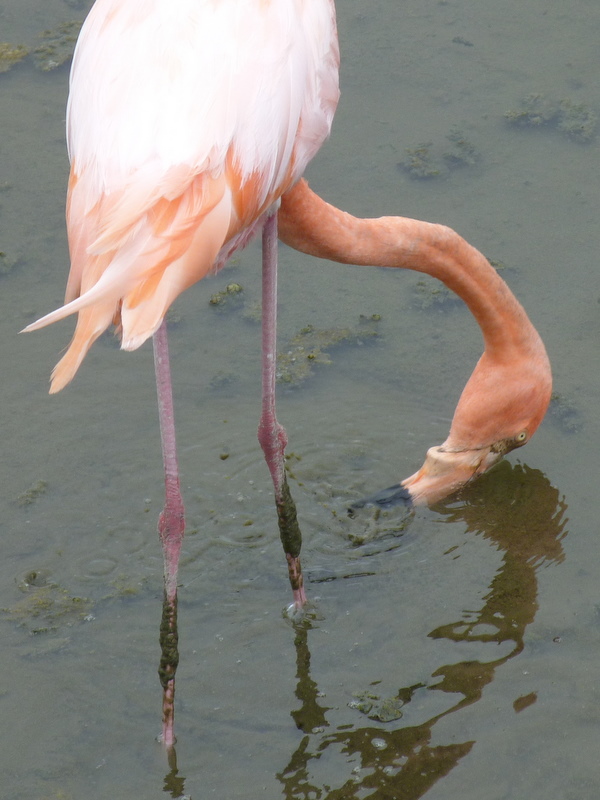
Flamingoes have an extraordinary feeding behaviour, which requires an extraordinary bill. In all the birds we've looked at today, the top mandible is the larger one with the flexible lower one working against it. In flamingoes the opposite is true.
American Flamingo Phoenicopterus ruber, Galápagos Islands.
Here the lower mandible is clearer larger than the top one.
What makes this seem especially peculiar is that the flamingo then turns its head upside down in the water so that the bill is almost horizontal, to feed with its bill in the conventional bird shape - larger mandible upwards! Presumably only thus can it get its bill close to and parallel to the substrate.
American Flamingo, same location, feeding in shallow water. It is separating water and
unwanted muddy particles from food items using a large, fatty, highly sensitive tongue with
numerous fleshy protuberances (lamellae), complemented by a keeled bill also fringed with
fleshy lamellae. The tongue is used as a pump which beats from five to 20 times a minute to
suck in beakfuls of muddy water and wrigglies - including algae, small fish and invertebrates -
and to expel unwanted gunk via a complex set of movements. Remarkable.
And while all these bills are, I believe, fascinating variations, I've left one of the most peculiar and  mysterious - ie whose function has only recently been properly understood - until last. There are two species of openbill stork, genus Anastomus, one in Africa and one in Asia. They, like the Snail Kite earlier, feed on the big apple snails but their approach is quite different. There has been a lot of debate as to how they use this structure to extract the snails, not least because the process is both rapid and mostly occurs under water. It is now agreed however that despite earlier beliefs they do not break the shell, or use the gap to carry snails away.
African Openbill Anastomus lamelligerus, Entebbe Botanic Gardens, Uganda.
You can see readily enough the outward curve towards the end of the lower mandible, but not
obvious from this angle is the twist to the side, so that the tips don't meet. Stalked pads at the
tip of the upper mandible hold a big Pila snail against the ground (or underwater mud) while
the lower tip stabs past the protecting operculum to cut the muscle which holds the flesh
in the shell. Even more remarkably a narcotic in its saliva trickles down the bill to assist the
process by relaxing the snail.
Well, there's probably nowhere to go after that story, at least in my opinion. I've gone on longer than I intended, but that's the (only) problem with good stories. Maybe we can even follow this thread in different directions one day. Meantime, thanks for perservering!

NEXT POSTING THURSDAY 13 OCTOBER
 
I love to receive your comments and in future will be notifying you personally by email when a new posting appears, if you'd like me to. All current subscribers have been added to this mailing list and have already been contacted. This will mean one email every three weeks at the current rate of posting. I promise never to use the list for any other purpose and will never share it.
Should you wish to be added to it, just send me an email at calochilus51@internode.on.net. You can ask to be removed from the list at any time,or could simply mark an email as Spam, so you won't see future ones.