About Me

My photo
Canberra-based naturalist, conservationist, educator since 1980. I’m passionate about the natural world (especially the southern hemisphere), and trying to understand it and to share such understandings. To that aim I’ve written several books (most recently 'Birds in Their Habitats' and 'Australian Bird Names; origins and meanings'), and run tours all over Australia, and for 17 years to South and Central America. I've done a lot of ABC radio work, chaired a government environmental advisory committee and taught many adult education classes – and of course presented this blog, since 2012. I am a recipient of the Australian Natural History Medallion, the Australian Plants Award and most recently a Medal of the Order of Australia for ‘services to conservation and the environment’. I live happily in suburban Duffy with my partner Louise surrounded by a dense native garden and lots of birds.

Tuesday, 12 February 2013

From Puerto Montt to Puerto Chacabuco; water, mountains and beauty

I'm not a sea person by nature - it's definitely not my element - but I love boat trips, and one I can highly recommend is the 20 hours on Navimag's ferry from Puerto Montt to Puerto Chacabuco in southern Chile. The travel time varies quite a bit, and departure and arrival times seem utterly arbitrary, though they leave sometime from late afternoon to late at night. But, this is South America. So where, more specifically, are we talking about?
It starts at 42 degrees south (about Hobart, for Australian readers) and heads south along the coast for some 400 kilometres. That doesn't give you any feeling for it though; mostly we are passing through channels and between islands and the coast, before turning east up Aisén Sound (Seno Aisén). This is a marvellously complex coast line.
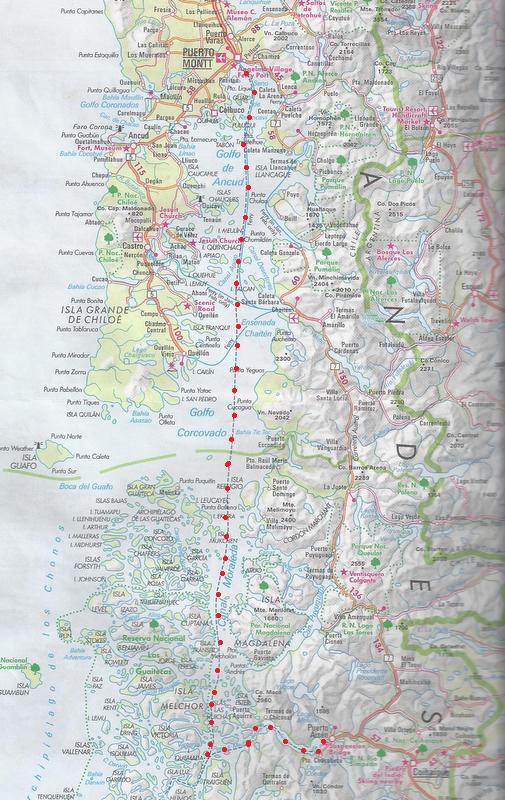
The dotted red line is the route. It starts from the industrial port of Puerto Montt, travels through the Gulf of Ancud, between the island of Grande Chiloé and the mainland. Chiloé represents the point at which the Cordillera de la Costa (the Coastal Range) - a lower range which parallels the mighty Andes, closer to the coast - runs into the sea. South of there the range continues as an archipelago of emergent mountains, the Chonos Archipelago, the northern part of which is the Guitecas Archipelago. Before we get to the sheltered waters of the deep Moraleda Channel however, between the Chonos and the mainland, we cross the Corcovado Gulf, the only unprotected part of the trip. Finally, in the maze of islands, we turn east up the narrow and spectacular Aisén Sound. Another important part of the spectacle is the Andes themselves, which are edging close to the sea by now; they too run into it further south.  
Ferry in front of Volcano Corcovado.
The ferries are run by Navimag (an abbreviation of Magellanic Navigation) which has a monopoly; there is little road access to the communities of this incredibly broken coast, and they rely almost entirely on Navimag to deliver. The ferries are freight carriers first, which also cater for local passengers, and finally tourists; having said that, the little cabins are quite adequate, food is good if basic, and the bar is well-stocked. And the scenery is amazing. (They also go all the way to Puerto Natales, far to the south.)
The ferry Puerto Eden, which does this run, at Puerto Chacabuco.
Puerto Montt is not somewhere you'd really visit for its own sake, though the setting is superb, and it is the arrival point for both Chiloé and the beautiful lakes area inland.
Sunset (at about 9pm) on Volcano Chacabuco, behind Puerto Montt.
We tend to pass most of Chiloé at night, waking to the beginning of the Corcovado Gulf. Depending on the conditions, sunrise on Volcano Corcovado can look like this....

or this...

The gulf itself is now known to be a Blue Whale breeding ground, though I've spent days peering without seeing one; I'll keep trying though!

Other marine animals, including sea lions and dolphins, are easier to see.
Sooty Shearwaters Puffinus griseus (above and below) are abundant.

Black-browed Albatrosses Thalassarche melanophrys
Southern Fulmar Fulmarus glacialoides
And the scenery is always stunning.
Canal Moraleda, above and below.
 

The only settlement we see during the entire trip is little Puerto Aguirre on Las Huichas; there are no roads there. We don't visit it, though there are regular ferry services.
The trip up the Aisén Sound is one of the highlights of the journey. The birds, ubiquitous until here, mostly leave us at this stage; they are children of the wind and don't appreciate the stillness. However the experience of sailing through the Andes is special.
The snows and glaciers continue into the great permanent ice fields.


One of the joys of the trip up the Sound is not knowing what's around the next corner.

Finally, it is almost an anticlimax to find yourself looking at Puerto Chacabuco, having been certain on several occasions that the fjord was about to end.

This somewhat bleak little port - and the larger Puerto Aisén just beyond it - are unlikely to be your destination per se, though the beautiful high country beyond is well worth the journey.

On the other hand, this journey is its own reward.

BACK FRIDAY

Friday, 8 February 2013

Taken as Red; more on plants

Any flower pollinated by animals needs to be seen; red is a good way to achieve that. Having been pollinated, the next function of the flower is to form a fruit, which both protects the developing embryo (which we call a seed) and in many cases provides the mechanism for its distribution. Animals are important in this too - and again red is an important signal that the fruit is ripe, meaning that it is now full of appealing sugars. Obviously enough this coincides with the time that the seed is mature and ready to start life as an independent plant. Interestingly, blues, purples and black are also used to promote the same message.

Most of the animal vectors are birds (hence the prevalence of red as an "I'm ready!" signal), but in lower latitudes fruit bats are very important; however, as night foragers, colour isn't an important cue to them. Many examples are available; here are a few.
Ruby Saltbush Enchylaena tomentosa Chenopodiaceae
inland northern New South Wales.
Many saltbushes have luscious berries (these particular ones are very pleasant to eat),
though others have dry papery fruit.
False Rosewood Synoum glandulosum Melicaceae, Nowra, New South Wales.
Many rainforest fruits are distributed by bowerbirds and fruit pigeons.
Yellow Pittosporum Pittosporum revolutum Pittosporaceae, Bawley Point, New South Wales.
Another rainforest plant; however long ago as Australia dried out,
one member of the genus adapted to the new arid regime.
Berrigan P. angustifolium (Whyalla, South Australia) below, has apparently recruited dry county birds (possibly inland honeyeaters or bowerbirds) to do the job.
 
Native Raspberry Rubus parvifolius Rosaceae, Namadgi National Park near Canberra.
We probably wouldn't argue with the birds over the previous couple of fruits,
but I certainly share their tastes with regard to this one!
Quandong Santalum acuminatum Santalaceae, Pinnacles NP, Western Australia.
Quandong jam is a traditional staple among inland European-Australians, recently 'rediscovered' and marketed.
Other genera in the family however have taken a different approach.
Dwarf Ballart, Exocarpos strictus Santalaceae, Pilliga NP, New South Wales.
Here the true fruit is the hard seed at the tip of the red 'fruit' which is actually just a section of stem,
swollen, filled with sugar, red; different origin, same job.

Oddly, at least one Australian conifer - non-flowering by definition, so no true fruit is possible - has adopted the same strategy.
Mountain Plum Pine Podocarpos lawrencei Podocarpaceae, Namadgi National Park near Canberra.
Here the seed is the large green structure on top of the red bird-attractor.
Other structures can turn red to act as bird-attractors too.
New South Wales Christmas Bush, Ceratopetalum gummiferum Cunoniaceae, Nowra, New South Wales.
Here the sepals, hitherto inconspicuous, have expanded and turned red to draw attention to the seeds.
Nor are birds the only vector; many Australian plants - and presumably elsewhere too - use ants to do the job. They don't want the ants to eat the seeds, which are usually protected by being too big and hard, so offer a fleshy structure to attract them. Presumably the ants can see red.
Blackwood Acacia melanoxylon, Namadgi National Park.
The red elaiosome is full of desirable protein and fat; the ants haul the whole structure away and strip the
undesirable seed off before taking the elaiosome into the nest.
It is widely recognised - though not common among Australian plants - that leaves often turn red before they drop, as the plant withdraws the valuable chlorophyll, leaving less valuable chemicals, notably anthocyanins which protect the photosynthetic systems from light overload.

Bleeding Heart Tree Omolanthus populifolius, Euphorbiaceae, Nowra, New South Wales.
In many eucalypts - and other trees - bark turns red before it dies and drops off. Probably a similar story explains this too, though I'm not sure what it is in this case. It can be very aesthetic though!
Red Bloodwood (though several species are called that) Eucalyptus erythrophloia, Cooktown, north Queensland.
And with that I'm about redded out, though I still want to feature the common and striking juxtaposition of red and black, especially in many birds. However we'll leave that for a little while, and look elsewhere next time.

I just realised that this is my 100th posting; thanks for making it possible!

BACK TUESDAY

Thursday, 7 February 2013

Redness in Plants

Continuing the theme of red in nature, today's the turn of plants. As with animals, plants generally show red to be noticed. Probably the most obvious manifestation of this is in flowers; the entire purpose of a flower is to attract a pollinator, which is then persuaded by means of a bribe - usually an energy hit in the form of sugar, ie nectar - to venture where it will inadvertently collect pollen to take to another flower. Insects in general see best in the shorter wavelength end of the colour spectrum - blues, purples, yellows - so red flowers are primarily bird-pollinated. 
New Holland Honeyeater Phylidonyris novaehollandiae on Calothamnus sp.
Cape Le Grande NP, Western Australia.
See pollen all over forehead; the nectary is at the base of the flowers,
the pollen is on the feathery red anthers which the bird must push past to claim its treat.
Australia appears to have an unusually high proportion of bird-pollinated flowers relative to other parts of the world, though work coming out of southern Africa and South America suggests that numbers there are higher than hitherto recognised. Here a few plant families provide a high proportion of bird-pollinated flowers; these are especially Proteaceae, Myrtaceae, Epacridaceae (Australian heaths, sometimes now placed in Ericaceae, the Old World heaths), Fabaceae (peas) and Myoporaceae (mainly Eremophila, though this genus is now sometimes included in Scrophulariaceae). Honeyeaters are by far the major pollinators, followed by the lorikeets, but many other bird families are involved. Here are some examples of the flowers.
Scarlet Banksia Banksia coccinea, Proteaceae
Stirling Ranges NP, Western Australia.

Grevillea wickhamii, Proteaceae
Bladensburg NP, Queensland.
Waratah Telopea speciosissima Proteaceae
Carrington Falls, southern New South Wales.
Proteaceae is an old Gondwanan family, and in South America in particular similar genera occur.
Notro Embothrium concinnum Proteaceae
Laguna Verde, southern Chile.
Its main pollinators are hummingbirds and elaenias, generally thought of as flycatchers.
Mottlecah, Eucalyptus macrocarpa, Myrtaceae
north of Perth, Western Australia.
Eremophila glabra Myoporaceae (but see comment above)
Shark Bay Western Australia.
Running Postman Kennedia prostrata Fabaceae
Coffin Bay NP South Australia
Epacris longifolia Epacridaceae (but see comment above)
Morton NP, New South Wales.
Lechanaultia formosa Goodeniaceae
Stirling Ranges NP, Western Australia.
In northern South America hummingbirds dominate pollination and they too are attracted to red.
Bomeria sp. Alstroemericaceae
El Cajas NP, southern Ecuador
Fuchsia ampliata Onagraceae
Yanacocha Reserve near Quito, Ecuador
Epidendrum ardens Orchidaceae
Manu National Park southern Peru - 4000 metres above sea level.
 All of this is not of course to say that insects do not visit red flowers - they certainly do.
Common Crows Euploea core on Callistomen viminalis
Undarra NP Queensland
Whether they respond to scent - not likely, given that birds generally don't rely on it much, unless some red flowers also seek to attract them as a back-up - or simply recognise the flower from other cues, is not known, at least to me. 

There are other plant parts that turn red too; I was going to talk about them today, but this has alreddy gone on long enough I think, so I'll pop back tomorrow to finish off.


Tuesday, 5 February 2013

Nature Red in Feather and Leg

Time for another instalment in the ongoing saga of postings on colour in nature. Animals and plants wear red - like black and white that we discussed previously - to be noticed. 

Crimson Chat Epthianura tricolor, Nullarbor Plain, South Australia.
For plants it is to draw attention to flowers or fruit; for animals it is likely to be to attract mates or intimidate rivals, or perhaps even to warn enemies off. Most reds in nature come from a large class of chemical pigments called carotenoids; these may produce yellow or red (or combinations and variants, such as orange, pink or russet) but because there are so many options I'll stick with red today - and indeed in the next posting too!

Plants, algae and bacteria can produce carotenoids, but animals in general can not. They must eat it from plant sources and transport it internally to deposit it where it is required; this is energetically expensive, but in fact the situation is worse than that for them. Yellow carotenoids are much easier to obtain, and there are many yellow animals of course, but if you really want to stand out red and proud, then you must chemically convert the yellow carotenoids to red, which of course takes even more energy. Being red then is a statement of your fitness and strength - you've got surplus energy to squander on looking gorgeous. It also, I think, helps explain why very few animals are entirely red - that really would be extravagant. On the other hand in some situations the red is made more striking by being in juxtaposition with another colour - the Crimson Chat above for instance. In particular black and red is a very dramatic combination, and I shall devote a whole posting to this very soon.

Not many mammals utilise true red (though some primates have dramatically red faces, or nether regions to advertise sexual receptivity), so most of this post will feature birds and invertebrates.

In some birds the red is featured in bills or legs.
Red-tailed Tropicbird Phaethon rubricauda on nest, Lady Elliot Island
The red tail-spike is a nice balancing touch.
Purple Swamphen Porphyrio porphyrio, Canberra
Blackish Oystercatchers Haematopus ater, Isla Chiloe, Chile.
The red eyes incidentally are due to pterin, a chemical quite unrelated to carotenoids.
Black-necked Stork Ephippiorhynchus asiaticus, Fogg Dam, Northern Territory

Malachite Kingfisher Alcedo cristata, Lake Mburo NP, Uganda


Coscoroba Swan Coscoroba coscoroba, Puerto Natales, southern Chile.
Many however have incorporated the red carotenoids into their plumage. It's interesting that the oldest living groups of birds - ratites (emus, kiwis, ostriches etc), gallids (chooks, turkeys, quail, guinea-fowl etc) and ducks, geese and swans - never have red feathers, though they may have red bills or legs like the Coscoroba Swan above. The red feather innovation evolved later.
Red-browed Finches Neochmia temporalis, Canberra.
The brilliant red eyebrow, bill and rump doubtless help this widespread little bird keep in touch with the rest of the flock when feeding on grass seeds on the ground.
Diamond Firetail Stagonopleura guttata, Canberra.
Another finch with a brilliant red rump which flashes in flight.
Northern Carmine Bee-eaters Merops nubicus, northern Cameroon.
Red-capped Cardinal Paroaria gularis, Manu NP, Peru
Actually a tanager..
Crimson Finch Neochmia phaeton, Fogg Dam near Darwin, Northern Territory
 Parrots are different. They use a different class of chemicals, called psittacofulvins, which they can manufacture themselves, so can afford to be more profligate with them.
Australian King-Parrot Alisterus scapularis male, Canberra.
Crimson Rosella Platycercus elegans, Canberra.


Red and Green Macaws Ara chloropterus, Blanquillo Clay Lick, Peru.
 For insects the motivations may be similar, though we shouldn't assume that other animals see the same colours that we do.
Euchromia creusa, Keatings Lagoon, north Queensland.
These are warning colours, but a bluff - apparently they are mimicking stinging wasps.
Two red Ugandan butterflies; from Bwindi Impenetrable NP (above)
and Budonga Forest (below).
Any suggestions welcomed!


Diplacodes haematodes, Fogg Dam, Northern Territory
And finally, a crab - I have no idea what the advantage of being red is to a crab; if you do, please share!
Sally Lightfoot Crab Grapsus grapsus, Galapagos
(Even green or grey crabs and prawns will of course turn red on cooking; this is because in life the red carotenoid Astaxanthin in their shells is masked by the binding protein chains, which the cooking destroys.)

To be continued on Thursday.