About Me

My photo
Canberra-based naturalist, conservationist, educator since 1980. I’m passionate about the natural world (especially the southern hemisphere), and trying to understand it and to share such understandings. To that aim I’ve written several books (most recently 'Birds in Their Habitats' and 'Australian Bird Names; origins and meanings'), and run tours all over Australia, and for 17 years to South and Central America. I've done a lot of ABC radio work, chaired a government environmental advisory committee and taught many adult education classes – and of course presented this blog, since 2012. I am a recipient of the Australian Natural History Medallion, the Australian Plants Award and most recently a Medal of the Order of Australia for ‘services to conservation and the environment’. I live happily in suburban Duffy with my partner Louise surrounded by a dense native garden and lots of birds.

Thursday, 5 January 2017

Special Western Myrtles

The family Myrtaceae is one of the most conspicuous families in Australia, and is also well-represented in South America, but is also found, albeit less profusely, throughout much of the rest of the world, including Europe where the Common Myrtle Myrtus communis gave its name to the family.

In Australia Eucalyptus, Callistemon and Leptospermum are the largest genera and the most familiar, but there are some 1500 species and 70 genera here, representing about half of the world's total for both. (I have seen some recent figures suggesting twice the number of species and less genera, but without exploring the basis of this I suspect it represents a current trend in botanical taxonomy towards massive 'lumping', the helpfulness of which in terms of understanding more subtle levels of relationships I've questioned before.)

However the year is just getting into gear and I'm not inclined to be too philosophical or disputatious today. Rather I'd like to introduce and celebrate some Myrtaceous genera which are only (or nearly only) found in Western Australia, famous for its amazingly rich flora and high level of endemics. Some of these beauties may be new to you if you're not familiar with WA, but in any case I hope you enjoy them. To avoid suggestions of favouritism I'm simply going to introduce the genera in alphabetical order; bear in mind that this is nowhere near the full number of such genera. (Bear in mind too that plant taxonomy is a rapidly changing field, and it may be that some of the plants that follow have in recent times been offered different names - you'll readily find them under the names I use here though, and I've tried, as ever, to keep up to date.)

      Actinodium
This is a slightly contentious genus to begin with, because though there has traditionally only been one species recognised, there seems to be a growing opinion that a second one, still unnamed, has long been confused with it. The name refers to rays, for the flowers' superficial resemblance to daisies, also reflected in the common names.
Swamp Daisy Actinodium cunninghamii, Stirling Ranges NP.
Albany Daisy A. sp., also from the Stirling Ranges.
I have based my identification on the larger paler flowers, but I'm happy to be corrected, as ever.

      Balaustion
Another very small genus, comprising just one species (but see under Cheyniana below). Like the Actinodium, the flowers don't immediately remind an eastern-stater of the family members with which we're familiar.
Native Pomegranate B. pulcherrimum, east of Hyden.
The genus name cames from the Greek for a pomegranate flower.
      Beaufortia
A larger genus, restricted to the south-west, of some 22 species closely related to the widespread Melaleuca, as well as some similar WA endemic genera. Needless to say there are some who would lump them all into Melaleuca, but this doesn't seem to have gathered much traction. Beaufortia was named by the great Scottish botanist Robert Brown to honour the Duchess of Beaufort, Mary Somerset; she is often described as a botanist, but is better thought of, I believe, as an assiduous horticulturist. She died in 1715, nearly 100 years before Brown's naming.
Pink Bottlebrush B. schauerii, Stirling Ranges NP.
'Bottlebrush' is commonly used for the genus, though it is better-known as the common name for Callistemon
elsewhere in Australia. Johannes Schauer was a German botanist with an interest in Australian plants;
as far as I can tell he named this for himself, which would be a most irregular thing to have done.
Sand or Kalbarri Bottlebrush B. aestiva, Kalbarri NP.
This northern sandplain species also comes in a red form.
(Scan of an old and somewhat faded slide - sorry.)
      Calothamnus
Probably the largest WA endemic Myrtaceous genus, with some 40 species (but see Verticordia below), generally referred to as one-sided bottlebrushes, netbushes or clawflowers. The claws comprise long red stamens in four or five clusters, protruding from a short tube of sepals; the petals are tiny or absent. Often the flowers appear on one side of the stem. The somewhat unimaginative (though a propos) name simply means 'beautiful bush'.
Calothamnus blepharospermus, Kalbarri NP.
The flower characteristics described above are shown here, along with the typical cylindrical leaves.
blepharospermus means 'eyelash seed'...

Common Netbush Calothamnus quadrifidus, Christmas Rock, east of Perth.
This widespread species is especially known as One-sided Bottlebrush, for the obvious reason.
      Chamaelaucium
There are 14 species recognised of this endemic genus, by far the best known of which is Geraldton Wax G. uncinatum, which is widely cultivated on both sides of the Nullabor. They have open teatree-like flowers with waxy petals. The somewhat mysterious name (appended by French botanist René Desfontaines without explanation) apparently refers to the shape of the base of the flower as resembling a bishop's mitre!
Geraldton Wax, Badgingarra NR, with pollinating wasp.
These northern sandplains are their natural habitat.

      Cheyniana
Another tricky one; the genus was only described in 2009, to incorporate just two species, one formerly placed in Balaustion (see above), the other being an unnamed species formerly described as a Baeckea. (I wouldn't want to be working on the WA Myrtaceae, though it would guarantee a life's work!)

Bush Pomegranate Cheyniana (formerly Balaustion) microphylla, Pindar.
This one is found in a small area of the northern sandplains and is threatened by clearing for agriculture.
      Eremaea
A genus of 14 species closely related to Calothamnus. The name means 'solitary' (as in hermit, and ultimately from the word for desert), in apparent reference to the relative few clustered flowers at the tips of branches. They can be a quite prominent part of the heathlands.

E. beaufortioides, Moore River NP, north of Perth.
Orange is not a common colour in Australian plants.
Violet Eremaea V. violacea, Yandin Hill Lookout, north of Perth.
A lovely low sprawling shrub.
       Hypocalymma
A genus of at least 23 species (plus some still unnamed) which have generally been known as myrtles since species were introduced to England in the 1840s, where their resemblance to the European myrtle was noted. Some are widely cultivated for their profuse flowers.

White Myrtle H. angustifolium, John Forrest NP, Darling Ranges.
One might reasonably think this an odd common name, but the flowers start white and darken with age.
This is one of those introduced early to English gardens.
X. xanthopetalum, Moore River NP, north of Perth.
Yellow is an unusual colour for this genus.
      Verticordia
Technically I shouldn't be including this here, as in addition to the 100 or so WA species, two are also found in the Northern Territory. However it's too beautiful a plant to exclude on a technicality, it's one of my favourites, and how could I not include a genus whose name means 'heart turner'?! Featherflower is an oft-used common name. Anyway, let's enjoy some to end today's offering.
Scarlet Featherflower V. grandis, Gathercole Nature Reserve near Wongan Hills, above and below.
An especially large-flowered species, quite dramatic.
 

V. insignis, John Forrest NP. The name, perhaps counter-intuitively, means 'remarkable' or 'decorative'.

Woolly Featherflower V. monadelpha, Kalbarri NP.

V. chrysanthella, near Ravensthorpe.
Despite being widespread this species was only described (by the doyen of WA botanists, Alex George)
in 1991; prior to that it had been confused with the larger V. chrysantha.
And that's probably enough for one day. I hope you've enjoyed these glories as much as I have. But, as ever there's no substitute for going to see them for yourself...

BACK ON THURSDAY

 (And remember that you can get a reminder when the next post appears by putting your email address in the Follow by Email box in the top right of this screen.)

Saturday, 31 December 2016

Farewell to 2016!

As is my wont, I am going to celebrate my minuscule part in the great drama of 2016 by choosing just one photo from each month of the year - not for their non-existent photographic excellence, but because they remind me of some highlights, large and small, from my year.

JANUARY
Orchard Butterfly Papilio aegeus, inserting its proboscis into the wet soil to take up water and perhaps nutrients.
We were at Rosedale on the New South Wales south coast where we retreat for a couple of weekends a year to relax.
This is a common big butterfly from the entire east coast of Australia and New Guinea, which visits our yard in
inland Canberra fairly regularly. They evolved to feed their larvae on native shrubs of the family Rutaceae,
which pre-adapts them to citrus trees, hence the alternative name of Citrus Butterfly.
I am intrigued by the fact that butterflies' proboscises evolved long before the rise of flowering plants,
presumably for purposes such as this; when flowers came along, butterflies were pre-prepared!
FEBRUARY
Bull Ant (or Bulldog Ant, or Inch Ant according to my father), Myrmecia sp.
Another insect, and another from the NSW south coast, this time at Currarong where we went to
help celebrate a friend's birthday.
This is a genus of nearly 100 large, primitive Australian ants, with extremely painful stings.
I like this photo because of the reminder that the jaws are pretty impressive too, especially if you're of its
size range. (I also liked the fact that I manged to take the pic without being stung!)
MARCH
Diamond Python Morelia spilota, a subspecies of the more widespread Carpet Python.
It is found further south than any other python in the world, in southern NSW and (marginally) in Victoria.
This lovely animal, which had recently shed its skin (the eye scales have still not dropped) was relaxing in a pond the back yard of friends in the Kangaroo Valley, north-east of Canberra.

APRIL
Australian Pelican Pelecanus conspicillauts, bathing at Tidbinbilla Nature Reserve near Canberra.
To be honest I didn't have a lot of April photos to choose from, but I like the evening light and
the splashy enthusiasm of the bird at its ablutions
MAY
Young Bornean Orangutan Pongo pygmaeus, Gomantong Caves, Sabah.
It's not very hard to see orangutans in Malaysian Borneo, with rehabilitation centres such as at Sepilok
featuring rescued animals in the process of being returned to the wild.
It is always exciting to see them in the wild even in such situations, but this youngster and its more
circumspect mother were an unexpected bonus, entirely wild and unhabituated animals on the forest
walk into the famous caves. 

JULY
Spinifex (Triodia sp.) at sunset, Great Sandy Desert, Western Australia.
I had the good fortune to be invited to assist in a biological survey of this remote and little-known
part of Australia. It was a memorable experience indeed - and as I seem not to have taken any photos
in June (!), I'm going to indulge in a second one from here.
Male Rufous-crowned Emuwren Stipiturus ruficeps, Great Sandy Desert.
I had only seen this tiny bird (reputedly Australia's smallest) once before, and had never
succeeded in laying lens on any of the three species, so was quietly pleased with this stroke of luck.

AUGUST
In August we set out on a five week trip to tropical northern Australia, so I have a real wealth of options for the next two months!
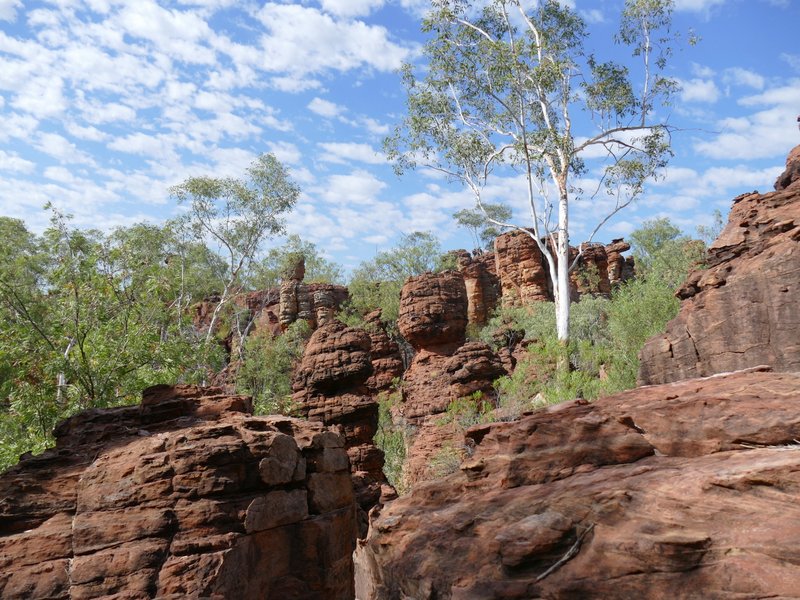
Darwin Woollybutt Eucalyptus miniata, among the sandstone outcrops of the 'Southern Lost City'
in the relatively little known, but very large, Limmen National Park, in the eastern Top End
of the Northern Territory. We did a memorable walk through the stacks and across the plateau.
SEPTEMBER
Baobabs Adansonia gregorii Gregory National Park, western Top End.
I love these splendid old arthritic giants which only come this far east. This is the only baobab
outside of Africa. Deciduous, they lose their leaves in the dry winter months.

OCTOBER
Canberra Spider Orchid Caladenia (or Arachnorchis) actensis, Mount Majura, Canberra Nature Park.
This little spider orchid is listed as Critically Endangered at a national level, being found only in a small area
of the lower slopes of the suburban Mt Majura - Mt Ainslie forests.
I was honoured to have been directed to this newly-found population.
NOVEMBER
Hoverfly (family Syrphidae) on Yam Daisy or Murnong Microseris lanceolata, Aranda Ridge,
Canberra Nature Park. This was a remarkable season for the delightful hoverflies, which seemed to be
everywhere in Canberra and beyond. This picture is also a souvenir of a very pleasant morning flower walk
with good friends Jeanie and David.
DECEMBER

Leafy Bossiaea B. foliosa under Snow Gums, Mount Ginini, Namadgi National Park above Canberra.
I can't imagine not going into the mountains near Canberra at least once every December.
Over the past 30 years I've seen the flowering get steadily earlier until these bossiaeas (a pea) now flower
regularly in November, where they used to peak in the first or second week of December.
This year however spring was unusually cold and wet, and flowering was delayed to the tine that
it used to be; I'm sure that next year however things will be back to the new 'normal'. 
And so, that was my year, or at least one version of it. Overall it wasn't a great year for the world, but we've probably been luckier than most, as we have mostly good memories of it. I hope it was OK for you too, and that next year brings us all some joy. Nature can be pretty instrumental in that.

BACK ON THURSDAY

 (And remember that you can get a reminder when the next post appears by putting your email address in the Follow by Email box in the top right of this screen.)


Thursday, 22 December 2016

A Walk in the Centre; an easy stroll to the old Alice Springs Telegraph Station

Not long ago we were in the beautifully situated, sometimes challenging, Alice Springs in the central deserts of Australia, heading home from a trip to the tropics. I know it fairly well, and Lou lived there for six years, but we still managed to find a new lovely little walk to do before we left. The historic Telegraph Station on the northern edge of town is a popular destination for visitors and locals, to visit the restored and interpreted buildings and surrounds, to picnic on the shady lawns by the Todd River or to walk in the rugged low hills of the Historical Reserve across the river looking for flowers and wildlife. 
Telegraph Station buildings.
Grassy picnic area sloping to the Todd River on the left, shaded by beautiful River Red Gums.
Built in 1872 it was the site of the first European settlement in central Australia, and one of twelve such stations along the route of the revolutionary Overland Telegraph Line linking Darwin and Port Augusta (and ultimately Adelaide and even Perth) across 3,000kms of desert. From Darwin it linked to an underwater cable to Java and thus the world. It was a triumph of nineteenth century engineering, but that's a story for someone else to tell, and many have done so. 

Perhaps most visitors aren't aware of the substantial reserve that includes the station itself; I have read a surprising range of figures for the size of it, ranging from 400 to 2000 hectares! However 445ha seems to be the most convincing figure. Our walk, the Spencers Hill Walk (though it's nice and flat) is a 1.5km stroll each way between the station and the northern edge of the old suburb of East Side (you can find maps for it easily enough). It passes through open woodland between the low red sandstone hills and the Todd River. Actually, let's lay to rest any misconceptions about the Todd at this point! Here's what it usually looks like.
The Todd River at the Telegraph Station.
However that's not always true, and when I was there a couple of months previously it had a substantial amount of (non-flowing) water in it. That was the first time I'd seen it thus, and there was still some left for our visit.
Also at the Telegraph Station. It is said that if you see the Todd with water, you'll come back.
Well, I came back several times before I got the sign that I would do so!
Anyway, the walk - and I confess that this is a busy week, so the rest will be mostly pictures, but I think that's all we need. We started from East Side; here are some scene-setters.
Daisies; it had been an unusually wet season (as per the water in the Todd) and the
understorey flowers were abundant.
Typical rocky hill in the low range which the route passes along.

Ghost Gum Eucalyptus (or Corimbia) aparrerinja.
This glorious tree is one of my favourites, and I've talked about it (including the intriguing name) in some detail before - here, if you're interested. Nonetheless I can't stop taking pictures of it, and here's another.
A particularly magnificent old Ghost Gum along the walk.
The ghost gums dominate, but they certainly don't have it all to themselves.
Cork Tree Hakea lorea; a common central desert tree.

Southern Ironwood Wattle Acacia estrophiolata.A lovely pendulous wattle, with extremely hard timber, in common with other slow-growing desert acacias.
Dead Finish Acacia tetragonophylla.The common name is supposedly a reference to its hardiness - when it dies of drought, there's nothing else left.
Sadly not all is pristine, and not just because of the proximity to town. Buffel Grass Cenchrus ciliaris is one of the great tragedies of central and northern Australia. It grows naturally from east Africa to south Asia, and is believed to have been brought here as stuffing for camel saddles. However there was nothing accidental about its subsequent choking spread across millions of hectares; graziers loved its hardiness and brought in seed. They are still planting it across vast areas, despite its smothering growth and high flammability. It grows in sandy creek beds - once they were fire breaks, but now they act as wicks. The intensity of the fires threatens the River Red Gums.
Wall to wall Buffel Grass along sections of the walk, under River Red Gums.
The only depressing aspect of the walk.
It was late morning when we walked, so not a lot of animals, but we witnessed some drama - or at least a tense stand-off - for some time. We first saw some delightful little Black-footed Rock-Wallabies Petrogale lateralis sitting upright and very alert on the rocks - but not concerned about us.
Female Black-footed Rock-Wallaby with pouch young.

This species is found scattered in arid ranges across central and western Australia.
For more on the fascinating rock-wallabies, see here.
A Euro Macropus robustus, a big tough hill kangaroo, also came from total relaxation to alertness as we approached - but again his unease was not directed at us. He watched us approach but didn't bother to get up, until something in the other direction got his attention.
Judging by the ear, this bloke had seen a scrap or two!


The problem wasn't long in making an appearance.
Dingoes Canis lupus dingo are common in the reserve, and are unfazed by people - several domestic
dogs have been killed by them there while accompanied by their owners.
This one initially focussed on us, but I had the feeling it was more to do with we might have that was
appealling to it than because it was worried about us.
More on them here.
In fact there was a pair, who initially appeared on each side of the Euro, but he wasn't going to back down - he was probably safer up where he was.

The rock-wallabies vanished, presumably into crevices, but with the advantage of awareness they could almost certainly have fled successfully across the rocks. We watched for a while but it seemed to be stalemate and we continued to the telegraph station. When we returned, Euro and Dingoes had moved on, and the rock-wallabies had warily reappeared.

I love a good natural drama, but was glad that this one didn't get any more dramatic than that!

A couple of familiar birds were present, including an old favourite.
Yellow-throated Miner Manorina flavigula on the Telegraph Station lawns, where it
is used to scrounging crumbs.
A flock of Zebra Finches Taeniopygia guttata, always a welcome addition to the day (hence their appearance
here in a very poor photo!), was searching for grass seeds.
The bird star however was a stunning male Splendid Fairy-wren Malurus splendens, a parade of blues. The species is found over much of the inland and the south-west, where they replace the south-eastern Superb Fairy-wren as the common and familiar bush and garden wren.
Impressive as he is, this is only the start of his glory, as he moults into breeding plumage.
Soon his wings, underparts and tail will all be different shades of blues.
Well, that's probably all you've got time for at this time of year, so I'll leave it there, but next time in Alice Springs, make sure you leave a couple of hours for the Spencers Hill walk - who knows what you might see!

I'll be back once more this year, for the now traditional last day of the year photo summary of the year - I hope to see you then.

BACK ON SATURDAY 31 DECEMBER

 (And remember that you can get a reminder when the next post appears by putting your
email address in the Follow by Email box in the top right of this screen.)