About Me

My photo
Canberra-based naturalist, conservationist, educator since 1980. I’m passionate about the natural world (especially the southern hemisphere), and trying to understand it and to share such understandings. To that aim I’ve written several books (most recently 'Birds in Their Habitats' and 'Australian Bird Names; origins and meanings'), and run tours all over Australia, and for 17 years to South and Central America. I've done a lot of ABC radio work, chaired a government environmental advisory committee and taught many adult education classes – and of course presented this blog, since 2012. I am a recipient of the Australian Natural History Medallion, the Australian Plants Award and most recently a Medal of the Order of Australia for ‘services to conservation and the environment’. I live happily in suburban Duffy with my partner Louise surrounded by a dense native garden and lots of birds.

Thursday, 16 June 2022

Daisies Part Two; a family album

In my last post, I introduced the wonderful world of daisies, one of the world's two great plant families (along with orchids) in terms of number of species, which are found in all continents where plants thrive. I introduced a range of habitats in which daisies grow, and showed what makes up the complex hoax of clustered tiny florets that we (and, more importantly, presumably pollinating insects) see as a showy flowers. I ended with a look at some pollinating insects at work on daisies, and the two main strategies for distributing seeds which help make daisies so successful. And I also ended with a promise to be back this time for a look through some pages of the daisy family album; thanks for coming back for that!

Though we think of non-native daisies as garden ornamentals (eg dahlias, chrysanthemums, dahlias, gerberas and zinnias) there are also some important edible ones, such as lettuce, globe and Jerusalem artichokes, chicory, chamomile, calendula, absinthe and tarragon, and oil-producers such as sunflowers and safflowers. On the downside of the ledger are serious environmental and agricultural weeds such as thistles, boneseed/Bitou Bush, dandelions, Crofton Weed, Bathurst and Noogoora Burr, ragweeds and hawkweeds.
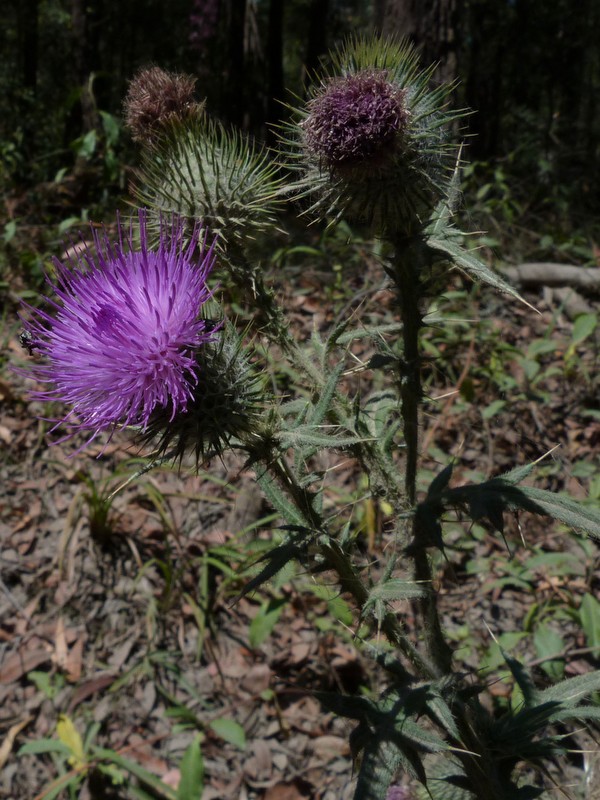
Spear Thistle Cirsium vulgare, Nowra, south coast New South Wales.
Just one of many thistle species which make our lives harder, and one of very many exotic
and invasive daisies which Australia would be better off without.

I'm going to start with a few non-Australian daisies from three continents to set the wider picture, then focus on some of the 300 Australian genera (just a few of them, I promise).

Formerly Aster (now generally called Symphyotrichum) vahlii, Seno Otway, in the snowy
eternal winds of Patagonian Chile. It is a widely accepted convention that a family of
plants (or animals) is named for the first genus in the family to be described.
The whole daisy family, Asteraceae, is based on the genus Aster, a big Eurasian genus.
Daisies originally described as Aster from elsewhere, like this one, have since been moved
to other genera. This is the classic daisy 'flower' with yellow fertile disc florets
and numerous surrounding white sterile ray florets to attract attention.
Staying in this cold wind-blasted landscape near the tip of South America where
flowers are surprisingly profuse, here is Chiliotrichum diffusum. This tough daisy is found
only in the far south of the continent and on the Falkland Islands.

And from the nearby spectacular Torres del Paine National Park, here is the lovely
Perezia recurvata (which I would not have immediately recognised as a daisy).
The genus is mostly restricted to the high Andes.

Another daisy that I'd not necessarily have recognised (though the resemblance to thistles
is obvious once you get your eye in) is the 'Flower of the Andes' Chuquiraga jussieui,
here at nearly 4,000 metres above sea level in El Cajas NP, southern Ecuador. It is the
unofficial national flower of Ecuador, but sadly endangered.

Chuquiraga is the main food source of the Ecuadorian Hillstar Oreotrochilus chimborazo.
This gorgeous hummingbird is found only above 3600 metres in the páramo, the near-treeless
tundra of the northern Ecuadorian Andes.

One daisy habitat that I was unable to show you last time was rainforest, though there are certainly some rainforest daisies in Australia. Here are a few from rainforests elsewhere to compensate. 

Mutisia sp. in the cloud forests of Manu Reserve in southern Peru. This big genus
of some 60 species is spread along the full length of the Andes.

Senecio sp. from lower down in the Manu. This huge genus (currently nearly 1300 species though it is likely to be broken up) is one of the largest genera of flowering plants and is found over much of the world.

Chilco Baccharis neae in wet temperate rainforest in Alerce Andino NP near
Puerto Varas in southern Chile. Another huge genus of some 500 species
found throughout the Americas, though mostly in the south.
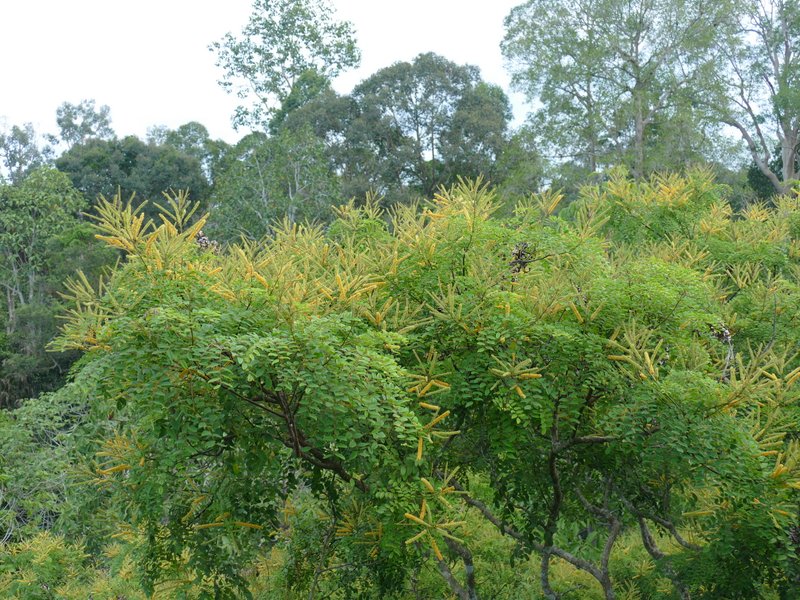
Red Bean Tree, Red Sandalwood (and many other names) Adenanthera pavonina, from a
rainforest elevated boardwalk in Sepilok, Sabah, Malaysian Borneo. Native to southern
China and India it has become widely naturalised (including northern Australia,
and in Borneo).
And with that, back to Australia for some more Family members. To prevent family squabbles I'll introduce them in alphabetical order. A couple of these were taken in botanic gardens but most were in the wild.
Winged Everlasting Ammobium alatum, Southern Tablelands Ecosystems Park, in
the Canberra Arboretum. This NSW grassland plant makes a superb garden plant,
and has thus become established in other states.
Hill Daisy Brachyscome aculeata in Namadgi NP above Canberra, a common daisy of the ranges.
When French botanist and daisy specialist Henri Cassini published the name in 1816 he used this
spelling but soon realised that it was grammatically incorrect and corrected it to Brachycome.
Unfortunately, despite widespread support in Australia for retaining the 'correct' version,
it was eventually deemed (in 1993) that his original incorrect version must stand. Hmm.
Variable Daisy Brachyscome ciliaris, Ormiston Pound, western Tjoritja/
MacDonnell Ranges
. This species is widespread in inland southern Australia.
Brachyscome obovata Kosciuszko NP. This species is restricted to wet sites in the high alps;
these plants were actually growing in running water.
Milky Beauty Heads Calocephalus lacteus National Botanic Gardens, Canberra.
The genus name means 'beautiful head'. This striking little daisy is scattered in wet grassy
sites in south-eastern Australia. Last time I featured the closely related Lemon Beauty Heads.
And another of the same genus, but this time a desert species.
Yellow Billy Button Calocephalus platycephalus, central Australia.
(And yes, Billy Button is more usually applied to Craspedia spp. but there are
no rules for common names!)
Purple Burr Daisy Calotis cuneifolia, Mutawintji NP, western NSW.
Can be abundant (often with Yellow Burr Daisy C. lappulacea below).
I discussed burr daisies last time regarding their effective seed dispersal mechanism
via sticky sharp burrs in fur and socks.

Yellow Burr Daisy, Canberra woodlands.

Sifton Bush Cassinia quinquefaria, Angle Crossing, ACT. A familiar genus of large
shrubs, which locally tend to flower in summer when not much else is doing so.
Some can cause skin complaints.

Silver Snow Daisy Celmisia sp. with beetle (Eleale sp.) and spider, Namadgi National Park.
Pompom Everlastings Cephalipterum drummondii near Mount Magnet, Western Australia.
The only member of its genus, it comes in both yellow and white, which can be
confusing initially.

Bear's Ears Cymobonotus lawsonianus or preissianus - the two are virtually
indistinguishable, so I haven't a hope! - Canberra.
 
Silver Ewartia Ewartia nubigena, Kosciuszko NP, forms creeping silvery mats in some of
the toughest habitats in Australia, living only above the treeline and south from Kosciuszko.
Blue Bottle Daisy Lagenophora stipitata, Namadgi NP.
This is a common grassland daisy in eastern Australia, and north into Asia.
Olearia is a large genus of conspicuous shrubs, herbs and small trees found in range of Australian, New Guinea and New Zealand habitats. I've included several because I couldn't work out which ones to leave out!
Alpine Daisy Bush Olearia algida, Kosciuszko NP. A shrub from the high country
of south-eastern Australia.
Large-leaved Daisy Bush Olearia megalophylla, Namadgi NP. A common large shrub
of the tall wet forests of the ranges of south-eastern Australia.
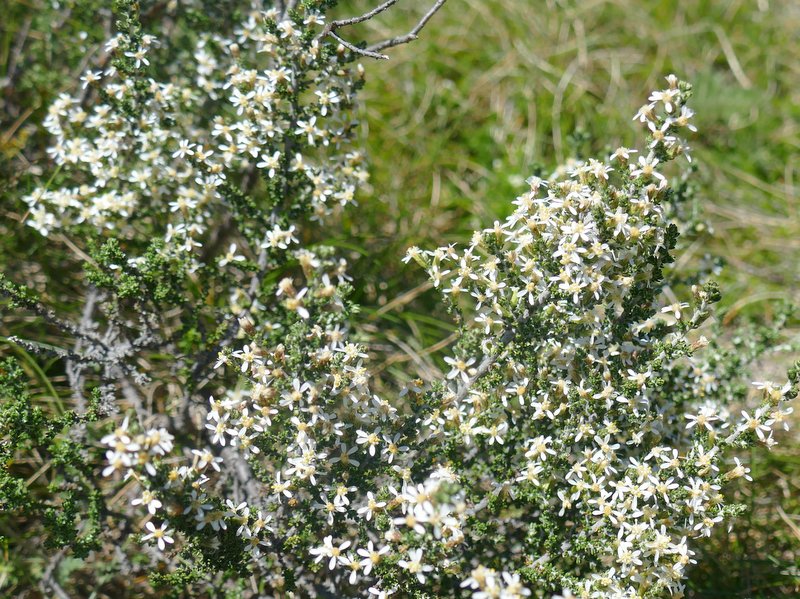
Twiggy Daisy Bush Olearia microphylla (cf the previous species), Timmallallie NP, north-central NSW.
Olearia montana Tinderry Ranges, south-east of Canberra, is a rare shrub restricted
to the Tinderries and a couple of nearby sites.
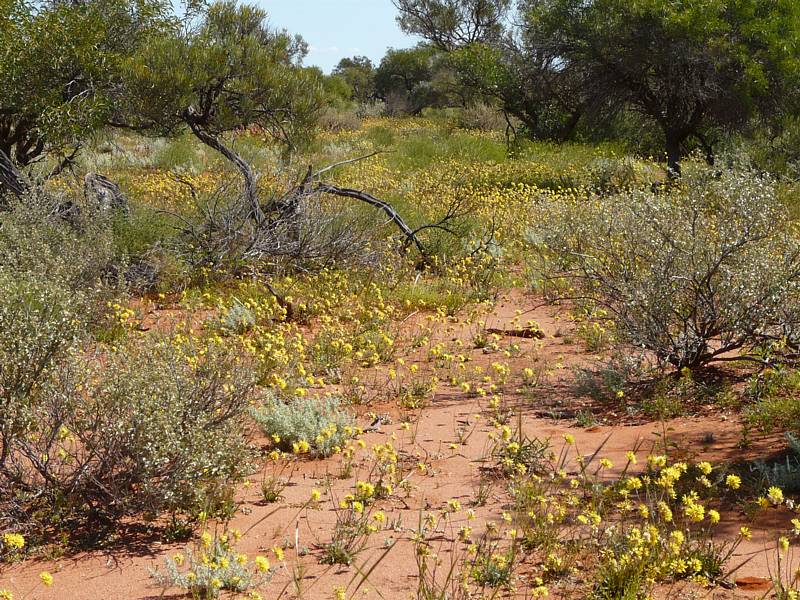
Goldfields Daisy Olearia muelleri, Mildura, north-west Victoria. Found across semi-arid southern
Australia, but especially common in the Goldfields region of Western Australia around Kalgoorlie,
hence the common name.
Dusty Daisy Bush Olearia phloggopappa, Namadgi NP. This is, as you can see, quite a sight in flower.
It is common in the ranges of south-eastern Australia.
Sticky Daisy Bush Olearia tenuifolia, Mount Tennent, south of Canberra. Found
scattered in drier rocky areas of inland eastern New South Wales and Victoria, and
to me it's not at all common.

Grey Podolepis Podolepis canescens, Caiguna, Nullarbor Plain, Western Australia.
We met this genus last time, in alpine and arid situations. This is another example of the latter.
Mountain (or Cattleman's) Lettuce Podolepis robustus is another high country species.
It wasn't the cattleman who ate this with gusto but their cattle. When cattle were removed
from the fragile high alps the species (and many others) began to recover.
Soft Billy Buttons Pycnosorus pleiocephalus, Mutawintji NP, western NSW.
Widespread in dry inland south-eastern Australia, where it favours situations which are
periodically wet - clay pans or, like here, at the foot of a stony ridge.
Splendid Everlasting Rhodanthe chlorocephala, inland from Geraldton,
central west of Western Australia. I can't fault the common name, it is spectacular.
The black marks at the base of some of the bracts are interesting - they are not insects
but may well play a part in attracting pollinators to the adjacent disc florets.
The species is found across WA and into western South Australia.
White Paper Daisy Rhodanthe floribunda, on the edge of the stony Breakaways
near Coober Pedy. It is found in a discontinuous range across the whole of the arid inland.
Cotton Fireweed Senecio quadridentatus, Namadgi NP, ACT. Not the 'standard' daisy flower
we've been looking at and, moreover, it doesn't even resemble most other Senecio.
I find it a bit of a mystery. It is also found in Indonesia and New Zealand.
Streptoglossa decurrens or odora, Great Sandy Desert, Western Australia. The two species are
generally reckoned by those much better qualified than I as almost impossible to distinguish
with any certainty. They are found scattered across the tropical drylands.
Golden Waitzia Waitzia nitida, Kalbarri NP, Western Australia.
It is found across the south-western sector of the state.
This has been an extensive journey through the family album, and thank you for reading this far! Time to wrap up our daisy dedication now with some simple enjoyment of some fine spreads of daisies in various situations, starting in the high south-east and moving downhill and west.
Silver Snow Daisies Celmisia sp., Kosciuszko NP, above and below.
In the top picture there are also Mountain Aciphylls Aciphylla glacialis Family Apicaceae,
in the background.

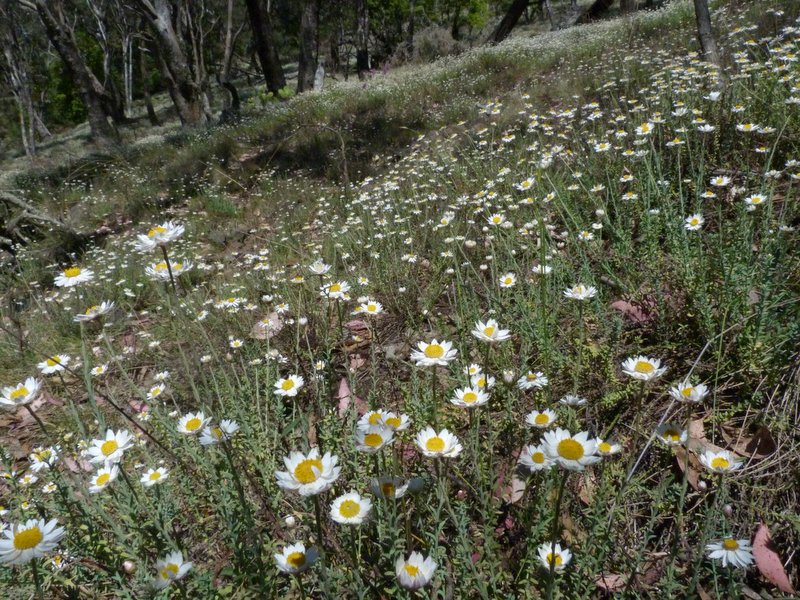
Hill Daisies Brachyscome aculeata under the Snow Gums on Mount Ginini, Namadgi NP, ACT.

Hoary Sunrays Leucochrysum albicans, Liverpool Range near Merriwa, central western NSW.
(Also some feral Prickly Pear cactus on the left.)
Lemon Beauty Heads Callocephalon citreus brightening a summer native grassland,
Mulligans Flat NR, northern ACT.
Many-stemmed (or Woolly-headed) Burr Daisy Calotis multicaulis, Mutawintji NP, western NSW.
Pompom Everlastings Cephalipterum drummondii near Mount Magnet, Western Australia.
As noted earlier this spectacular species comes in both white and yellow.
A magnificent massed display in Kalbarri NP, WA. I think the stars here are
Splendid Everlastings Rhodanthe chlorocephala and Pink Everlastings Schoenia cassiniana.
I hope neither of us is daisied out, but I think that's enough for today! Thanks for coming on the journey with me, and I'm looking forward to wherever we may travel together next time. But meantime, love your daisies!

NEXT POSTING THURSDAY 7 JULY

I love to receive your comments and in future will be notifying you personally by email when a new posting appears, if you'd like me to. All current subscribers have been added to this mailing list and have already been contacted. This will mean one email every three weeks at the current rate of posting. I promise never to use the list for any other purpose and will never share it.
Should you wish to be added to it, just send me an email at calochilus51@internode.on.net. You can ask to be removed from the list at any time,or could simply mark an email as Spam, so you won't see future ones.

Thursday, 26 May 2022

Daisies, Daisies, here's an answer or two

Daisies seem to rule, I often think. There may be in excess of 30,000 species of them, though 24,000 is a more often cited tally. The mighty Flora of Australia is adamant (or at least was in 2015) that they are the largest plant family in the world, eclipsing the orchids which seemingly held the crown until recently, though this perplexes me slightly and I'd like more recent comparative data. Either way these are definitely the Big Two of the plant world. Moreover daisies are found on every continent except Antarctica (as are the orchids) but are also found in every land habitat, from the seashores to the tops of mountain ranges, from deserts to rainforests. They may be tiny annuals, perennial herbs, shrubs or trees. There are at least 1400 Australian species, but this number is a bit lower than was bandied about a decade ago, so maybe we shouldn't get hooked up on the numbers despite my best efforts to do so.

Instead, to begin with here are some daisies in a variety of Australian landscapes, to set the scene so to speak, before talking about what actually makes a daisy. 

Mountains...

Silver Snow Daisies Celmisia sp. in the mist of the Brindabella Mountains,
Namadgi National Park near Canberra.
Hoary Sunrays Leucochrysum albicans among the Snow Gums
on Mount Ginini, Namadgi NP.
Alpine Sunrays Leucochrysum alpinum near the roof of Australia,
Kosciuszko National Park.
Rock Daisy Bush Olearia ledifolia, near the top of Mount Wellington overlooking Hobart.
This is a tough, seemingly perpetually windy, icy landscape.
...wet forests... Locally at least many of these daisies are large shrubs and small trees.

Snowy Daisy Bush Olearia lirata, Tidbinbilla Nature Reserve near Canberra.
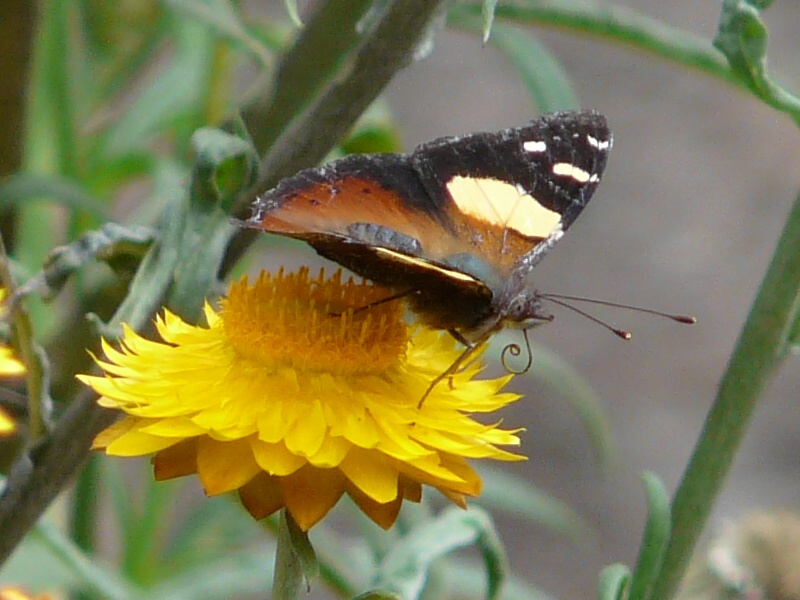
...temperate grasslands...
Hoary Sunrays Leucochrysum albicans in remnant lowland grassland near Canberra.
...woodlands...
Hoary Sunrays again, well north of here in the Liverpool Range on
the central Western Slopes.

Burr daisies Calotis spp., Cocoparra National Park near Griffith NSW,
on the eastern edge of the Western Plains.

on coastal cliffs...


Nullarbor Daisy Brachyscome tatei on the Nullarbor Cliffs at the Head of the Great
Australian Bite in South Australia. Next stop Antarctica! This tough little daisy
is restricted to the arid lime soils of the Nullarbor.

and throughout the arid lands... In the broad swathe of dry habitats that dominate most of the continent, we'd expect to find many daisies, and we do. Some grow on rock or gravel substrates...

Rock Daisy Bush Olearia stuartii is found in rocky gorges throughout much of the arid inland.

Common White Sunray Rhodanthe floribunda growing on the edge of one of the
Breakaways (like the one in the background) near Coober Pedy, northern South Australia.
... and many more grow in pure sand. Here are a few, because I love the deserts and their inhabitants!

Tangled Burr Daisy Calotis erinacea on a red sand dune near Windorah,
south-west Queensland.
Burr Daisies Calotis spp. by the Stuart Highway, far northern South Australia.
Pompom Everlastings Cephalipterum drummondii near Mount Magnet, Western Australia.
The only member of its genus, this spectacular daisy comes in both white and yellow,
the latter form shown below near Murchison River, Western Australia.

Invisible Plant Podolepis capillaris Pinkawillinie National Park, Eyre Peninsula,
South Australia. I love the common name of this one. While it's not obvious here, the
fine wiry stems really can seem to disappear against a background of vegetation.
Streptoglossa sp. (decurrens or odora) Great Sandy Desert, Western Australia.
Poached Egg Daisy Polycalymma stuartii, Kinchega NP, far western NSW.
(The name is more obvious if you imagine the flowers closer up, but better still
wait for the picture which you'll reach in a few more minutes,)
OK, I hope you enjoyed that little tour of some daisies in their homes as much as I did - now let's look at some of the array of themes and variations of daisy 'flowers' and finish here by looking at some of them at work. The basis of a daisy flower (and I'll stop using inverted commas for the term, but they're still there!) is that it's a hoax. By that I mean that the flower we're looking at is not really a flower at all, but lots of tiny flowers (florets) clustered together to be conspicuous to pollinators. This is the 'basic' daisy model, which many species have developed further. The flower cluster comprises many fertile florets emanating from the expanded tip of the flower stem, and may be spherical, or slightly extended, or somewhat flattened. Here are some examples which may be familiar.
Lemon Beauty Heads Calocephalon citrinus Canberra.
This grassland daisy shows well the numberous florets, though the overall head is quite small.
The bigger flower heads of Billy Buttons make the individual florets easier to see.
Craspedia sp., Tinderry Ranges, south of Canberra.
There are many species of Billy Buttons, but their taxonomy is still a bit unclear,
at least to me. They seem to be particularly diverse and conspicuous in the mountains around here.
Yellow Buttons, Chrysocephalum apiculatum, Canberra.

Blanket Bush Bedfordia arborescens, Namadgi National Park.
This small tree of the wet mountain gullies of the south-east is one of Australia's biggest daisies.
The flower clusters are not especially conspicuous but the fern gullies don't have many flowers
compared with more open drier forests, so perhaps it's not necessary to try as hard!
Most daisies go further into showiness than just producing these clusters of fertile florets however. Have a look for instance at this spectacular Showy Copperwire Daisy from the high country (though it does occur at lower altitudes too).
Podolepis jaceoides, Namadgi National Park. A meadow of these in late summer
produces a truly spectacular display.
But what are we seeing here? Centrally we can still see the fertile florets, but surely those are petals surrounding them and catching our eye from quite a distance? Well no - petals surround a single flower, not a bundle of numerous flowers. These are more florets, but this time sterile ones called ray florets whose sole purpose is attract attention to the crucial fertile disc florets. Here's another example.
Yam Daisy or Murnong Microseris lanceolata, Canberra Nature Park. This used to be abundant
and a very important food source for Indigenous people, but with the loss of the grasslands
and grassy woodlands they are no longer common.
These all-yellow flowers are certainly showy, but think how much more so they'd be in contrasting colours. And guess what?
Spoon-leafed Daisy Brachyscome spathulata, high in Namadgi National Park.
Now we have purple ray florets calling attention to the yellow disc florets.
Here are a couple of other variations.

Ovens Everlasting Ozothamnus stirlingii, Namadgi National Park,
where it is common in the high wet forests. Like the Blanket Bush previously,
another wet forest shrub, this is not as showy as many of the others.

Poached Egg Daisy Polycalymma stuartii near Erldunda, southern Northern Territory.
(We met this one earlier while introducing daisies growing from desert sand.)
Olearia ferressii (it has no common name that I can find), Kata Tjuta, Central Australia.
It has the same white-around-yellow pattern as the Poached Egg Daisy, but quite
different floret structures.
But other daisies yet have come up with another trick in order to be more noticeable. They use the same principle as the colourful ray florets, but instead they use stiff glossy bracts, which are modified leaves, to achieve the effect. These are mostly known as paper daisies or everlastings (it is the bracts which are long-lasting, not the fertile florets).
Alpine Sunrays Leucochrysum alpinum high in Namadgi National Park.
Alpine Everlastings Xerochrysum subundulata in alpine Koscuiszko National Park.
Pink Everlastings Schoenia cassiniana Kalbarri NP, Western Australia.
Surely one of the loveliest daisies, and one of the few with pink bracts..

It's hardly worth asking if all this effort to attract insect pollinators works - the myriad of daisy species and individual plants is proof of that! It's still nice to see some of them going about it though. A range of native insect groups are involved, including bees...

These photos were taken at the Australian National Botanic Gardens, unless
stated otherwise. And if the insect isn't named it's because I can't! Sorry...
...flies...
Hoverfly Melangyna sp., above on Murnong in Canberra Nature Park,
below on Silver Snow Daisy high in Namadgi NP.
Hoverflies, and locally especially this one, are very important polliators
of native plants, including daisies.
Fly on Hoary Sunray; Family Acroceridae (thanks Susan!).
Bee Fly Comptosia apicalis on paper daisy in our yard.
...wasps...
Billy Button high in the Snow Gums with an entourage of small wasps.
... and of course butterflies...
Yellow Admiral Vanessa itea on Sticky Everlasting Xerochrysum viscosum.
Note the long proboscis coiled out of the way.
Painted Lady Vanessa kershawi, with proboscis inserted deep among the florets.
A transparent butterly on Senecio sp. (I think) in the Ecuadorian cloud forests
north of Quito.

All of this cross-fertilisation between flowers of the same daisy species is for the sole purpose of producing seeds for the next daisy generation. But how to distribute those seeds far from the parent plants? Needless to say, daisies are very good at this too. They have two major strategies (though as far as I know, each genus specialises in just one of them). I'm sure you're familiar with both. When I was a child in Adelaide, in summer the sky would be seemingly full of drifting white fluffballs which we called Father Christmases. They were in fact the highly efficient seed distribution mechanism of the Scotch Thistles, a daisy which covered vast areas of abused land to the north.

Seed heads of Salsify Tragopogon porrifolius, a daisy which is grown for its edible root,
and which is often found growing as a weed. Very soon the individual 'parachutes'
will break free, each carrying a single seed far on the wind.
This, in various forms, is the dispersal strategy of most of the daisies I know of. Both the following examples are common local natives.
Cauliflower Bush Cassinia  longifolia ready to cast its seeds to the wind.
Clustered Everlasting Chrysocephalum semipapposum. The disc florets have done their
job and died back, leaving the seeds with their fluffy appendages to float away.
The other daisy seed dispersal strategy involves harnessing involuntary animals which get the spiny or sticky seed appendages tangled in fur or feathers (or socks!). Eventually the burrs fall apart and the seed drops by the track.
Burr Daisies (Calotis spp.) with the sticky burrs forming from dried flowers.
Extracting them from socks is both difficult and painful!
Well I'm sure you agree that this is enough for today, wonderful as daisies are. That's not all though, and I'll conclude the story next time with a stroll through selections of the daisy family album, mostly Australian but also some from further afield. Thanks for reading this far, and I hope you can join me then.
Here's a link to the next post.

NEXT POSTING THURSDAY 16 JUNE

I love to receive your comments and in future will be notifying you personally by email when a new posting appears, if you'd like me to. All current subscribers have been added to this mailing list and have already been contacted. This will mean one email every three weeks at the current rate of posting. I promise never to use the list for any other purpose and will never share it.
Should you wish to be added to it, just send me an email at calochilus51@internode.on.net. You can ask to be removed from the list at any time,or could simply mark an email as Spam, so you won't see future ones.