About Me

My photo
Canberra-based naturalist, conservationist, educator since 1980. I’m passionate about the natural world (especially the southern hemisphere), and trying to understand it and to share such understandings. To that aim I’ve written several books (most recently 'Birds in Their Habitats' and 'Australian Bird Names; origins and meanings'), and run tours all over Australia, and for 17 years to South and Central America. I've done a lot of ABC radio work, chaired a government environmental advisory committee and taught many adult education classes – and of course presented this blog, since 2012. I am a recipient of the Australian Natural History Medallion, the Australian Plants Award and most recently a Medal of the Order of Australia for ‘services to conservation and the environment’. I live happily in suburban Duffy with my partner Louise surrounded by a dense native garden and lots of birds.

Thursday, 7 July 2022

Buffalo Springs National Reserve; superb 'outback Kenya' #2

I've just realised that it's been a year since I posted on the wonderfully scenic, wildlife-rich and semi-arid Shaba National Reserve in central Kenya, which I ended by promising a follow-up on the neighbouring reserve of Buffalo Springs. It's probably time I did something about that! If you're interested in this you might like to look at the original posting here, where I also described the apparently unusual management situation, whereby it's run by the local Isiolo County Council, rather than the generally excellent Kenya national park service. I can't however explain this apparent anomaly.

We travelled with Rockjumper, a South African birding company in which I have great confidence. Entitled Kenya & Tanzania - Birds & Big Game, this was a slightly unusual tour for them, in that it focuses on mammals (and not just big ones!) as well as birds. I've done a couple of 'serious' bird trips with them and enjoyed them, but this one is well suited for couples such as us, where one partner doesn't need the intense bird focus of their usual trips. It's obviously popular as they run a few every year.

Buffalo Springs, along with Sambura, was declared at the same time as Shaba in 1974 and is just across the main highway north from Nairobi to Ethiopia. Buffalo Springs is smaller than Shaba, at just 13,000 hectares, though it is augmented by the 16,500ha of Samburu (where we didn't go) just across the Ewaso Ng'iro River which rises on Mount Kenya to the south. 

The three reserves are located right in the centre of Kenya, well away from the potentially
dangerous border areas of Ethiopia and especially Somalia, though the tour guides
tend to refer to them as in 'northern Kenya'.


The combined area of the three reserves is only 53,000 hectares and they are separated not
only by the highway (the north-south red line) but bya small area between it and Shaba to the east.
The highway does give us easy access from the south however.
Shaba is characterised by rugged lava ridges and outcrops, while most of Buffalo Springs is flatter, with basalt soils over lava flows across the plain. Each has its unique features and, to my eyes, special beauty.

Mount Kenya in the distance, above the semi-arid acacia scrub of Buffalo Springs;
it is very rare to see the mountain free of cloud.
Spiny succulents dominate the drier plains, along with Umbrella Thorn Trees
Vachiella (formerly Acacia) tortilis.

A flock of Helemeted Guineafowl Numida meleagris feeding on a typical dry grassland plain.
We felt more 'at home' in Buffalo Springs than in Shaba, not least because we had the reserve to ourselves for the time we were there! The accommodation felt 'more African', as Lou put it, than the more western fancy resort at Shaba. It was much lower key than Shaba but very gracious, lovely staff, lots of wood, open-air restaurant and bar. I'm afraid it often doesn't occur to me to photograph the accommodation, and I failed to do so on this occasion, though I took some photos from the little balcony and through the windows of our room, which gives you some idea.
Dawn from our balcony.
Our own Umbrella Thorn Tree and the nice cane lounges on the balcony.

An elephant from the balcony is pretty impressive, though there was a discreet
electric fence between us and it.
There was plenty of other wildlife to be seen from, and even on, the balcony in our 'down' time (which coincided with the hottest parts of the day).

The White-browed Sparrow-Weaver Plocepasser mahali colony nearby was busy
most of the day; the untidy nests (relative to those of many other weavers) above,
and one of  the builders investigating us below.
This handsome big weaver is found scattered across much of eastern and southern Africa.
One male Vervet Monkey Chlorocebus pygerythrus was a real problem however, due doubtless
to previous guests ignoring the strict instructions about not feeding. He tried to force open
the doors from the balcony and refused to take a backward step when I tried to shoo him
away, instead threatening me with bared teeth. In the end he only retreated after I
threw a couple of glasses of water at him (not the glasses, just the water!).
This was not him - I didn't get the chance to photograph him! - but a younger
better-behaved male who dropped by later. The blue scrotum is characteristic.

Other visitors were much less problematic.

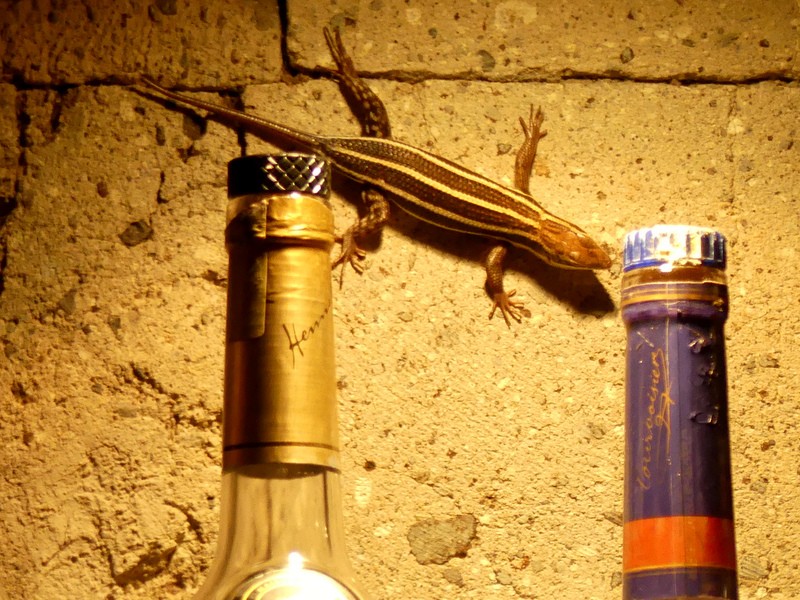
Gecko on the outside of the bathroom window, waiting for insects attracted to the lights.

You probably didn't need two photos of this, but I couldn't
resist the beautiful symmetry of this pair.

And a very different impressive symmetry was also found in the paved lodge driveway - but why?!

The open dining room was also an excellent place to watch wildlife, including on the tables in the case of the starlings!

I reckon that Superb Starlings Lamprotornis superbus trade on their spectacularly
good looks to get away with things that other birds could only aspire to.
But that's just me being anthropomorphic of course.

Others were seen from the dining room, especially in the nearby bushes. 

 A pair of Black-bellied Sunbirds Cinnyris nectarinioides, north-eastern
African specials; female above, male below.
This is reputedly the world's smallest sunbird, some weighing only four grams!
And I know I'm not a great photographer, but the light really was awful on this occasion.

Golden Palm Weavers Ploceus bojeri (also limited to the north-east) were very interested
in our meals, but were nowhere near as bold as the starlings. Females, like this one,
seemed to be more daring than the males (below) however.

This magnificent Goliath Heron Ardea goliath landed in the nearby creek bed while we
were breakfasting early one morning. This is the world's biggest heron,
standing 1.5 metres tall and weighing up to five kilograms. It is said to be relatively
common across sub-Saharan Africa, but I have to admit that's not been my experience.

This Vervet Monkey baby had not yet learnt the attitude that
s/he will doubtless acquire a bit later in life.
At night the restaurant lights attracted lizards, both geckos and skinks, following the insects, as our bathroom window did. The wall of the bar seemed especially attractive. Lounge lizards?


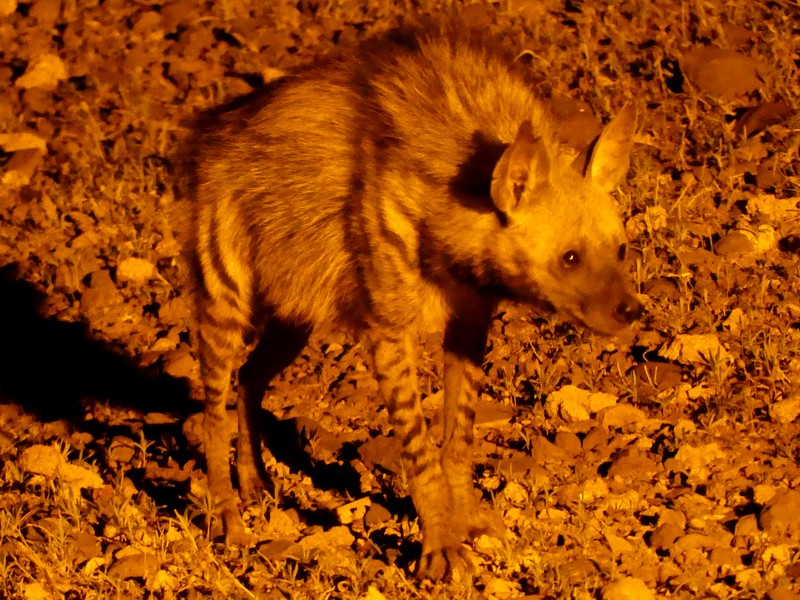
The most dramatic visitor however was a big Striped Hyena Hyaena hyaena which came in at night to scavenge kitchen scraps. Unlike the Spotted Hyena with which I'm much more familiar, this species is strictly nocturnal. It's widespread from north and east Africa to India, but I'd not been in its range before and was very pleased to see this one. It is listed as Near Threatened.
 
At the other end of the short (very fancily paved!) driveway was a boom gate and a cottage for the operator. He was in the habit of throwing grain and scraps out in his little yard, which attracted a seething ruck of mendicants, including the following.
A mob of Parrot-billed Sparrows Passer gongonensis, the world's largest sparrow,
with a couple of Superb Starlings and a Northern Red-billed Hornbill Tockus erythrorhynchus
trying to get a piece of the action.
Parrot-billed Sparrow; perhaps the bill is a little parrot-like.
Bristle-crowned Starling Onychognathus salvadorii, for me the standout of the mob on
the ground in the yard. It is huge (for a starling), up to 40cm long, with that unmistakable
coiffure. Another north-eastern special, with a distribution centred on Ethiopia.
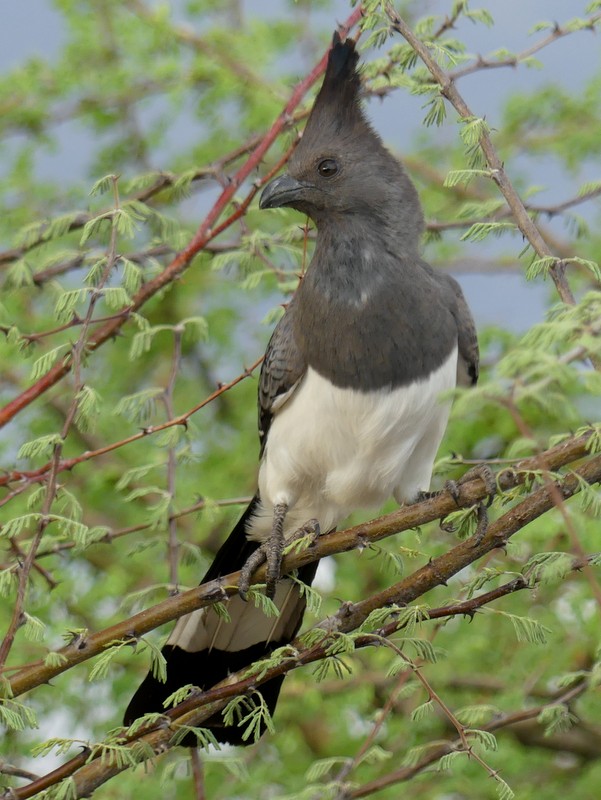
White-bellied Go-Away Bird Crinifer leucogaster; this a male with a grey (not green) bill.
The wonderful go-aways are a small group of large, atypically dull-coloured but charistmatic,
African trogons. Their name comes from the southern Grey Go-Away Bird C. concolor
whose call is a whiny nasal 'go waaaay'. This is yet another north-eastern special.


And these alert little Dwarf Mongooses Helogale parvula came out of the shelter of the
rocks to watch proceedings; I have no doubt they'd snap up the odd inattentive sparrow
but on this occasion the opportunity didn't arise.
However nothing can really beat the thrill of a drive in new country in an open vehicle with good guides; you never know what will appear, but there'll always be something! This is certainly true in Buffalo Springs. Including the drive in, we did three drives while we were there and each was rich and rewarding. Last time I started with the birds, but the mammals deserve equal billing in these parks, so I'll let them lead off this time. As you'd expect there were similar species in both the parks we explored (or rather Peter, our driver, did the exploring and his knowledge of the network of park tracks was remarkable), but the relative numbers of the different species was apparently different.

There was a big herd of Grevy's Zebra Equus grevyi, which is unusual.

This is the largest, rarest and most threatened of the three zebra species, found in a very scattered
small range in Kenya and Ethiopia. There are perhaps only 2000 left in the wild, though
the numbers are no longer falling. For more on the three zebras, see here.
Antelopes were also present in good numbers, the most imposing of which were the big Galla Oryx Oryx gallarum (recently separated from the Beisa Oryx O. beisa, though inevitably not everyone agrees).

The oryxes are a group of large long-horned (straight or curved) arid land antelope; above and below.

Curiously (to me at least) Grant's Gazelle Nanger granti, though much better known through numerous wildlife documentaries, has an even smaller range than the oryx, but it includes the great and endlessly filmed reserves of southern Kenya and northern Tanzania.

Grant's Gazelles, above and below.
One of my very favourite antelopes is also restricted to this part of the world - the seemingly impossibly elegant and attenuated Southern Gerenuk Litocranius walleri (there is also a Northern Gerenuk, restricted to a tiny area of northern Djibouti). We'd already seen them in Kenya, further south in Amboseli and across the road in Shaba, but you can't have too many gerenuks!
Southern Gerenuks using their long necks and legs - and stretching even higher -
to browse on prickly acacias.
And of course no African landscape is complete without a giraffe, and the richly patterned Reticulated form of Northern Giraffe Giraffa camelopardalis is one of the most striking of all. The debate about giraffe taxonomy has been going on for some time, with the traditional model of just one species and nine subspecies looking increasingly shaky. Three species seemed the best fit to the combined evidence until very recently (2020), but see the following caption.
An even more recent study (2021) makes a strong case for four species,
separating out the Reticulated Giraffe as a full species, G. reticulata.
It is easy to dismiss these arguments as esoteric and irrelavant, but in fact it has
very important implications for conservation, as I'm sure you appreciate.
No-one I think though is going to debate the magnificence of these
extraordinary giants!
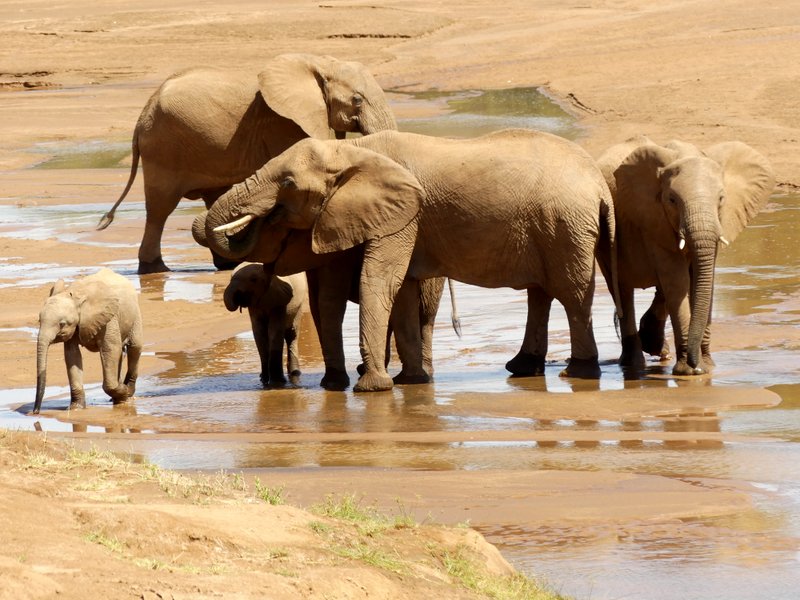
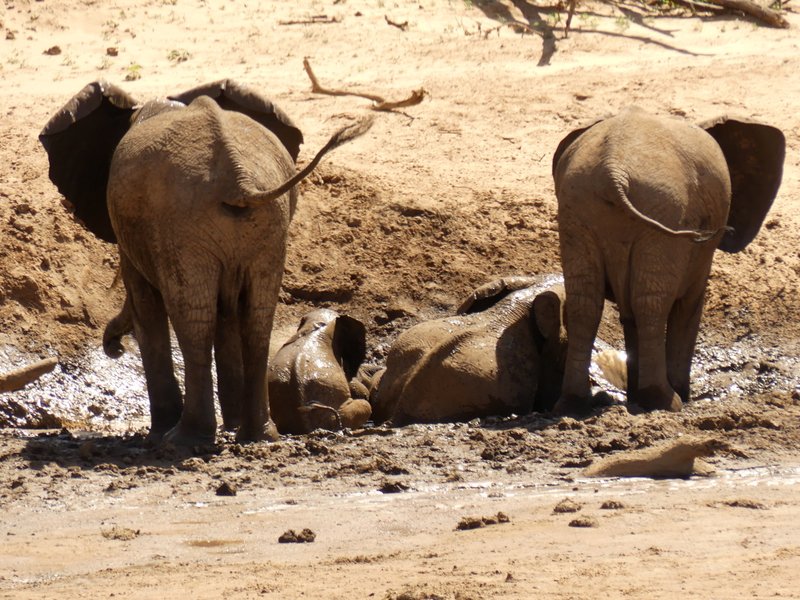
The highlight of the mammal watching however was the hour or so we spent parked on the river bank watching a herd of some 20 elephants, including babies, coming down into the river bed to drink, spray and wallow in the delightfully cooling mud. We were entranced - no further commentary required I think.


And I have many other photos of this wonderful experience that I could have shared with you!
After that some of you may well decide that talking about birds is a bit of an anticlimax, but I know that some won't, so you choose!
This Crowned Lapwing had laid her eggs right alongside the track, and was indignant
 at our presence with all the outrage that only a lapwing can muster!

Eastern Chanting Goshawk Melierax poliopterus. This attractive bird of prey is
the north-eastern representative of a group of three similar predators found
across most of Africa. It has only recently been recognised as separate from the others.

This splendid big Martial Eagle Polemaetus bellicosus (to whom this photo doesn't do
justice) was glowering at us over its meal of a very large snake, which I'm afraid we
couldn't identify. They are formidable predators, including of other predators as
large as Servals, jackals and big monitor lizards.

Wattled Starlings Creatophora cinerea are widespread in grasslands from the Red Sea to
South Africa, but wander widely, generally in flocks.

Blue-naped Mousebirds Urocolius macrourus are found in a band of dry country across
Africa south of the Sahara. There are six species of them which creep through foliage
with trailing long tails (ie supposedly mouse-like), forming the only Order of birds
confined to mainland Africa.

Grey Wren-warbler Calamonastes simplex, actually in the cisticola family.
Common enough in east Africa, but a skulker and I hadn't previously met it.

Slate-colured Boubou Laniarius funebris. The boubous belong to the African family
of bushshrikes, now regarded as separate from the northern hemisphere shrikes.
Another fairly secretive bird.

White-throated Bee-eater Merops albicollis - I really can't get enough of bee-eaters!
This one has a fascinating life story, breeding in the southern edge of the Sahara, and
spending the rest of the year in central African rainforests. Some however breed in
a small area of central Kenya, at the time we were there.
Donaldson-Smith's Sparrow-Weaver Plocepasser donaldsoni is mostly found only
in north-central Kenya (and in nearby Ethiopia and Somalia). Little seems to be known
about it. Arthur Donaldson Smith (not hyphenated apparently) was a US 'collector'
of everything from elephants to weavers in the 1890s.
White-headed Buffalo Weaver Dinemellia dinemelli is yet another north-east special,
though it's common enough once you find it. It's the only one of its genus, though the
'buffalo' name is also used for related genera. They allegedly follow the buffalo herds
to feed on disturbed insects.
 

Rufous Chatterer Argya rubiginosa, which belongs to a family which includes
laughing thrushes and African babblers. This one was very curious about us.
Cut-throat Finches Amadina fasciata. This group was more interested in preening than
posing, but you can see the dramatic gash of red feathers on the throat that gives them their name.

Red-winged Lark Mirafra hypermetra. To someone coming from a country - and
continent - containing just one speces of native lark, the number and variety of
larks in Africa is bewilderiing and challenging. This is a big stocky lark from a small
area of the north-east.

Well, that's probably enough, even if you're still reading! I hope I've convinced you that this is a place well worth visiting. Although relatively remote from the much-vaunted southern parks of Kenya, I gather that most of the reputable natural history guides go there so you shouldn't have much trouble visiting if you choose to do so, and I really hope you do.
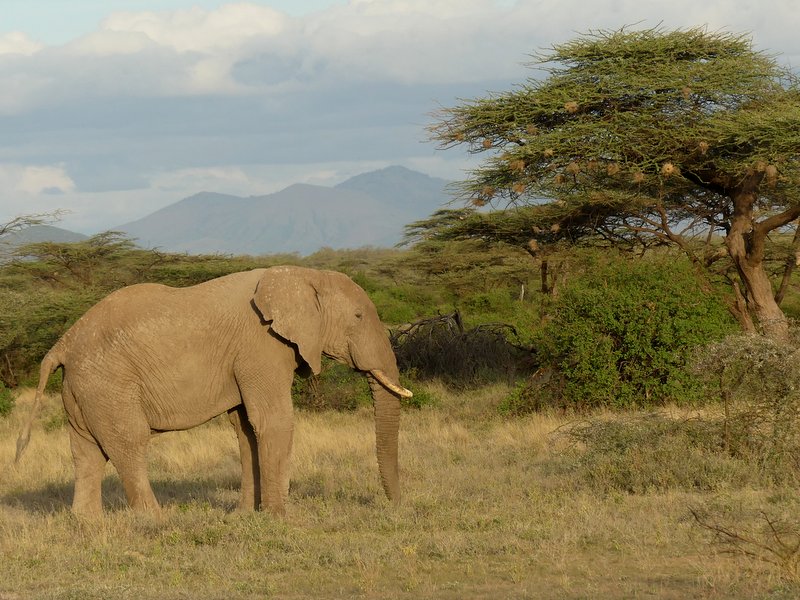
Elephant, weaver nests in a thorn tree, all in front of Mount Kenya. Yes,
I know, it's a cliche of Africa - but it also happens to be real. You really
should experience it at least once in your life.
Thanks for coming with me on this virtual safari.


NEXT POSTING THURSDAY 28 JULY

I love to receive your comments and in future will be notifying you personally by email when a new posting appears, if you'd like me to. All current subscribers have been added to this mailing list and have already been contacted. This will mean one email every three weeks at the current rate of posting. I promise never to use the list for any other purpose and will never share it.
Should you wish to be added to it, just send me an email at calochilus51@internode.on.net. You can ask to be removed from the list at any time,or could simply mark an email as Spam, so you won't see future ones.

Thursday, 16 June 2022

Daisies Part Two; a family album

In my last post, I introduced the wonderful world of daisies, one of the world's two great plant families (along with orchids) in terms of number of species, which are found in all continents where plants thrive. I introduced a range of habitats in which daisies grow, and showed what makes up the complex hoax of clustered tiny florets that we (and, more importantly, presumably pollinating insects) see as a showy flowers. I ended with a look at some pollinating insects at work on daisies, and the two main strategies for distributing seeds which help make daisies so successful. And I also ended with a promise to be back this time for a look through some pages of the daisy family album; thanks for coming back for that!

Though we think of non-native daisies as garden ornamentals (eg dahlias, chrysanthemums, dahlias, gerberas and zinnias) there are also some important edible ones, such as lettuce, globe and Jerusalem artichokes, chicory, chamomile, calendula, absinthe and tarragon, and oil-producers such as sunflowers and safflowers. On the downside of the ledger are serious environmental and agricultural weeds such as thistles, boneseed/Bitou Bush, dandelions, Crofton Weed, Bathurst and Noogoora Burr, ragweeds and hawkweeds.

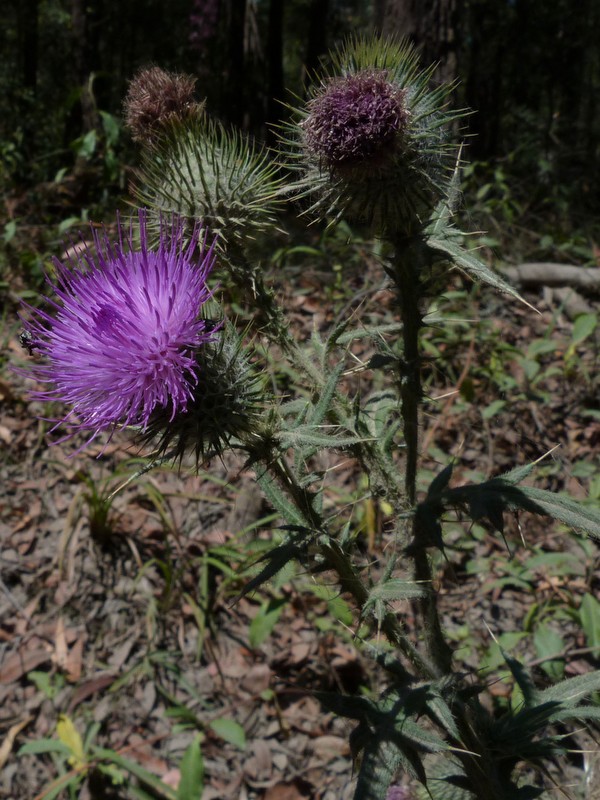
Spear Thistle Cirsium vulgare, Nowra, south coast New South Wales.
Just one of many thistle species which make our lives harder, and one of very many exotic
and invasive daisies which Australia would be better off without.

I'm going to start with a few non-Australian daisies from three continents to set the wider picture, then focus on some of the 300 Australian genera (just a few of them, I promise).

Formerly Aster (now generally called Symphyotrichum) vahlii, Seno Otway, in the snowy
eternal winds of Patagonian Chile. It is a widely accepted convention that a family of
plants (or animals) is named for the first genus in the family to be described.
The whole daisy family, Asteraceae, is based on the genus Aster, a big Eurasian genus.
Daisies originally described as Aster from elsewhere, like this one, have since been moved
to other genera. This is the classic daisy 'flower' with yellow fertile disc florets
and numerous surrounding white sterile ray florets to attract attention.
Staying in this cold wind-blasted landscape near the tip of South America where
flowers are surprisingly profuse, here is Chiliotrichum diffusum. This tough daisy is found
only in the far south of the continent and on the Falkland Islands.

And from the nearby spectacular Torres del Paine National Park, here is the lovely
Perezia recurvata (which I would not have immediately recognised as a daisy).
The genus is mostly restricted to the high Andes.

Another daisy that I'd not necessarily have recognised (though the resemblance to thistles
is obvious once you get your eye in) is the 'Flower of the Andes' Chuquiraga jussieui,
here at nearly 4,000 metres above sea level in El Cajas NP, southern Ecuador. It is the
unofficial national flower of Ecuador, but sadly endangered.

Chuquiraga is the main food source of the Ecuadorian Hillstar Oreotrochilus chimborazo.
This gorgeous hummingbird is found only above 3600 metres in the páramo, the near-treeless
tundra of the northern Ecuadorian Andes.

One daisy habitat that I was unable to show you last time was rainforest, though there are certainly some rainforest daisies in Australia. Here are a few from rainforests elsewhere to compensate. 

Mutisia sp. in the cloud forests of Manu Reserve in southern Peru. This big genus
of some 60 species is spread along the full length of the Andes.

Senecio sp. from lower down in the Manu. This huge genus (currently nearly 1300 species though it is likely to be broken up) is one of the largest genera of flowering plants and is found over much of the world.

Chilco Baccharis neae in wet temperate rainforest in Alerce Andino NP near
Puerto Varas in southern Chile. Another huge genus of some 500 species
found throughout the Americas, though mostly in the south.
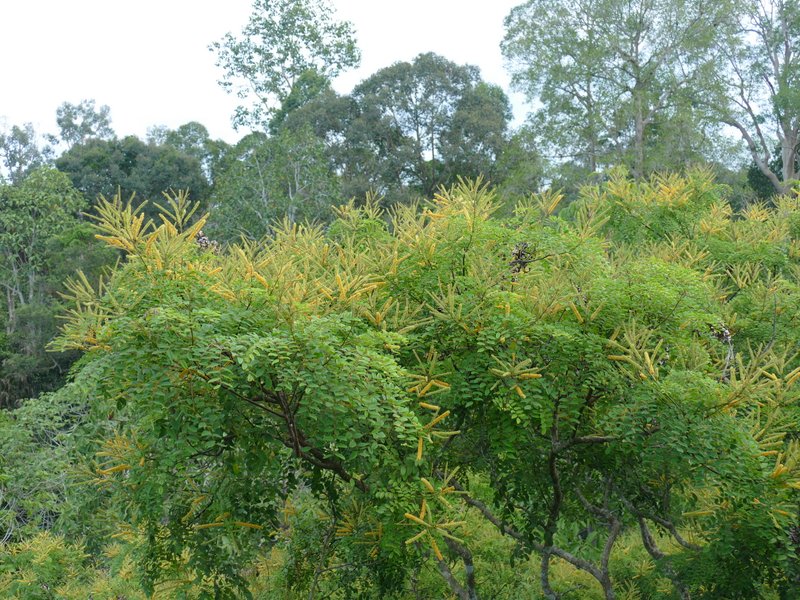
Red Bean Tree, Red Sandalwood (and many other names) Adenanthera pavonina, from a
rainforest elevated boardwalk in Sepilok, Sabah, Malaysian Borneo. Native to southern
China and India it has become widely naturalised (including northern Australia,
and in Borneo).
And with that, back to Australia for some more Family members. To prevent family squabbles I'll introduce them in alphabetical order. A couple of these were taken in botanic gardens but most were in the wild.
Winged Everlasting Ammobium alatum, Southern Tablelands Ecosystems Park, in
the Canberra Arboretum. This NSW grassland plant makes a superb garden plant,
and has thus become established in other states.
Hill Daisy Brachyscome aculeata in Namadgi NP above Canberra, a common daisy of the ranges.
When French botanist and daisy specialist Henri Cassini published the name in 1816 he used this
spelling but soon realised that it was grammatically incorrect and corrected it to Brachycome.
Unfortunately, despite widespread support in Australia for retaining the 'correct' version,
it was eventually deemed (in 1993) that his original incorrect version must stand. Hmm.
Variable Daisy Brachyscome ciliaris, Ormiston Pound, western Tjoritja/
MacDonnell Ranges
. This species is widespread in inland southern Australia.
Brachyscome obovata Kosciuszko NP. This species is restricted to wet sites in the high alps;
these plants were actually growing in running water.
Milky Beauty Heads Calocephalus lacteus National Botanic Gardens, Canberra.
The genus name means 'beautiful head'. This striking little daisy is scattered in wet grassy
sites in south-eastern Australia. Last time I featured the closely related Lemon Beauty Heads.
And another of the same genus, but this time a desert species.
Yellow Billy Button Calocephalus platycephalus, central Australia.
(And yes, Billy Button is more usually applied to Craspedia spp. but there are
no rules for common names!)
Purple Burr Daisy Calotis cuneifolia, Mutawintji NP, western NSW.
Can be abundant (often with Yellow Burr Daisy C. lappulacea below).
I discussed burr daisies last time regarding their effective seed dispersal mechanism
via sticky sharp burrs in fur and socks.

Yellow Burr Daisy, Canberra woodlands.

Sifton Bush Cassinia quinquefaria, Angle Crossing, ACT. A familiar genus of large
shrubs, which locally tend to flower in summer when not much else is doing so.
Some can cause skin complaints.

Silver Snow Daisy Celmisia sp. with beetle (Eleale sp.) and spider, Namadgi National Park.
Pompom Everlastings Cephalipterum drummondii near Mount Magnet, Western Australia.
The only member of its genus, it comes in both yellow and white, which can be
confusing initially.

Bear's Ears Cymobonotus lawsonianus or preissianus - the two are virtually
indistinguishable, so I haven't a hope! - Canberra.
 
Silver Ewartia Ewartia nubigena, Kosciuszko NP, forms creeping silvery mats in some of
the toughest habitats in Australia, living only above the treeline and south from Kosciuszko.
Blue Bottle Daisy Lagenophora stipitata, Namadgi NP.
This is a common grassland daisy in eastern Australia, and north into Asia.
Olearia is a large genus of conspicuous shrubs, herbs and small trees found in range of Australian, New Guinea and New Zealand habitats. I've included several because I couldn't work out which ones to leave out!
Alpine Daisy Bush Olearia algida, Kosciuszko NP. A shrub from the high country
of south-eastern Australia.
Large-leaved Daisy Bush Olearia megalophylla, Namadgi NP. A common large shrub
of the tall wet forests of the ranges of south-eastern Australia.
Twiggy Daisy Bush Olearia microphylla (cf the previous species), Timmallallie NP, north-central NSW.
Olearia montana Tinderry Ranges, south-east of Canberra, is a rare shrub restricted
to the Tinderries and a couple of nearby sites.
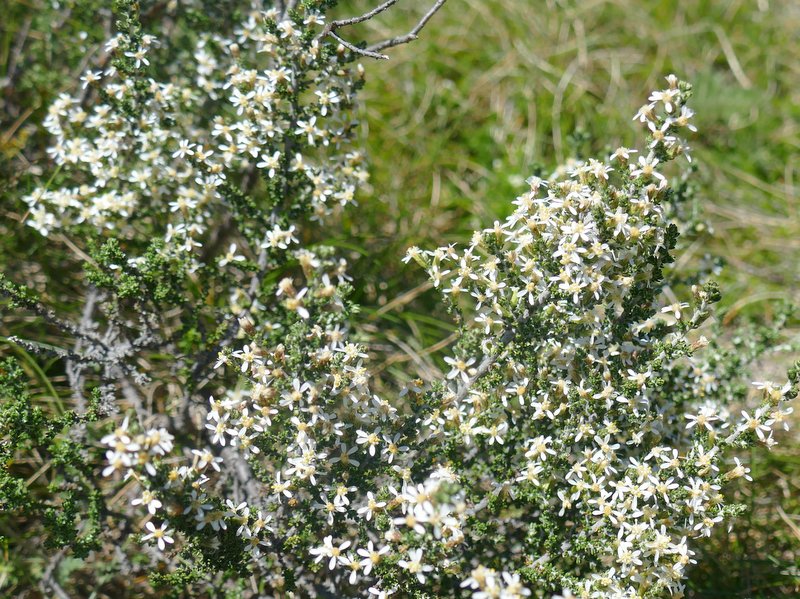
Goldfields Daisy Olearia muelleri, Mildura, north-west Victoria. Found across semi-arid southern
Australia, but especially common in the Goldfields region of Western Australia around Kalgoorlie,
hence the common name.
Dusty Daisy Bush Olearia phloggopappa, Namadgi NP. This is, as you can see, quite a sight in flower.
It is common in the ranges of south-eastern Australia.
Sticky Daisy Bush Olearia tenuifolia, Mount Tennent, south of Canberra. Found
scattered in drier rocky areas of inland eastern New South Wales and Victoria, and
to me it's not at all common.

Grey Podolepis Podolepis canescens, Caiguna, Nullarbor Plain, Western Australia.
We met this genus last time, in alpine and arid situations. This is another example of the latter.
Mountain (or Cattleman's) Lettuce Podolepis robustus is another high country species.
It wasn't the cattleman who ate this with gusto but their cattle. When cattle were removed
from the fragile high alps the species (and many others) began to recover.
Soft Billy Buttons Pycnosorus pleiocephalus, Mutawintji NP, western NSW.
Widespread in dry inland south-eastern Australia, where it favours situations which are
periodically wet - clay pans or, like here, at the foot of a stony ridge.
Splendid Everlasting Rhodanthe chlorocephala, inland from Geraldton,
central west of Western Australia. I can't fault the common name, it is spectacular.
The black marks at the base of some of the bracts are interesting - they are not insects
but may well play a part in attracting pollinators to the adjacent disc florets.
The species is found across WA and into western South Australia.
White Paper Daisy Rhodanthe floribunda, on the edge of the stony Breakaways
near Coober Pedy. It is found in a discontinuous range across the whole of the arid inland.
Cotton Fireweed Senecio quadridentatus, Namadgi NP, ACT. Not the 'standard' daisy flower
we've been looking at and, moreover, it doesn't even resemble most other Senecio.
I find it a bit of a mystery. It is also found in Indonesia and New Zealand.
Streptoglossa decurrens or odora, Great Sandy Desert, Western Australia. The two species are
generally reckoned by those much better qualified than I as almost impossible to distinguish
with any certainty. They are found scattered across the tropical drylands.
Golden Waitzia Waitzia nitida, Kalbarri NP, Western Australia.
It is found across the south-western sector of the state.
This has been an extensive journey through the family album, and thank you for reading this far! Time to wrap up our daisy dedication now with some simple enjoyment of some fine spreads of daisies in various situations, starting in the high south-east and moving downhill and west.
Silver Snow Daisies Celmisia sp., Kosciuszko NP, above and below.
In the top picture there are also Mountain Aciphylls Aciphylla glacialis Family Apicaceae,
in the background.

Hill Daisies Brachyscome aculeata under the Snow Gums on Mount Ginini, Namadgi NP, ACT.

Hoary Sunrays Leucochrysum albicans, Liverpool Range near Merriwa, central western NSW.
(Also some feral Prickly Pear cactus on the left.)
Lemon Beauty Heads Callocephalon citreus brightening a summer native grassland,
Mulligans Flat NR, northern ACT.
Many-stemmed (or Woolly-headed) Burr Daisy Calotis multicaulis, Mutawintji NP, western NSW.
Pompom Everlastings Cephalipterum drummondii near Mount Magnet, Western Australia.
As noted earlier this spectacular species comes in both white and yellow.
A magnificent massed display in Kalbarri NP, WA. I think the stars here are
Splendid Everlastings Rhodanthe chlorocephala and Pink Everlastings Schoenia cassiniana.
I hope neither of us is daisied out, but I think that's enough for today! Thanks for coming on the journey with me, and I'm looking forward to wherever we may travel together next time. But meantime, love your daisies!

NEXT POSTING THURSDAY 7 JULY

I love to receive your comments and in future will be notifying you personally by email when a new posting appears, if you'd like me to. All current subscribers have been added to this mailing list and have already been contacted. This will mean one email every three weeks at the current rate of posting. I promise never to use the list for any other purpose and will never share it.
Should you wish to be added to it, just send me an email at calochilus51@internode.on.net. You can ask to be removed from the list at any time,or could simply mark an email as Spam, so you won't see future ones.